
Denizli · UNESCO · Trip planning
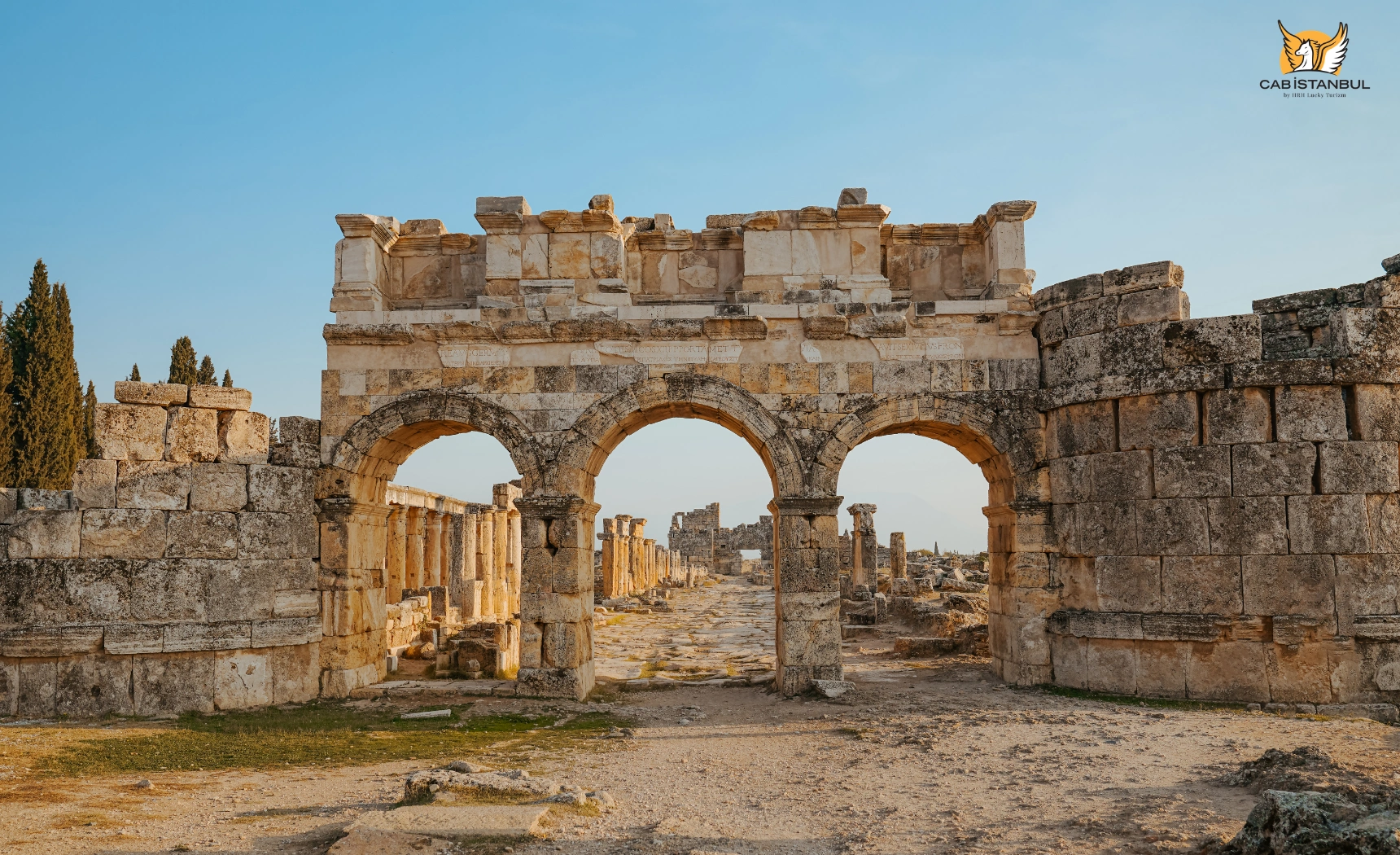
Pamukkale — Turkish for “Cotton Castle” — names the dazzling white travertine terraces that cascade down a hillside roughly 18 km north of Denizli. On the plateau above sits Hierapolis, a Greco-Roman spa city whose theatre, colonnaded streets and vast Necropolis share the same ticketed gate. Together they form one UNESCO World Heritage property since 1988 — not two separate attractions with two entrance fees. This guide separates terrace geology from archaeological layers, quotes verified 2026 DOSIM prices, and omits hotel room rates and unproven medical cure claims.
Cab Istanbul is an independent transfer and chauffeur provider. It does not operate Pamukkale gates, Cleopatra Pool tickets or hotel inventory. For wider Aegean routing, see Aegean coast attractions and Marmaris attractions. A driver is transport — not a licensed tour guide.
Geography
Pamukkale, Hierapolis, Denizli — and what belongs on one ticket
Pamukkale village sits at the foot of the terraces — hotels, restaurants and the south/pedestrian gate access. Karahayıt, roughly 3–5 km north, is a thermal-hotel belt with red mineral springs — a separate lodging universe from village walk-to-gate convenience. Denizli is the provincial transport hub (otogar, city life) — not “inside” the white terraces. Laodicea (Laodikeia) lies between Denizli and Pamukkale as a separate archaeological site with its own DOSIM fee.
- One UNESCO property: Travertines + Hierapolis archaeological zone = single combined ticket — do not market them as unrelated pay-per-attraction stops.
- UNESCO since 1988: Mixed natural and cultural World Heritage — calcium-carbonate terraces plus Greco-Roman urban fabric.
- Denizli ≠ Pamukkale: City hotels suit transport connections; village or Karahayıt bases suit terrace mornings.
- Regional framing: Pair with Aegean coast or Marmaris planning only when your route genuinely crosses corridors — Pamukkale is inland, not a beach resort.
- Primary airport: Denizli Çardak (DNZ) — roughly 65–72 km / 60–80 minutes to Pamukkale depending on traffic and drop-off point.
Video is visual context only — gate hours, terrace water levels and pool open status follow the day you travel, not clips.
In the area
Popular places at Pamukkale, Hierapolis and nearby
Most visitors combine a barefoot terrace walk, Hierapolis theatre and Necropolis loop, optional museum stop, and one regional day trip — Laodicea, Kaklık Cave or a longer Aphrodisias outing. Stack archaeology on cooler mornings and terraces when light is best.
| Place | Area | Why visit | Access / fee note |
|---|---|---|---|
| Pamukkale travertine terraces | Hillside · UNESCO core | Iconic white calcium-carbonate pools and cascades | Included in combined €30 ticket · barefoot on designated wet sections |
| Hierapolis archaeological site | Plateau above terraces | Theatre, colonnaded street, gates, martyrium | Same €30 combined ticket · gate hours vary — confirm day-of |
| Hierapolis Archaeology Museum | Within site zone | Sculpture, sarcophagi and regional finds | FREE (DOSIM) · pair with ruins same day |
| Cleopatra / Antique Pool | Hierapolis · thermal pool | Submerged Roman columns; optional swim product | Separate swim fee · open status conflicting — confirm day-of at pool booth |
| Necropolis | North of Hierapolis core | One of SW Anatolia's largest ancient burial fields | Included in combined ticket · allow 45–90 min on foot |
| Temple of Apollo & Plutonium | Hierapolis sacred zone | Sanctuary remains; cave of deadly CO₂ gas | View from barriers only — do not approach beyond fence |
| Laodicea (Laodikeia) | Between Denizli & Pamukkale | Seven Churches context; ongoing excavations | Separate site — €12 foreign (DOSIM) |
| Kaklık Cave | Honaz / Kaklık | “Underground Pamukkale” travertine formations | Municipal fee — variable · confirm locally · no fixed TL quote here |
| Aphrodisias | Regional · ~2 h drive | UNESCO marble city; stadium and theatre | Full-day commitment — not a village stroll |
| Pamukkale Natural Park | Pamukkale village | Local recreation lake / pedalos (if operating) | Distinct from UNESCO terraces — do not confuse products |
| Karahayıt thermal village | ~3–5 km north | Red thermal springs; hotel belt | Shuttle or taxi to main site · separate from white terraces |
Travertines
How the terraces form — and conservation rules that protect them
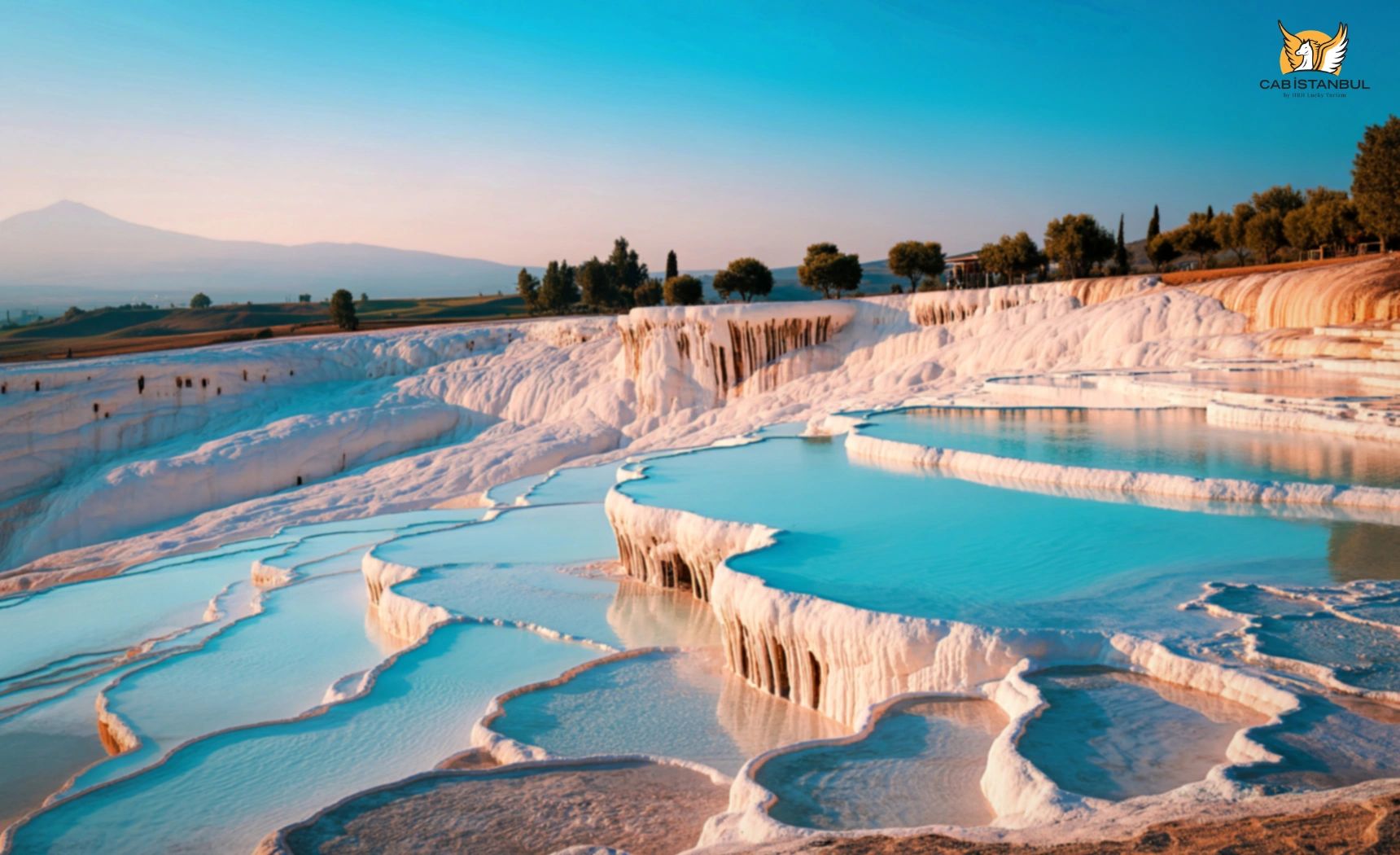
Calcium carbonate precipitates from thermal spring water as it cools and degasses, building the white stepped terraces over millennia. Source temperatures are often cited in broad bands around 35–100 °C at spring outlets — that range applies to thermal sources, not every shallow walkway pool you photograph. Brochure dimensions (~2700 × 600 m footprint, ~160 m drop) are approximate UNESCO-scale figures; treat them as orientation, not survey-grade numbers.
- Barefoot only: Walk designated wet terrace sections without footwear — shoes damage the calcite crust.
- No souvenirs: Do not break off or remove travertine — it is protected heritage, not a keepsake.
- Swimming limits: Full swimming is restricted on open terraces; permitted immersion is mainly at the managed Antique/Cleopatra Pool product where open.
- Water levels vary: Not all pools are filled daily — expectations from old photos may not match the day you visit.
- Historical spa tradition: Hierapolis grew as a Roman thermal destination — mineral-rich water and bathing culture are fair framing. Removed from this guide: disease-cure lists, “scientifically proven” treatment claims, and marketing lab numbers (pH, radon, exact °C per pool) unless you verify them same-day at source.
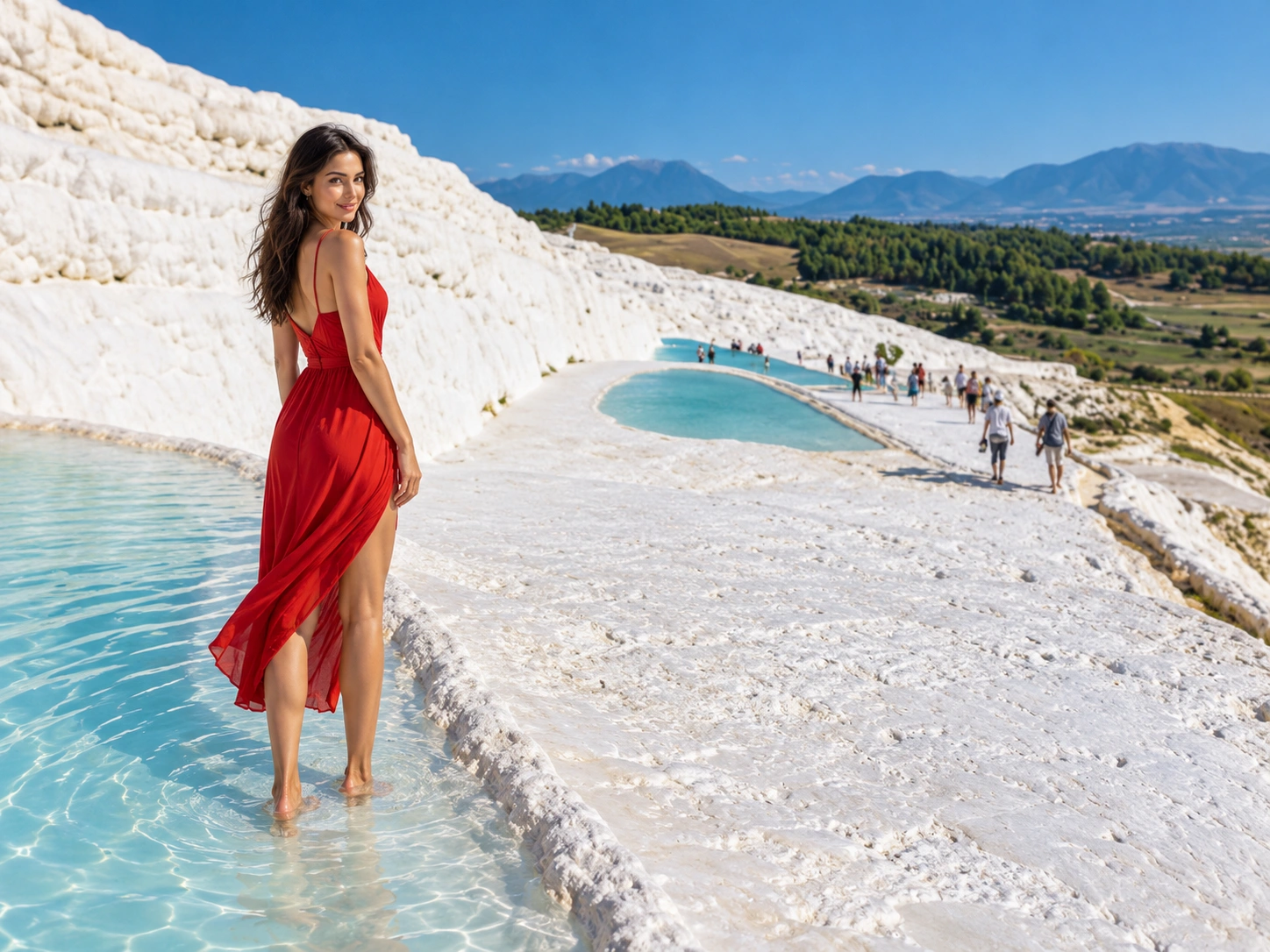
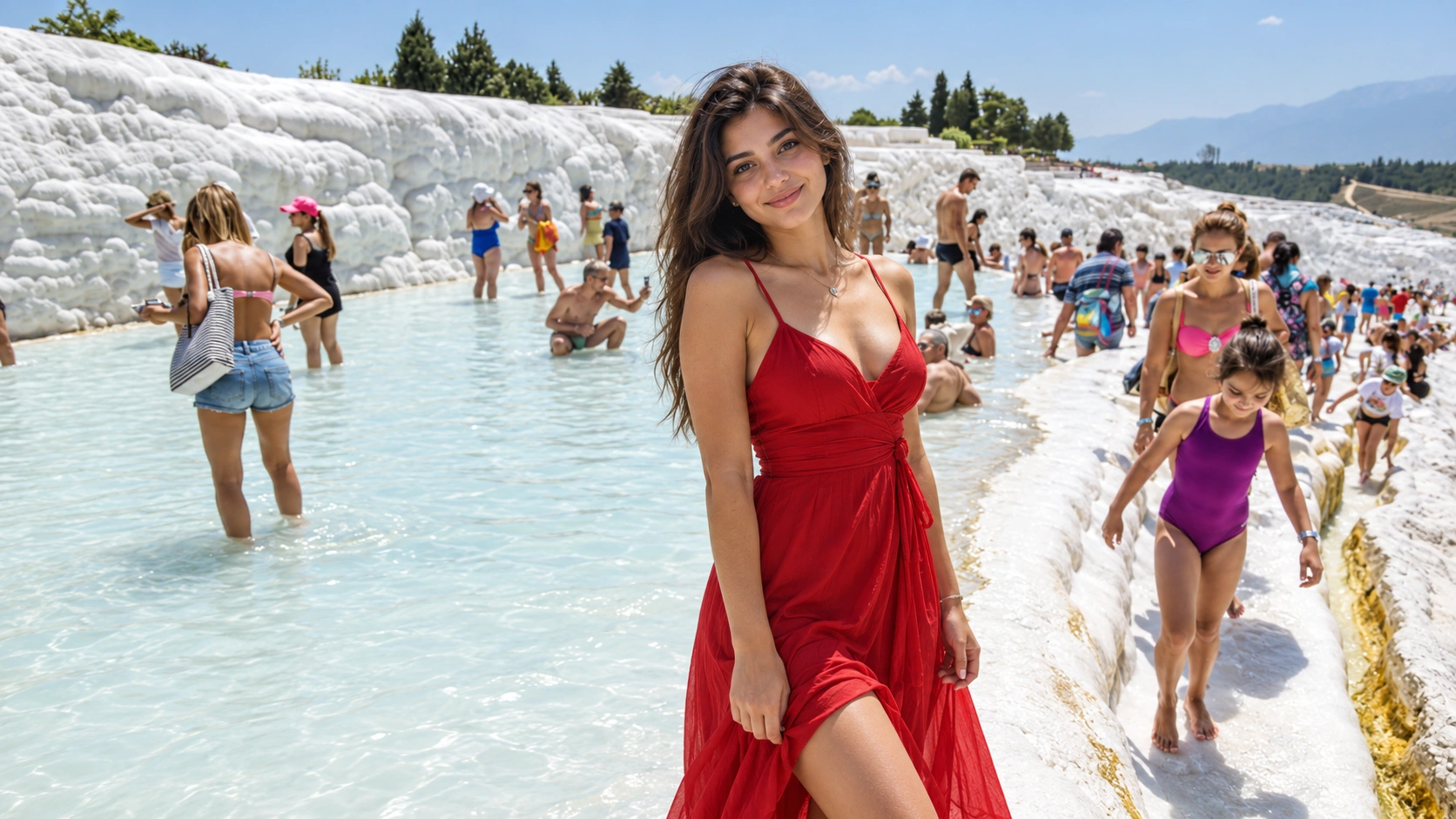
Terrace video shows typical routing — closed sections and water depth follow daily site management, not footage.
Archaeology
Hierapolis highlights — theatre, Necropolis, gates and sacred sites
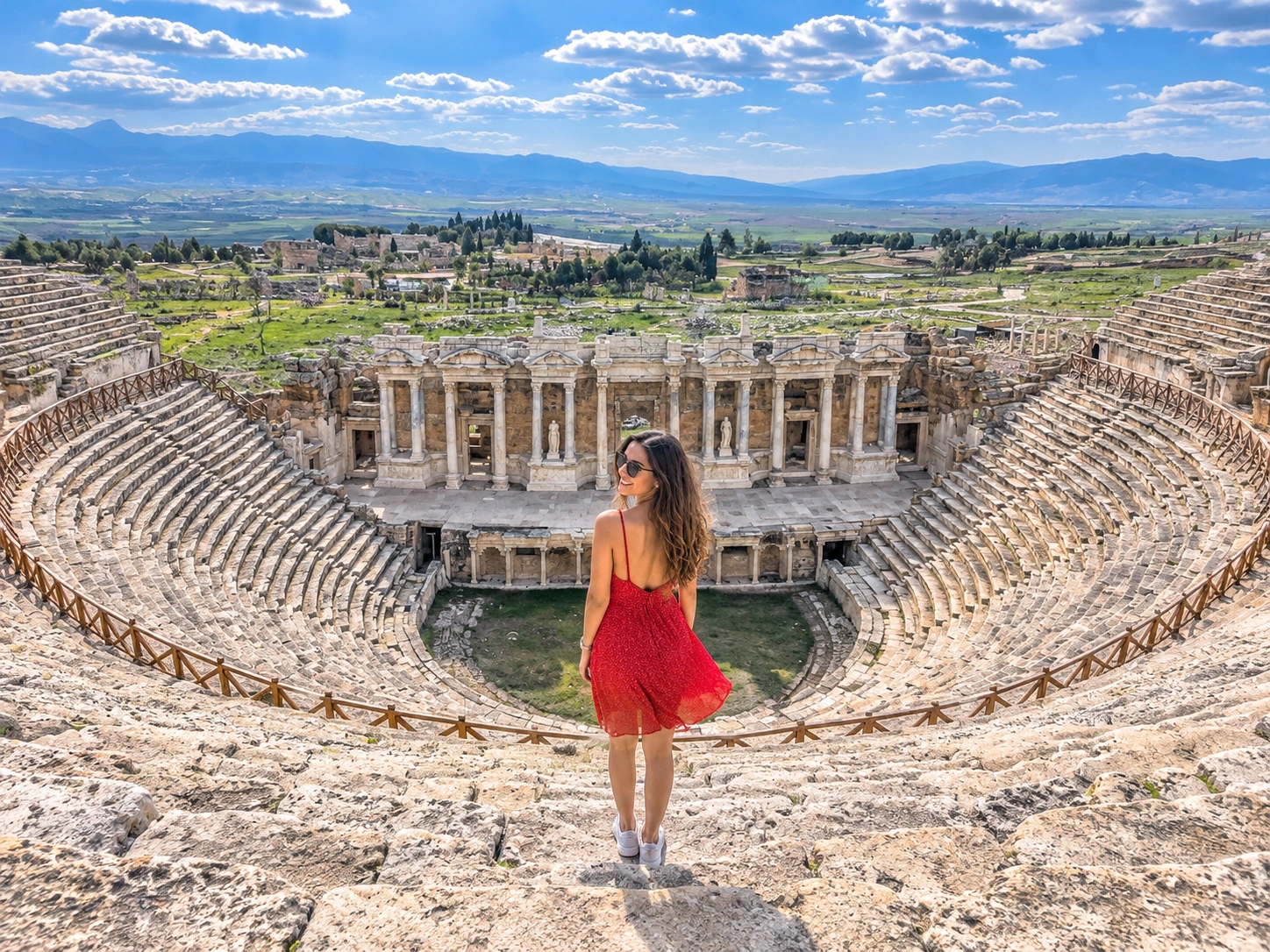
Official museum narrative credits foundation to Eumenes II of Pergamon in the 2nd century BCE, with name traditions (Hiera, Telephos) recorded as mythic backstory rather than single proven facts. Excavations suggest earlier Iron Age presence and Cybele cult layers — qualify rather than flatten into one founding date. After the AD 60 earthquake, major Roman rebuilding shaped the theatre and urban core you walk today.
| Structure / zone | Period / note | Highlights | Visitor note |
|---|---|---|---|
| Ancient Theatre | Hellenistic roots · Roman rebuild post-AD 60 quake | Hillside seating with wide valley views | Among the better-preserved theatres in Asia Minor — exact seat counts vary by source; avoid unverified “15,000” unless confirmed |
| Necropolis | Hellenistic–Roman burials | Sarcophagi, house-tombs, varied funeral architecture | Use Necropolis — not “Anatolian Cemetery” as the primary English label |
| Frontinus Gate & colonnaded street | Roman urban spine | Monumental gate, column lines, agora context | Core walking axis linking major ruins |
| Temple of Apollo & Plutonium | Sacred cave sanctuary | Oracle cave emitting CO₂ — ancient “gateway to underworld” tradition | View from fence only — carbon dioxide pooling is lethal; do not enter restricted zone |
| St Philip Martyrium | Early Christian complex | Octagonal martyrium tied to Philip tradition | Tradition of martyrdom — label as religious narrative where not archaeologically settled |
| Antique / Cleopatra Pool | Earthquake-collapsed colonnade narrative | Column fragments under warm mineral water | Separate swim product — see dedicated section; confirm open status day-of |
| North & South gates | Modern access points | Parking, ticket checks, evening access windows | North/South gates listed 08:00–21:00 in portal notes — pedestrian gate hours may differ |
| Hierapolis Archaeology Museum | On-site collection | Sculpture, friezes, tomb goods | FREE entry (DOSIM) — efficient rainy-hour filler |
2026 fees
Tickets — combined site, museum, Laodicea and night entry
| Site / product | 2026 price (reported) | MüzeKart | Important note |
|---|---|---|---|
| Hierapolis–Pamukkale combined örenyeri | €30 foreign | Valid for Turkish citizens | Travertines + archaeological site on one ticket · replaces stale 700 TL references |
| Hierapolis Archaeology Museum | FREE | N/A | DOSIM · visit same day as ruins |
| Laodicea (Laodikeia) | €12 foreign | Check current DOSIM rules | Separate site between Denizli and Pamukkale |
| Cleopatra / Antique Pool swim | Operator-set · omitted here | N/A | Not included in €30 · confirm open status & fee at pool booth day-of |
| Night museum programme | Portal-listed night access | +200 TL night ticket note for MüzeKart holders (portal) | 19:00–23:00 · confirm seasonal operation day-of |
| Kaklık Cave | Municipal · variable | N/A | No fixed TL quote — ask at Honaz/Kaklık gate |
| Aphrodisias | Separate DOSIM site | Check muze.gov.tr | UNESCO day trip ~2 h — budget full day |
| 2027 foreign fee rise | News: €35 from 1 Apr 2027 | N/A | Do not apply 2027 price to 2026 visits |
| Hotel rooms | Dynamic daily rates | N/A | Omitted from this guide by editorial policy |
Hours (confirm day-of at muze.gov.tr): Site listed open daily. Pedestrian gate often 08:00–18:00; North/South gates noted 08:00–21:00. Daytime archaeological closing also listed around 18:45 with ticket office near 18:00 — portal notes can conflict with the night programme. Treat gate times as guidance until you verify on travel morning.
Cleopatra Pool
Antique Pool — separate fee, conflicting open status, day-of checks
The Cleopatra Pool (Antique Pool) is a managed swim product among Roman column fragments — popular narrative links its formation to earthquake collapse, which is tradition-friendly framing rather than a single excavation headline. It is not included in the combined €30 Hierapolis–Pamukkale ticket.
- Conflicting official notes: DOSIM fee lists have carried “Antik Havuz Kapalıdır” wording while muze.gov.tr has also listed the Antique Pool as open to visitors — confirm open status and swim fee at the pool booth or operator desk on the day you visit.
- No invented swim price: Blog TL/EUR ranges shift seasonally — this guide quotes no exact swim tariff. Ask at the booth.
- Not terrace swimming: Immersion here is the designated pool product — not a licence to bathe in protected travertine pools.
- Pack accordingly: Towel, swimwear and a dry bag if you plan to swim after the barefoot terrace walk.
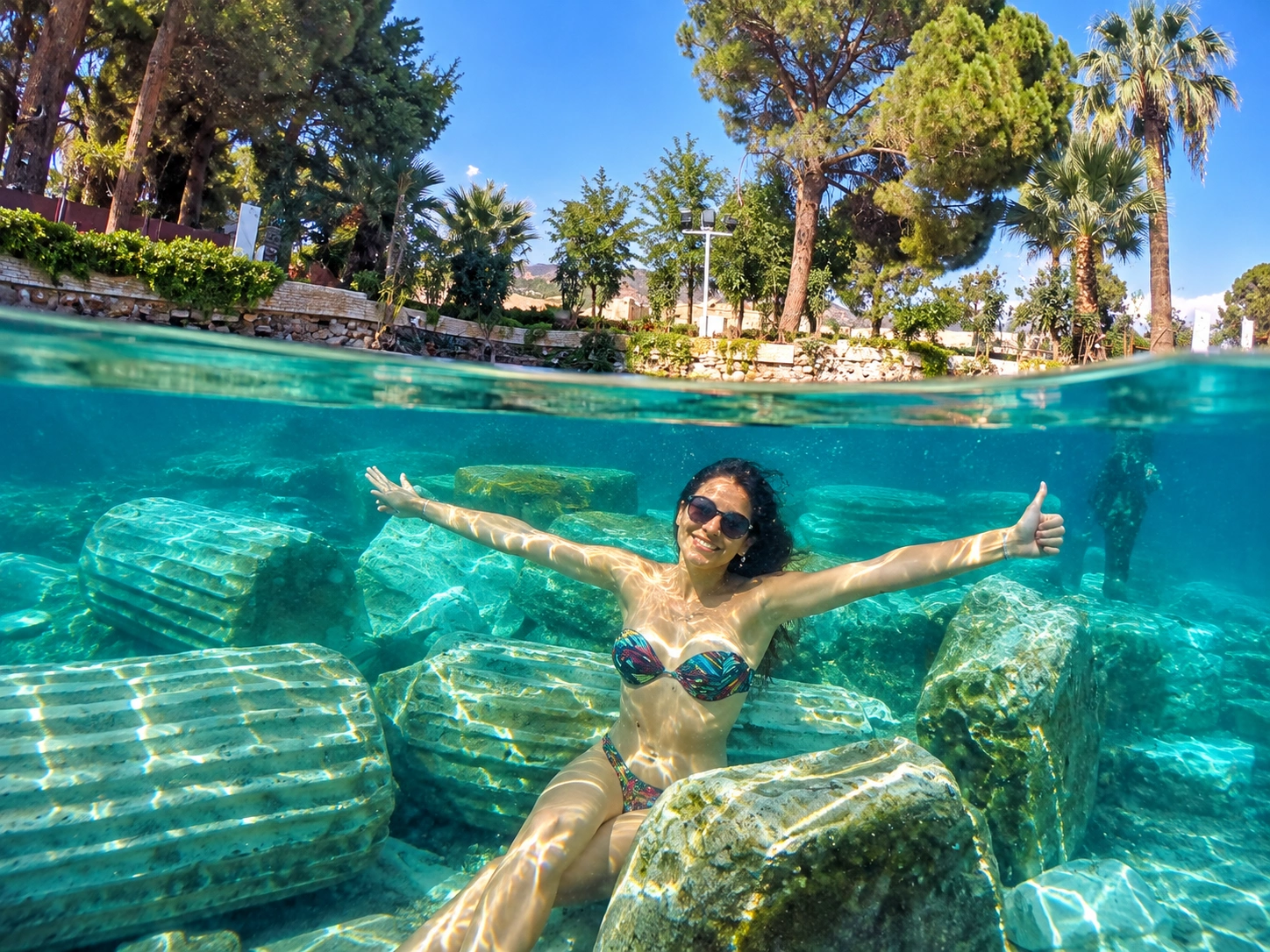
Pool video is atmosphere only — whether you can swim, and what you pay, follows the booth on your visit date.
Day trips
Nearby outings — Laodicea, Kaklık Cave and Aphrodisias
| Day trip | Distance / drive | Highlights | 2026 fee / access note |
|---|---|---|---|
| Laodicea (Laodikeia) | Between Denizli & Pamukkale | Excavated streets, churches, stadium context | €12 foreign (DOSIM) · separate from main €30 ticket |
| Kaklık Cave | Honaz / Kaklık · short drive from Denizli axis | Underground travertine formations; cool interior | Municipal fee variable — confirm locally |
| Aphrodisias | Regional · ~2 h from Pamukkale area | UNESCO marble city; stadium, Tetrapylon, museum | Full-day commitment · separate DOSIM pricing |
| Denizli city half-day | ~20–30 min from Pamukkale village | Market, local food, otogar connections | Transport hub — not a terrace substitute |
| Karahayıt red springs | ~3–5 km north of Pamukkale | Iron-rich thermal water; hotel thermal pools | Hotel spa products priced separately |
| Ağlayan Kaya / Yeşildere waterfall | ~1 h · seasonal | Cool-off stop in heat | Verify access and flow seasonally |
| Bağbaşı cable car (Denizli) | Denizli city | Urban viewpoint product | Regional optional — not core terrace visit |
| Pamukkale Natural Park | Pamukkale village | Local lake leisure if operating | Not the UNESCO travertine site |
Stack at most one long regional day (Aphrodisias) per 24 hours with a full Pamukkale plateau walk — Laodicea pairs cleanly as a half-day add-on from Denizli or village bases.
Where to stay
Hotels — area and style, not rates or review scores
Choose by geography: Pamukkale village for walking distance to south/pedestrian gates, Karahayıt for thermal-hotel pools and red-spring ambience, or Denizli city for otogar and flight connections with less terrace-at-dawn convenience. This table names representative properties only — no room prices and no OTA review scores.
| Hotel | Area | Style / best for |
|---|---|---|
| Richmond Pamukkale Thermal | Karahayıt | Thermal resort with on-site pools; shuttle/taxi to main site |
| Melrose Viewpoint Suites | Pamukkale village / view belt | View-oriented suites above terrace outlooks |
| Apollon Garden Hotel | Pamukkale village | Garden hotel near tourist village core |
| Bellamaritimo Hotel | Pamukkale village | Mid-scale village base for gate access |
| Pamukkale Whiteheaven Suite Hotel | Pamukkale village | Suite-style village lodging |
| Venus Suite Hotel | Pamukkale village | Suite hotel near terrace approach roads |
| Alida Hotel | Pamukkale village | Compact village hotel option |
| Hotel Sahin | Pamukkale village | Budget-friendly village base |
| Aspawa Hotel | Pamukkale village | Long-established village hotel name |
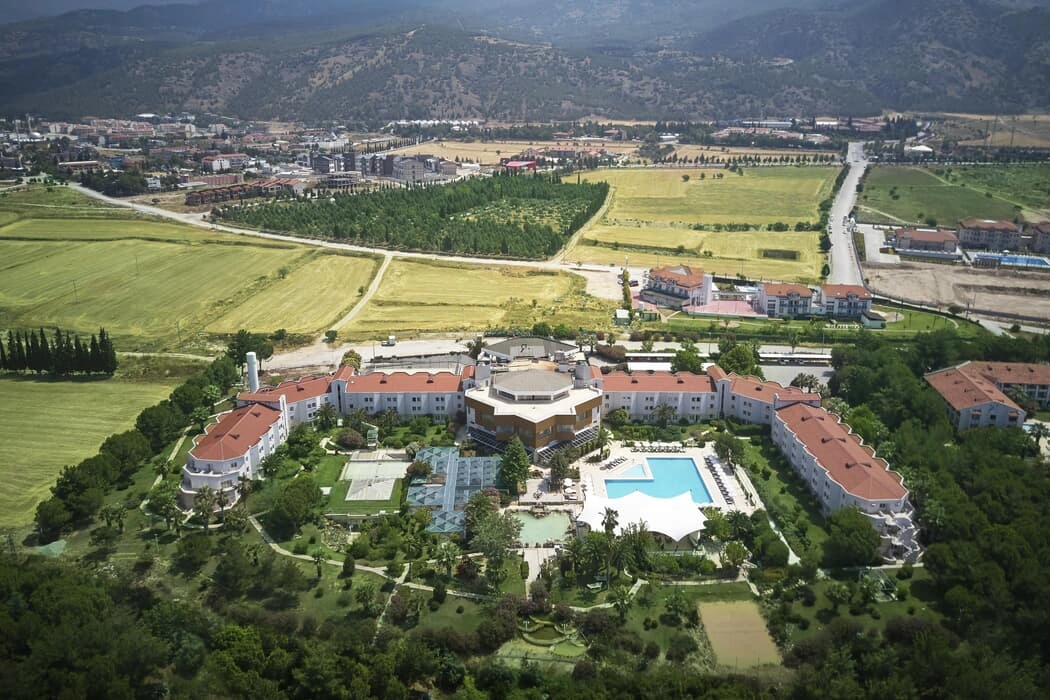
Room rates change daily — book through official hotel channels or your preferred OTA. Cab Istanbul does not sell hotel inventory.
Food
Eating around Pamukkale and Denizli — keep expectations light
Village restaurants near the gates cater heavily to day-trip coaches — menus rotate and quality varies by season. Denizli kebab and regional meat dishes are fair local anchors; pide and simple home-style cooking appear on many village menus. Treat specific “only restaurant of its kind” or hard price superlatives as stale unless you verify same-week — storefronts change frequently in tourist belts.
- Village vs city: Pamukkale village for convenience after terrace walks; Denizli centre for broader choice near otogar.
- Coach-hour crunch: Lunch peaks follow bus arrivals — eat slightly early or late to avoid queues.
- Hotel half-board: Karahayıt thermal properties often bundle dinner — useful after a long plateau day.
Getting there
Transport — DNZ airport, dolmuş links and chauffeur options
| Route / mode | Practical note | Booking pointer |
|---|---|---|
| Denizli Çardak (DNZ) → Pamukkale | Primary air gateway — roughly 65–72 km / 60–80 min by road | Taxi, hotel transfer or pre-booked local shuttle |
| DNZ → Denizli otogar | Municipal HavaUlaşım airport bus ~1 h | Then dolmuş to Pamukkale village |
| Denizli otogar → Pamukkale | Dolmuş ~20–30 min in normal traffic | Cash handy; frequency drops off-season |
| Istanbul → DNZ | Daily flights from IST/SAW — practical vs 10–12 h overnight bus to Denizli | Compare flight vs road time honestly |
| Istanbul → Denizli bus | Overnight coach ~10–12 h (range) | Otogar dolmuş or taxi to village after arrival |
| Drive from Istanbul | ~600–650 km · often 7–9+ h depending on route and traffic | Two-day chauffeur routing more realistic than same-day |
| Train | No direct Istanbul–Pamukkale rail — multi-leg via Ankara/Eskişehir is cumbersome | Fly DNZ for most international visitors |
| Multi-day Türkiye chauffeur | Useful for Istanbul ↔ inland chains with Laodicea or Aphrodisias stops | Intercity car with driver in Turkey |
| Istanbul airport transfer (separate product) | For Istanbul IST/SAW days — not a DNZ Pamukkale shuttle substitute | Istanbul Airport transfer |
| Istanbul city chauffeur | City mobility product — distinct from Denizli/Pamukkale routing | Car with driver in Istanbul |
Cab Istanbul operates independently of Pamukkale hotels and site gates. An intercity chauffeur can help on Istanbul–Anatolia multi-day routes — do not treat Istanbul Airport Transfer as if it were a DNZ Pamukkale shuttle product. There is no local Pamukkale Cab branch; drivers provide transport, not guided archaeology commentary.
Access video is context only — DNZ schedules, dolmuş times and road works follow your travel date.
Itineraries
How many days — sample 1-day and 2-day plans
| Day | Time band | Outline | Tip |
|---|---|---|---|
| 1-day highlight (arrive early) | |||
| Day 1 | 07:30–09:00 | Enter via south or north gate → Necropolis edge → theatre | Cooler light for plateau walks · confirm gate open time day-of |
| Day 1 | 09:00–11:00 | Frontinus Gate · colonnaded street · museum (FREE) | Museum fits if midday heat builds |
| Day 1 | 11:00–13:00 | Barefoot travertine descent on designated wet route | Shoes in bag · follow staff on open sections only |
| Day 1 | 13:00–15:00 | Optional Cleopatra Pool — confirm open & fee at booth | Not included in €30 ticket |
| Day 1 | Evening | Village dinner · optional night museum 19:00–23:00 if operating | MüzeKart night +200 TL note on portal — verify locally |
| 2-day Pamukkale + Laodicea | |||
| Day 1 | Full day | Combined site circuit as above · sunset terrace photos if gate hours allow | DNZ arrival same morning is tight — prefer prior-night village check-in |
| Day 2 | Morning | Laodicea (€12) half-day · return via Denizli otogar if departing | Separate ticket from main €30 site |
| Day 2 | Afternoon option A | Kaklık Cave — confirm municipal fee on arrival | Short add-on if Laodicea finishes early |
| Day 2 | Afternoon option B | Start Aphrodisias only if you accept ~2 h drive each way | Full-day product — do not pair with morning Laodicea unless you extend stay |
Coach-day visitor: Prioritise theatre → terraces → museum skip if queues grow — Cleopatra Pool only if booth confirms open status.
Photography focus: First light on travertines, second pass at dusk if night programme or extended gate hours apply on your date.
History-heavy: Add Laodicea on Day 2; reserve Aphrodisias for a third day or overnight near Geyre.
Coast combo: See Marmaris attractions or wider Aegean coast guides for separate beach blocks — Pamukkale is an inland UNESCO detour, not a seaside substitute.
FAQ
Pamukkale, Hierapolis and Denizli — frequently asked questions
Are Pamukkale and Hierapolis the same ticket?
Yes. The white travertine terraces and the Hierapolis archaeological site form one UNESCO property with a combined €30 foreign ticket (2026 DOSIM). They are different layers on the same visit — not two unrelated entrances.
How much is Pamukkale entrance in 2026?
€30 for foreign visitors to the combined Hierapolis–Pamukkale örenyeri. The old 700 TL figure is stale — removed from this guide. Turkish citizens may use MüzeKart per current DOSIM rules.
Is the Hierapolis Archaeology Museum free?
Yes — DOSIM lists the on-site museum as FREE. Pair it with your ruins circuit the same day.
How much is Laodicea?
€12 for foreign visitors (separate site, DOSIM Sep 2026). It is not included in the main Pamukkale €30 ticket.
Is Cleopatra Pool included in the €30 ticket?
No. The Antique/Cleopatra Pool is a separate swim product with its own booth fee. Open status has conflicting official notes — confirm day-of at the pool. This guide quotes no exact swim price.
Is the Cleopatra Pool open in 2026?
Official sources have carried both closure wording and open-to-visit listings. Treat status as day-of verification at the pool booth or muze.gov.tr — do not assume from old blog posts.
Do you have to walk barefoot on the travertines?
Yes on designated wet terrace walkways — footwear damages calcite. Pack a bag for shoes and follow staff routing. Swimming on open terraces is restricted.
Can you swim in the white terraces?
Only where site management explicitly allows — generally shallow wading on open terrace routes, not full bathing in protected pools. Managed swimming is mainly at the Cleopatra/Antique Pool when open.
Does Pamukkale cure diseases?
This guide makes no disease-cure or scientifically proven medical claims. Hierapolis has a historical thermal-spa tradition and mineral-rich water — that is heritage framing, not clinical advice.
What is the Plutonium and is it safe to enter?
The Plutonium is a cave sanctuary where CO₂ accumulates — ancient tradition called it an underworld gateway. View from the fence only. Carbon dioxide pooling is dangerous; do not cross barriers.
What is the Necropolis — is it called Anatolian Cemetery?
The site is the Necropolis of Hierapolis — one of SW Anatolia's largest ancient burial fields. “Anatolian Cemetery” is not the primary English name used here.
When was Pamukkale UNESCO listed?
The Hierapolis–Pamukkale mixed site has been UNESCO World Heritage since 1988.
How far is Pamukkale from Denizli?
Roughly 18 km north of Denizli city — about 20–30 minutes by dolmuş or taxi to the village gates under normal traffic.
Which airport serves Pamukkale?
Denizli Çardak (DNZ) — approximately 65–72 km / 60–80 minutes to Pamukkale by road. Istanbul visitors often fly IST/SAW–DNZ rather than drive cross-country same-day.
How do you get from DNZ airport to Pamukkale?
Taxi or pre-booked transfer direct; or HavaUlaşım bus to Denizli otogar (~1 h) then dolmuş to Pamukkale village (~20–30 min). Confirm last dolmuş times if you arrive late.
What are Pamukkale opening hours?
Portal notes vary: pedestrian gate often 08:00–18:00; North/South gates 08:00–21:00; ticket office near 18:00; night museum 19:00–23:00 when operating. Confirm day-of at muze.gov.tr or the gate.
What is the night museum programme?
Listed hours 19:00–23:00. Portal notes MüzeKart holders may need a +200 TL night ticket — verify locally. Seasonal operation applies.
Where should I stay — Pamukkale village or Karahayıt?
Pamukkale village for walk-to-gate convenience. Karahayıt (~3–5 km north) for thermal hotels and red springs — budget taxi/shuttle time to the UNESCO entrance. Denizli city suits transport hubs, not terrace-at-dawn photography.
Are hotel prices listed in this guide?
No. Room rates and OTA review scores are omitted by editorial policy. Named hotels (Richmond, Melrose, Apollon Garden, Bellamaritimo, Whiteheaven, Venus Suite, Alida, Hotel Sahin, Aspawa) are area labels only.
How many days do you need in Pamukkale?
1 full day covers terraces, theatre, Necropolis and museum if you start early. 2 days add Laodicea or Kaklık cleanly. Aphrodisias wants a separate long day (~2 h drive each way).
Is Pamukkale Natural Park the same as the terraces?
No. The village recreation park (lake/pedalos if operating) is a local leisure product distinct from the UNESCO travertine archaeological site.
What is Kaklık Cave?
An underground travertine cave near Honaz/Kaklık — nicknamed “underground Pamukkale.” Municipal fee is variable; this guide quotes no fixed TL price.
Can you visit Aphrodisias on a day trip from Pamukkale?
Possible as a long day (~2 h drive each way) but tight if combined with a full terrace circuit. Better as a dedicated day or overnight near Geyre.
Does Cab Istanbul operate Pamukkale airport transfers?
Cab Istanbul has no local Pamukkale branch. Its intercity chauffeur product may help on Istanbul–Anatolia multi-day routes. Istanbul Airport Transfer is an Istanbul product — not a DNZ Pamukkale shuttle substitute.
Can I book a chauffeur from Istanbul to Pamukkale?
Multi-day overland routing is possible via intercity car with driver in Turkey (~600–650 km, often 7–9+ h). Most travellers still fly DNZ for time efficiency. Drivers provide transport, not guided tours.
Is there a train from Istanbul to Pamukkale?
No direct service. Rail requires cumbersome multi-leg routing via Ankara/Eskişehir — flying to DNZ is the practical default.
Will the foreign entrance fee rise in 2027?
News reports cite a rise to €35 from 1 April 2027. That figure does not apply to 2026 visits — use €30 until official 2027 confirmation at the gate.
Are all terrace pools filled with water?
Not daily. Flow management and conservation close sections; shallow pools you see in marketing may be dry or roped off on your visit. Plan photos flexibly.
Can you take travertine rocks as souvenirs?
No. Removing travertine damages protected heritage and may carry penalties. Photography only.
How big is the Hierapolis theatre?
It is among the better-preserved large theatres in Asia Minor with Hellenistic roots and Roman rebuilding after the AD 60 earthquake. Exact seat counts differ by source — this guide avoids an unverified fixed “15,000” figure.
Does Cab Istanbul sell museum or pool tickets?
No. Cab Istanbul provides independent transfers and chauffeur services only — not hotel, site, pool or museum inventory.
Next step
Build Pamukkale in layers — terraces, plateau ruins and Denizli links
Label Pamukkale terraces, Hierapolis ruins, Cleopatra Pool and Laodicea as separate map pins before you book. Lock the combined €30 ticket against the fee table, walk barefoot only where staff allow, and treat Cleopatra Pool as a day-of booth check — not a guaranteed swim. Fly DNZ, use Denizli dolmuş honestly, and stack Laodicea on a second morning if time allows. For wider planning, read Aegean coast attractions and Marmaris attractions — then arrange DNZ onward transport locally or an intercity chauffeur if you are chaining Istanbul with inland UNESCO stops.