
Edirne stands where the Ottoman story began in Europe. Captured in 1369 and serving as the empire's capital for nearly a century before Mehmed II moved to Constantinople, the city retains an extraordinary architectural legacy — four major mosques that trace Ottoman design from its earliest experiments through Mimar Sinan's greatest achievement, an intact covered bazaar, a 19th-century stone bridge, and a railway station handed over by treaty. Beyond the historic centre, the province extends south to one of Turkey's finest Aegean beaches and a bird-rich national park at the edge of a Greek border delta. This guide covers everything worth seeing in the city and the wider Edirne province, including what has changed, what has been restored, and what the factual record actually shows.
Selimiye Mosque — Mimar Sinan's Masterpiece
Selimiye Camii is the undisputed centrepiece of Edirne and, by many measures, the highest achievement of classical Ottoman architecture. Commissioned by Sultan Selim II and designed by the imperial architect Mimar Sinan, construction ran from 1568 to 1574. Sinan himself, then in his eighties, declared it his masterpiece — a verdict posterity has upheld. UNESCO inscribed Selimiye on the World Heritage List in 2011, along with the broader Edirne complex of Ottoman-era buildings.
The engineering is the most-discussed aspect of Selimiye's achievement. The main dome reaches a diameter of 31.25 metres — fractionally wider than Hagia Sophia's — supported by eight massive piers that Sinan concealed within the octagonal wall mass, eliminating the heavy columns that darkened earlier mosques and flooding the interior with light through 999 windows. The four minarets, at 70.89 metres each, are among the tallest in the world and give Edirne's skyline its defining silhouette from every approach to the city. Each minaret carries spiral and zigzag decorative bands; the şerefe (balcony) galleries are accessible via separate internal staircases — Sinan's technical flourish to allow multiple simultaneous calls to prayer from different levels.
The mosque is an active place of worship, open to visitors free of charge outside the five daily prayer times. Women should have a head covering; modest dress is expected. The attached Selimiye Arastası — a covered market street of 124 shops aligned along an arcade — sells textiles, local produce and souvenirs and dates from the same construction campaign. The broader Selimiye complex includes the Edirne Museum of Turkish and Islamic Arts, housed in one of the original medrese buildings facing the mosque courtyard.
Eski Camii — Edirne's Oldest Mosque
Three hundred metres from Selimiye in Edirne's old town centre stands a mosque that predates it by a century and a half. Eski Camii (Old Mosque) — sometimes called the Ulu Cami (Grand Mosque) by Edirne residents — was begun in 1403 under Emir Süleyman, son of Yıldırım Bayezid, and completed in 1414 under Sultan Çelebi Mehmed I after an interruption caused by the Ottoman interregnum. It is the oldest surviving Ottoman mosque in the city and the most visited after Selimiye.
The mosque's plan is immediately distinctive: a nine-dome grid interior (three rows of three), carried on four massive square piers, gives Eski Camii an almost basilical solidity that predates the centralised single-dome form Sinan would perfect at Selimiye. The calligraphy covering virtually every wall surface — bold metre-high Arabic lettering naming God and the Prophet — is among the finest in Turkey and remains in extraordinary condition. The total interior creates an intimate prayer hall that receives a steady flow of visitors throughout the day; it is never locked and feels like a living mosque rather than a heritage exhibit.
The covered revak (arcade) and courtyard around Eski Camii are pleasant for a brief rest. The neighbouring Bedesten — a vaulted market hall also dating from the early 15th century — opens onto the same square and continues to sell fabrics, leather goods, local produce and Edirne's celebrated white cheeses, making the surrounding streets the most rewarding half-hour circuit in the city centre.
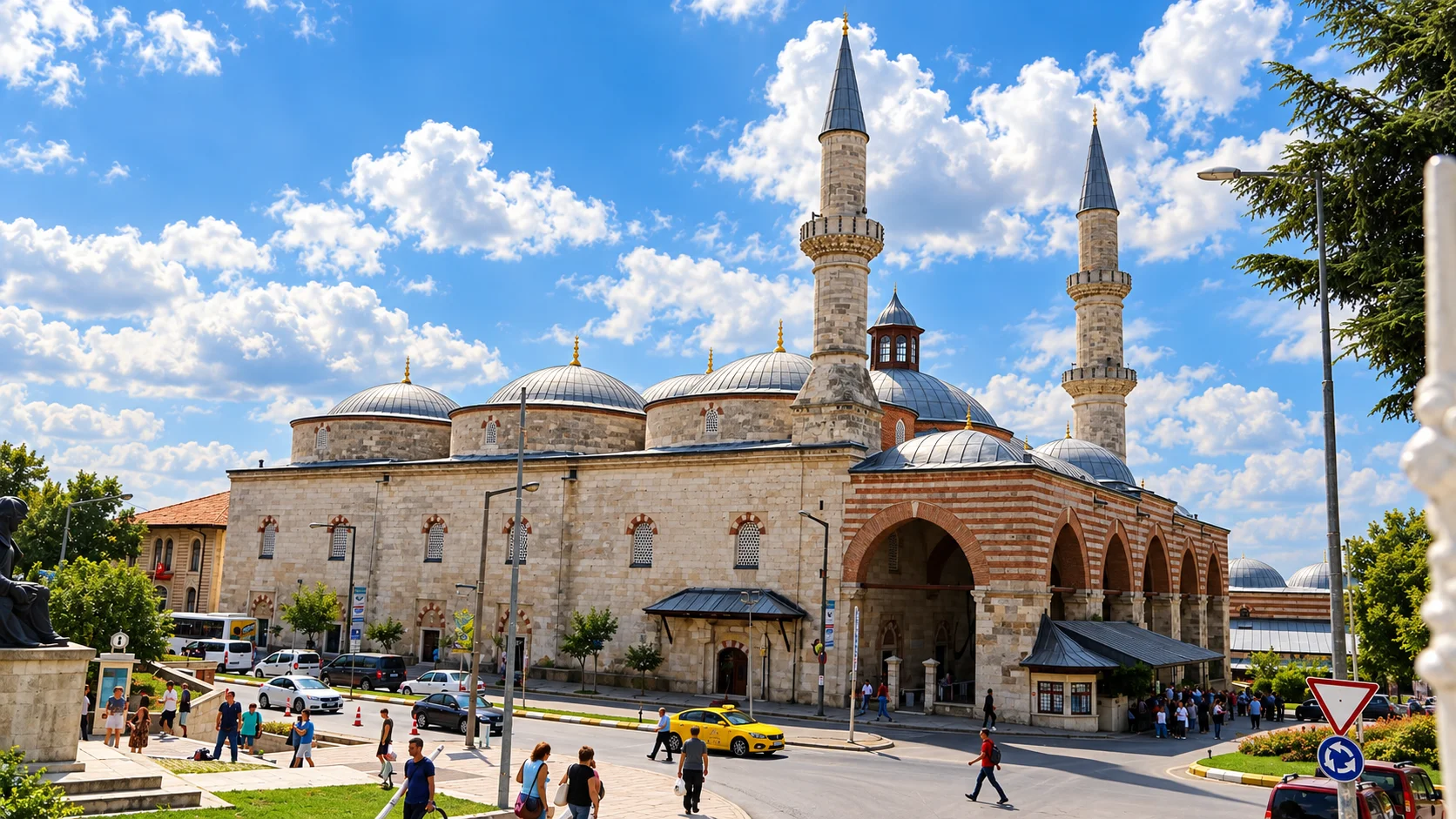
Üç Şerefeli Camii
Between Eski Camii and Selimiye stands a mosque that bridges the two architecturally — Üç Şerefeli Camii, commissioned by Sultan Murad II (Murat II) and built between 1433 and 1447. The name means "Mosque of Three Galleries" and refers to the tallest of its four minarets, which uniquely carries three separate şerefe (balcony levels) — a structural experiment at the time that no earlier Ottoman minaret had attempted. Each of the four minarets is different in shape, height and decorative banding, making Üç Şerefeli the most architecturally varied building in Edirne despite its relatively modest interior volume.
The interior marks a decisive step in Ottoman architectural evolution: a single large central dome (24.5 m diameter) flanked by two smaller domes, supported by columns that replaced the wall-interrupting structural piers of earlier mosques. The large, purpose-designed courtyard — arguably the first monumental mosque courtyard in Ottoman architecture — established a template used in virtually every subsequent imperial mosque. Üç Şerefeli is free to enter, remains active for daily prayers, and sits a short walk from the Ali Paşa bazaar.
Sultan Bayezid II Complex & Health Museum
One of Edirne's most distinctive attractions sits across the Tunca River from the city centre: the Sultan II. Bayezid Külliyesi, built between 1484 and 1488. Positioned on the far bank to benefit from the river's clean air and the therapeutic setting away from the city's noise, the complex was designed as a complete welfare institution — mosque, medrese, imaret (soup kitchen), caravanserai and a dedicated darüşşifa (hospital). The architect was Hayreddin, working within the style developed by Sinan's predecessors.
The darüşşifa earned its historical distinction through the systematic use of music therapy for the treatment of mental illness — prescribed compositions played by employed musicians at set intervals for patients. European travellers documented the practice with admiration; it represents one of the most progressive aspects of Ottoman medicine in the late 15th century. Today the hospital ward operates as the Edirne Health Museum (Sağlık Müzesi), jointly managed with Trakya University, with life-sized tableaux demonstrating Ottoman medical and therapeutic practices.
Opening hours: 09:00–17:30 daily, closed Mondays. Admission: 60 TL (card payment only; cash not accepted). Extended summer evening hours apply on Thursday, Friday and Saturday. The mosque itself and the riverside setting are freely accessible and among the most peaceful in Edirne — the complex receives far fewer visitors than Selimiye, which makes the quiet interior feel like a genuine discovery.
Kırkpınar Oil Wrestling — A Living UNESCO Tradition
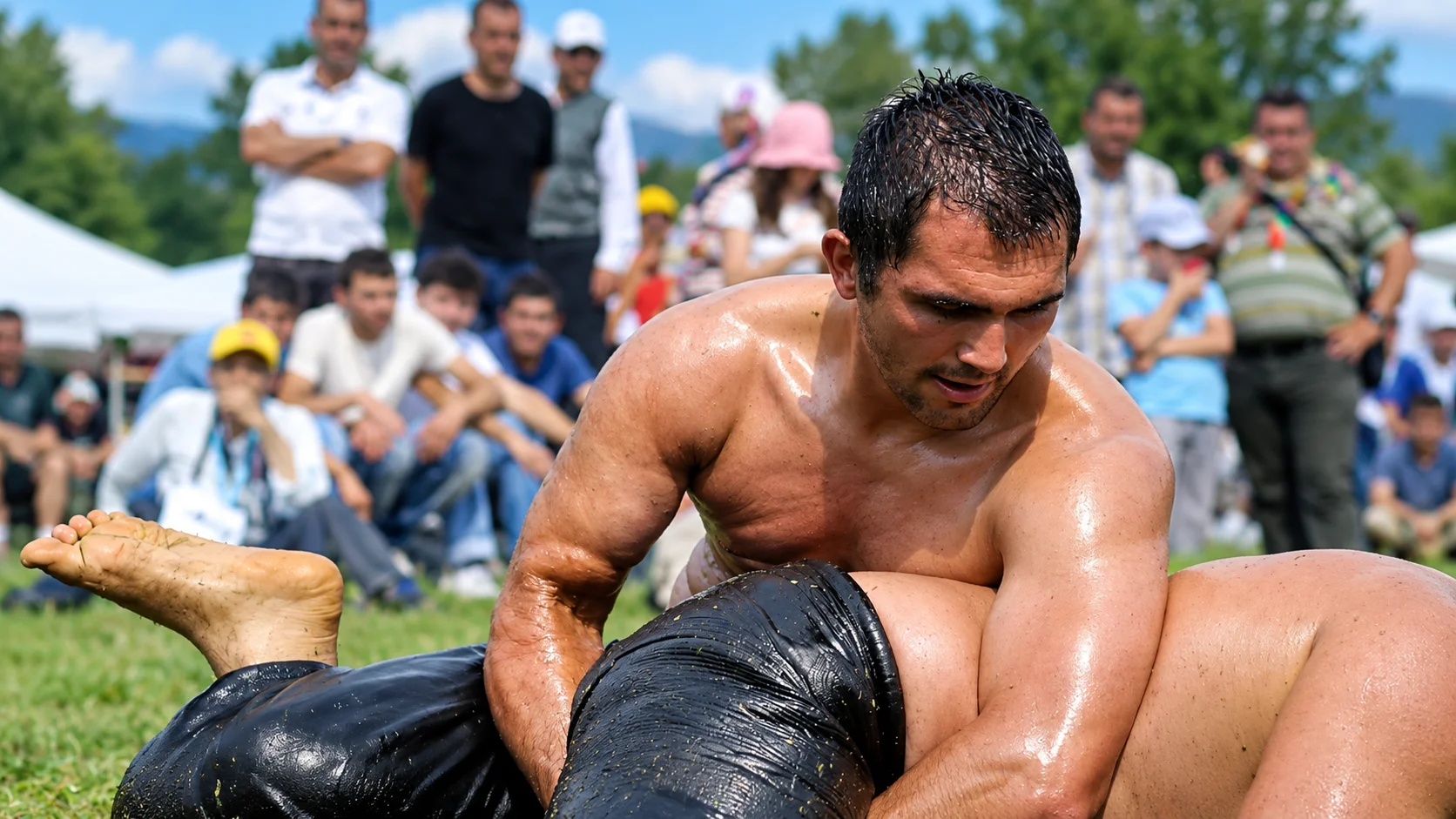
Every summer, Edirne hosts what may be the world's most continuously running sporting event. Kırkpınar Yağlı Güreş (Oil Wrestling) has been held annually at Sarayiçi — the meadow island in the bend of the Tunca River — since the 14th century. UNESCO added Kırkpınar to its Representative List of the Intangible Cultural Heritage of Humanity in 2010.
The competition runs for seven days, typically in late June or early July. Wrestlers — called pehlivanlar — cover their bodies and legs in olive oil and don thick kıspet trousers made from buffalo or cattle leather. Matches have no time limit: the goal is to throw the opponent flat or lift them fully off the ground. The head pehlivan who wins the gold-belt competition — the başpehlivan — holds a status close to a national hero in Turkish sporting culture. Drummers and zurna (double-reed horn) players perform wrestling melodies continuously throughout the competition, providing an almost ritual soundtrack.
The festival attracts tens of thousands of spectators, and the broader Kırkpınar week includes cultural events, concerts and the appointment of the new ağa (ceremonial sponsor). Even outside festival season, the Sarayiçi meadow and Er Meydanı (wrestling grounds) are freely accessible and give a clear sense of the landscape. The Ottoman Palace ruins lie within the same grounds.
Edirne Palace (Sarayiçi) — Ottoman Imperial Ruins
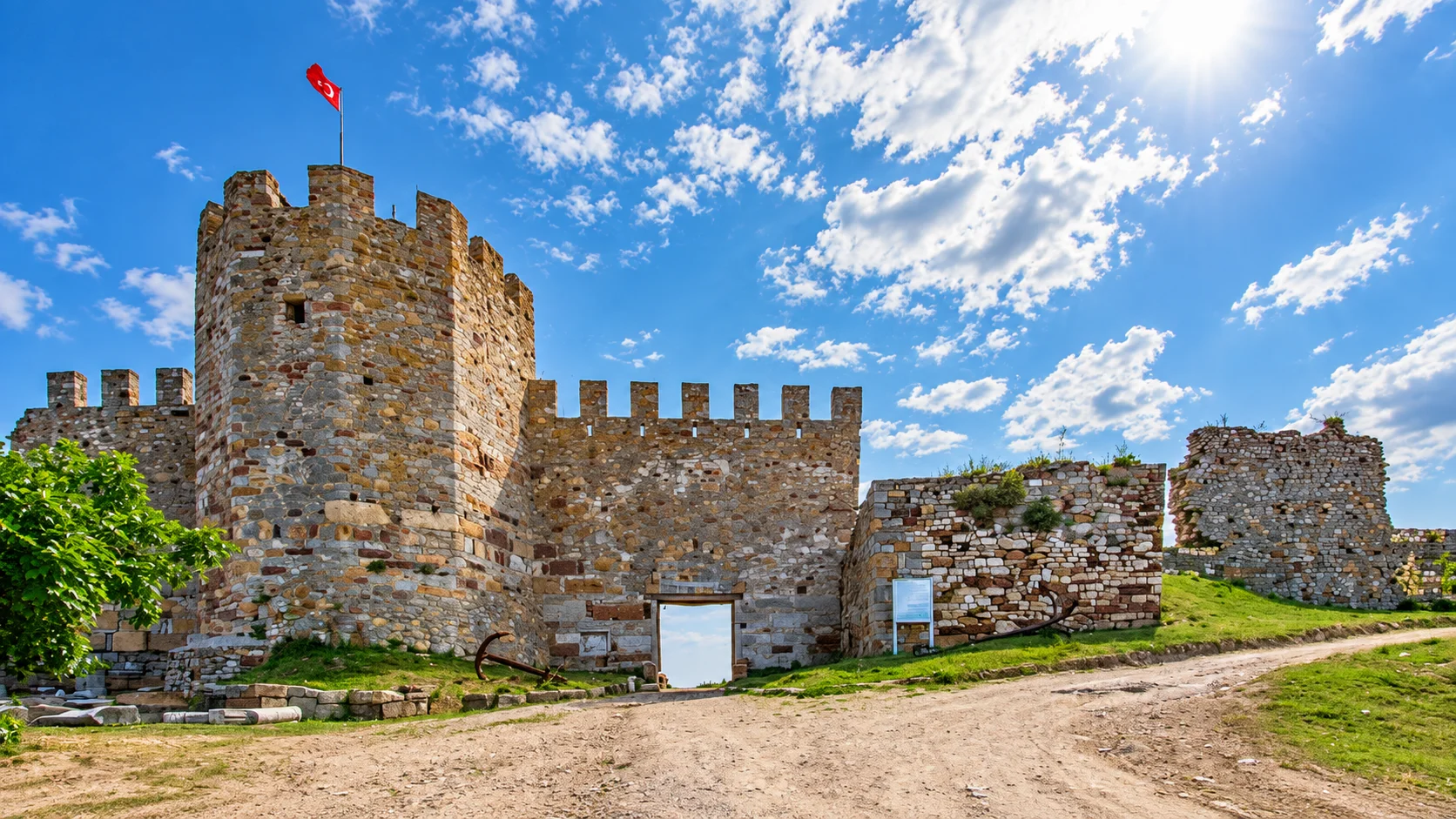
The Edirne Palace (Saray-ı Cedid-i Amire) was the largest imperial Ottoman palace complex in the world at its height — larger even than Topkapı, which replaced it as the seat of Ottoman power after 1453. Construction began under Sultan Murad II around 1450 and the palace took its principal form under Mehmed II (Fatih), who used Edirne as his base for the campaigns that led to the conquest of Constantinople. Over the following centuries, successive sultans added towers, kiosks, baths and ceremonial pavilions. At its peak, the complex reportedly contained over a hundred separate structures on Sarayiçi island, enclosed by the Tunca River on multiple sides.
What remains is a fraction of that scale. The Ottoman army demolished much of the palace in 1876 to prevent capture by Russian forces during the Russo-Turkish War, and subsequent earthquakes damaged surviving structures further. However, the National Palaces Administration (Milli Saraylar) assumed control of the site in 2022 and launched a systematic restoration programme. Current excavations and work focus on the Cihannüma Kasrı (Imperial Observation Tower). The site is not yet open as a standard visitor attraction — but the Sarayiçi meadow, Kırkpınar arena, Tavuk Ormanı recreation area and Balkan Wars Cemetery are all freely accessible within the same grounds.
Ali Paşa Covered Bazaar & Bedesten
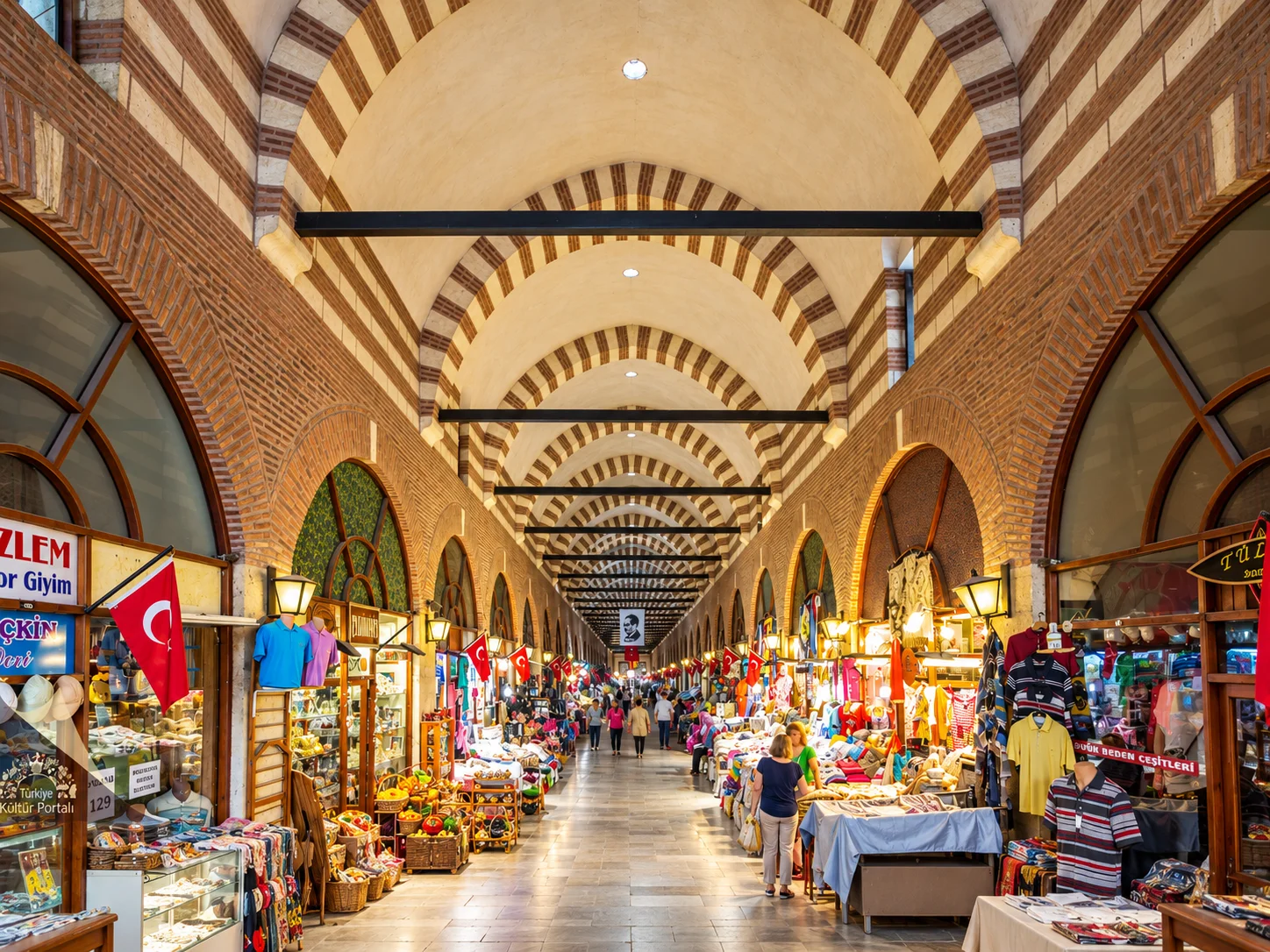
Edirne's finest Ottoman shopping street is the Ali Paşa Çarşısı, designed by Mimar Sinan and built for Grand Vizier Semiz Ali Paşa between 1561 and 1565. The covered market stretches in a single long vaulted arcade from near the Üç Şerefeli Mosque toward the Bedesten, its stone-arched ceiling and recessed shop fronts essentially unchanged in structure since the 16th century. Today the shops sell a mixture of local produce, textiles, spices, traditional sweets, badem ezmesi (almond paste) and Edirne's celebrated white cheeses — making it the most practical place in the city to shop for food souvenirs.
The Edirne Bedesteni adjacent to the Ali Paşa Çarşısı dates from the early 15th century and served as the financial core of the city's trade — a secured vault where merchants stored and exchanged high-value goods under the market-hall's thick stone vaults. Today it continues as a working market selling fabrics, leather, jewellery and local crafts. Together, the Ali Paşa Çarşısı and Bedesten constitute the best-preserved Ottoman commercial quarter outside Istanbul's Grand Bazaar.
Saraçlar Caddesi, the main pedestrian street running alongside the bazaar, is lined with modern shops, cafés and restaurants — a good place for a break between mosque visits, with several restaurants serving Edirne's celebrated tava ciğeri within a short walk.
Karaağaç & the Lausanne Monument
Karaağaç is a quiet neighbourhood west of the city centre with an outsized historical charge. The district's railway station — designed in ornate Beaux-Arts style by the Oriental Railways company and completed around 1914 — was intended to be Edirne's main rail gateway to Europe. Construction finished just as World War I began, the border shifted, and the station never entered full service. Under the Treaty of Lausanne (1923), Karaağaç and the surrounding district were awarded to Turkey as financial reparations for wartime damage to Anatolia — one of the more precisely negotiated territorial provisions in modern European diplomacy. The station was formally handed over by Greece on 14 September 1923.
Today the magnificent station building houses the Faculty of Fine Arts of Trakya University — an apt occupant for an ornate structure that never fulfilled its railway function. The Lozan Anıtı (Lausanne Monument), erected in 1998, stands in the grounds: three concrete pillars rising at 45-degree angles from the earth, their heights carrying symbolic weight — 36.45 metres representing Anatolia, 31.95 metres Thrace, and 17.45 metres Karaağaç itself. The monument is striking in its architectural abstraction and best seen from across the Meriç River.
The neighbourhood around the station has developed a pleasant café and restaurant scene, with tree-lined streets and a distinct early-20th-century residential character that differs markedly from the Ottoman old town. An afternoon walk from Eski Camii through Saraçlar Caddesi, across the Meriç Bridge and into Karaağaç, ending at the Lozan Anıtı, covers the essential east–west geography of central Edirne in about three hours on foot.
Meriç Bridge
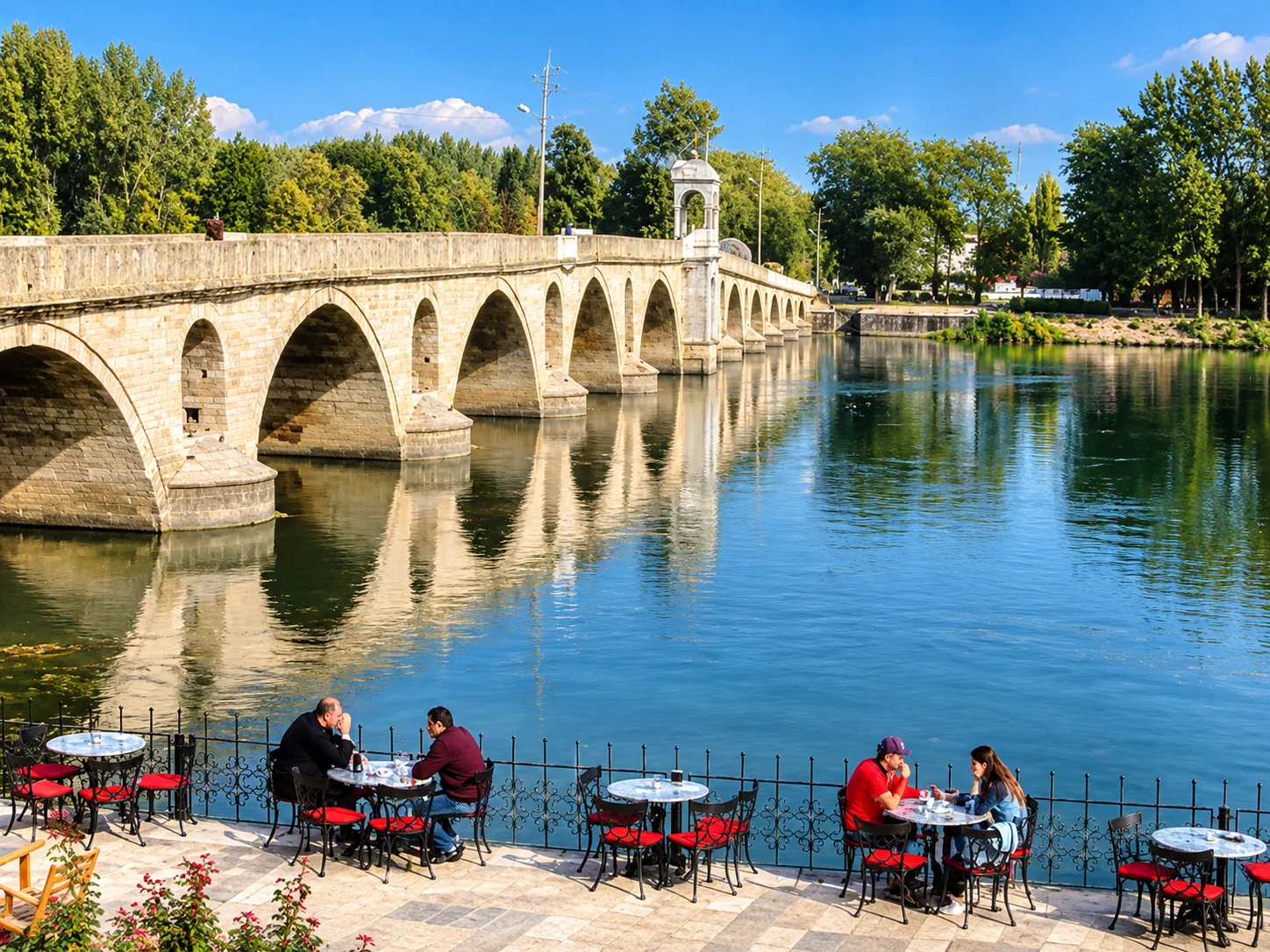
The Meriç Bridge — also known as the Mecidiye or Mahmudiye Bridge — connects the historic city centre to the Karaağaç neighbourhood across the Meriç River. Construction ran from 1842 to 1847 under Sultan Abdülmecid I; at 263 metres long and 7 metres wide, with 12 pointed stone arches carried on 13 piers, it is the longest surviving Ottoman stone bridge in Turkey. Decorative details include a 12-animal calendar carved into the balustrade and an eight-pointed star medallion set into the parapet — Ottoman bridge architecture at its most ornate.
The bridge is pedestrian-accessible and remains in daily use. Walking its length at dusk, when the stone arches reflect in the Meriç water, is one of the best free experiences in Edirne. The Meriç River here forms the natural border between Turkey and Greece — the far bank is Greek territory — but the bridge itself lies entirely within Turkey and does not function as a border crossing point.
Multicultural Heritage: Synagogue, Orthodox Churches & Balkan History
Edirne was a genuinely cosmopolitan city under the Ottomans — home to substantial Greek, Jewish, Armenian and Bulgarian communities alongside the Muslim majority. Several monuments to that plural heritage remain accessible today. The Grand Synagogue of Edirne (Büyük Sinagog), built in 1907, was the third-largest synagogue in Europe at construction. After decades of disuse and a long restoration project, the synagogue has been opened for visitors and occasional events; its ornate Moorish-influenced interior — with its gallery levels and painted ceiling dome — is one of the more striking architectural surprises in Edirne.
The Sveti Georgi Bulgarian Orthodox Church and the Sveti Konstantin i Elena Church survive from Edirne's Bulgarian community and are occasionally open for visits. Muradiye Camii, built by Murad II in 1435, is a smaller mosque worth seeking out for its exceptional early İznik tile panels — among the earliest surviving examples of the blue-and-white ceramic style that would become synonymous with Ottoman decorative arts. The Balkan Wars-related sites around the city — including the Museum of the Balkan Wars and the Şükrü Paşa Memorial at Sarayiçi — document the Ottoman retreat from the Balkans and the 1912–1913 siege of Edirne.
Edirne Province: Day Excursions Beyond the City
The administrative province of Edirne extends south and west to the Greek and Bulgarian borders, encompassing landscapes that differ significantly from the historic city. The following destinations require dedicated excursions from Edirne centre — distances are substantial and they are best planned as a second-day itinerary or a dedicated trip from Istanbul.
Ainos (Enez) Ancient City
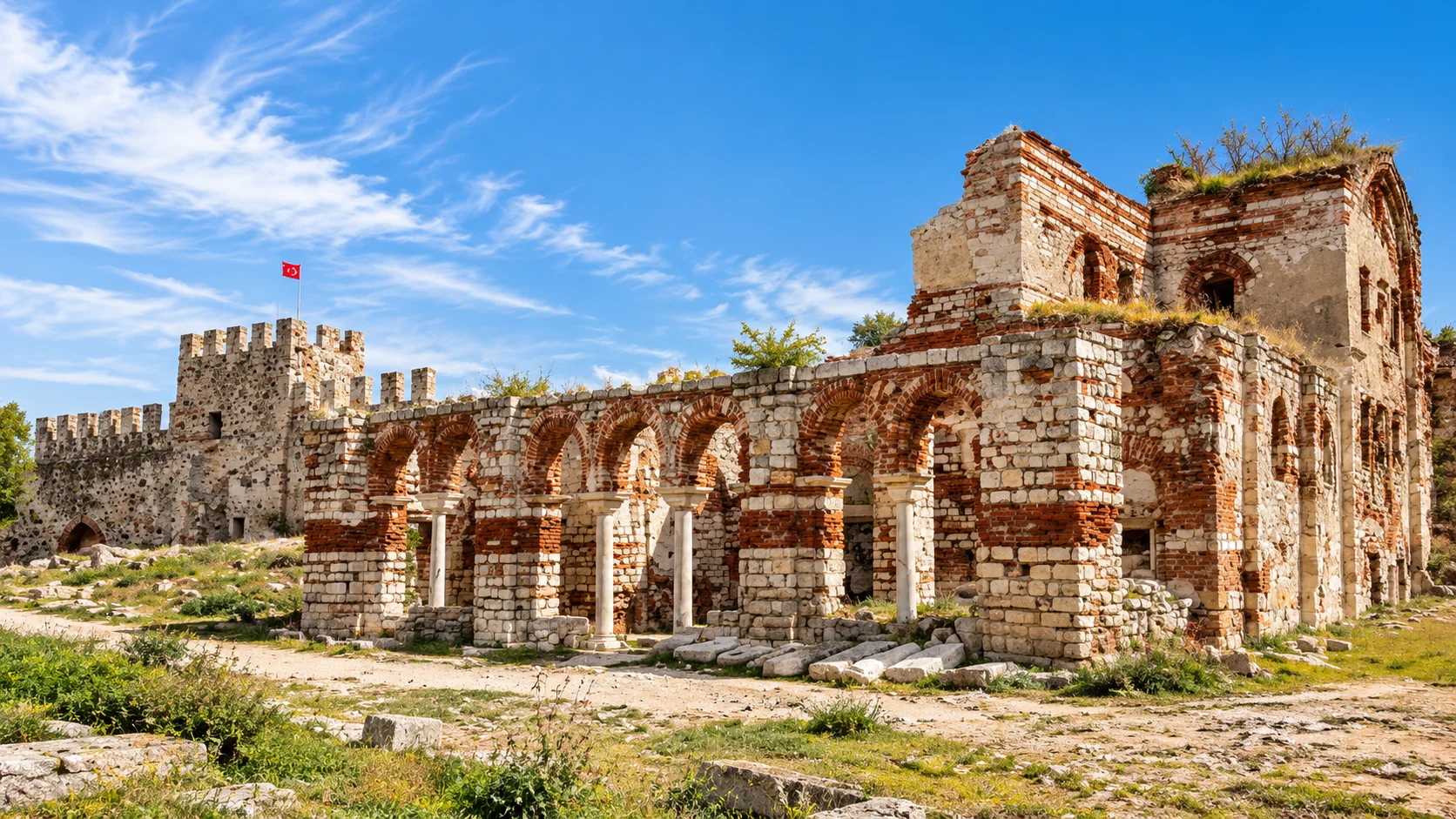
Ainos (modern Enez) is the only major ancient city excavation within Edirne's administrative province. Founded as a Greek colony in the 6th century BC, it became one of the significant Thracian Aegean ports — positioned at the delta of the Hebros River (today's Meriç) where it meets the Aegean Sea. Control passed through Persian, Macedonian, Roman, Byzantine and Ottoman hands before the city declined as the river delta silted up.
Ongoing excavations by Istanbul University have recovered approximately 30,000 archaeological objects from the site — roughly half of all exhibits in the Edirne Archaeology and Ethnography Museum. Four Ionic capitals from Ainos displayed in the museum entrance hall are among the finest surviving examples from antiquity. The site itself is accessible; Byzantine sea-tower foundations and fragmentary city walls are the most visible standing structures. The adjacent Enez Castle, a Byzantine fortification modified under Ottoman rule, provides elevated views over the delta landscape and the Aegean horizon beyond.
Enez is approximately 85 km south of Edirne city centre (about 1 hour 15 minutes by car). Combined with Erikli Beach, 15 km further along the coast, it forms a natural day-excursion pairing from either Edirne or Istanbul.
Erikli Beach & the Saros Gulf
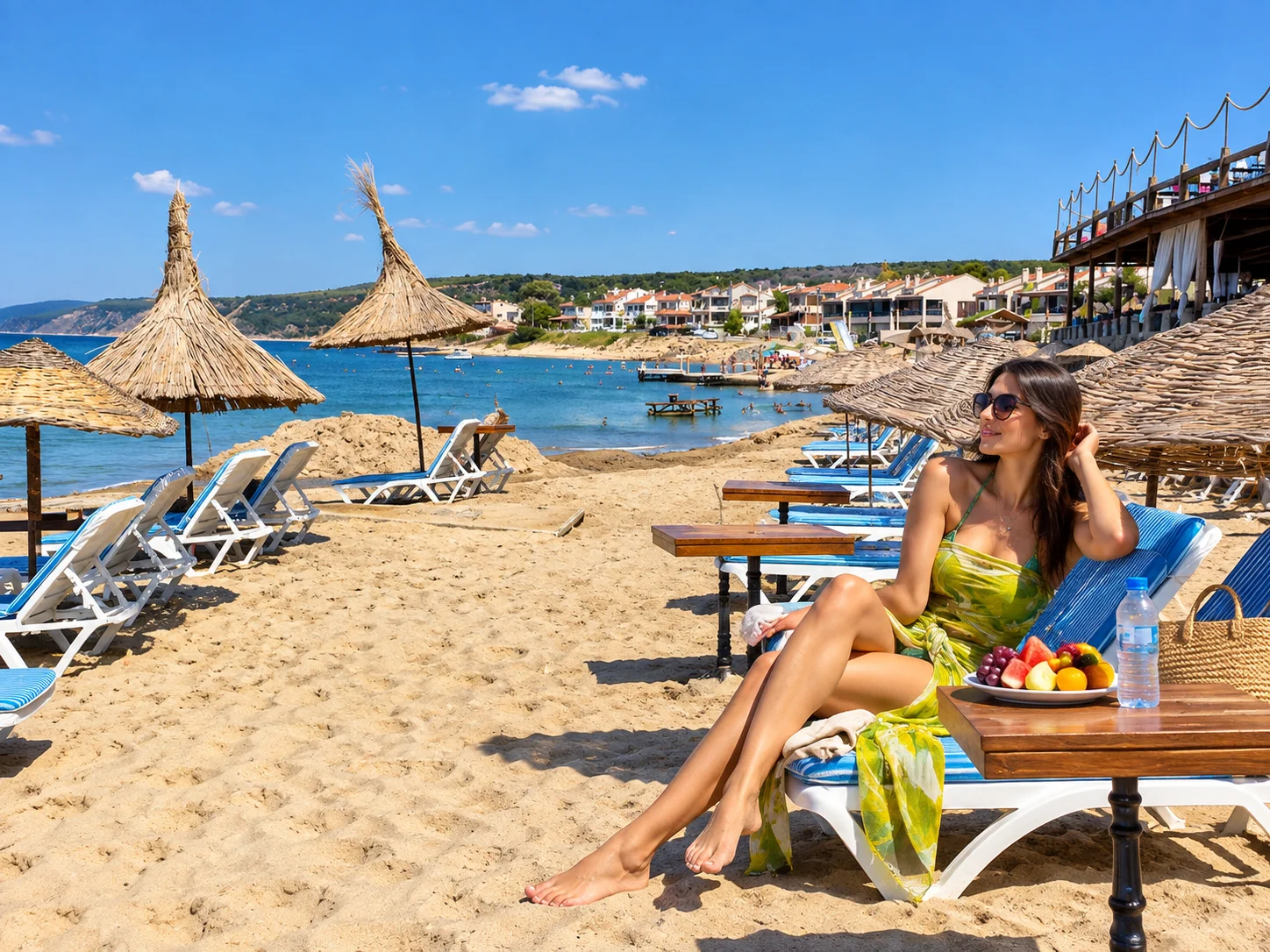
Edirne province's most celebrated beach is Erikli, in the Keşan district, on the northern shore of the Saros Gulf — an arm of the Aegean Sea famous for its unusually clear, cold water and relatively undeveloped coastline. Older descriptions that link Erikli to Marmaraereğlisi are geographically incorrect: Erikli village is in Keşan district, facing the Saros Gulf, on the Aegean. The drive from Edirne city centre is approximately 90 km.
The Saros Gulf as a whole is one of the least overdeveloped coastlines accessible from Istanbul — a three-to-four-hour drive from the city, with Blue Flag beaches, low-rise accommodation and a summer atmosphere considerably calmer than the Marmara coast. The town of Keşan, 30 km inland, serves as the service hub; Erikli village sits directly on the water with small pansiyons, restaurants and the beach itself. Sea conditions are best between July and September. Gökçetepe Nature Park, further east along the same coast, adds birdwatching and light nature walking as alternatives to the beach.
Gala Lake National Park
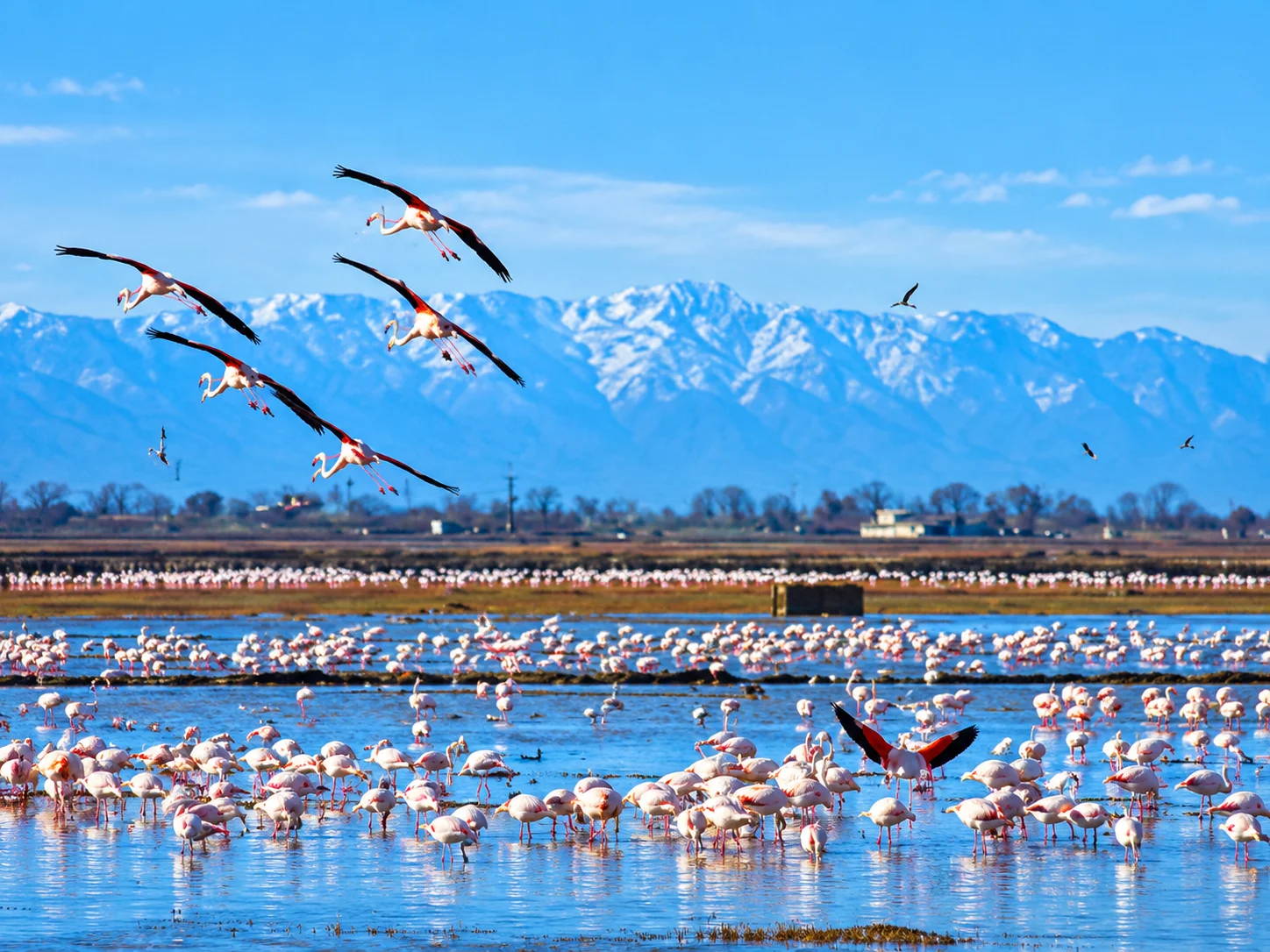
Gala Gölü Milli Parkı (Gala Lake National Park) sits in a wetland basin between the Enez and İpsala districts, approximately 65 km south-west of Edirne. The lake and surrounding marshes lie directly on the trans-Eurasian bird migration route — one of the most significant wetland sites in the Balkans. Close to 250 bird species have been recorded here, including flamingos, Dalmatian pelicans, swans (mute, Bewick's and whooper), grey herons, cormorants and a wide range of migratory ducks and waders.
The lake is a protected national park: fishing and extractive activities are regulated, and habitat conservation takes priority over recreational use. A viewing platform and access paths allow birdwatching without disturbing nesting areas. Spring (April–May) and autumn (September–October) are the peak migration windows; flamingos are present through most of the warmer months. Gala Gölü sits conveniently in the same south-Edirne excursion zone as Enez and Erikli, making a combined day excursion to all three feasible with an early start.
Getting from Istanbul to Edirne
Edirne is approximately 239 km from central Istanbul, almost entirely on the O-3/E-80 motorway across Thrace. By private car, the journey takes approximately 2.5 hours in normal conditions — though rush-hour traffic on Istanbul's European side and weekend border queues near Kapıkule can extend this. Bus services from Istanbul's Esenler coach terminal reach Edirne in approximately 3 to 3.5 hours; trains from Halkalı station take around 4 hours.
For groups or families wanting to visit multiple sites in one day — Selimiye, Bayezid Complex, Karaağaç, and optionally Enez or Erikli — a private transfer with a chauffeur avoids parking constraints in the narrow historic centre and allows a flexible itinerary. Travellers arriving at Istanbul Airport (IST) can arrange an Istanbul airport transfer into the city and continue to Edirne the same morning via an intercity car with driver — covering the full distance door-to-door without bus connections.
One Day in Edirne
A full but achievable single-day itinerary for Edirne's city-centre essentials:
- Morning (09:00–12:00): Begin at Selimiye Mosque when it is quietest — the 999-window light is at its best before noon. Walk the Selimiye Arastası, then south to Eski Camii and the adjacent Bedesten. Continue five minutes to Üç Şerefeli Camii — all three mosques within a ten-minute walk of each other.
- Midday (12:00–14:00): Lunch on Saraçlar Caddesi or in the Ali Paşa Çarşısı area. Multiple restaurants serve tava ciğeri within steps of the bazaar; pastane shops have badem ezmesi and peynir helvası for dessert.
- Afternoon (14:00–17:00): Cross the Tunca River to the Bayezid II Complex and Health Museum (allow 1.5 hours). Return via Sarayiçi — walk the Kırkpınar arena and the palace grounds.
- Late Afternoon / Evening (17:00–19:30): Cross the Meriç Bridge into Karaağaç on foot. Visit the Trakya University station building and the Lozan Anıtı. Return along the river promenade at dusk — this stretch at golden hour is the best free view in Edirne.
Two Days in Edirne
A second day can either deepen the city experience or venture into the province:
- Option A — Museums & Minority Heritage: Edirne Archaeology and Ethnography Museum (half the collection is Ainos finds), Museum of Turkish and Islamic Arts in the Selimiye medrese, Grand Synagogue, Muradiye Camii, Balkan Wars Museum.
- Option B — Aegean South: Drive to Enez (85 km, 1h15min) for the Ainos ancient city and Enez Castle. Continue to Erikli Beach (15 km) for lunch and the afternoon. Return via Gala Lake (65 km from Edirne, small detour westward). Best in late spring or summer.
For visitors based in Istanbul, Option B works well as a standalone day trip: depart Istanbul by 07:00, reach Enez by 10:00, lunch at Erikli, return to Istanbul by early evening.
Best Time to Visit Edirne
Edirne's climate is continental Thracian — dry summers regularly exceeding 35°C, cold winters with occasional snowfall, and mild spring and autumn. The best time depends on what you want to do:
- Spring (April–May): Ideal for city sightseeing. Comfortable walking temperatures, green countryside, uncrowded mosques.
- Summer (June–August): Best for Saros beaches (Erikli, Gökçetepe). Kırkpınar Oil Wrestling runs in late June or early July — book accommodation months in advance for this period. City temperatures are high; start mosque visits before 10:00.
- Autumn (September–October): Second-best window for city sightseeing. Saros sea is still warm in September. Gala Lake bird migration peaks September–October.
- Winter (November–March): Cold and very quiet — tourists are almost absent. Mosque interiors are intimate with winter light; snow occasionally transforms the Selimiye skyline into one of the most striking views in Turkey.
What to Eat in Edirne
Edirne has a distinctive food culture that diverges significantly from Istanbul's repertoire. Several dishes are authentically local and worth seeking out specifically:
- Tava Ciğeri: The city's signature dish — sliced beef (dana) liver floured and shallow-fried in sunflower oil, served crisp outside and tender inside, typically with fried red chilli peppers and onion rings. The recipe is specifically for beef liver; the use of lamb (kuzu) liver is a variant, not the traditional preparation. The dish received a geographical indication (coğrafi işaret) since 2010. Found throughout the city centre; the highest concentration of specialist ciğer restaurants clusters around the Ali Paşa Çarşısı.
- Badem Ezmesi: Edirne almond paste — produced locally from an essentially unchanged recipe, moulded into stylised figures (fish, fruits, traditional forms) and sold throughout the bazaar. The most sought-after edible souvenir from the city.
- Edirne Beyaz Peyniri: Locally produced white cheese with a creamier texture and milder flavour than commercial Turkish beyaz peynir. Available in the Bedesten and local delis.
- Hardaliye: A traditional Thracian fermented drink made from grape must and black mustard seeds — low-alcohol, tangy and slightly effervescent. Produced in the Trakya region for centuries. An acquired taste, increasingly available in commercial form.
- Kavala Kurabiyesi: A Balkan-heritage butter shortbread brought to Edirne by muhacir (refugee) communities in the late 19th and early 20th centuries, still made to original recipes in local bakeries.
- Peynir Helvası: A sweet unique to Edirne — fresh white cheese combined with semolina and sugar into a warm dessert. Not found in this form anywhere else in Turkey.
Shopping in Edirne
The best shopping is concentrated in the historic bazaar district. Ali Paşa Çarşısı and the Bedesten are the primary destinations for local food products and crafts. Key items to seek out: badem ezmesi, local beyaz peynir, hardaliye, and Edirnekari — a traditional form of carved and lacquered woodwork developed in Edirne, historically used for decorating Ottoman interiors. Authentic Edirnekari pieces are relatively rare and expensive; machine-produced versions are common in tourist shops. Aynalı Süpürge (decorative mirror-inlaid brooms), a regional craft tradition specific to Edirne, are sold in several bazaar stalls and make distinctive gifts. Saraçlar Caddesi serves everyday shopping needs — jewellery, textiles and confectionery alongside the bazaar.
Where to Stay in Edirne
Edirne's accommodation is concentrated in the historic city centre (walking distance of Selimiye and the bazaar) and the Karaağaç neighbourhood (more atmospheric, slightly further from the mosques). Osmanlı Evi-style boutique hotels in converted historic buildings offer the most characterful stays in the city centre. For visitors planning a Saros coast excursion, accommodation in Keşan (the service town for Erikli and the gulf) adds a practical overnight option.
The Kırkpınar festival period (late June / early July) fills Edirne's hotels weeks in advance — book early if your visit coincides with the wrestling week. Outside that period, demand is well below supply and last-minute bookings are rarely a problem.
Interesting Facts About Edirne
- Edirne served as the capital of the Ottoman Empire from approximately 1369 to 1453 — nearly ninety years during which it rivalled Constantinople as an imperial centre.
- Selimiye's main dome diameter (31.25 m) fractionally exceeds Hagia Sophia's (31.24 m) — a deliberate architectural statement Mimar Sinan encoded into his masterpiece.
- Kırkpınar Oil Wrestling is believed to have been held continuously since the 1360s — making it the longest continuously running sporting event with documented history in the world.
- The Edirne Palace reportedly contained over 100 separate pavilions and service buildings at its peak — surpassing Topkapı in total scale before it was destroyed in 1876 to prevent capture.
- The Bayezid II Complex used music as systematic therapy for mental illness in the 15th century — patients were treated with prescribed compositions played by employed musicians at set intervals.
- Karaağaç railway station was awarded to Turkey not by conquest but by diplomatic reparation at Lausanne — one of the most unusual territorial provisions in the modern peace treaties following World War I.
- Approximately half of all exhibits in the Edirne Archaeology and Ethnography Museum come from the Ainos excavations at Enez — a single ancient site that most visitors to Edirne have never heard of.
- Edirne is within an hour's drive of both the Greek border (Pazarkule) and the Bulgarian border (Kapıkule) — the only city in Turkey that is simultaneously a three-border city.
- Eski Camii's nine-dome interior has never been significantly altered since 1414 — one of the very few early Ottoman interiors that can be experienced today essentially as it was built.
- The Grand Synagogue of Edirne, built in 1907, was the third-largest synagogue in Europe at construction — a reminder of the scale of Edirne's Jewish community before the 20th-century emigrations.
Edirne Travel FAQ
Is Edirne worth a day trip from Istanbul?
Yes — Edirne is one of Turkey's most rewarding day excursions from Istanbul. The drive is approximately 239 km (about 2.5 hours on the motorway each way), leaving enough time to visit Selimiye, Eski Camii, Üç Şerefeli Camii, the Ali Paşa bazaar and Karaağaç in a single day. A two-day visit is recommended if you want to include the Bayezid II Complex, the Enez archaeological site, Erikli Beach or Gala Lake.
How far is Edirne from Istanbul and how long does the journey take?
Edirne is approximately 239 km from central Istanbul via the O-3/E-80 motorway across Thrace. By private car the journey takes around 2.5 hours in normal traffic. Buses from Istanbul's Esenler coach terminal take approximately 3 to 3.5 hours. The train from Halkalı takes around 4 hours to Edirne station.
Is Selimiye Mosque open to non-Muslim visitors?
Yes, Selimiye Mosque is open to all visitors free of charge outside the five daily prayer times. Non-Muslim visitors are welcome. Women should have a head covering available at the entrance. Modest dress — covered shoulders and knees — is expected. The mosque is an active place of worship, so respectful, quiet behaviour is important.
When is the Kırkpınar Oil Wrestling Festival?
Kırkpınar is held annually, typically in late June or early July. The festival runs for seven days at the Sarayiçi arena on the Tunca River. It is Turkey's largest sporting festival by attendance. Exact dates vary each year — check the Edirne municipality's official announcements for current scheduling. Accommodation books out weeks in advance during festival week.
Can visitors see Edirne Palace?
The Ottoman Palace at Sarayiçi is currently under restoration by the National Palaces Administration and is not open as a standard visitor attraction. The broader Sarayiçi area — the Kırkpınar wrestling grounds, Tavuk Ormanı recreation area and Balkan Wars Cemetery — is freely accessible. Future visitor access may expand as the restoration programme progresses.
Where exactly is Erikli Beach, and which sea does it face?
Erikli Beach is in the Keşan district of Edirne province, on the northern shore of the Saros Gulf — an arm of the Aegean Sea. It is approximately 90 km south of Edirne city centre. Older travel descriptions linking Erikli to Marmaraereğlisi are geographically incorrect; Erikli is in Keşan, on the Saros coast, facing the Aegean Sea.
What is the best time of year to visit Edirne?
Spring (April–May) and early autumn (September–October) are the best windows for city sightseeing — comfortable temperatures, uncrowded mosques. Summer is best for the Saros beaches. Kırkpınar Oil Wrestling in late June/early July brings tens of thousands of visitors — book accommodation well in advance. Winter is quiet and atmospheric, with the Selimiye skyline occasionally dusted with snow.
What is the traditional food of Edirne?
Tava Ciğeri — shallow-fried beef (dana) liver — is Edirne's signature dish, protected by a geographical indication (coğrafi işaret) since 2010. The traditional preparation uses beef liver, not lamb. Served with fried red peppers and onion rings. Badem ezmesi (almond paste) is the most popular edible souvenir. Hardaliye (fermented grape-and-mustard drink) and peynir helvası (cheese dessert) are also distinctly Edirne specialities.
What is the Lausanne Monument in Karaağaç?
The Lozan Anıtı (Lausanne Monument) commemorates the Treaty of Lausanne (1923), under which the Karaağaç neighbourhood and its railway station were awarded to Turkey as financial reparations from Greece. The monument consists of three concrete pillars rising at 45-degree angles: 36.45 m representing Anatolia, 31.95 m representing Thrace, and 17.45 m representing Karaağaç. It stands on the grounds of Trakya University's Faculty of Fine Arts — the former station building.
How do I get from Istanbul Airport to Edirne?
From Istanbul Airport (IST), Edirne is approximately 270 km by road — about 2.5–3 hours by private vehicle heading directly northwest on the O-3 motorway. The most practical direct option is a private intercity car with driver. Alternatively, take an airport transfer to the city centre and continue by intercity bus from Esenler terminal (approximately 3–3.5 hours to Edirne).