
Konya: Capital of the Anatolian Seljuks, City of Rumi and a Neolithic Plain
A trip to Konya is really several trips in one. In the historic centre, the Mevlana Museum, the Selimiye and Aziziye mosques, the shrine of Shams, Alaeddin Hill and the Seljuk madrasas are all within walking or tram distance. Sille and Meram sit on the edge of the city. Çatalhöyük, Beyşehir, Karapınar, Hadim and İvriz are separate day-long outings, roughly 45 to 150 km from the centre.
This page places every site in its correct district, keeps UNESCO programmes apart and flags what is current. Some claims that circulate in older guides were dropped or qualified because they could not be verified: Çatalhöyük as "the world's first city", the nearest river being the Euphrates, Lake Meke still looking like a blue eye, İvriz being "in Ereğli", Shams being buried "for certain" in Konya, or desserts from other regions being listed as Konya specialities. Information was compiled as of October 2026. For opening hours, fees and access we point to official sources rather than guess.
Konya at a Glance
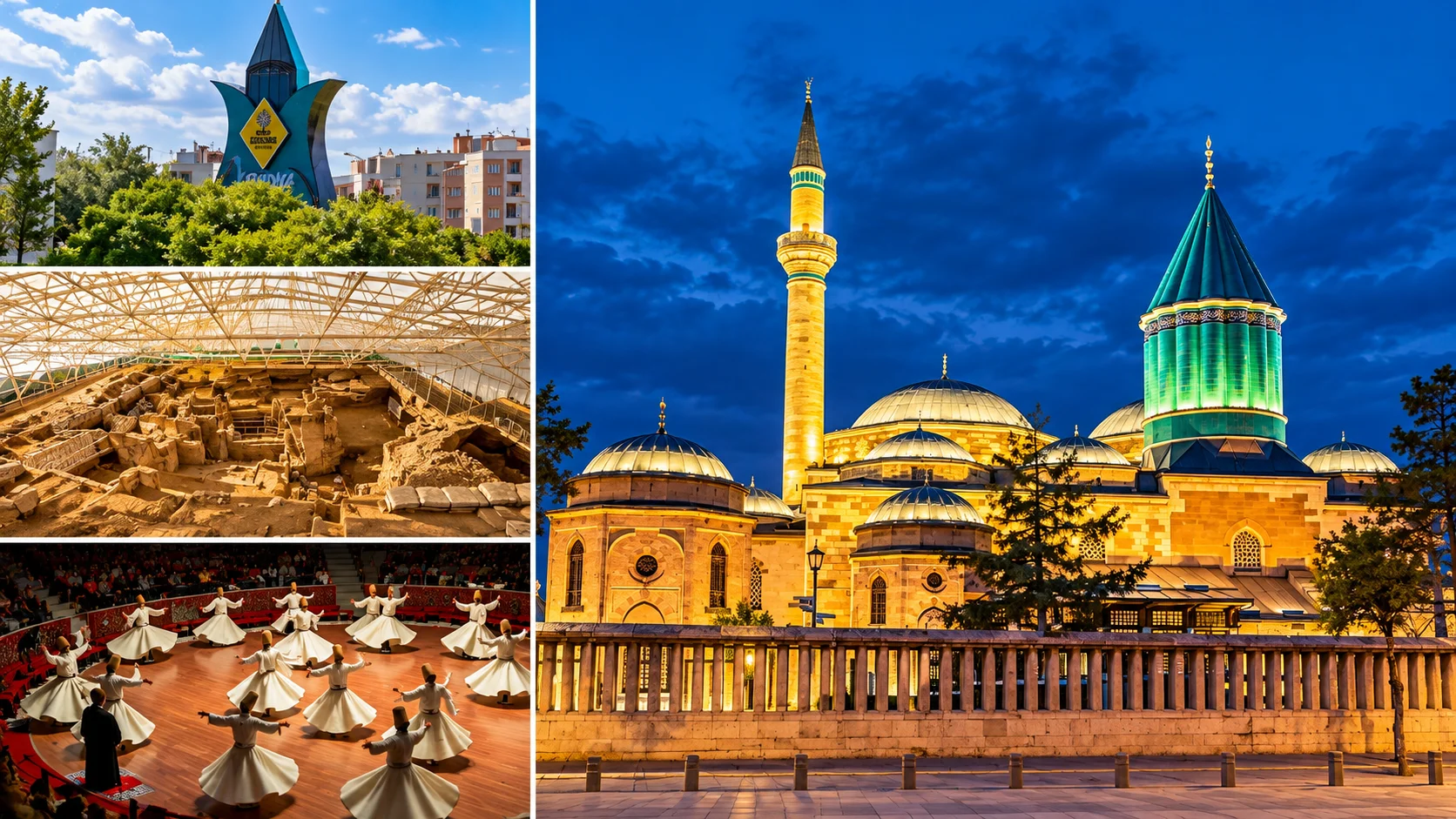
Mevlana, Alaeddin and the Seljuk Madrasas
The core route for a first visit. Most stops connect by tram and short walks.
Çatalhöyük and Eşrefoğlu Mosque
Both are on the World Heritage List. The Mevlevi Sema is on a different list, the Intangible Cultural Heritage list.
Beyşehir, Karapınar, Hadim, İvriz
Each one is a day of its own. Squeezing them together lowers the quality of the trip.
The sections below plan Konya area by area. If you are combining Konya with other cities, the Turkey travel guide gives general route ideas.
Konya City or Konya Province?
Konya is Turkey's largest province by area. A large share of the places people search for under "things to do in Konya" are not in the city but in districts across the province. Çatalhöyük is in Çumra district, Lake Beyşehir and the Eşrefoğlu Mosque are in Beyşehir, Lake Meke is in Karapınar, Yerköprü Waterfall is in Hadim, and the İvriz rock relief lies within Halkapınar district. None of them is "right next to the centre".
Thinking in three tiers makes planning easier:
- City and its edge (0-10 km): Mevlana Museum, Selimiye, Aziziye, Alaeddin Hill, Karatay, İnce Minare, Sahip Ata, Sille and the closer parts of Meram.
- Half a day to a day (45-60 km): Çatalhöyük and Kilistra (Gökyurt). Check distances on a map service, as they vary with the route.
- A full day (roughly 100-150 km): Beyşehir and its surroundings, Karapınar, Hadim and Yerköprü, Halkapınar and İvriz. These distances are estimates, so check drive times and road conditions before you go.
Konya was one of the capitals of the Anatolian Seljuk State, also called the Seljuk Sultanate of Rum. This was a separate state from the Great Seljuk Empire. The Anatolian Seljuks emerged in Anatolia in the late 11th century, and Konya's period of prominence as a capital runs mainly through the 12th and 13th centuries. "Seljuk" in this guide refers to that state.
Konya by Area: What Is Where, and How Long It Takes
| Area | Main Highlights | Best For | Suggested Time | Transport Note |
|---|---|---|---|---|
| Historic Centre (Karatay) | Mevlana Museum, Selimiye, Aziziye, the shrine of Shams, the bazaar area | First-timers, Mevlevi culture, Seljuk heritage | Half a day to 1 day | Mostly on foot. The tram reaches the Mevlana stop. |
| Alaeddin Hill | Alaeddin Mosque, the Seljuk sultans' tomb, the hill park, plus Karatay and İnce Minare | Seljuk architecture and city history | 2-3 hours | Alaeddin tram stop and walking. |
| Selçuklu (modern district) | Tropical Butterfly Garden, Science Centre, high-speed train station and airport | Families with children | Half a day | City transport or a car. |
| Sille | Aya Elenia Church, stone lanes, valley cliffs | Photography, Greek Orthodox heritage, a quiet walk | 2-3 hours | A short drive outside the centre. Car or city bus. |
| Meram and Kilistra | Meram's green belt; further out, the Kilistra rock settlement at Gökyurt | Walking, Byzantine remains | Meram 1-2 hours, Kilistra half a day | Kilistra needs a car and facilities are limited. |
| Çatalhöyük (Çumra) | Neolithic settlement, protective roofs, visitor area | Archaeology fans | Half a day | By car, about 45-50 km from the centre. |
| Beyşehir | Lake Beyşehir, Eşrefoğlu Mosque, Kubadabad Palace, Eflatunpınar | Lake scenery, Seljuk heritage, a Hittite monument | 1 full day | By car, about 90-100 km from the centre. |
| Karapınar | Meke Maar, volcanic and karst terrain, sinkhole area | Geology and landscape fans | 1 full day | A car is essential. Check the lake's water status first. |
| Hadim | Yerköprü Waterfall, the Göksu valley | Nature, waterfall, a cool break | 1 full day | By car, about 110 km from the centre. |
| Halkapınar and İvriz | İvriz rock relief, link with Ereğli | Late Hittite period and landscape | 1 full day | By car, commonly approached via Ereğli. |
Distances and times are approximate and depend on the route, weather and roadworks.
Quick Konya Picks by Interest
| Visitor Type | Suggested Stops |
|---|---|
| First-time visitor | Mevlana Museum, Aziziye and Selimiye, Alaeddin Hill, Karatay and İnce Minare |
| Seljuk heritage | Alaeddin Mosque and the sultans' tomb, Karatay, İnce Minare, Sahip Ata, Eşrefoğlu Mosque |
| Spiritual and cultural history | Mevlana Museum, the shrine of Shams, Şeb-i Arus season events |
| Archaeology | Çatalhöyük, Eflatunpınar, İvriz |
| Families | Tropical Butterfly Garden, Science Centre, Sille, selected parks |
| Nature | Yerköprü, the shores of Lake Beyşehir, Meke area (depending on water) |
| Lake scenery | Lake Beyşehir and the Kubadabad area |
| Historic neighbourhood | Sille |
| Food | Etli ekmek, oven-baked lamb, tirit, okra soup |
| Day trip | Çatalhöyük or Beyşehir, one far route only |
This table is not a ranking. It is meant to help you choose by interest.
The Mevlana Museum and Mevlevi Heritage
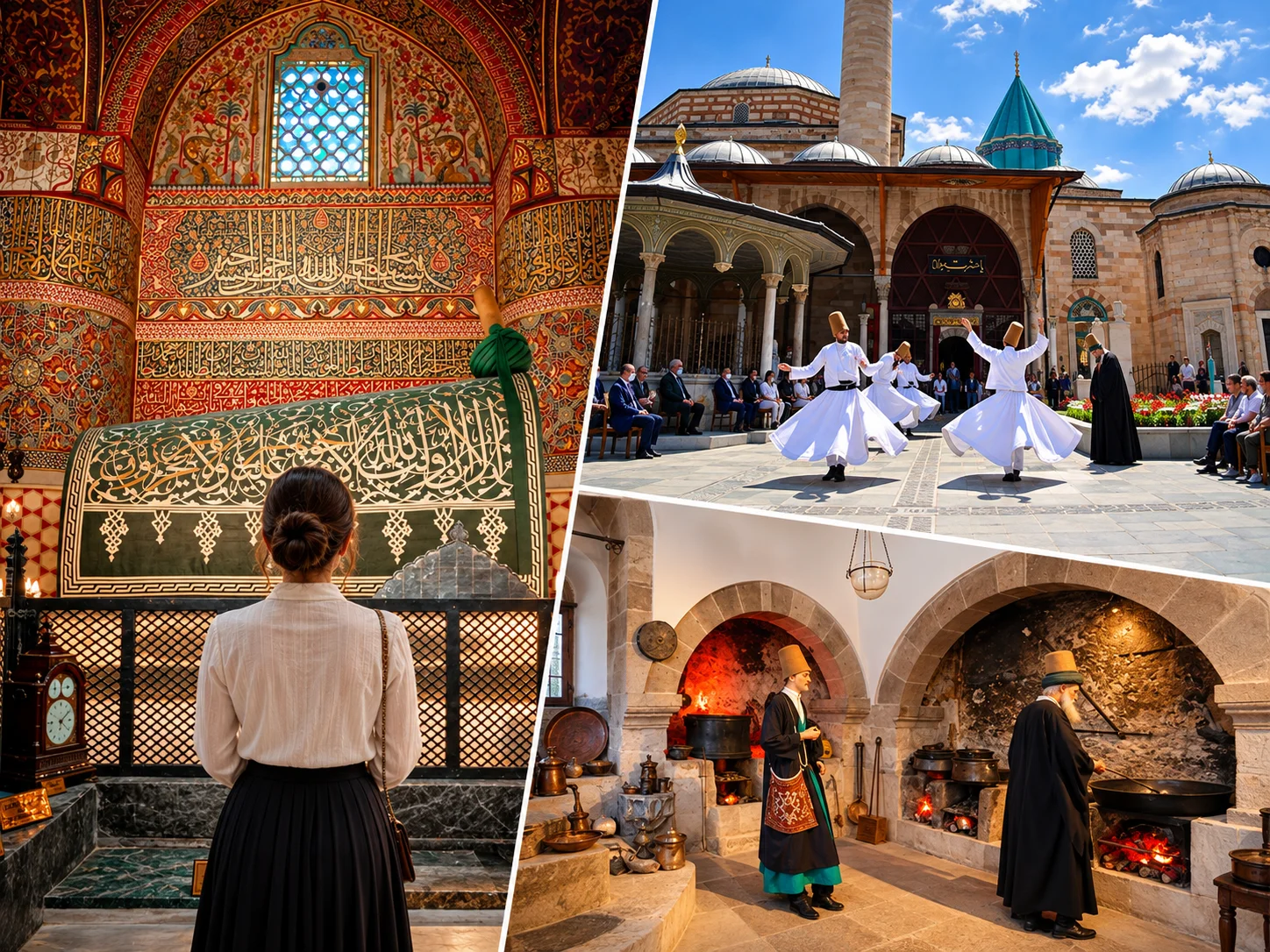
The Mevlana Museum is the heart of Konya and of Mevlevi culture. According to sources, the site was a rose garden belonging to a Seljuk palace, given by the sultan Alaeddin Keykubad I to Rumi's father, Bahaeddin Veled. Bahaeddin Veled died in 1231 and was buried here. Rumi was laid beside his father after his death in 1273. The Green Dome (Kubbe-i Hadra) was built in 1274 by the architect Tebrizli Bedreddin. Sources disagree on who financed it.
The lodge buildings took on their present form mostly under the Ottomans in the 16th century. The complex opened as a museum in 1926 under the name "Konya Asâr-ı Atîka Müzesi" and took the name Mevlana Museum in 1954. Inside you will find the sarcophagi of Rumi and his family, the semahane (Sema hall), dervish cells, manuscripts and objects from Mevlevi life.
Visitor Information: Hours, Fees, Museum Pass
We could not confirm the museum's current hours, admission fee or Museum Pass status from the Ministry of Culture and Tourism's own page while preparing this guide. Secondary sources say entry is free and disagree on closing times, so this page gives no fixed figure. Check the Mevlana Museum page on muze.gov.tr or ask the museum directly.
- Respect: The tomb is also a place of religious visit. Keep quiet, dress modestly and do not step in front of people praying.
- Crowds: Weekends, holidays and the December Şeb-i Arus season are busy. Early morning is calmer.
- Accessibility: Ask the museum about accessibility arrangements before you visit.
- Time: One to two hours for the interiors and courtyard is a reasonable estimate.
Who Was Rumi? A Short, Sourced Summary
Mevlana Celaleddin Rumi was born in 1207 in the Balkh region of Khorasan. After a long migration with his father, Bahaeddin Veled, the family settled in Anatolia and then in Konya in the first half of the 13th century. Rumi worked as a madrasa teacher in Konya and died in 1273. In the West he is called "Rumi" because he settled in Rum, the Anatolian lands.
The Mevlevi order that formed around him was organised after his death by his son, Sultan Veled. The foundational texts include the Mesnevi, the Divan-ı Kebir and his discourses, Fihi Ma Fih. Tradition holds that he met Shams-i Tebrizi in the 1240s. Reading popular tales as "according to Mevlevi sources" helps separate what is tradition from what is documented history.
The "philosopher of tolerance and love" label is widely used but does not describe his works well. In the Mesnevi and the Divan-ı Kebir, Rumi writes in a Sufi idiom about love, separation and turning toward God. For a visitor, it is enough to know that these texts are far more layered than modern tourist slogans suggest.
Şeb-i Arus and the Mevlevi Sema Ceremony
What Is Şeb-i Arus?
Şeb-i Arus means "wedding night" in Turkish. It is the name of the commemoration of Rumi's death on 17 December 1273, which the tradition regards as a reunion with God. Each December Konya hosts the "Commemoration of Hazrat Mevlana and Şeb-i Arus Ceremonies". According to the official Şeb-i Arus site, the 2025 calendar ran from 7 to 17 December, the main programme took place on 17 December in the Sema Hall of the Mevlana Cultural Centre, and tickets were sold online. Some events, such as conferences, Mesnevi talks, exhibitions and ney sessions, were free. We give no 2026 dates because we could not verify an official calendar. Follow the Ministry's Şeb-i Arus page and announcements from Konya Metropolitan Municipality.
The city becomes very crowded in December, so plan accommodation and train tickets early. In 2025 TCDD added extra high-speed services between Ankara and Konya, but you should not assume the same every year.
Is the Sema a "Dance Show"?
No. In the Mevlevi tradition, the Sema is an act of worship and a ceremony known as a mukabele. "Mevlevi Sema Ceremony" is a more accurate name than "whirling dervish show". UNESCO inscribed the Mevlevi Sema Ceremony on the Representative List of the Intangible Cultural Heritage of Humanity in 2008, after recognising it in 2005 as a Masterpiece. UNESCO's own text also notes that many Sema performances today are shortened and simplified for tourist audiences. This is intangible heritage, not a World Heritage site. "Şeb-i Arus is UNESCO World Heritage" is wrong.
Follow the organiser's guidance on photography, applause and movement if you attend a Sema. It is a ritual more than a performance.
Selimiye, Aziziye and the Bazaar Quarter
Selimiye Mosque
Right beside the Mevlana Museum, the Selimiye Mosque is an Ottoman mosque built by Prince Selim (later Selim II) during his time as governor of Konya, in the name of his father, Süleyman the Magnificent. Sources date the construction anywhere from 1566 to 1574. It takes half an hour alongside a museum visit.
Aziziye Mosque
The first Aziziye Mosque is attributed to Damat Mustafa Pasha around 1671-1676. It was badly damaged in the fire of 1867 and rebuilt in the 19th century in the reign of Sultan Abdülaziz, whose name it bears. Sources give the completion of the rebuilding anywhere from 1875 to 1891. Architecturally it is a Konya example of the eclectic Ottoman style of the 19th century, with layered ornament, slender twin minarets and Western-influenced details. This is a more accurate description than the generic "baroque and classical Ottoman blend".
The Bedesten and Historic Bazaar
The line between Aziziye and Mevlana makes a good walking corridor for traditional bazaar shopping. Historic buildings such as the Bedesten market and the Kapu Mosque are mentioned for this area. We could not verify their current restoration or opening status, so we give no detail about them. Handicrafts and souvenirs are varied enough for most visitors. Because we found no basis to recommend particular shops, we name no businesses.
The Shrine of Shams-i Tebrizi: Tomb or Station?
The tomb and zaviye of Shams-i Tebrizi in Konya has been revered by Mevlevis for centuries as "Makam-ı Şems", the station of Shams. According to the TDV Encyclopaedia of Islam, who built it and when is not known, because it has no inscription or endowment deed. Where Shams is actually buried is also uncertain. Tombs attributed to him are mentioned not only in Konya but also in Niğde, in Khoy and Tabriz in Iran, and in Multan in Pakistan.
For that reason this guide does not say "Shams is certainly buried here". A more accurate wording is the station and tomb attributed to Shams-i Tebrizi in the Konya tradition. Visitors find it a calm, devotional place, and it draws heavy visits during the Şeb-i Arus season. Ask local authorities about the current state of restoration and visiting.
Alaeddin Hill, Alaeddin Mosque and the Seljuk Sultans' Tomb
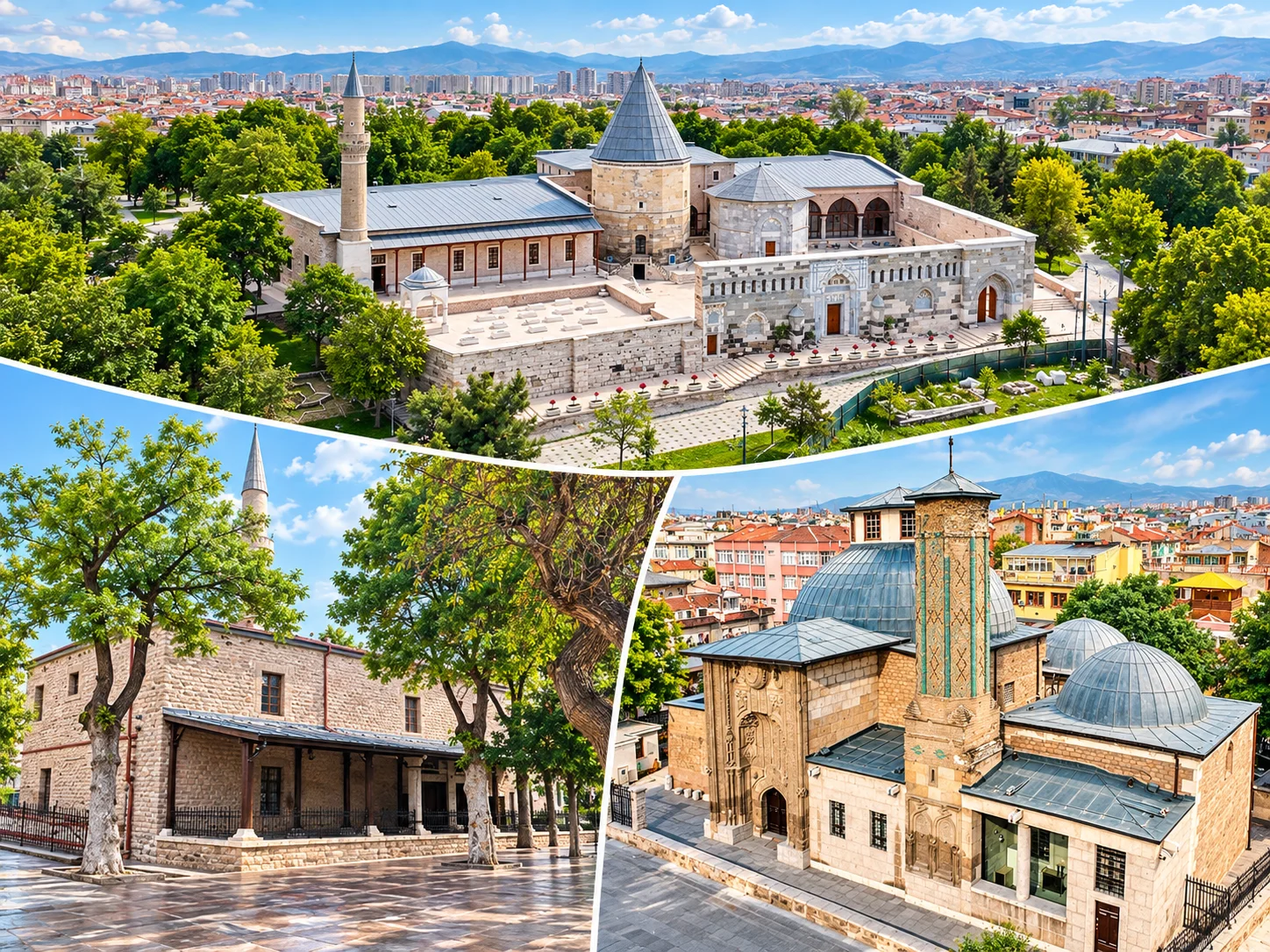
Alaeddin Hill is a tall mound in the middle of the city. It is the core of Konya's long settlement history and, in Anatolian Seljuk times, held a palace and a mosque complex. Today a public park and the Alaeddin Mosque stand on it. The park offers walking paths and city views, but the hill should be read as the historic heart of the city rather than just a scenic park.
Building phases of the Alaeddin Mosque. The mosque was not built in one go. According to the TDV Encyclopaedia of Islam, rebuilding with an enlarged plan began in the reign of Izzeddin Keykavus I (1210-1219) after demolishing an earlier building, and was completed under his brother Alaeddin Keykubad I (1219-1236). The architect is given as Mehmed b. Havlan of Damascus, and the works were overseen by Atabeg Ayaz. An inscription date of 617 (1220) on the main portal is read as the completion, and another inscription dated 616 (1219) as the start. The popular date of 1235 probably relates to the eastern extension. The old "built in the 12th century" line is therefore too simple. An older core is thought to exist, but the present look rests mainly on the early 13th-century rebuilding. It is also worth noting that the site has never had a serious archaeological investigation, so the sequence relies largely on inscriptions and architectural analysis.
The Sultans' Tomb
The Kılıçarslan tomb beside the mosque holds, according to sources, the sarcophagi of eight Seljuk sultans, among them Kılıç Arslan II and Alaeddin Keykubad I. Nearby is an unfinished octagonal marble mausoleum that Keykavus I began and left incomplete at his death in 1219. Whether the mosque and tombs are open to visitors, and their restoration status, change from time to time. Check Konya Museum Directorate or the regional Foundations Directorate before you go.
Karatay, İnce Minare, Sahip Ata and Sırçalı Madrasa
| Building | Date and Founder | Known For | Present Use and Caution |
|---|---|---|---|
| Karatay Madrasa | 1251-52, built for the vizier Celaleddin Karatay | A portal and a dome interior with black, white and turquoise tile work | Known as the Tile Works Museum. Sources give 1954 or 1955 as the year it opened as a museum. Tiles from the Kubadabad excavations are displayed here. |
| İnce Minareli Madrasa | Vizier Sahip Ata Fahreddin Ali. Sources give 1260-1265, 1264 or 1279. | The portal and the tile-covered minaret. The upper part of the minaret was destroyed by lightning in 1901. | Has served as the Stone and Wood Works Museum since 1956 and reopened on 9 July 2002 after restoration in 2000-2002. Confirm current use and hours on muze.gov.tr. |
| Sahip Ata Complex | 13th century, vizier Sahip Ata Fahreddin Ali | A complex of mosque, hanikah, tomb and bath. It deserves more attention than older guides gave it. | Current museum function and visiting conditions were not verified. Confirm before you go. |
| Sırçalı Madrasa | Mid-13th century. Sources give dates between 1242 and 1251. | Seljuk madrasa architecture | Known as a museum with a gravestone collection. Current use and access were not verified. |
Their closeness makes these buildings a dense route for one half day. Because dates come from inscriptions and academic reading, you may see different years in different guides. For hours and Museum Pass validity, use the official muze.gov.tr page.
Sille: Aya Elenia, Stone Lanes and Greek Orthodox Heritage
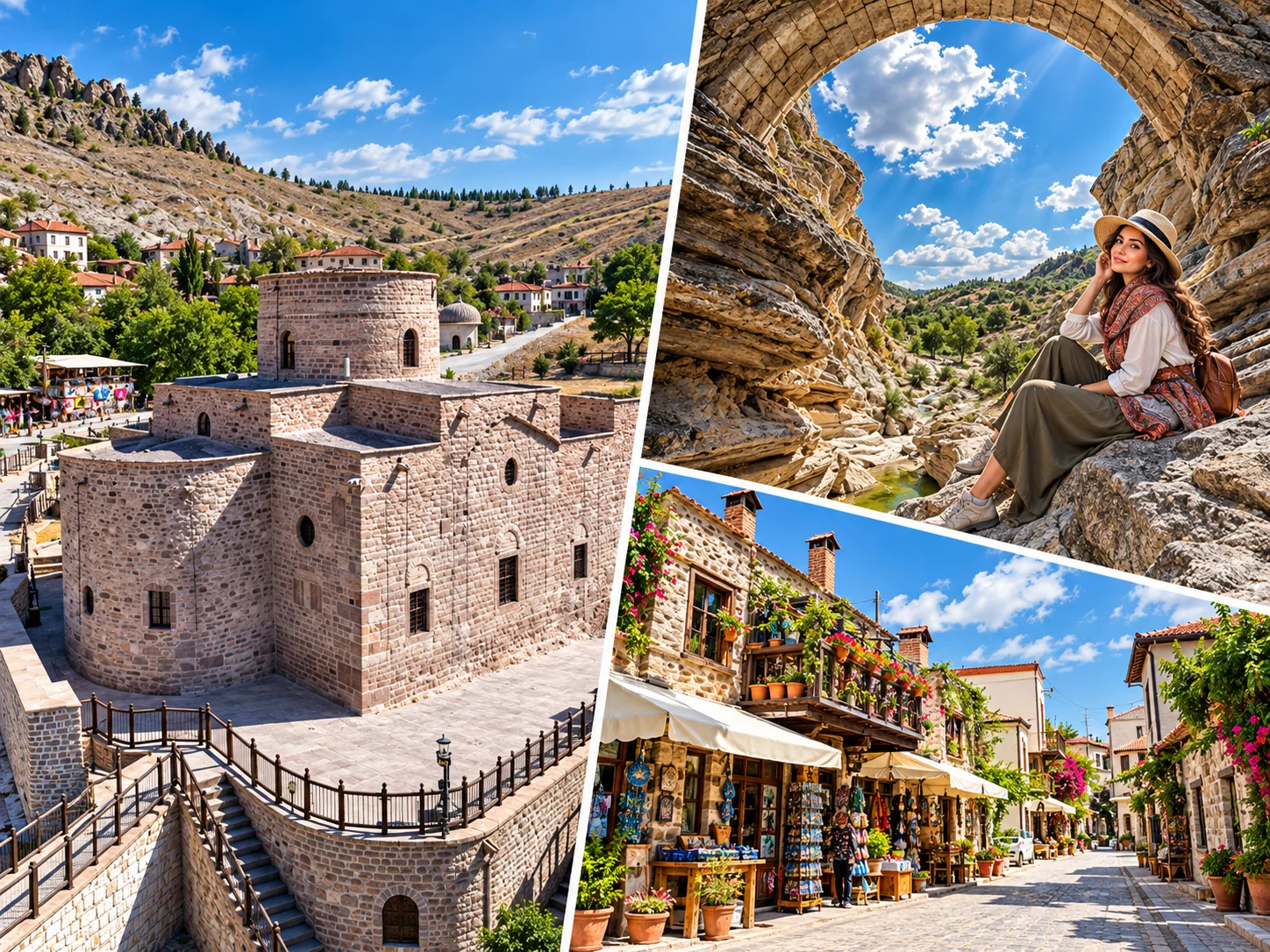
Sille is today a neighbourhood (mahalle) of Selçuklu district. Historical accounts call it a "village", but its present administrative status is a neighbourhood. It lies a short drive from the city centre and is known for its valley cliffs, stone houses and narrow lanes. Until the 1923 population exchange it was home to a Greek Orthodox (Karamanlı) community. That is why it is better seen as a neighbourhood with the heritage of a historic Christian community than as a romantic "village of ancient churches".
Aya Elenia Church. According to local and historical tradition the church was founded by Helena, mother of the Byzantine emperor Constantine, in the 4th century (around 327). This is a tradition, not an established archaeological fact. For the present building, Karamanlıca inscriptions mention Sultan Mahmud II and a repair in 1833. After a long restoration by Selçuklu Municipality the church opens as a museum. Its management reported about 172,000 visitors in 2024. Sources spell the name "Aya Elenia", "Aya Elena" and "Aya Eleni".
Sille also has small rock-cut chapels, a historic bridge and traditional houses. Ask locally which are open. Walk carefully on rock surfaces and valley edges.
Meram: Historic Gardens or Today's Park Belt?
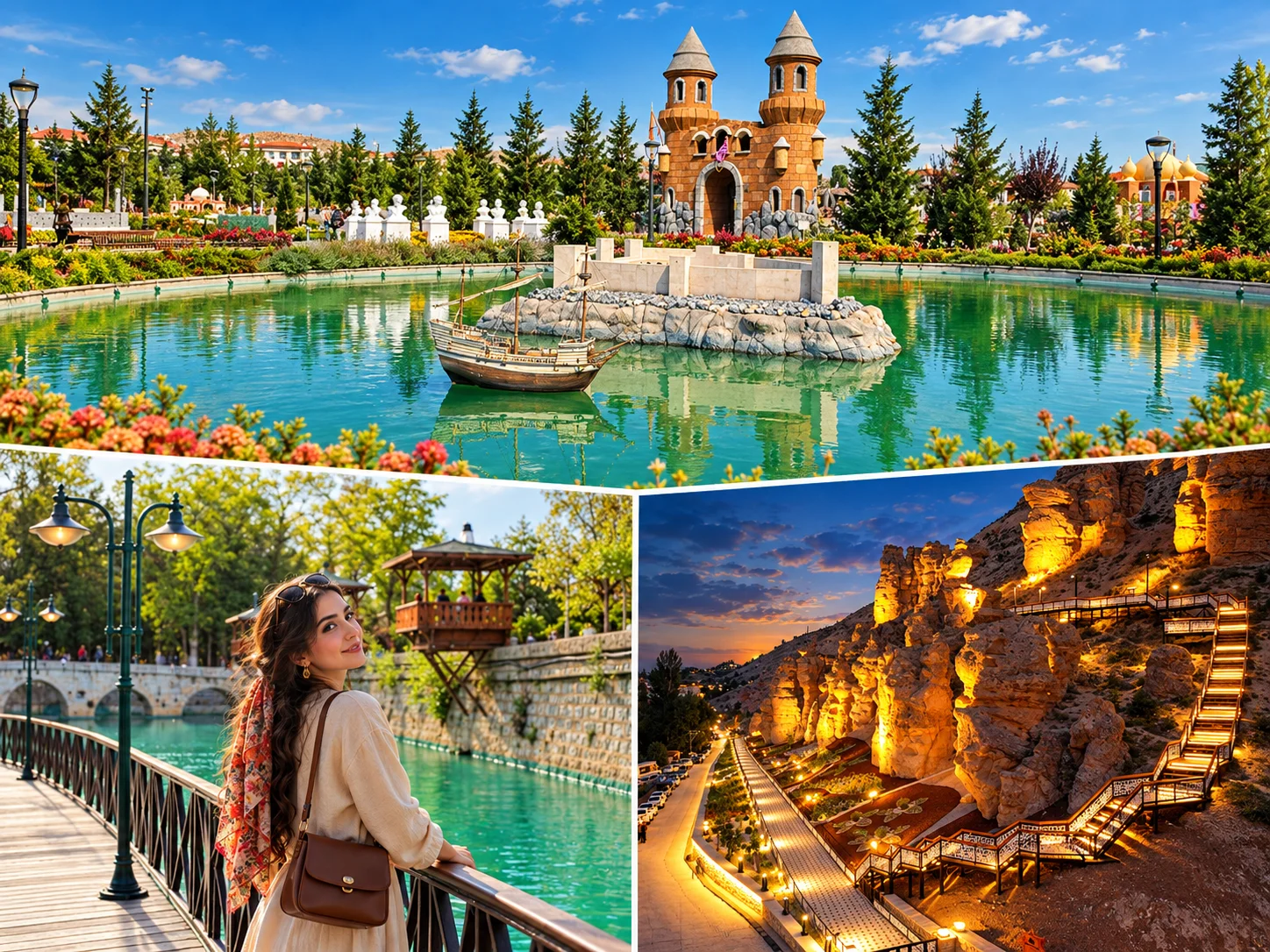
Meram is the green belt along the Meram stream on Konya's western side. Historically it was where Konya families kept summer vineyards and gardens. Today "Meram Bağları" does not mean a single vineyard or a single attraction. It recalls a historic summer district together with the present parks and the walking routes along the stream. If you arrive expecting a real "vineyard visit" you may be disappointed.
The Meram image on this page is a collage of municipal park and streamside scenes. We do not claim it shows historic garden houses. Because we could not verify individual parks, restaurants or facilities in Meram, we name no businesses. Plan Meram as a cool summer evening or a break after a day of city walking.
Kilistra (Gökyurt)
Kilistra is a Byzantine rock-cut settlement within Meram district, around Gökyurt village near Hatunsaray. It is roughly 45-55 km from Konya centre and lies on the historic King's Road. You will find churches, chapels, tombs, cisterns and monastic remains cut into the rock. Sources compare the landscape to Cappadocia. That is a comparison, and "Konya's Cappadocia" is not an official designation. The site has not been fully excavated and facilities are limited. We could not confirm current opening hours or entry conditions, so ask Konya Provincial Directorate of Culture and Tourism before you go. Take care on rock surfaces and valley edges.
If you want to see the real Cappadocia as part of the same trip, the Cappadocia tours page is a general starting point for Nevşehir.
Çatalhöyük: A Neolithic Settlement
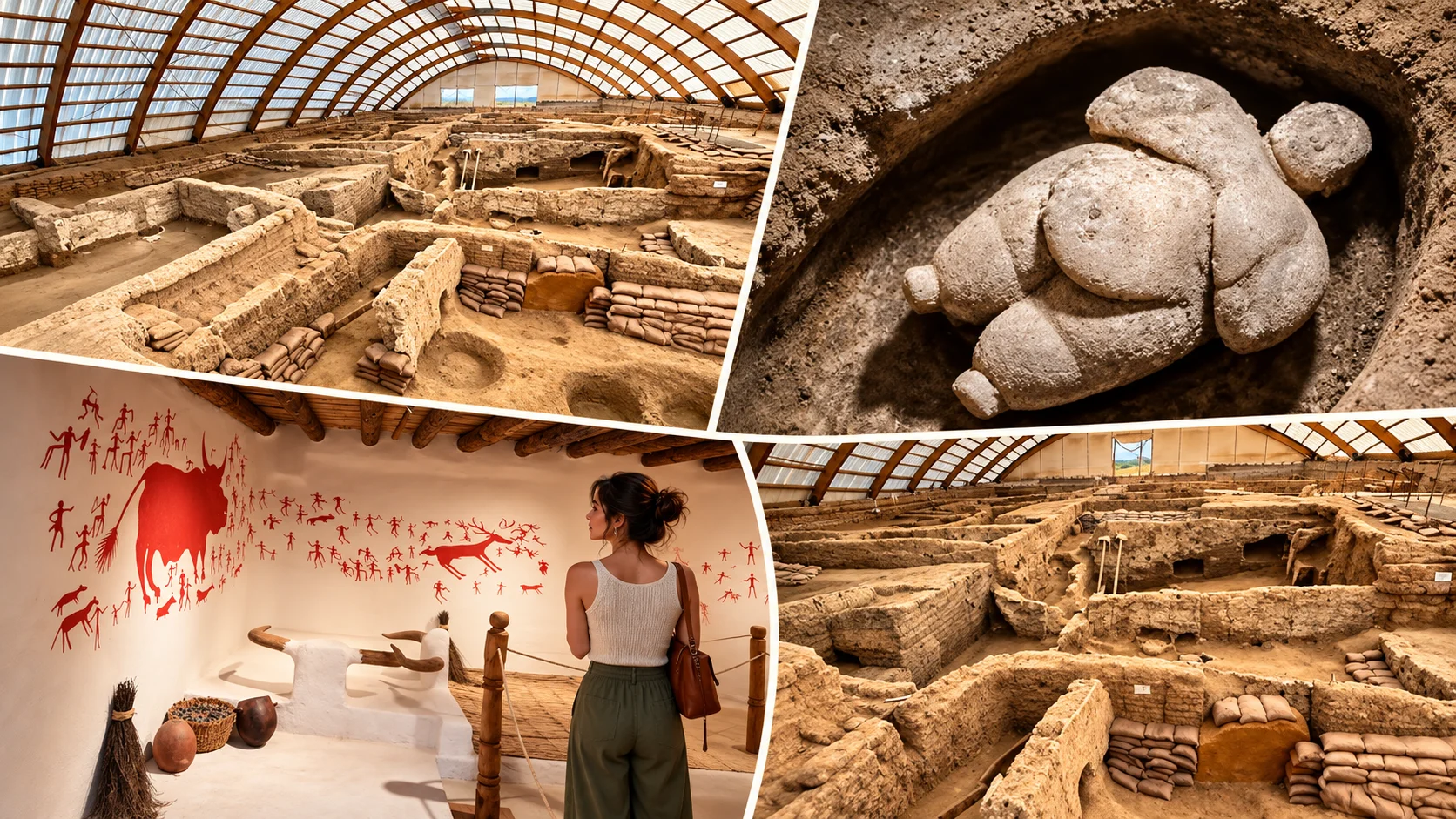
Çatalhöyük is a Neolithic settlement made up of two mounds, in Çumra district of Konya province near Küçükköy. It lies about 45-50 km from Konya centre and is reached by car. It was inscribed on UNESCO's World Heritage List in 2012 as the "Neolithic Site of Çatalhöyük". According to UNESCO documents the property covers about 37 hectares, with a buffer zone of about 110.74 hectares. It has an East Mound and a West Mound.
The East Mound holds 18 Neolithic levels and dates to roughly 7400-6200 BC. The West Mound continues the story in the Chalcolithic period, around 6200-5200 BC. These dates come from UNESCO's nomination material. That is why we dropped the older "continuous settlement from 7500 to 5600 BC" line: it hides the separate periods of the two mounds and differences in excavation data.
How the Settlement Worked
Houses were built of mudbrick, side by side. Many were entered through an opening in the roof, and the roofs are interpreted as shared living and movement space. Inside the houses are hearths, ovens, storage areas, plastered floors and wall paintings. The dead were often buried beneath house floors. Instead of the absolute claim that "there were no streets", it is more accurate to say that open spaces were limited and the architecture was dense and attached.
Excavations have produced bull-head reliefs, platforms with animal horns and painted walls. Wall paintings show hunting scenes, animals such as bulls and deer, and geometric motifs. The wall painting you see in our collage is a recreation, not a photograph of an excavated original.
Popular Claims and Scholarly Debate
| Popular Statement | A More Careful Reading |
|---|---|
| "The world's first city" | Çatalhöyük is one of the largest and densest known Neolithic settlements. Terms such as "proto-urban" or "large town" are debated. With no clear public buildings or central administration, the "first city" claim is not supported academically. |
| "An egalitarian society" | The lack of palaces or temple-like buildings led to this reading. It is now debated. Differences between houses in wealth, storage and burial practice are studied, so this should be read as a scholarly discussion rather than a settled verdict. |
| "A Mother Goddess cult" | Female figurines such as the "Seated Woman" supported this idea. In current research it is not accepted as an established belief system, and the meaning of the figurines is debated. |
| "Painted skull ritual" | Some skulls at Çatalhöyük were plastered and painted and treated separately, but their place in society, frequency and meaning should be checked against academic publications. |
| "Sheep and cattle were domesticated here" | Sheep and goats are present in early phases. Cattle domestication appears later in the sequence and is a debated chronology in zooarchaeology, so we give no absolute date. |
| "The place where farming began" | Çatalhöyük shows a farming and herding community but is not where agriculture began. |
Obsidian tools and materials brought from distant regions show that the settlement was linked into a wide exchange network. Volcanic areas of Central Anatolia are named among the obsidian sources. For a detailed list, see the publications of the excavation team.
The line "the nearest river today is the Euphrates" is wrong and has been removed. In the Neolithic, Çatalhöyük stood on the alluvial fan of the Çarşamba River, in a mosaic of wet and dry land fed by river branches. The exact Neolithic course of the Çarşamba is still under research. The modern landscape has been transformed by 20th-century irrigation and land reclamation, including the Beyşehir-Suğla canal system and the Apa Dam, completed in 1962.
Excavation and Visitor Information
The existence of Çatalhöyük was documented by James Mellaart in 1958, and detailed excavations followed in 1961-1965. A new campaign led by Ian Hodder ran from 1993 to 2018. According to sources, the excavation is now directed by Ali Umut Türkcan of Anadolu University, appointed in 2020. Reports say only a small share of the site has been excavated and that new neighbourhoods have been uncovered. As this can change, check the excavation team's channels for current work.
The site has open areas, protective roofs and visitor arrangements. Sources conflict on current opening hours, fees and Museum Pass status, and we found no official 2026 announcement. Before you go, check muze.gov.tr and Konya Provincial Directorate of Culture and Tourism. In summer the site is very exposed and hot, so bring a hat, water and sun protection. Some finds, such as the Seated Woman figurine, are in the Museum of Anatolian Civilisations in Ankara.
UNESCO Status in Konya: Do Not Mix the Programmes
UNESCO runs different programmes, and Konya has examples of three. The World Heritage List protects a place or structure. The Intangible Cultural Heritage list covers a tradition or practice. A Tentative List is only a country's list of sites it may nominate later and does not mean a place is World Heritage.
| Site or Tradition | UNESCO Status | Year | What It Covers |
|---|---|---|---|
| Neolithic Site of Çatalhöyük | World Heritage List | 2012 | East and West Mounds, a core area of about 37 ha and a buffer zone. |
| Eşrefoğlu Mosque (Beyşehir) | World Heritage List, one component of a serial property | 2023 | One of five components of "Wooden Hypostyle Mosques of Medieval Anatolia" (Afyon Great Mosque, Sivrihisar Great Mosque, Ankara Ahi Şerafettin Mosque, Beyşehir Eşrefoğlu Mosque, Kastamonu Mahmud Bey Mosque). Criteria (ii) and (iv). |
| Mevlevi Sema Ceremony | Representative List of Intangible Cultural Heritage | 2008 (Masterpiece proclamation in 2005) | A tradition and practice. The Mevlana Museum or the Şeb-i Arus events themselves are not World Heritage. |
| Eflatunpınar Hittite Water Monument | Tentative List | 2014 (per Turkish sources) | A site Turkey plans to nominate. It is not an inscribed World Heritage site. |
| İvriz Cultural Landscape | Tentative List | Year not verified | Appears on UNESCO's Tentative List as "The Cultural Landscape of Ivriz". Not an inscribed World Heritage site. |
We did not verify a separate UNESCO World Heritage entry for the Mevlana Museum, the Alaeddin Mosque or the Karatay Madrasa, so this guide does not present them as UNESCO sites.
Beyşehir: The Lake, Eşrefoğlu Mosque and Seljuk Heritage
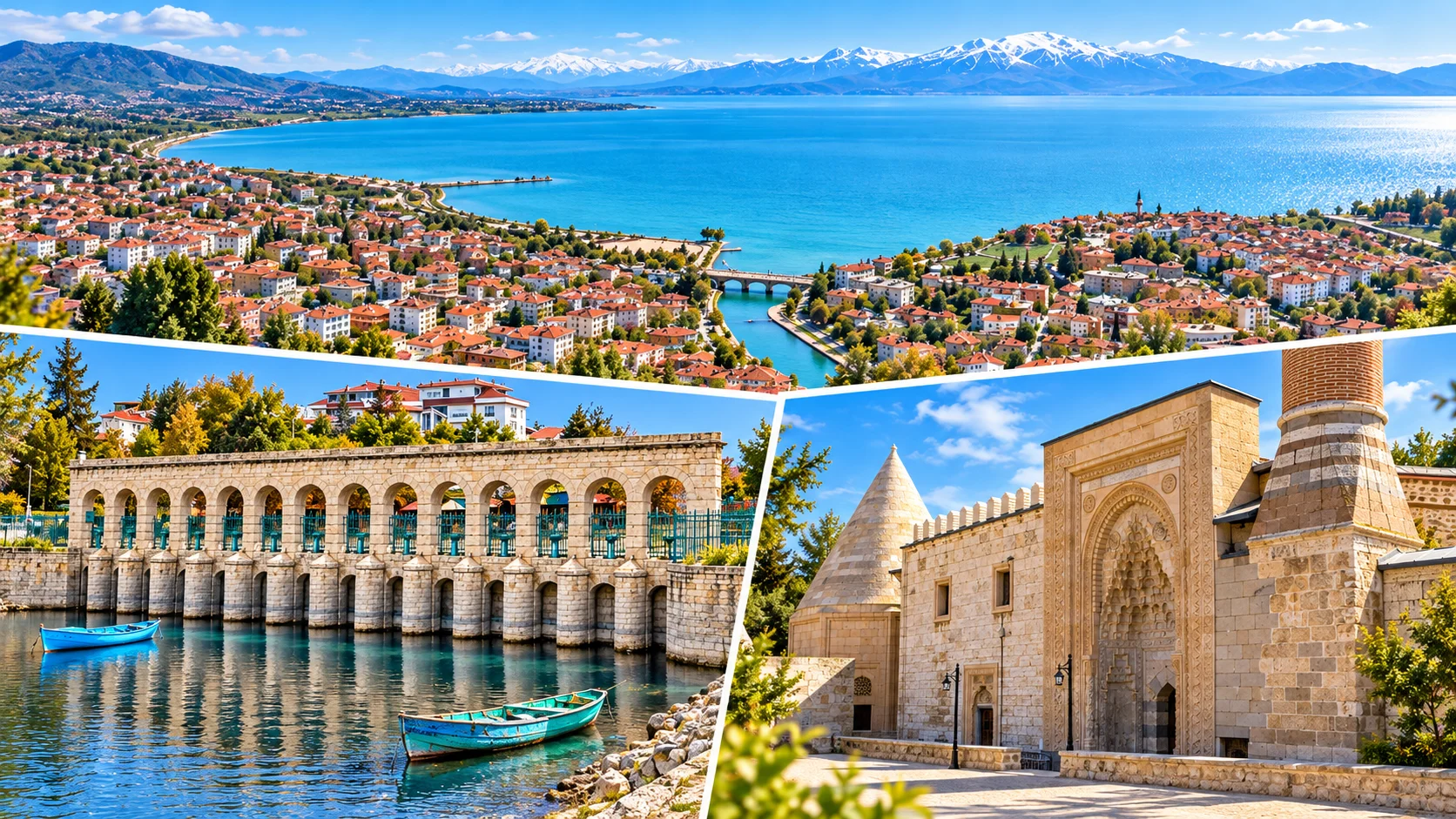
Beyşehir is a district on the shore of Lake Beyşehir, west of Konya and about 90-100 km from the centre. It is not just a lake view. It makes a one-day route that combines Seljuk and beylik-era heritage, a palace on the lakeshore and a Hittite monument. The route needs a car from Konya.
Lake Beyşehir
Sources describe Lake Beyşehir as Turkey's largest freshwater lake, with an area of about 651 km² and an elevation of roughly 1,116 m. It lies within Lake Beyşehir National Park, declared in 1993. The park spans Konya and Isparta and covers about 86,855 hectares. The old claim that it is "Turkey's largest national park" has not been current since 2013.
In dry years, water is reported to be transferred from the Derebucak Dam by DSİ to protect the lake's level. The water level varies from year to year and season to season. For that reason it is better to treat the shoreline not as an ever-idyllic "full lake" but as a living ecosystem shaped by drought and water management.
Eşrefoğlu Mosque
The Eşrefoğlu Mosque was built between 1296 and 1299 by Süleyman Bey of the Eşrefoğulları beylik. It is a hypostyle mosque with a wooden structure. The columns that carry the timber ceiling have capitals that are either wooden muqarnas or reused marble. UNESCO links this type of mosque to the Mongol invasions of the 13th century and to craftsmen arriving from Central Asia. The tiled mihrab, the crown portal and the central space also stand out.
UNESCO status. The mosque is part of the serial property "Wooden Hypostyle Mosques of Medieval Anatolia", inscribed on the World Heritage List in 2023 at the 45th session of the World Heritage Committee in Riyadh (criteria ii and iv). This does not mean that all of Beyşehir or all of Konya is a UNESCO site. Only this building is a component of the serial property.
Kubadabad Palace
Kubadabad is the summer palace complex that Alaeddin Keykubad I had built in 1236 on the south-western shore of Lake Beyşehir. It is about 100 km from Konya. Excavations have continued since 1980. The tile revetments, stucco pieces and ceramics found there are largely displayed in the Karatay Madrasa Tile Works Museum in Konya. To see the tiles, you therefore need to visit the museum in the city. We could not confirm current hours at the open-air site, so ask Beyşehir District Governorate or the Provincial Directorate of Culture and Tourism.
Eflatunpınar Hittite Water Monument
Eflatunpınar is a Hittite monument with reliefs standing in front of a spring, near the Sadıkhacı area of Beyşehir. Sources date it to the 13th century BC, the Late Bronze Age. Some link it to Tudhaliya III or Tudhaliya IV, but that attribution is not certain. In the Tentative List entry it is described as a Hittite sacred water structure with a relief wall. That does not make it a World Heritage site. In summer heat it is a short outdoor stop, so confirm visiting conditions on the spot.
If you plan a Beyşehir day, a sensible order is the Eşrefoğlu Mosque, the town centre, the lakeshore and then either Kubadabad or Eflatunpınar. Adding both lengthens the day and the driving time.
Karapınar: Meke Maar, Sinkholes and Volcanic Terrain
Karapınar lies south-east of Konya, around 100 km from the centre (confirm on a map service), and is known for volcanic maars, dunes and collapse sinkholes. It is a geological route rather than a classic history trip.
Lake Meke and Meke Maar
Lake Meke is a lake that formed inside a maar, a volcanic explosion crater, with a small volcanic cone in its centre, and it is nicknamed the "evil-eye bead of the world". According to sources, the area was declared a first-degree natural site in 1989 and a nature monument in 1998, and it is listed as Meke Maar on the Ramsar list (Ramsar no. 1618, 2005). The Kızören sinkhole is also named among Turkey's Ramsar sites.
Current state: Lake Meke has largely dried up because of drought, climate change and groundwater use. A June 2026 report said the lake remained without water despite that year's rainfall. Konya Metropolitan Municipality plans to send about 7,000 cubic metres of treated water a day to the lake. Do not expect the turquoise "eye" seen in older photographs. Reports say there are no food or drink facilities around the site, so bring water and snacks and wear non-slip shoes.
Sinkholes (Obruks) and Safety
The obruks of the plain south-east of Konya are deep pits formed when karst ground collapses. The Kızören sinkhole is one of the best known. The edges of sinkholes can be unstable. Do not approach the rim, do not cross railings or warning signs, and do not leave children unattended. We could not verify current visiting conditions or geopark arrangements. Ask Karapınar District Governorate or the municipality before you go. Treat additional maar sites such as Acıgöl only with local knowledge and from safe access points.
Yerköprü Waterfall (Hadim) and the İvriz Rock Relief (Halkapınar)
Yerköprü Waterfall
Yerköprü Waterfall is in Hadim district, on the Göksu River, around Habiller village. It is about 110 km from Konya centre and 20-30 km from Hadim town (sources differ). The name comes from the natural passage formed when the river dissolved the loose ground and left a travertine structure like a bridge. Sources give the fall's height as 20 to 25 m, and we found no official measurement. The site has a walking trail, a suspension bridge and picnic areas. One news report warned of cracks about 50 m long in the area, so stay behind the railings.
We do not recommend camping or canyoning without knowing current rules. Summer can be a cool break, but spring and early summer bring a higher water flow. Check road and access conditions in advance if you travel in winter.
İvriz Rock Relief
The İvriz rock relief lies within Halkapınar district, at the source of the İvriz stream, about 17 km from the centre of Ereğli. The older "in Ereğli" description is therefore incomplete. Visitors usually come via Ereğli, but the administrative location is Halkapınar.
The relief, from the Late Hittite period (8th century BC), shows King Warpalawas and the storm god Tarhunza and carries a Luwian hieroglyphic inscription. Tarhunza holds ears of grain and a bunch of grapes, an image of fertility. The king's dates are given slightly differently, as 740-705 or 730-710 BC. The site appears on UNESCO's Tentative List as "The Cultural Landscape of Ivriz" but is not an inscribed World Heritage site. Some reliefs and stelae from the area are kept in the Ereğli Museum. We could not build a verified list of other places to visit in Ereğli, and we removed generic lines about fruit orchards.
Ilgın, Tuz Gölü and Tulip Fields: Three Items from the Old Guide
- Ilgın thermal springs: The Konya provincial tourism note lists Ilgın Thermal City and the İsmil springs under thermal tourism. This page makes no health or treatment claims. Check official facility sources for current status.
- Salt Lake (Tuz Gölü): It is not specific to Konya. It spreads across the provinces of Ankara, Konya and Aksaray. We do not recommend it as a stand-alone day trip from Konya centre. Check distance and access on a current map.
- Tulip fields: The old guide described tulip fields as a permanent nature stop. We could not confirm a publicly accessible tulip-viewing area in Konya. Tulip growing is seasonal and mostly on private farmland. Do not enter private fields, and check official announcements if an event or festival is held.
Konya with Children: Butterfly Garden, Science Centre and Sille
Tropical Butterfly Garden. It is in Selçuklu district, inside Butterfly Valley Park, and opened on 4 July 2015. According to Habertürk, it has a usable area of 7,600 m² and a walking area of 3,500 m². The press repeats the line "Europe's largest butterfly flight area", but we could not verify the metric behind it with an independent source. Species and butterfly counts also vary between sources at 40, 45 or 60 species. For that reason we do not use the superlative. For current hours and prices, see the municipality's official page.
Konya Science Centre. The centre, set up with TÜBİTAK support, is reported to have themed exhibitions, a planetarium, an observation tower and laboratories. We could not verify hours or fees. Some older sources say it is closed on Mondays, so check before you visit.
Konya Panorama Museum. Described as presenting Rumi's life and 13th-century Konya through panoramic paintings, sculpture and models. We could not verify its current name or whether it is open, so confirm before you go.
Modern parks such as Kültürpark, Ecdat Park and the Kyoto Japanese Park are fine for a break in the city. For a first-time visitor they do not carry the same weight as the historic sites and are not described one by one here.
When to Visit Konya
| Season | Advantage | Watch For |
|---|---|---|
| Spring | Comfortable temperatures for the city, Sille and nature routes | Rainfall is variable. |
| Summer | Far archaeology and nature routes, long daylight | Exposed sites such as Çatalhöyük and Eflatunpınar get very hot. |
| Autumn | Ideal for the city, the madrasas and Beyşehir | Evenings can turn cool. |
| Winter | Mevlana Museum and the Şeb-i Arus period | Crowds and tight accommodation in December. Snow can disrupt far routes. |
Water levels and road conditions at Beyşehir and Yerköprü depend on the season. For Meke, check the water status rather than the season.
What to Eat in Konya: Verified Local Dishes
The old guide listed cezerye, künefe and generic lokma as "famous Konya" items even though they are not specific to the city. This page highlights dishes that are tied to the Konya table and backed by sources. Cezerye and künefe are available in Konya but belong to other regions' repertoires, so they are not presented as local signatures.
| Dish | What It Is | Note |
|---|---|---|
| Etli ekmek | A thinly stretched dough topped with knife-chopped meat, onion, tomato and pepper and baked in an oven. Often a long, boat-like flatbread. | Registered with TÜRKPATENT as the "Konya Etli Ekmeği" indication of origin in 2017 (registration no. 214). Sources mention a debate between Sivas and Konya over its origin. It is spelled "etli ekmek" or "etliekmek". |
| Fırın kebabı (oven-baked lamb) | Whole cuts of meat cooked for a long time in an oven, a traditional kebab. | We could not verify a geographical indication, so we do not describe it as one. |
| Tirit | Bread soaked in meat broth, topped with minced meat, garlic yoghurt and sizzling butter. | Preparation varies by family and restaurant. There is no single absolute rule on beef versus lamb. |
| Bamya çorbası (okra soup) | A soup of small dried okra, meat and lemon. | Reported to be served after dessert at Konya weddings and feasts as an appetiser for the next course. |
| Düğün pilavı (wedding rice) | A meat and rice dish of Konya wedding tables. | "Konya Etli Düğün Pilavı" was registered as an indication of origin in 2011 (no. 142), and "Konya Etli Yaprak Sarması" in 2021 (no. 859). |
| Arabaşı, çebiç | Traditional dishes associated with feasts and weddings. | We found no source for detailed recipes or origins, so we do not define them here. |
| Topalak, yağ somunu, sac arası | Dishes known to be searched for in Konya. | We could not verify definitions, recipes or GI status, so we did not give them separate sections. |
Be careful with the "Seljuk cuisine" label. A modern themed restaurant menu is not the same as documented medieval recipes. We did not repeat claims such as "from the Seljuk palace kitchen to today" without a source.
Restaurants. Because we could not verify the names in the old guide as current and we do not rank restaurants, we name no businesses. For etli ekmek and oven-baked lamb, people usually look to long-established eateries around the bazaar, and for tirit and local soups to local, long-running halls. Check current reviews and opening hours before you go. Celebrity endorsements were not used because they are not a lasting criterion in a guide like this.
Where to Stay in Konya
Choose accommodation by area rather than by ranking. We give no hotel scores or prices, because these should be read live from a booking site. Check a hotel's current name, brand and location on its official website.
| Area | Advantage | Watch For |
|---|---|---|
| Around Mevlana and Karatay | On foot to the museum, bazaar and mosques | Busy at weekends and during Şeb-i Arus. |
| Alaeddin and city centre | Close to the tram and Alaeddin Hill | Traffic and noise are possible. |
| Selçuklu | Modern hotels, the high-speed train station, the airport road and family venues | You reach the historic centre by car or tram. |
| Meram | Green and quiet surroundings | Accommodation options may be limited, so verify. |
Among hotels named in 2026 booking listings are Hich Hotel (described as near the Mevlana Museum), Dedeman Konya, Hilton Garden Inn, Novotel, Ramada Plaza and Grand Millennium. This is not a recommendation. We did not check their official sites one by one in this work, so verify location and brand yourself. Names from the old guide such as Araf Hotel, Bayır Diamond and Grand Hotel were not carried over because we could not verify them as current. The hotel collage supplied for this page was not used because we could not be sure it matched current property names.
How to Get to Konya and Get Around
High-Speed Train (YHT)
There are direct high-speed services between Ankara and Konya and between Istanbul and Konya. According to sources, Ankara-Konya takes about 1 hour 45 minutes to 1 hour 57 minutes, with about 7 services a day. On the Istanbul (Söğütlüçeşme)-Konya line, journey times of about 4 hours 40 minutes to 5 hours 55 minutes are reported, with about 5 services a day. These times and counts change with the timetable, so use TCDD Taşımacılık's official site for current departures and fares. Konya's high-speed station is in Selçuklu district. The Konya-Ereğli line is reported to have slipped to the end of 2026.
Konya Airport
Konya Airport (DHMİ) is in Selçuklu district, in the Büyükkayacık neighbourhood, about 16-18 km from the city centre. Known options are the Havaş shuttle, taxis, private transfers and car rental. The shuttle route is reported to call at stops such as Alaeddin and Zafer Square. Sources are inconsistent on fares and times, so confirm with Havaş. We could not verify any tram link to the airport.
Tram and Getting Around the City
The Alaeddin-Adliye tram line passes stops including Alaeddin, Hükümet, Mevlana and the Mevlana Cultural Centre. A common way to reach Mevlana from the centre is to board at Alaeddin and get off at Mevlana. You can change between the two lines at Zafer and Alaeddin. ElKart and contactless bank cards are reported to work on public transport. Line hours and coverage can change, so check with Konya Metropolitan Municipality.
Far Routes
Public transport is not practical for Çatalhöyük, Beyşehir, Kubadabad, Karapınar, Hadim or İvriz. For these, think of your own car, a rental, an organised tour or private transport. Do not combine several far routes in one day.
1, 2, 3 and 4 Day Konya Itineraries
1 Day in Konya: The Historic Centre
| Order | Stop | Note |
|---|---|---|
| 1 | Mevlana Museum | Early morning, before the crowds. |
| 2 | Selimiye Mosque | Right next to the museum. |
| 3 | Aziziye Mosque and the bazaar area | Lunch of etli ekmek or oven-baked lamb. |
| 4 | Shrine of Shams | A calm, short visit. |
| 5 | Alaeddin Hill and Alaeddin Mosque | Check in advance whether the mosque and tomb can be visited. |
| 6 | Karatay and İnce Minare | Swap the order to fit museum hours. |
2 Days in Konya
| Day | Plan |
|---|---|
| Day 1 | The historic centre route above. |
| Day 2 | Sille in the morning and Meram in the afternoon. With children, the Butterfly Garden or Science Centre. For archaeology, Çatalhöyük is the alternative. |
3 Days in Konya
| Day | Plan |
|---|---|
| Day 1 | Mevlana, Selimiye, Aziziye, Shams. |
| Day 2 | Alaeddin Hill, Karatay, İnce Minare, Sille. |
| Day 3 | Half a day at Çatalhöyük. In the afternoon, Meram or a family stop in the city. |
4 Days in Konya
| Day | Plan |
|---|---|
| Days 1-2 | The first two days of the 3-day plan. |
| Day 3 | Çatalhöyük (half a day) and Meram. |
| Day 4 | Choose one major far route: Beyşehir (Eşrefoğlu, the lake and either Kubadabad or Eflatunpınar), or Karapınar, or Hadim and Yerköprü, or Halkapınar and İvriz. |
Do not squeeze Beyşehir, Karapınar, Hadim and İvriz into one day. Distances, drive times and seasonal conditions make each a day of its own.
A Short Video Look at Konya
The video below gives a general overview of Konya's sights. The information on this page has been reviewed and updated. Hours, prices and business details in the video may be out of date.
If you are making Konya part of a longer route, the Cappadocia tours page is a general starting point for the next stage in central Turkey.
A Short Transport Note for Far Routes
Cab Istanbul is an independent private transport provider. Our drivers act as chauffeurs and are not licensed tourist guides. We have no official partnership with the Mevlana Museum, municipalities, the Çatalhöyük excavation team or hotels, and this page does not speak on their behalf. For intercity travel within Turkey, see our intercity car with driver service and our chauffeur service page. We do not claim to run a local service in Konya. Please verify transport details with official sources first when you plan your trip.
Frequently Asked Questions About Visiting Konya
What are the must-see places in Konya?
The Mevlana Museum, Alaeddin Hill and Mosque, the Karatay and İnce Minare madrasas, the Aziziye and Selimiye mosques and Sille make the core list for a first visit. If you have time, add Çatalhöyük, Beyşehir and the Eşrefoğlu Mosque.
How many days do you need in Konya?
One day covers the historic centre. Two days add Sille and Meram, three add Çatalhöyük, and a fourth day lets you add one far route such as Beyşehir, Karapınar, Hadim or İvriz.
Can you walk around central Konya?
The Mevlana, Selimiye, Aziziye and bazaar area is walkable. Alaeddin Hill, Karatay and İnce Minare connect by tram and short walks. For Sille, Meram and the far routes you need a car or public transport.
Is the Mevlana Museum free, and what are its hours?
Secondary sources say entry is free and they disagree on hours. Because we could not confirm this on the official page, we give no firm figures. Check muze.gov.tr or ask the museum.
What is Şeb-i Arus?
It is the name of the commemoration of Rumi's death on 17 December 1273, which the tradition regards as a reunion with God, literally a wedding night. Commemoration ceremonies are held in Konya each December.
When are the Şeb-i Arus ceremonies held?
Every December. According to the official calendar the 2025 programme ran from 7 to 17 December. For 2026 dates, follow the official Şeb-i Arus page and Konya Metropolitan Municipality announcements.
Is the Sema a dance show?
No. In the Mevlevi tradition the Sema is an act of worship and a ceremony, so "Mevlevi Sema Ceremony" is the more accurate name. UNESCO inscribed it on the Intangible Cultural Heritage list in 2008.
Is Shams-i Tebrizi really buried in Konya?
It is not known for certain. The Konya shrine has been revered by Mevlevis for centuries as the station of Shams, and tombs attributed to him are also mentioned in Niğde, Khoy, Tabriz and Multan.
Which Seljuk sultan built the Alaeddin Mosque?
According to the TDV Encyclopaedia of Islam, rebuilding began under Izzeddin Keykavus I and was completed under Alaeddin Keykubad I. A portal inscription gives 1220. An older core is also thought to exist.
Which Seljuk sultans are buried at the Alaeddin Mosque?
The Kılıçarslan tomb beside the mosque holds, according to sources, the sarcophagi of eight sultans, among them Kılıç Arslan II and Alaeddin Keykubad I. The unfinished octagonal tomb was begun by Keykavus I.
Is the İnce Minareli Madrasa open as a museum in 2026?
It has served as the Stone and Wood Works Museum since 1956 and reopened in 2002 after restoration. Confirm its current use and hours on muze.gov.tr.
When was the Karatay Madrasa built?
It dates to 1251-52 and was built for the vizier Celaleddin Karatay. It is known today as the Tile Works Museum. Sources give 1954 or 1955 for its opening as a museum.
Is Sille a village or a neighbourhood of Konya?
Sille is today a neighbourhood of Selçuklu district. Historical accounts call it a village. Until the 1923 population exchange it was home to a Greek Orthodox (Karamanlı) community.
Did Helena really build the Aya Elenia Church?
According to local and historical tradition, Helena, mother of Emperor Constantine, founded it in the 4th century. This is a tradition, not an established archaeological fact. Karamanlıca inscriptions in the present building mention Mahmud II and a repair in 1833.
Can you visit the Meram Gardens today?
Meram was historically a green belt of summer vineyards and gardens. Today the phrase recalls parks and streamside routes rather than a single vineyard. Ask locally which historic garden houses are open.
Where is Kilistra?
It is a Byzantine rock-cut settlement within Meram district, around Gökyurt village near Hatunsaray, about 45-55 km from Konya centre. A car is needed.
Is Çatalhöyük the world's first city?
No, that is not an established claim. It is one of the largest known Neolithic settlements. Terms such as proto-urban or large settlement are debated, and with no clear public buildings or central administration the "first city" claim is not supported.
Is Çatalhöyük a UNESCO World Heritage site?
Yes. The Neolithic Site of Çatalhöyük was inscribed on the World Heritage List in 2012. The property covers about 37 hectares and includes the East and West mounds.
Which district is Çatalhöyük in, and how far is it from Konya?
It lies in Çumra district near Küçükköy, about 45-50 km from Konya centre. Check the distance on a map service.
Did people at Çatalhöyük really enter their houses through the roof?
Many buildings are interpreted as entered through a roof opening, with roofs used as shared space. Rather than saying there were no streets at all, it is safer to say open spaces were limited and the architecture was dense and attached.
Was Çatalhöyük an egalitarian society?
That reading is debated. The lack of palace or temple-like buildings led to it, but current research also looks for differences between houses, so it is best seen as a scholarly discussion, not a verdict.
Are the female figures at Çatalhöyük a mother goddess?
That interpretation was once widespread, but it is not accepted as an established belief system in current research. The meaning of the figurines is debated among scholars.
Is Lake Beyşehir the largest freshwater lake in Turkey?
Sources describe it as Turkey's largest freshwater lake, with an area of about 651 km². Lake Beyşehir National Park was declared in 1993.
Is the Eşrefoğlu Mosque a UNESCO World Heritage site?
Yes, as a component of a serial property. It is one of five mosques in "Wooden Hypostyle Mosques of Medieval Anatolia", inscribed in 2023. Beyşehir as a whole and Konya as a whole are not UNESCO sites.
Can you visit Kubadabad Palace?
It is an excavation site where work has continued since 1980. We could not confirm current visiting hours, so ask Beyşehir District Governorate or the provincial directorate. Most of its tiles are displayed in the Karatay Madrasa in Konya.
What is Eflatunpınar?
A Late Bronze Age Hittite monument with reliefs standing in front of a spring in the Beyşehir area. It is on UNESCO's Tentative List, which does not make it a World Heritage site.
Is Lake Meke still full of water in 2026?
No. A June 2026 report said Lake Meke remained without water despite that year's rainfall. A plan exists to send treated water to it, but we could not verify that it has been completed.
Is Lake Meke a Ramsar site?
According to sources, yes. Meke Maar is listed on the Ramsar list as no. 1618 (2005), and the Kızören sinkhole is also named among Turkey's Ramsar sites. Check the Ramsar site for the official record.
Which district is Yerköprü Waterfall in?
Hadim district, on the Göksu River, about 110 km from Konya centre. Sources give its height as 20-25 m.
Is the İvriz rock relief in Ereğli or Halkapınar?
Administratively it lies within Halkapınar district, about 17 km from Ereğli town centre. Visitors usually come via Ereğli.
Is the Konya Tropical Butterfly Garden the biggest in Europe?
The claim is repeated in the press, but we could not verify the metric behind it with an independent source, so we do not use it. The garden opened in 2015.
Are the health benefits of Ilgın thermal springs proven?
This page makes no health or treatment claims. Ilgın is mentioned under thermal tourism. Consult a doctor on health matters.
What should you eat in Konya?
Etli ekmek, oven-baked lamb, tirit, okra soup and wedding rice stand out. Cezerye and künefe can be found in Konya but are not presented here as local signature dishes.
Does cezerye belong to Konya?
Cezerye is a sweet associated with other regions. It is available in Konya but not presented as a local signature product.
Where should you stay in Konya?
Around Mevlana and Karatay if you want to walk, around Alaeddin for tram access, and Selçuklu for modern hotels and the high-speed station. Verify current hotel details on official sites.
Can you reach Konya by high-speed train, and is there one from Istanbul?
Yes. There are direct YHT services between Ankara and Konya and between Istanbul and Konya. Check TCDD Taşımacılık's current timetable for times and fares.
Is Konya Airport far from the centre?
The airport is in Selçuklu district, about 16-18 km from the city centre. Havaş shuttles, taxis and private transfers are the options.
Do you need a car for Çatalhöyük and Beyşehir?
Yes. Public transport is not practical for these routes. Think of your own car, a rental, an organised tour or private transport.
Can you visit Konya in winter?
Yes. The Mevlana Museum and the Şeb-i Arus period fall in winter. Snow and ice can disrupt far routes.
Should you book a hotel early for the Şeb-i Arus period?
Yes. The city is very crowded in December, so book accommodation and train tickets early.