
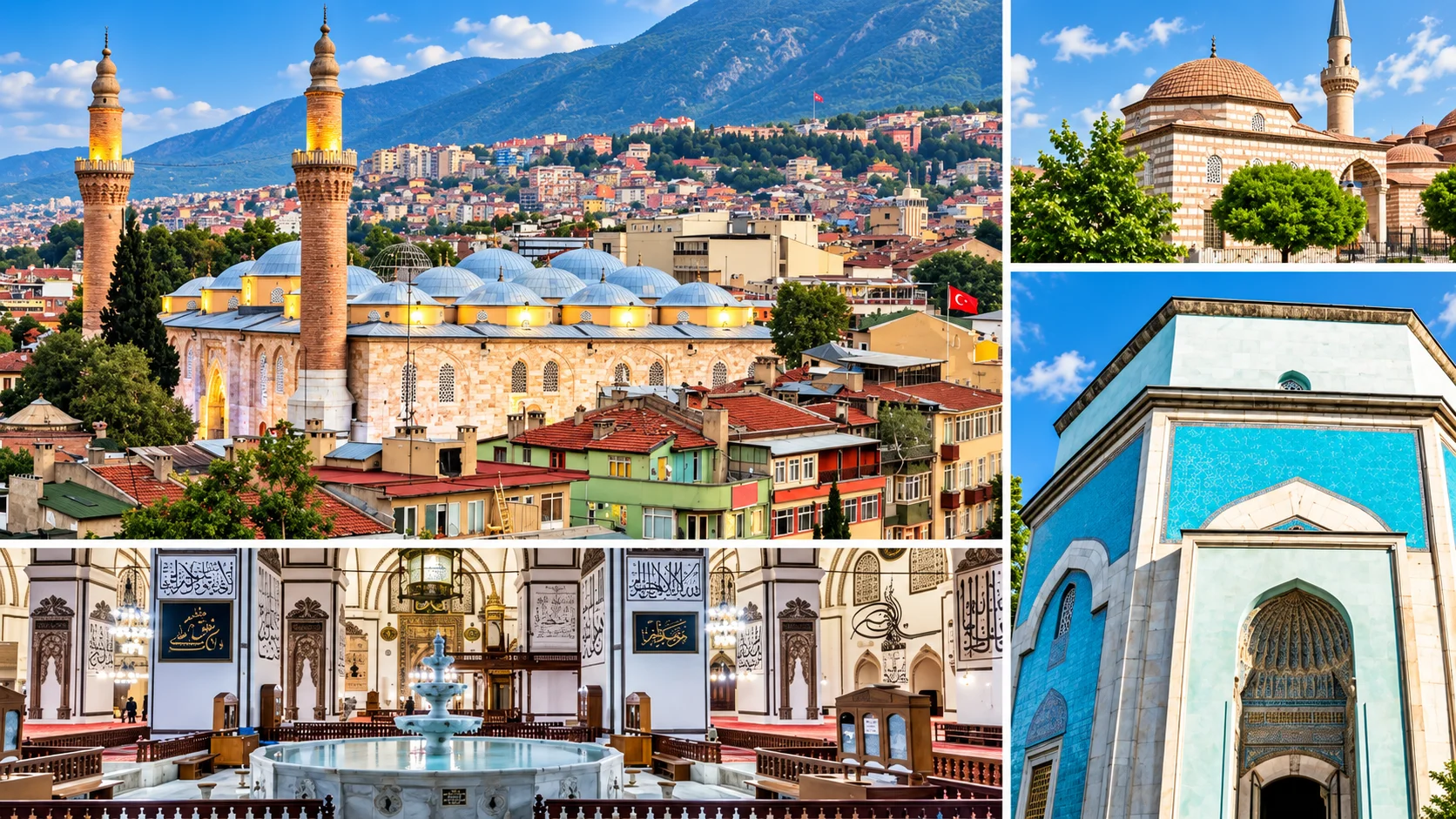
Bursa and the Ottoman Mosque Tradition
No Turkish city outside Istanbul carries as dense a concentration of early Ottoman religious architecture as Bursa. Conquered in 1326 by Orhan Gazi — son of the dynasty's founder Osman Gazi — the city served as the Ottoman capital for approximately four decades. Each successive ruler invested in mosques, medreses, hans and türbes (mausoleums) that together formed the külliye system: self-funding religious and charitable complexes anchored by a mosque at their centre.
The result is a layered landscape of Islamic architecture that spans four centuries of Ottoman development, from the plain stone of Orhan Gazi's 14th-century mosque to the turquoise tile masterpiece of Yeşil Camii and the restrained elegance of the Muradiye complex. In 2014, UNESCO recognised this heritage by inscribing Bursa and Cumalıkızık: the Birth of the Ottoman Empire on the World Heritage List, a designation that specifically includes several of the mosque complexes described below.
All of Bursa's historic mosques admit visitors free of charge. They remain active places of worship; respectful behaviour, modest dress and removing shoes at the entrance are expected of all visitors.
Bursa Ulu Camii — The Grand Mosque
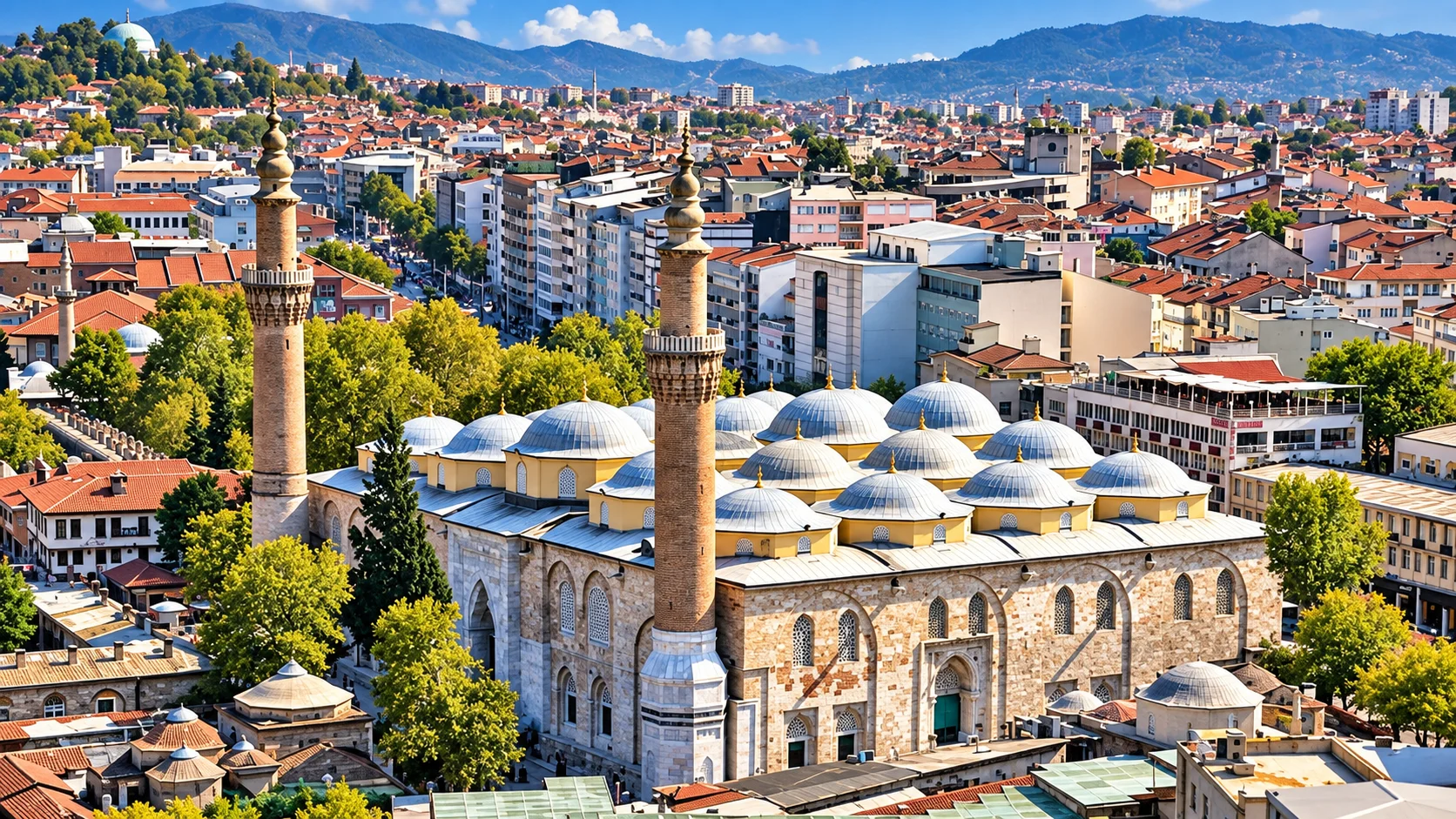
The Ulu Camii (Grand Mosque) is the most recognisable building in Bursa's historic centre. Sultan Yıldırım Bayezid I commissioned it following his victory at the Battle of Nicopolis in 1396, and construction was completed by 1399. The mosque stands at the western edge of the bazaar district (Hanlar Bölgesi), immediately adjacent to Koza Han.
Architecture and Domes
Ulu Camii's defining feature is its roof: twenty shallow domes arranged in a five-by-four grid, supported inside by twelve massive piers. This multi-domed plan was unprecedented in Ottoman architecture and remains unique among Bursa's mosques. Two slender minarets rise from the north corners of the building. The scale of the interior — wide, low and pillar-divided — creates an atmosphere quite different from the single-domed mosques that came later.
The Şadırvan and Oculus
At the centre of the prayer hall, a large marble ablution fountain (şadırvan) sits beneath an open circular skylight (oculus). This arrangement — bringing the exterior fountain tradition inside — was characteristic of the early Bursa mosque type and would influence later Ottoman design. The natural light entering through the oculus shifts throughout the day, giving the interior a meditative quality.
Calligraphy and the Minber
The walls of Ulu Camii carry one of the finest collections of early Ottoman calligraphy surviving anywhere. Large framed panels in several different scripts — sülüs, nesih, celi — were contributed by leading calligraphers of the 15th and 16th centuries, including work attributed to the celebrated master Şeyh Hamdullah. The carved wooden minber (pulpit) is an example of kündekâri craftsmanship, a joinery technique in which geometric interlocking pieces are assembled without nails or glue, allowing the wood to expand and contract with humidity over centuries.
Visitor Information
The mosque is open throughout the day. Visitors should wait outside or in the rear section during the five daily prayer times (approximately dawn, midday, mid-afternoon, sunset and night). Friday midday prayer draws a large congregation. Photography inside is generally permitted in the non-prayer sections; use judgment and avoid disturbing worshippers. Entry is free.
Yeşil Camii and the Yeşil Külliye
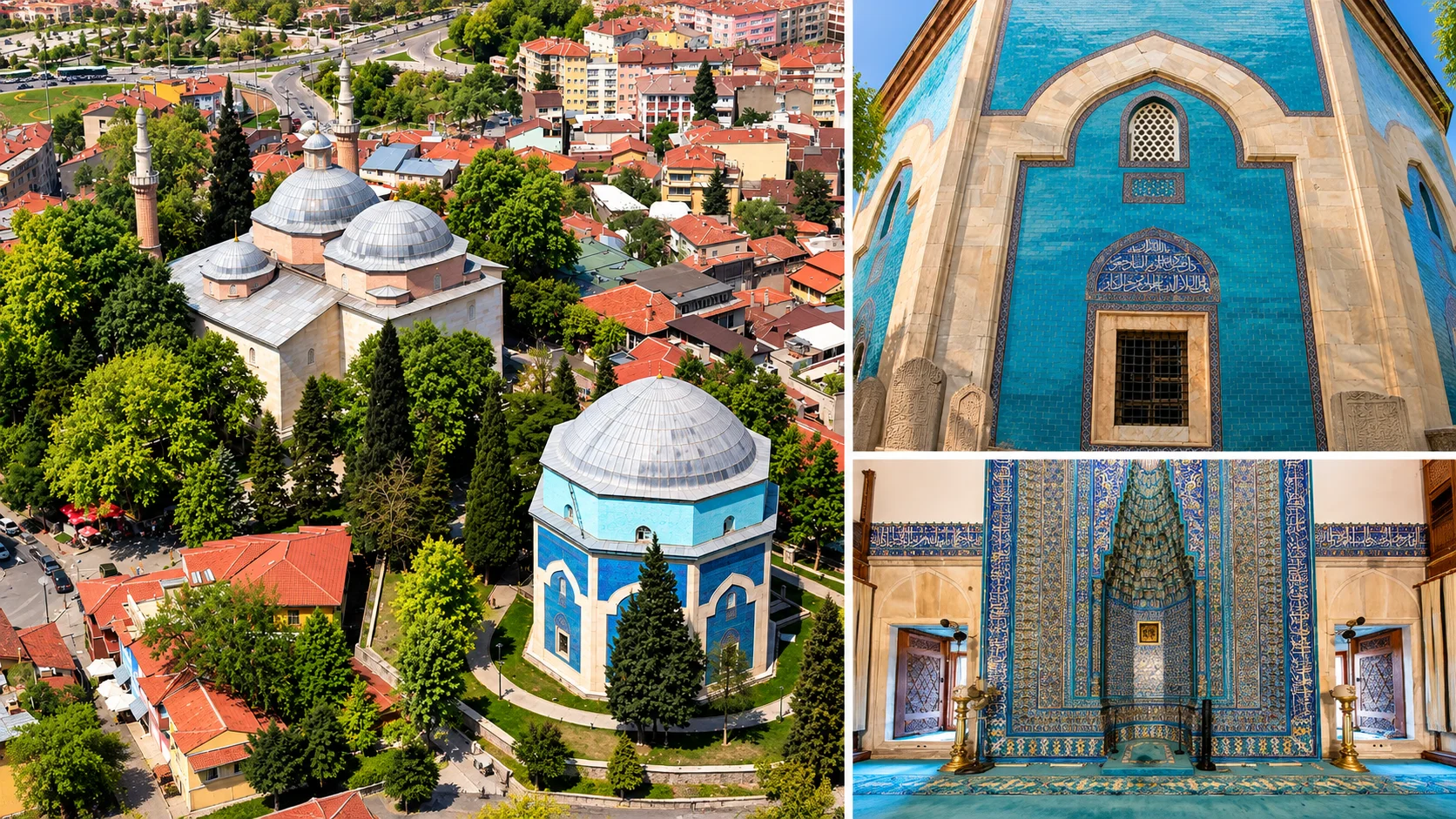
About 1.5 km east of the city centre in Bursa's Yıldırım district stands Yeşil Camii — the Green Mosque — commissioned by Sultan Mehmed I (Çelebi Sultan Mehmed) and completed in December 1419. Its architect was Hacı İvaz Paşa, and the tilework — which gives the mosque its name and fame — was executed by a craftsman named Mecnun Mehmed.
Location Clarification
Yeşil Camii is sometimes confused with a different mosque of the same name in İznik (ancient Nicaea). The two buildings are unrelated. The Bursa Yeşil Camii described here is in the Yıldırım / Yeşil neighbourhood of Bursa city, not in the İznik district. The İznik building is the former Byzantine church converted to a mosque; the Bursa building is an original Ottoman construction.
The Tilework
Ulu Camii is renowned for its calligraphy; Yeşil Camii is renowned for its tiles. The interior walls, ceilings, galleries and transition zones are covered almost entirely in İznik ceramic tiles in shades of green, turquoise and deep blue — among the earliest surviving examples of what would become the defining decorative art of the classical Ottoman period. The tile panels around the mihrab (prayer niche) and the sultan's loggia on the upper level are particularly fine.
Architecture — The Inverted-T Plan
Yeşil Camii follows the so-called inverted-T plan (ters T planlı): the central axis leads from the entrance hall to the main domed prayer space, with side chambers flanking the entrance. These side rooms originally served as residential quarters for the sultan and court dignitaries when the mosque was used as a government hall. The carved marble portal is among the most elaborately decorated in Bursa.
The Yeşil Külliye Complex
Yeşil Camii is the centrepiece of the Yeşil Külliye, a complex that also includes the Yeşil Türbe (tomb of Sultan Mehmed I, directly across the road), a medrese (now the Museum of Turkish and Islamic Arts), a hamam and an imaret (soup kitchen). The entire complex is part of the 2014 UNESCO World Heritage inscription. The Yeşil Türbe's octagonal exterior is sheathed in the same turquoise tiles as the mosque's interior; the sultan's cenotaph inside is richly carved and gilded.
Orhan Gazi Camii and the Hanlar Bölgesi
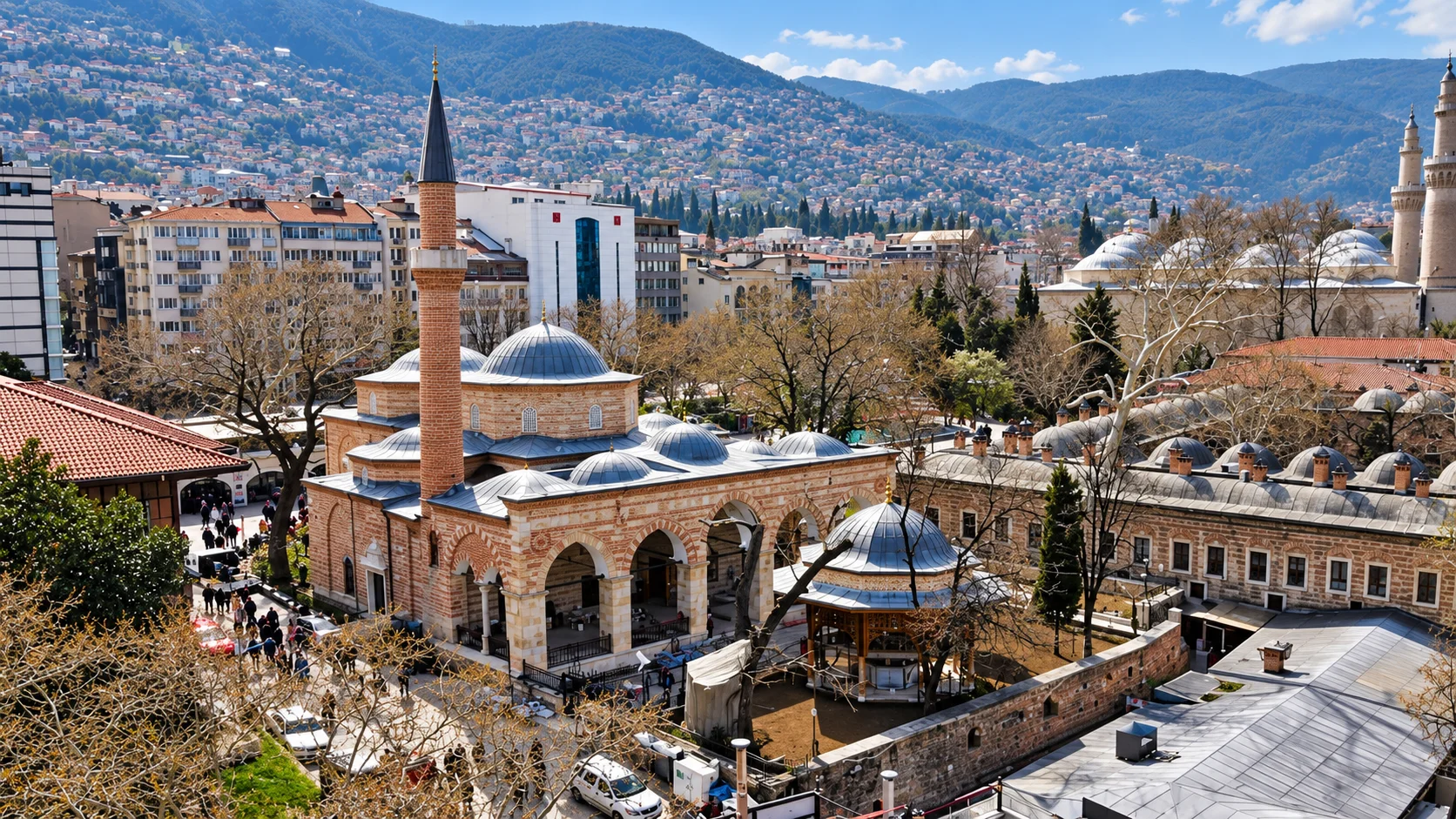
The Orhan Gazi Mosque is the oldest surviving Ottoman mosque in central Bursa, built in 1339 by Sultan Orhan Gazi — the son of Osman Gazi, the dynasty's founder, and the second Ottoman ruler. The mosque stands in the heart of the historic bazaar district (Hanlar Bölgesi), close to Ulu Camii and Koza Han.
History
An inscription above the door records the original 1339 construction date. The building was burned in 1413 by Karamanoğlu Mehmed Bey during the Ottoman interregnum, then repaired in 1417 during the reign of Çelebi Sultan Mehmed. Despite these interventions, the mosque retains much of its original structural form.
Architecture
Orhan Gazi Camii introduced to Bursa the zaviye (or zâviye) mosque plan: two main domed spaces arranged along the central axis toward the mihrab, with side eyvan halls on each flank. This became the dominant mosque type in 14th-century Bursa and influenced mosque design across the early Ottoman period. The adjacent imaret (now replaced by the 19th-century Belediye building), medrese and hammam — together forming the Orhan Gazi Külliyesi — were the seed around which the Hanlar Bölgesi commercial district grew over the following two centuries.
UNESCO Context
The Orhan Gazi Külliyesi and its surroundings form one of the defined components of the 2014 UNESCO World Heritage inscription. The commercial district that grew up around it represents a unique surviving example of early Ottoman urban development — a city-shaping investment in public welfare funded through the income of the complex's market buildings.
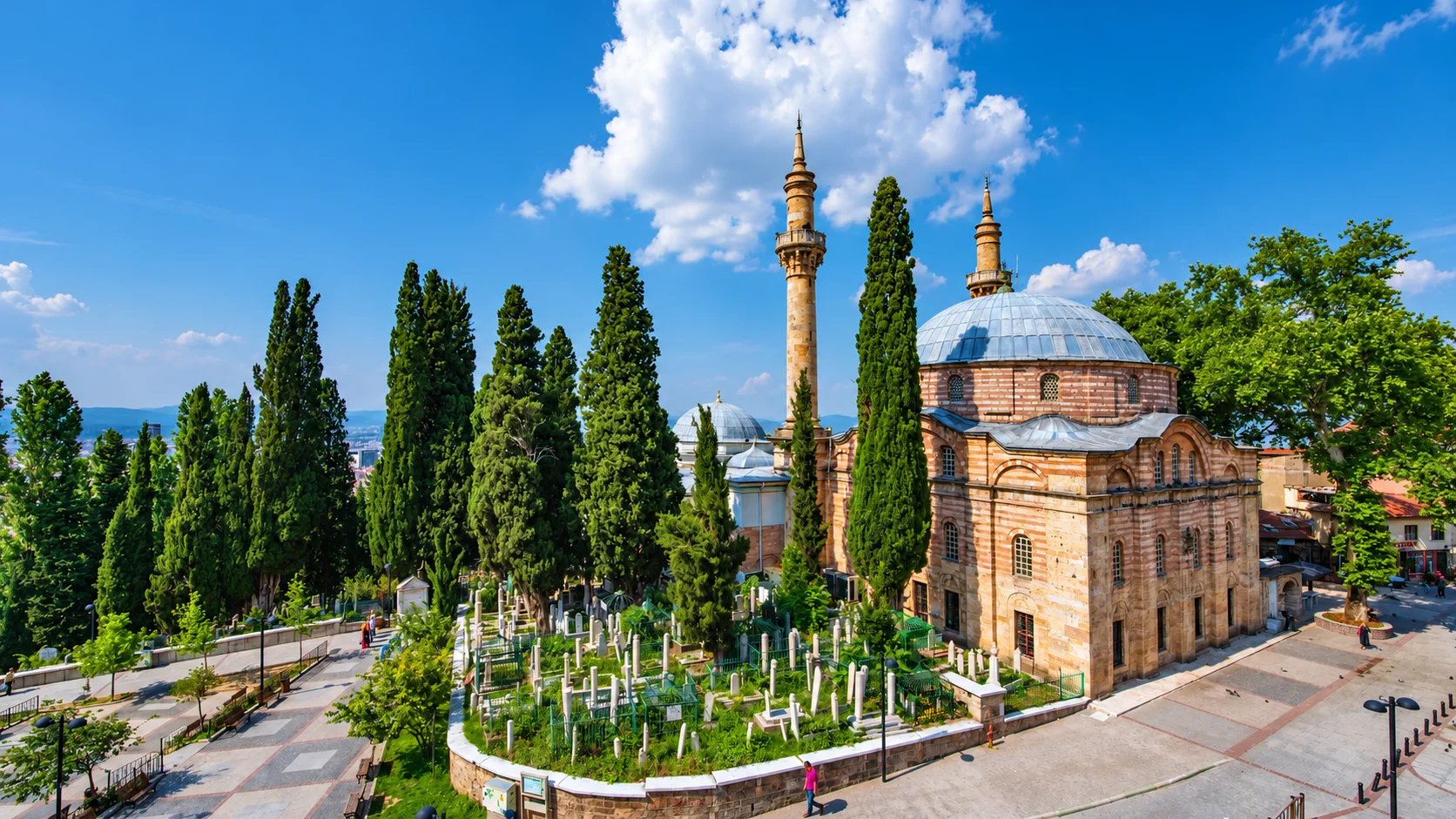
Emir Sultan Camii
Emir Sultan Mosque stands on a hillside in Bursa's Yıldırım / Emirsultan neighbourhood, overlooking the city from the east. It is dedicated to Şemseddin Muhammed el-Buhârî, known as Emir Sultan — a dervish scholar from Bukhara (Central Asia) who settled in Bursa, married Hundi Fatma Hatun (daughter of Sultan Yıldırım Bayezid I), and became one of the most venerated religious figures in the city's history. He died in 1429 and is buried in the adjacent türbe.
The Current Structure
The mosque visitors see today is not the original 15th-century building. The first mosque on this site was built by Hundi Fatma Hatun for her husband, probably in the first decades of the 15th century. Over subsequent centuries it was enlarged and modified. The entire structure was destroyed in a major earthquake in 1795–96. Sultan Selim III had it completely rebuilt in 1804–1805 in the Ottoman Baroque (Ampir) style; an inscription above the north entrance bears his name and the date 1219 in the Hijri calendar (1804–1805). The resulting building is a single-domed square-plan mosque of 15.20 × 15.20 metres, characteristic of the late Ottoman imperial style rather than the early Ottoman architecture found at Ulu Camii or Yeşil Camii.
What to See
The mosque's courtyard and fountain, its carved marble portal and the interior woodwork are the main architectural highlights. The adjacent türbe of Emir Sultan is the reason most visitors come: it is a place of continued devotion, particularly among visitors from Central Asia tracing the figure's Bukharan origins. The hilltop setting offers pleasant views over the lower city towards the Uludağ slopes.
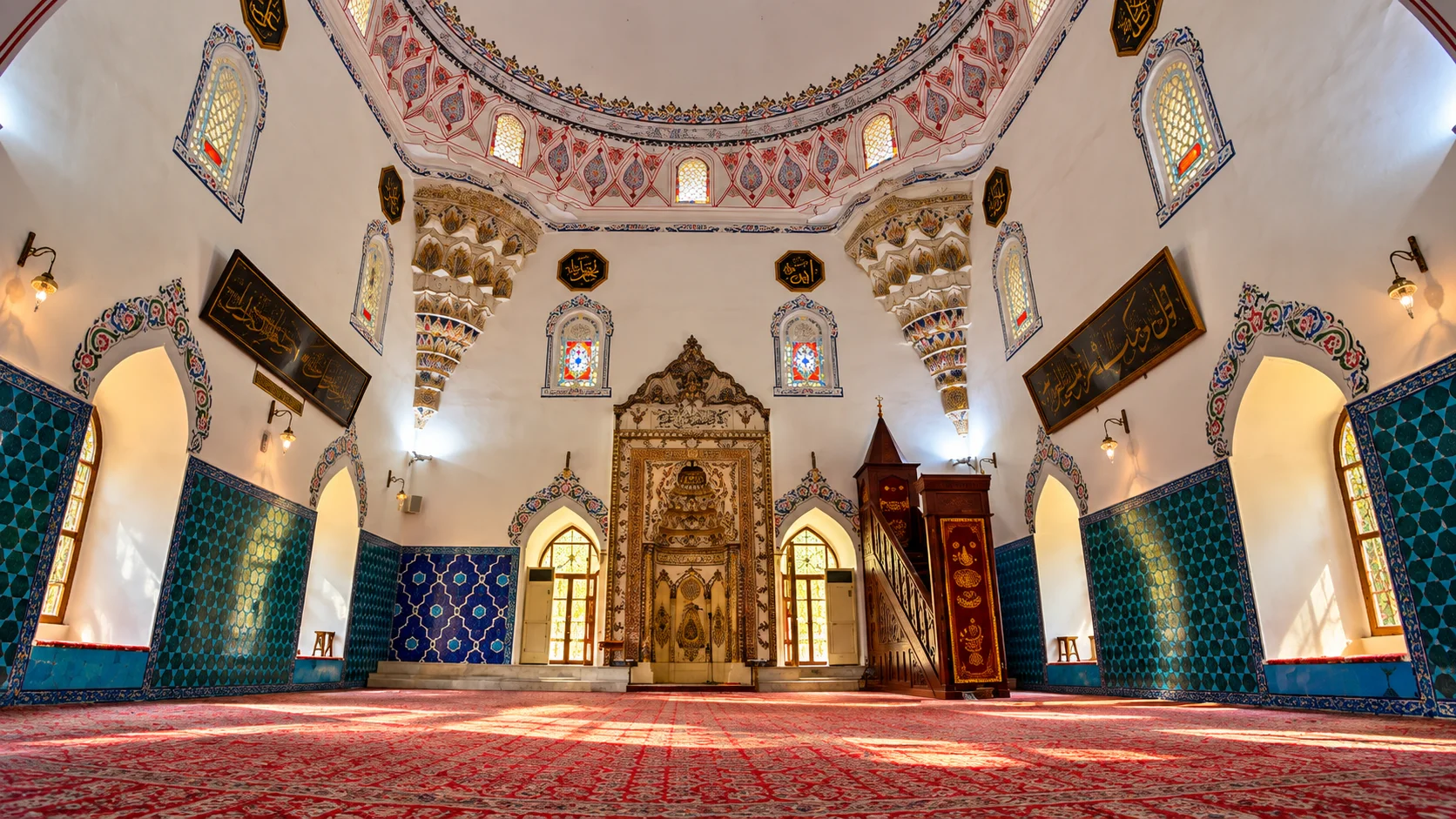
Muradiye Camii and the Muradiye Complex
The Muradiye Külliyesi stands in the Muradiye / Çekirge neighbourhood, about 2–3 km west of the bazaar centre, and is considered the most refined of Bursa's Ottoman complexes. Sultan Murad II (II. Murad) commissioned it between 1424 and 1426.
The Mosque
Muradiye Camii is a single-domed structure with an elegant triple-porticoed entrance. The interior is notable for its early 15th-century İznik tile panels — predating the later classical İznik production — and its carved wooden ceiling. The building is a working mosque visited daily by the local community.
The Royal Tomb Garden
The külliye's most unusual feature is its walled garden containing twelve royal tombs, built between the 15th and early 17th centuries for Ottoman princes and members of the ruling family. These are not just historically important — several are among the finest examples of Ottoman decorative arts in any medium:
- Cem Sultan Türbesi — tomb of Prince Cem (died 1495), the younger brother of Sultan Bayezid II who spent years as a fugitive in Europe. The painted interior decoration is exceptional.
- Şehzade Mustafa Türbesi — executed son of Suleiman the Magnificent, with beautifully painted walls.
- Murad II Türbesi — the sultan's own tomb, an open-roofed structure in which, per his instructions, rainwater falls directly on the grave — a gesture of humility.
The tomb garden is free to enter and is maintained as a quiet, reflective space. Roses are planted among the türbes, and local residents use the garden regularly. It is one of the most unexpectedly moving spots in all of Bursa.
Medrese
The külliye's medrese (theological school) survives intact and now operates as a health clinic — an ironic continuation of the complex's original welfare function, since Ottoman külliyes typically included medical facilities alongside religious education.
UNESCO Context
The Muradiye Complex is one of the defined components of the 2014 UNESCO inscription. Its combination of architectural quality, historical depth and the surviving density of royal türbes makes it arguably the most important single ensemble within the World Heritage property.
Yıldırım Külliyesi — A Significant Complex Often Overlooked
Before Ulu Camii was built, Yıldırım Bayezid I commissioned his own complex: the Yıldırım Külliyesi (1390–1395) in the Yıldırım district on the eastern hillside. It pre-dates Ulu Camii by several years and forms another component of the UNESCO World Heritage property. The complex includes a mosque with a characteristic inverted-T plan, a medrese, a dar-üş-şifa (hospital — one of the earliest Ottoman medical institutions), an imaret and the sultan's türbe. The Yıldırım Camii is less visited than Ulu Camii or Yeşil Camii, which means it can be explored without crowds. For visitors interested in the full sweep of early Ottoman architecture, it is worth including in a Bursa itinerary.
Bursa Mosques and UNESCO Heritage
The 2014 UNESCO inscription "Bursa and Cumalıkızık: the Birth of the Ottoman Empire" encompasses several distinct property components in Bursa city. Those directly related to the historic mosques include:
- Hanlar Bölgesi / Orhan Gazi Külliyesi — the bazaar district and Orhan Gazi's 14th-century complex
- Hüdavendigâr Complex (Çekirge) — Murad I's külliye
- Yıldırım Complex — Yıldırım Bayezid I's külliye in Yıldırım district
- Yeşil Complex — Mehmed I's Yeşil Camii, Türbe and külliye
- Muradiye Complex — Murad II's külliye in Çekirge/Muradiye
Not every mosque in Bursa is within the UNESCO boundary. The designation specifically covers the early Ottoman complexes described above, together with Cumalıkızık village. Emir Sultan Mosque, while historically important, is not within the UNESCO-defined property components.
Historic Mosque Route in Bursa
The main mosques can be grouped geographically into two areas, with one requiring a short drive or taxi ride.
Area 1 — City Centre (walkable): Start at Ulu Camii (30–45 minutes), then walk to Orhan Gazi Camii a few hundred metres east (15 minutes). Continue on foot or take a taxi up the hill to Yeşil Camii and the Yeşil Türbe (30 minutes). From Yeşil, Emir Sultan Mosque is about 15–20 minutes on foot uphill to the east.
Area 2 — Muradiye (taxi/bus required): Muradiye Külliyesi is 2–3 km west of the city centre. A taxi from Ulu Camii takes about 10 minutes. The Yıldırım Külliyesi is in the opposite direction (east), also reachable by taxi in 10–15 minutes from the centre.
A full day is comfortable for all the above sites; a half-day covers the centre plus Yeşil area well. Start before 10:00 to avoid crowds at Ulu Camii during the busy midday period.
Visiting Bursa's Mosques: Etiquette and Practical Notes
- Dress: Shoulders and knees should be covered. Scarves/shawls for women are available at mosque entrances, though bringing your own is more practical. Men in shorts may be asked to cover up.
- Shoes: Remove shoes before entering the prayer hall. Bags or plastic shoe covers are usually provided at the entrance.
- Prayer times: Avoid entering the mosque in the 10–15 minutes immediately before and during each of the five daily prayers. Friday midday (cuma) prayer attracts the largest congregation and is a particularly busy time at all Bursa mosques.
- Photography: Generally permitted in non-prayer areas. Avoid using flash, pointing cameras at worshippers or photographing individuals without permission.
- Entrance fees: All major Bursa mosques are free to enter. The Yeşil Medrese (Museum of Turkish and Islamic Arts, adjacent to Yeşil Camii) has a small admission fee.
- Türbe visits: The royal tombs at Muradiye are also free. Some türbes within the complex are not always open simultaneously; mornings tend to have the most consistent access.
Getting from Istanbul to Bursa's Mosques
The historic mosque district is in central Bursa (Osmangazi), about 2–2.5 hours from Istanbul by private car via the Osmangazi Bridge. The Yeşil area and Emir Sultan are slightly east of centre; Muradiye is west. A private Bursa day trip from Istanbul with a chauffeur allows you to visit all the main mosque complexes without navigating public transport. For airport connections, intercity chauffeur service provides direct transfer from Istanbul Airport (IST) or Sabiha Gökçen (SAW) to Bursa.
Interesting Facts About Bursa's Historic Mosques
- Ulu Camii's 20 domes make it unique in Ottoman mosque architecture; no other Ottoman mosque of the period was built with so many domes over a single prayer hall.
- The calligraphy panels inside Ulu Camii were not all placed at the same time — the collection was assembled over roughly two centuries, with successive calligraphers adding their work to the interior.
- Yeşil Camii's tiles were made at İznik kilns during the transition period when İznik ceramics were developing toward the classical 16th-century style; the colours and patterns are distinct from later İznik production.
- Orhan Gazi was the first Ottoman ruler to use the title "Sultan" and the first to issue coinage in the dynasty's name. His mosque, built in 1339, still functions as a place of worship in 2026.
- The Emir Sultan Mosque that visitors see today is not the original 15th-century building; it was completely rebuilt by Sultan Selim III in 1804–1805 following an earthquake. The Ottoman Baroque style of the current building is characteristic of the late imperial period, not the early Ottoman age.
- Sultan Murad II requested to be buried in an open-roofed tomb at Muradiye so that rain would fall directly on his grave — an act of theological humility he wished to demonstrate even in death.
- Prince Cem, buried at Muradiye, was the only Ottoman prince to seek asylum in Christian Europe. He spent years at the French and papal courts before dying in captivity in Naples in 1495.
- The entire Muradiye Complex — including all twelve türbes — is maintained by a single caretaker family who have held this hereditary position for generations.
Frequently Asked Questions — Historic Mosques in Bursa
What are the most important historic mosques in Bursa?
The five principal historic mosques are Ulu Camii (Grand Mosque, 1396–1399), Yeşil Camii (Green Mosque, 1419), Orhan Gazi Camii (1339), Emir Sultan Camii (current building 1804–1805), and Muradiye Camii (1424–1426). The Yıldırım Camii (1390–1395) is a significant early Ottoman complex that is less visited but architecturally important.
What is the oldest mosque in Bursa?
The Orhan Gazi Camii (Orhan Gazi Mosque) in the Hanlar Bölgesi district, built in 1339, is the oldest mosque still standing in central Bursa. The Yıldırım Külliyesi mosque (1390–1395) and Ulu Camii (1396–1399) followed in subsequent decades.
Who built the Ulu Camii and why does it have 20 domes?
Ulu Camii was built by Sultan Yıldırım Bayezid I, constructed between 1396 and 1399 following his victory at the Battle of Nicopolis. The 20-dome arrangement — unique in Ottoman mosque architecture — was a design choice to cover the wide prayer hall using multiple smaller domes rather than a single large one. The domes are supported by twelve interior piers.
Where is Bursa's Yeşil Camii? Is it in İznik?
No — Bursa's Yeşil Camii (Green Mosque) is in the Yıldırım / Yeşil neighbourhood of Bursa city, on the eastern hillside about 1.5 km from the city centre. This is an entirely different building from the mosque in İznik (ancient Nicaea). The two should not be confused. The Bursa Yeşil Camii was built in 1419 by Sultan Mehmed I.
Is the current Emir Sultan Mosque an original 15th-century building?
No. The current Emir Sultan Mosque is the result of a complete rebuild by Sultan Selim III in 1804–1805, after the original structure was destroyed in an earthquake in 1795–96. The building visitors see today is in the Ottoman Baroque style, characteristic of the late 18th–19th-century imperial style. The tomb of Emir Sultan himself (died 1429) is adjacent.
What is the relationship between Orhan Gazi and Osman Gazi?
Orhan Gazi was the son of Osman Gazi — not his father. Osman Gazi was the founder of the Ottoman dynasty; Orhan Gazi was the second Ottoman ruler, who conquered Bursa in 1326 and commissioned the Orhan Gazi Mosque in 1339. His mosque in Bursa is named after him, the conqueror of the city.
Are Bursa's mosques part of UNESCO World Heritage?
Several are, though not all. The 2014 UNESCO inscription Bursa and Cumalıkızık: the Birth of the Ottoman Empire covers specific components including the Orhan Gazi Külliyesi / Hanlar area, the Hüdavendigâr Complex, the Yıldırım Complex, the Yeşil Complex (Yeşil Camii, Türbe and medrese) and the Muradiye Complex. Emir Sultan Mosque is not within the defined UNESCO property components.
What is the Muradiye Complex and what tombs does it contain?
The Muradiye Külliyesi was built by Sultan Murad II in 1424–1426. Its walled garden contains twelve royal türbes (tombs) for Ottoman princes and family members, including the tomb of Sultan Murad II himself (an open-roofed structure), Prince Cem (who died in European captivity in 1495), Şehzade Mustafa (son of Suleiman the Magnificent), and several other princes. Entry is free.
Can I visit Bursa's mosques without a guide?
Yes. All the major historic mosques in Bursa are freely accessible to independent visitors without booking or a guide. Information panels in Turkish and sometimes English are available at the main sites. The Yeşil Medrese (Museum of Turkish and Islamic Arts, next to Yeşil Camii) provides good contextual information. A knowledgeable guide significantly deepens the experience but is not required.
Can all Bursa's historic mosques be visited in one day?
Yes, with an early start. A full day comfortably covers Ulu Camii, Orhan Gazi Camii, Yeşil Camii and Türbe, Emir Sultan, and Muradiye — the five main sites. Starting before 10:00 is recommended to visit Ulu Camii before it gets busy. Muradiye requires a short taxi or bus ride west of the centre. A half-day comfortably covers the central area (Ulu Camii, Orhan Gazi, Yeşil) plus either Emir Sultan or Muradiye.