
Where to Start in Sivas
Sivas is one of the largest provinces in Turkey by area, and its sights are far apart. This guide therefore treats the city centre and the districts separately: the 13th-century monuments around the old square, the building where the Sivas Congress met, UNESCO-listed Divriği, the clear waters of Gürün, Sızır in Gemerek, the lakes of Hafik and Zara, Âşık Veysel's village in Şarkışla, Kangal, and Yıldız Dağı in winter.
The usual "Hittite, Roman, Byzantine, Seljuk, Ottoman" checklist does not explain Sivas well. A better reading runs like this: the region has traces of very early settlement; in the 12th and 13th centuries, under the Danishmends, the Anatolian Seljuks and then the Ilkhanids, it became a monumental city; under the Ottomans it was a provincial centre; in 1919 it hosted the Sivas Congress; and today it is a Republican-era city on the Kızılırmak basin.
Dates, distances, districts and business details on this page were checked against the older content and updated. Several claims that circulate widely were wrong and are corrected below: that the Gök Madrasa dates to 1291, that the Şuğul Valley is in İmranlı, that Eğriçimen Plateau is in Yıldızeli, and the botanical name of madımak. Where we could not verify opening hours, fees or business details, we left them out and point you to official sources.
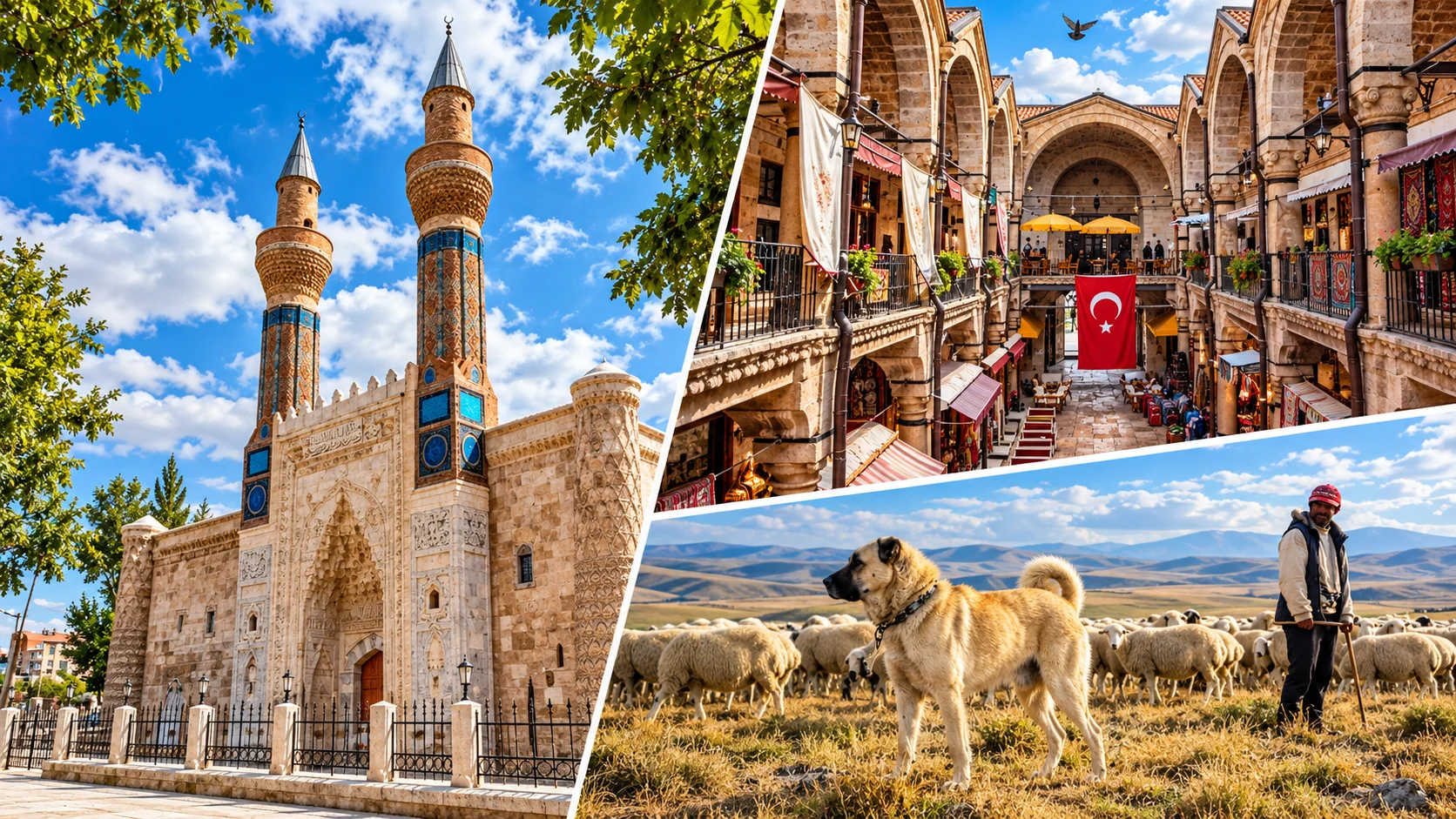
Sivas Quick Guide
| Topic | Short Answer |
|---|---|
| Best area for a first visit | The city centre: the Twin Minaret, Şifaiye, Buruciye and Gök madrasas, the Congress building and the Great Mosque are all within walking distance. |
| UNESCO site | Divriği Great Mosque and Hospital (World Heritage List, 1985). About 170-184 km from the city centre. |
| Main historic square | The old square area: Twin Minaret, Şifaiye, Buruciye and Gök madrasas. |
| Nature day trip | Gürün (Lake Gökpınar and Şuğul Canyon) or Gemerek (Sızır Waterfall). Each is its own day. |
| Folk-culture stop | The Âşık Veysel Museum and tomb in Sivrialan village, Şarkışla. |
| Winter option | Yıldız Dağı Winter Sports and Tourism Centre (Yıldızeli, about 58 km from the centre). Check season status in advance. |
| Airport | Sivas Nuri Demirağ Airport, about 22 km from the centre (per booking sites). |
| High-speed train | The Ankara-Sivas YHT line opened in 2023. Direct Istanbul-Sivas YHT services have been reported since May 2024. Check TCDD Taşımacılık for current trains. |
| Suggested minimum stay | 1 day for the centre, 2 with Divriği, 3-4 for nature. |
Hours, fees and timetables can change. Check official announcements before you travel. Prices may change over time.
Sivas City and Sivas Province Are Not the Same Trip
The sights in central Sivas can be covered on foot or over short distances. Sights in the districts are a different journey. Distances below are approximate, drawn from sources, and vary with route, road conditions and where they are measured from. Check them on a map service when you plan.
| Area | Main Highlights | Best For | Suggested Time | Transport Note |
|---|---|---|---|---|
| Sivas Centre | Twin Minaret, Şifaiye, Buruciye and Gök madrasas, Great Mosque, Congress building, Behrampaşa Han, Eğri Bridge | First-timers, history and architecture lovers | 1 day | The square area is walkable. Eğri Bridge is about 3 km from the centre. |
| Divriği | Great Mosque and Hospital, castle and Kale Mosque, historic houses | UNESCO and stonework enthusiasts | 1 full day or 1 night | About 170-184 km from the centre. By road or regional train. |
| Gürün | Lake Gökpınar, Şuğul Canyon, rock dwellings | Clear-water and canyon fans | 1 day | Şuğul is about 140 km from the centre. A car is needed. |
| Gemerek / Sızır | Sızır Waterfall and surroundings | Waterfalls and short nature walks | Half a day | About 19 km off the Sivas-Kayseri road. Car or taxi. |
| Hafik | Lake Hafik, bird watching | Birds and wetlands | 1-2 hours | Planned together with Lake Tödürge on the Zara-Hafik line. |
| Zara | Lake Tödürge, winter scenery | Nature photographers | Half a day | Tödürge is about 12 km from Zara and 17 km from Hafik. |
| Şarkışla | Âşık Veysel Museum and tomb in Sivrialan | Folk music and literature fans | Half a day | Car or district transport. |
| Kangal | The Kangal dog, Balıklı Thermal Spring | Culture and thermal-facility curiosity | Half to 1 day | The spring is about 98 km from the city and about 13 km from Kangal town. |
| Yıldız Dağı (Yıldızeli) | Ski centre | Winter sports | 1 day | About 58 km from the centre. Winter road conditions matter. |
| Koyulhisar | Eğriçimen Plateau | Highland and forest air | 1 day | 17-20 km from the district centre. Summer season. |
| İmranlı | Source area of the Kızılırmak, Mount Kızıldağ | Geography and hiking enthusiasts | Half a day | Remote and high. Take care in winter. |
Important: Do not treat Divriği, Gürün, Kangal, Zara or Şarkışla as "things to do in the city centre". Rather than squeezing them into one day, choose one or two. The itineraries below are built on that idea.
Sivas Centre: The Historic Square, Congress History and the Old City
The historic core of the city is the square around four large 13th-century buildings that stand very close together: the Twin Minaret Madrasa, the Şifaiye Madrasa, the Buruciye Madrasa and, a little further on, the Gök Madrasa. The Great Mosque of Sivas and the Congress building are nearby. This area is enough for a one-day route.
It helps to read these buildings without stamping "Seljuk" on all of them. The Şifaiye was built in 1217-18 under the Seljuk sultan Izzeddin Keykavus I. The Twin Minaret was built in 1271-72, when Anatolia was under Mongol (Ilkhanid) overlordship, by the Ilkhanid vizier Shams al-Din Juvayni. The Gök and Buruciye madrasas belong to the same years. So the square carries the traces of two different political eras rather than one dynasty.
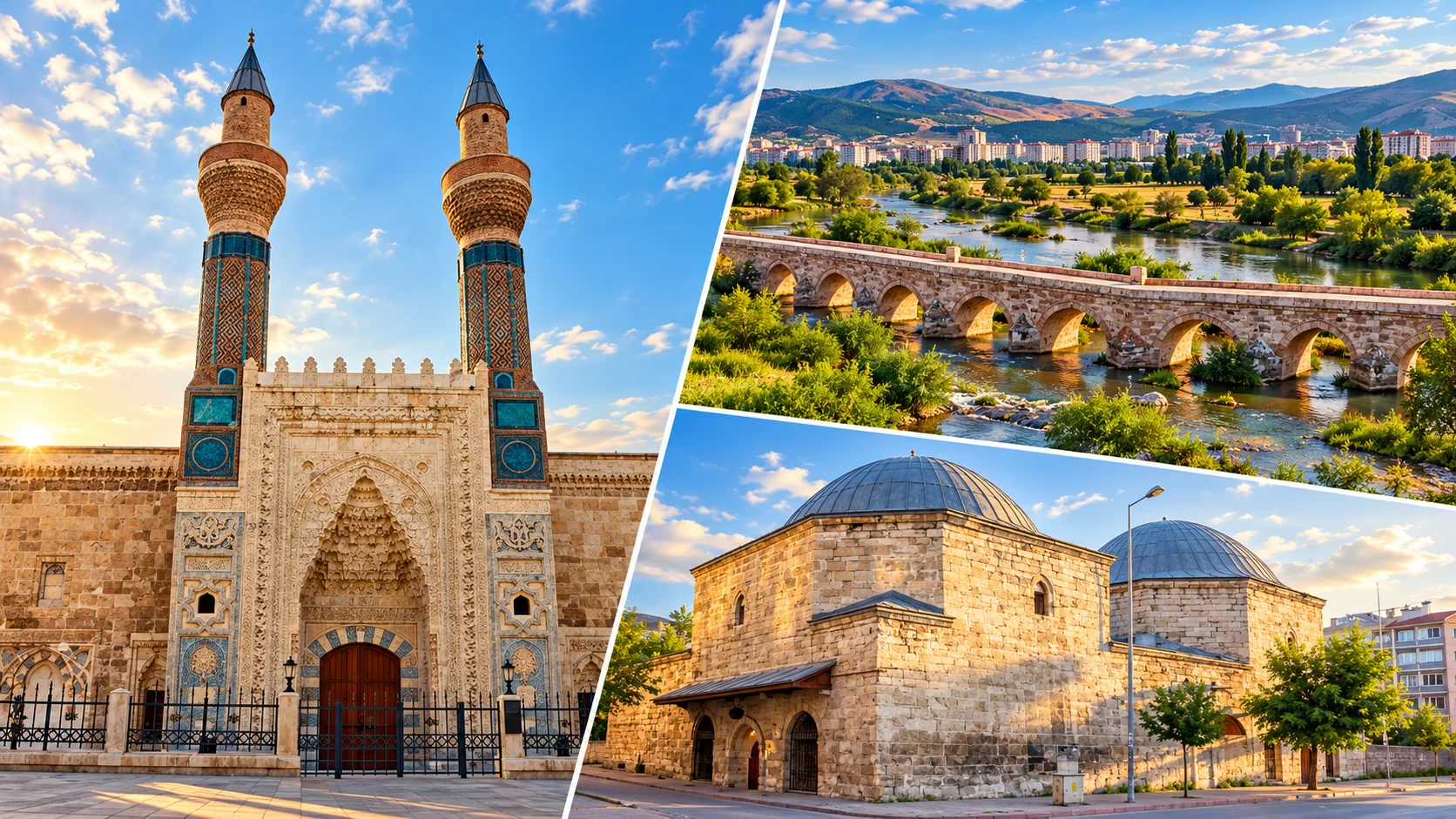
Note: this image's file name says "Great Mosque", but the scenes do not show the Great Mosque of Sivas, so the caption does not name them as such.
Walking the Square
A sensible order is the Twin Minaret facade, the Şifaiye directly opposite, then the Buruciye, then a short walk to the Gök Madrasa. Allow separate time for the Congress building and the Great Mosque. Which parts are open changes, so check local announcements before you go.
Twin Minaret Madrasa (Çifte Minareli)
According to the TDV Encyclopaedia of Islam, the foundation inscription gives AH 670 (1271-72) and names the Ilkhanid vizier Shams al-Din Juvayni as patron. The madrasa stands in the middle of the city, opposite the Şifaiye. What survives is mostly the front: a monumental portal with two brick minarets. The original plan is described as a rectangular two-storey courtyard with four iwans. The architect's name on the inscription is hard to read, and some researchers suggest Kölük b. Abdullah. Check current use and access locally.
Şifaiye Madrasa (Keykavus Hospital)
The old content left this building out, yet it is one of the most important parts of the square. Sources say it was built in 1217-18 by Sultan Izzeddin Keykavus I, that its inscription carries the date AH 614 (1217), and that the sultan's own tomb is inside the building. At roughly 48 by 68 metres it is described as one of the largest surviving Seljuk hospitals. In the Ottoman period it served as a madrasa, which is why it is known by that name today.
A darüşşifa was not an early "modern hospital". In the medieval Islamic world such institutions combined treatment and medical teaching and were run through endowments. Describing the building in modern hospital terms is misleading. Sources describe its present use differently: some as a museum and research centre, others as a courtyard with a café and souvenir stalls. Check the current situation before you visit.
Buruciye Madrasa
The Buruciye dates to 1271 and is linked to Muzaffer Burucerdi. Sources say it was founded to teach the positive sciences. Some older sources mix up the Buruciye and Şifaiye names, so different guides may use two names for what looks like the same building. Check local announcements for current use.
Gök Madrasa: 1271, Not 1291
The old content said it was built in 1291. That is wrong. Sources place it in 1271, under Sultan Giyaseddin Keyhusrev III, commissioned by his vizier Sahib Ata Fahreddin Ali. Its first name was the Sahibiye. Turkish press names a Konya-born architect, Kaluyan; the Kültür Ansiklopedisi entry gives "Kalûyanü'l-Konevî". The spelling varies by source, so the exact form is uncertain. The name Gök (blue) comes from the blue-turquoise tiles of the facade. A restoration including İznik tile work has been carried out. In 2019 the governor's office announced that the restoration was finished, and the General Directorate of Foundations said it was working to turn the building into a museum. However, an encyclopaedia entry updated in September 2025 says work is still under way. We could not resolve this contradiction. Confirm whether the building is open through the Foundations directorate or the Sivas Governorate.
1271: An Extraordinary Year in Sivas Monumental Architecture
The Twin Minaret (1271-72), the Gök Madrasa (1271) and the Buruciye (1271) belong to the same years. Under Mongol overlordship in Anatolia, viziers and statesmen commissioned monumental madrasas almost as if competing. The Twin Minaret's patron was the Ilkhanid vizier Juvayni; the Gök Madrasa's was Sahib Ata, who had served as a Seljuk vizier. In this sense the square is not one dynasty's showpiece but an open-air museum of a period of rivalry.
Great Mosque of Sivas: Stone Piers, Timber Ceiling, Leaning Minaret
An inscription giving 1196-97 (AH 592) was found during the 1955 repairs. Some researchers propose earlier dates. Attribution varies by source, with some stressing a Seljuk and others a Danishmend tradition. News reports mention the time of Qutbuddin Malik Shah, son of the Seljuk ruler Kilij Arslan II.
"Timber-column mosque" is wrong. The Great Mosque is a multi-aisled cut-stone hall divided by stone piers and pointed arches. It has a timber ceiling and a modern timber entrance porch, but the supports are stone. The "wooden hypostyle" description applies to mosques such as the Eşrefoğlu in Beyşehir. The two types should not be confused.
The famous minaret has a brick shaft with tile decoration. Its date varies in sources from the late 12th century to around 1213. It is described as about 35 metres high and as leaning roughly 116-117 cm from the vertical. Whether the tilt was deliberate or developed later is debated. One expert has said it looks as if it was given deliberately to resist wind, and that a lightning strike also caused problems in the shaft. For an exact angle, consult engineering reports.
A restoration that began on 25 July 2025 is reported, under a protocol between the Regional Directorate of Foundations and the mosque's foundation. The plan is to drill down through the minaret, secure it with steel connections, monitor the tilt with sensors, and then repair the main hall. News reports give the end of 2027 as the target. Check which parts are open before you visit.
The Building Where the Sivas Congress Met
When Atatürk and the Representative Committee reached Sivas in 1919, they worked in this building, which was then a school (Sivas High School). Sources say the congress opened on 4 September 1919, with the end date given as 11 or 12 September. The committee is said to have used the building as its headquarters between September and December 1919. One source gives 1892 for its construction, but since it does not fully match other sources we give no firm date. The building continued as a school and, according to most sources, became a museum in 1990. The most recent comprehensive restoration is reported as 2016.
The older "Atatürk Congress and Ethnography Museum" name appears in sources today in several forms (for example "National Struggle Headquarters" or "Atatürk and Congress Museum"). Check the current official name and hours on muze.gov.tr. We could not verify hours, fees or Museum Pass status, so we give none.
Behrampaşa Han and Kurşunlu Hamam
The Behrampaşa Han is a two-storey urban caravanserai built in the second half of the 16th century by Behram Pasha, governor of Rum. Sources give 1573 or 1576. In the late 19th century (1898-99) it became a cavalry barracks, used by the Ministry of National Defence until 1976. After restoration that began around 2015, it now operates as a boutique hotel, restaurant and café. You can read it as a historic commercial building and, separately, as a present-day business. The Kurşunlu Hamam is described as the bath Behram Pasha had built nearby in the 1570s. The old content's broken "in the ... century in the Ottoman period" sentence has been replaced with these facts. We could not verify the hamam's current operation, so we state no visiting conditions.
Eğri Bridge and the Kızılırmak
Eğri Bridge is a stone bridge over the Kızılırmak, about 3 km from the city centre. Sources describe it with 18 arches and a length of roughly 173-180 metres. It takes its name from a bend of about 45 degrees to the left after its midpoint. No inscription has been found, so its exact date is unknown. "Presumed Seljuk period" is more accurate than "13th century". The old content's arch count was right but its date was not firm. The bridge with 13 openings is the Yıldız River Bridge. We could not verify the bridge's current traffic or pedestrian use.
Other Central Stops
We do not describe the Sivas Museum (archaeology and ethnography collections) or Sivas Castle in detail because we could not verify current visiting conditions. If you want to include them, confirm through official announcements.
Divriği Great Mosque and Hospital: UNESCO World Heritage
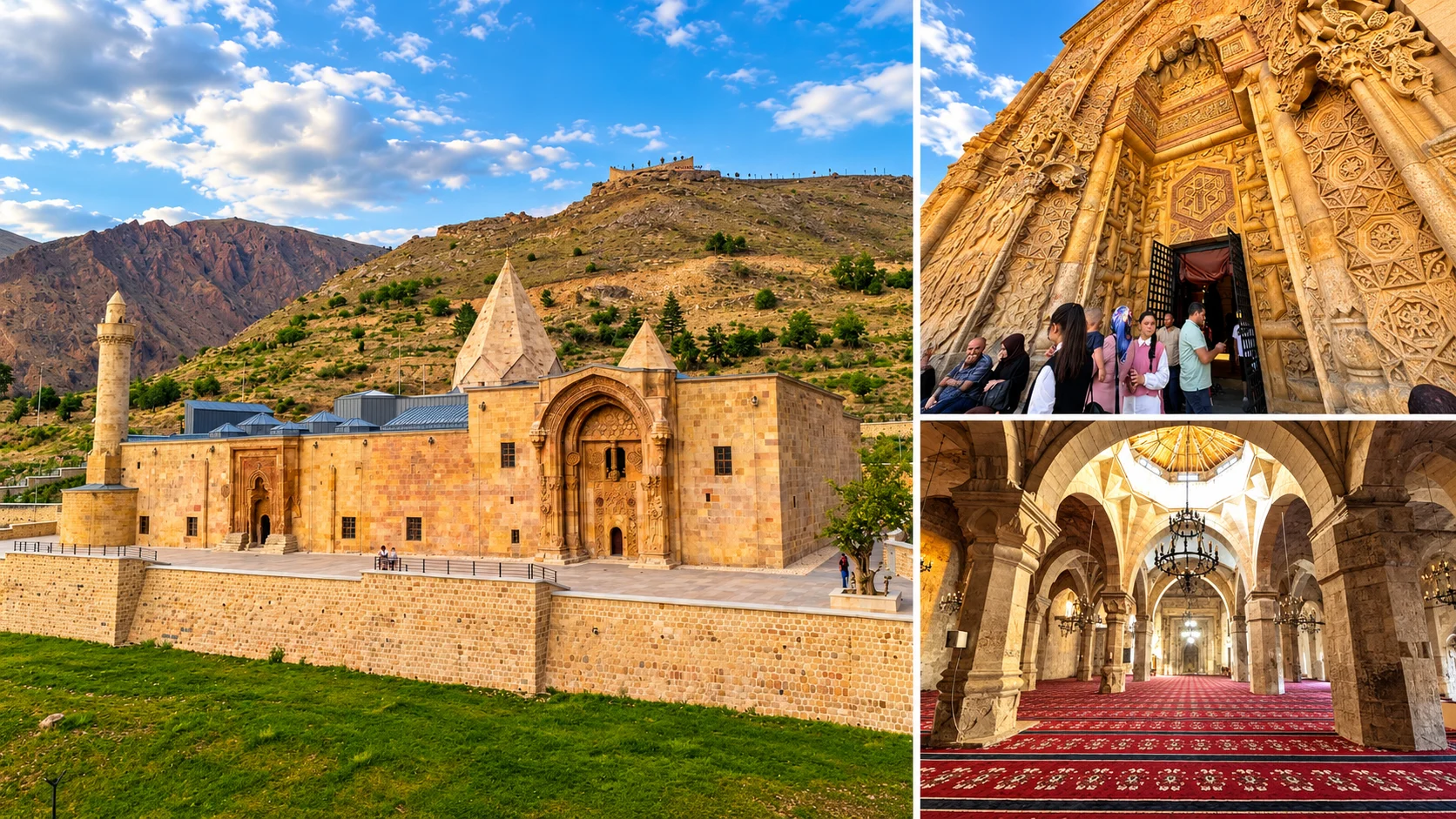
Divriği lies east of Sivas, roughly 170-184 km from the city centre (sources give 184 km by road and 179 km by rail). It is not a stop "near the city centre" but a route worth its own day or night.
UNESCO inscribed "Divriği Great Mosque and Hospital" on the World Heritage List in 1985 (reference 358, criteria i and iv). We do not repeat the old line "the first architectural work from Turkey on UNESCO's list" in that form, because Istanbul and Göreme were inscribed the same year. A more accurate wording is "one of the first Turkish sites inscribed, in 1985".
According to UNESCO, the mosque was founded by the Mengujekid emir Ahmed Shah. One UNESCO document says the adjoining hospital was founded by Ahmed Shah's wife Turan Melek, while another credits Ahmed Shah with both. The date is 1228-29. As reported by UNESCO, the chief architect was Hürremşah of Ahlat (the name appears as "Hurrem Shah" or "Hürremşah" in different documents).
Architecture, Portals and Stonework
Divriği is famous because the mosque and hospital form one whole, with dense stone carving on the portals and variety in plan. UNESCO notes that it is an example of an Anatolian mosque with no courtyard, colonnades or open ablutions basin. There are several distinct portals: the hospital portal, the mosque's north and west portals and an east entrance (sources call one of them the "Gate of Paradise", but naming varies). Each is worked in a different composition. If you want the official term for each, check the information panels on site.
Popular Claims and What We Could Verify
| Common Statement | What We Found |
|---|---|
| "There are about 10,000 different stone motifs." | The figure is repeated in local news, by guides and by the imam. We found no documented count or art-history source, so we give no exact number. "Many motifs, no two alike" is enough. |
| "The architect deliberately carved a praying figure's shadow into the portal." | A silhouette resembling a person is described forming at the west portal in summer (reports say May to September, especially in the afternoon). That is an observation. We found no evidence that the shadow was a deliberate design, so we do not write that the architect "made it on purpose". |
| "Patients in the hospital were treated with water and music." | Volunteer guides repeat this. We could not confirm it from a historical or academic source, so we do not state it as fact. We can say the complex had a water feature; we have no evidence it was a treatment method. |
| "The restoration was completed in 2024." | True. The restoration began in 2015 and ended in May 2024. The mosque and hospital reopened for worship and visits on 6 May 2024. The roof was replaced, with laser cleaning and strengthening works. December 2024 reports cite more than 150,000 visitors since reopening. |
| "It is Turkey's first UNESCO site." | Istanbul and Göreme were inscribed in 1985 too. "One of the first" is accurate. |
Visitor Information (Current Status)
The mosque is a place of worship. A 2025 travel review says entry is free and that modest dress is expected. We could not verify official visiting hours, fees or Museum Pass status, so we give no figures. Confirm hours with the Sivas Provincial Directorate of Culture and Tourism or the Divriği district administration. During prayer times the space is reserved for worship. Keep quiet, dress modestly and do not walk in front of people praying.
What Else Is in Divriği?
- Divriği Castle and Kale Mosque: Only parts of the outer walls survive, largely preserving their Mengujekid-era form. The Kale Mosque sits on a cliff edge and is said to date to around 1180. The climb is difficult.
- Historic houses and tombs: The district is noted for houses with fine woodwork and for tombs such as those of Sitte Melik and Nureddin Salih. We could not verify visiting conditions for each.
- Train: According to third-party timetable sites, there are three regional services a day between Sivas and Divriği, taking about 3 hours. Check TCDD Taşımacılık for current times and fares. The Tourist Eastern Express is also due to stop at Divriği and Sivas in the 2026-2027 winter season, with individual ticket sales reported to open on 26 October 2026.
- Accommodation: Options in the district are described as limited. If you plan to stay overnight, check the current situation beforehand.
Do not squeeze Divriği into the same day as Gürün or Kangal. The return drive is far longer than the visit.
UNESCO Status: Which Sivas Site Is on Which List?
UNESCO runs different programmes. The World Heritage List protects a place. Intangible Cultural Heritage lists cover a tradition or practice. A Tentative List is only a country's list of sites it may nominate later and does not make a place World Heritage.
| Site or Tradition | UNESCO Status | Year | Note |
|---|---|---|---|
| Divriği Great Mosque and Hospital | World Heritage List (cultural, criteria i and iv) | 1985 | The only World Heritage site in Sivas province that we verified. |
| Kangal dog | Not a UNESCO programme | - | A breed and cultural symbol. It appears in the international kennel federation FCI's standards, which is unrelated to UNESCO. |
| Minstrel (âşık) tradition | Not verified | - | We could not separately verify a UNESCO entry for the broad minstrel tradition in connection with Sivas, so we state no programme type. |
| Twin Minaret, Gök Madrasa, Great Mosque | Not verified | - | We do not present them as UNESCO sites. |
Gürün: Lake Gökpınar and Şuğul Canyon
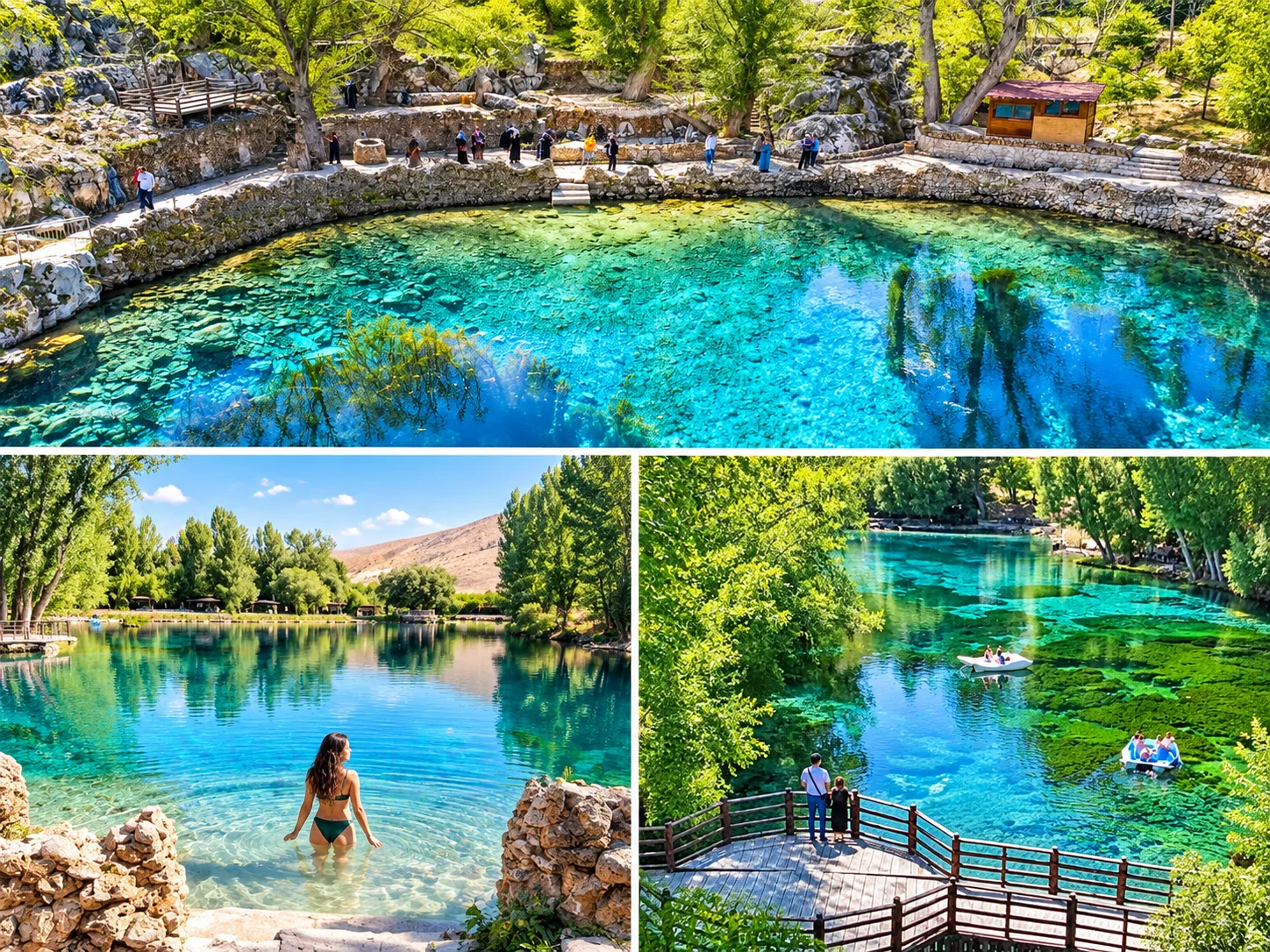
Lake Gökpınar is in Gürün district. It is known for its clear turquoise look and nicknamed the "blue bead of the steppe", but we avoid tourism clichés such as "the Maldives of Turkey". One report gives the lake's depth as about 17 metres. We found no official measurement.
Diving, swimming and canoeing: sources conflict. A 2019 article says swimming and fishing in the lake are banned and that diving is only for permitted teams. 2021 reports describe dives in the lake. A more recent report says the lake was declared a "strictly protected sensitive area" and closed to diving tourism. We could not confirm from an official source which is current. So do not assume you can dive, swim or canoe at Gökpınar, and we do not call it "ideal for diving". Check Sivas Governorate and Ministry of Environment, Urbanisation and Climate Change announcements. There is also a report of a lawsuit over development plans around the lake, so facilities may have changed.
Şuğul Canyon: In Gürün, Not İmranlı
The old content placed the Şuğul Valley first in Gürün and then in İmranlı. The correct district is Gürün. The canyon is about 5 km from the Gürün centre and about 140 km from the Sivas city centre. It is known for clear water running between high rock walls and for small waterfalls. Sources use both "Şuğul Canyon" and "Şuğul Valley". We could not verify nature-park status; the site declared a nature park in this area is Dipsizgöl Waterfall, which is in Doğanşar district. We removed the old "rock climbing and camping" line because we found no officially supported activities. Use visible paths for walking.
What Else Is in Gürün?
Rock dwellings on the hillside, appearing as three to five storeys (described by the mayor as roughly 4,000 years old), are an interesting part of Gürün. We found no reliable information on mansions or on Somuncu Baba, so we do not write about them.
Nature in Sivas: Lakes, Waterfalls and Walking Paths
Sivas's nature routes are far apart. Below, each place is described in its own district, and the place-to-district mix-ups in the old content are corrected. In every case, bear in mind that you need a car or taxi and that winter conditions are different.
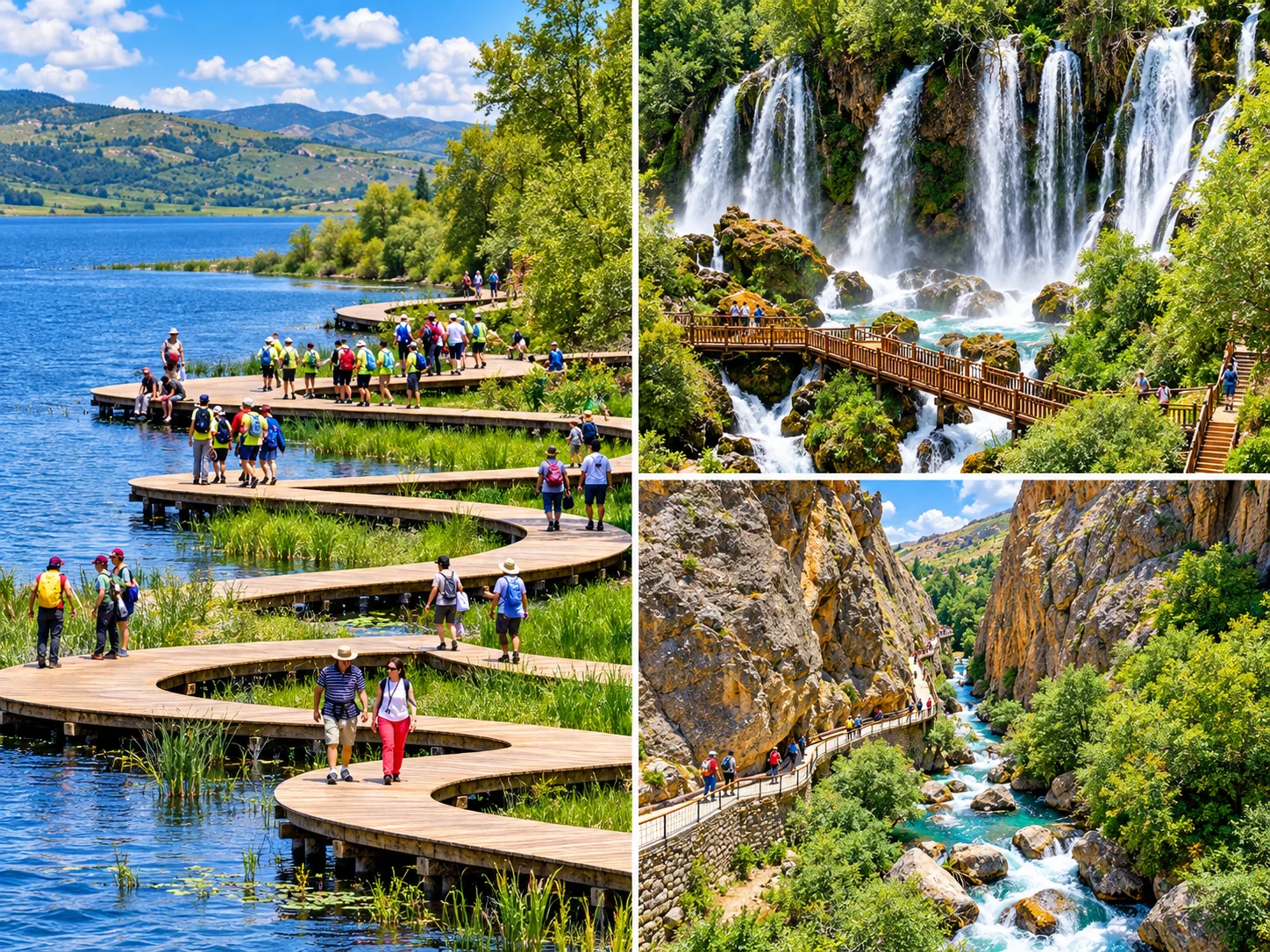
The collage beside this text shows a lakeside boardwalk, a multi-stream waterfall and a path along a canyon. It represents the guide's nature routes without being tied to a particular place name. The file name mentions Hafik, Sızır and Şuğul, but we could not confirm from the image which scenes belong to which places.
Gemerek and Sızır Waterfall
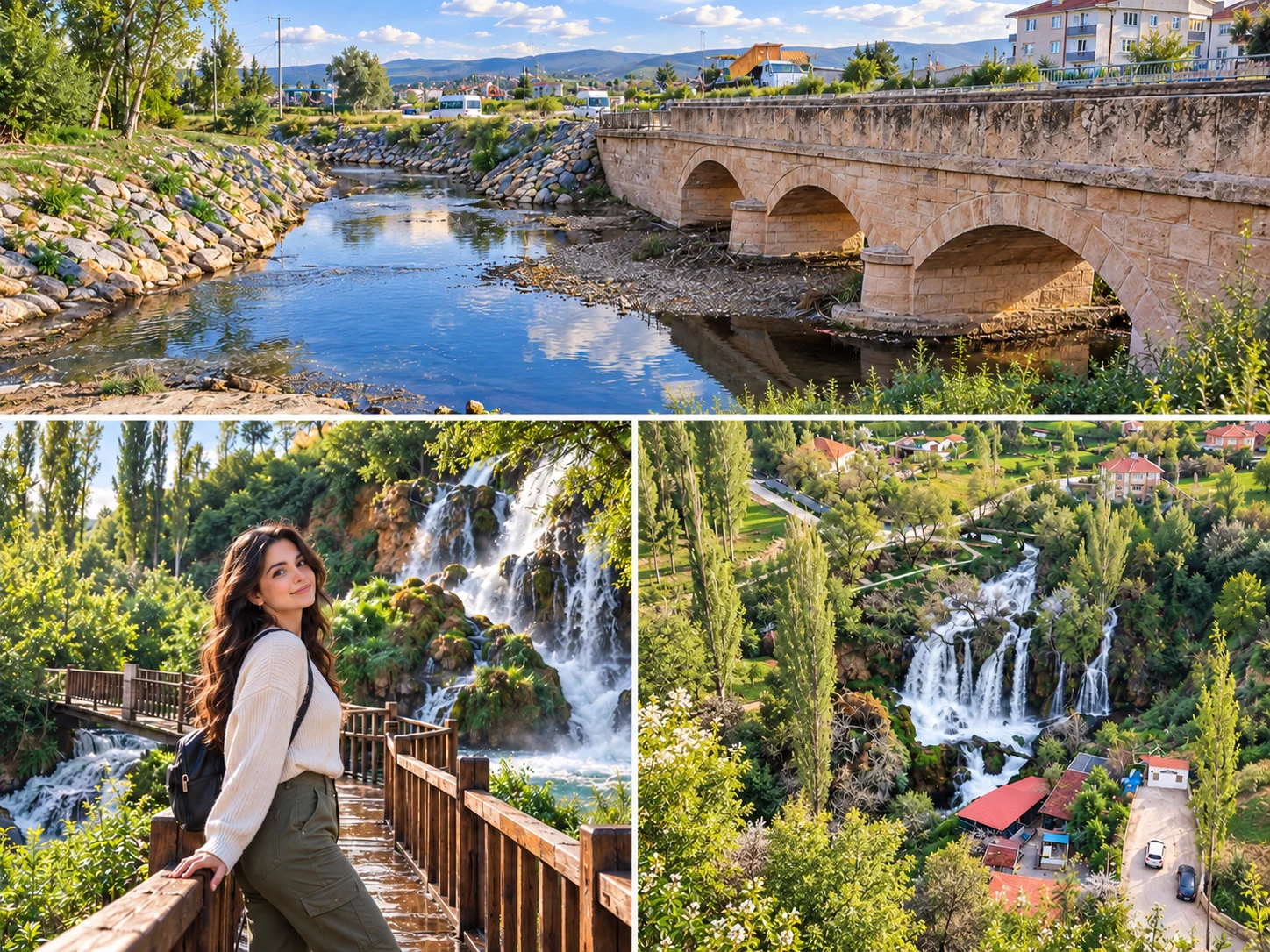
Sızır Waterfall lies within the Sızır township of Gemerek district. It forms where the Göksu stream (Sızır Suyu) pours over travertine steps. Sources give a height of about 22 metres, with water falling along seven lines. By ministerial approval dated 21 October 2019, the Ministry of Culture and Tourism registered it as a "Natural Site - Qualified Natural Protection Area". It is described as lying within the Çat forests. It is about 19 km from the Sivas-Kayseri highway.
April 2026 reports say the waterfall reached its highest flow in 20 years, with floodwater turning it muddy. Visitor numbers and water conditions therefore vary a lot with the season. Stay behind the railings and take care on wet ground. We dropped the old generic "Gemerek, known for its natural forests" line because it described no specific place.
Lake Hafik
Lake Hafik is near Hafik district. Sources describe an area of about 67 hectares and a depth of about 5 metres in summer and 3 in winter. It is a breeding ground for resident and migratory birds. According to the governor of Sivas, the reedbeds can shelter around 150 bird species over a year (a 2019 report). The lake is described as a "strictly protected sensitive area". It partly freezes in winter. We removed the old "suitable for camping" line because we found no official facility or rule. Watch birds quietly from a distance at the edges of the reeds. We found no reliable source for archaeological claims such as Bronze Age pile dwellings, so we do not include them.
Zara and Lake Tödürge
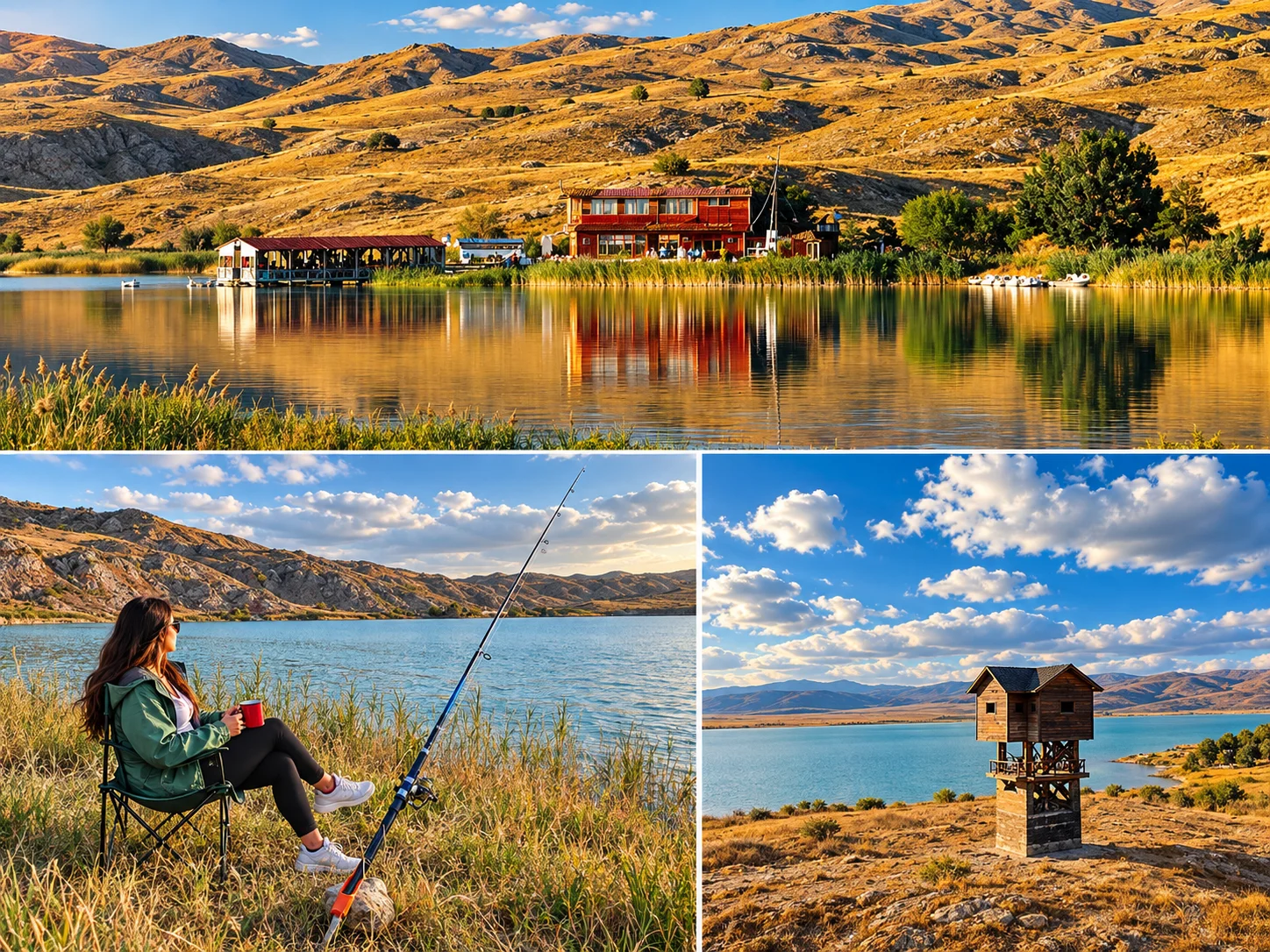
Lake Tödürge is in Zara district. It is about 12 km from Zara and about 17 km from Hafik, with a surface of about 350 hectares. Depth figures vary by source. A bird-observation tower and picnic areas are mentioned on its shore. Sources list species such as the great crested grebe and the ruddy shelduck. A 2025 report says that after a hunting ban, large catfish are reducing the birds, and one operator said there were no birds at that moment. So do not count on seeing birds.
Winter safety: January 2026 reports said the lake was completely covered in ice. The old advice to "photograph on the frozen surface" is dangerous. Ice thickness varies, and no part of the lake has been officially declared safe. Do not walk onto it. Take your photos from the shore.
Fishing: we could not verify current fishing rules or season, so we do not recommend fishing as an activity. Camping is mentioned in some sources, but check the official rule with the local authority. Take your rubbish with you.
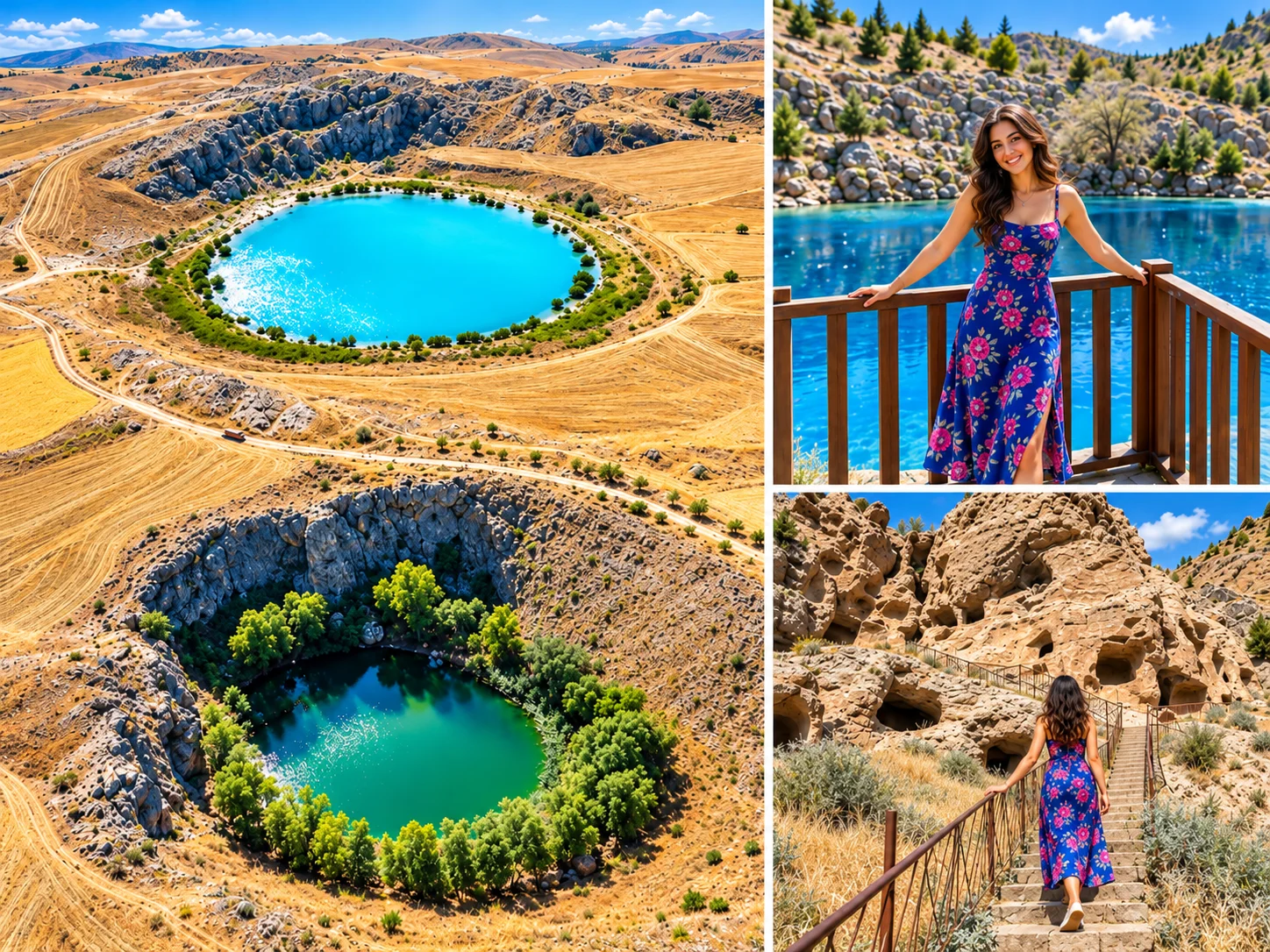
It would also be incomplete to describe Zara only through Tödürge. The collage beside this text shows round depressions with blue-green pools, a viewing platform and rock-cut cavities on a hillside. We could not verify the names of the places shown, so we do not label them one by one. Nor do we promise other stops around Zara such as historic bridges, caves or waterfalls, because we did not confirm exact names from an official source.
Plan the Zara-Hafik line as a half-day nature route and check winter roads in advance.
Şarkışla and Âşık Veysel's Sivrialan
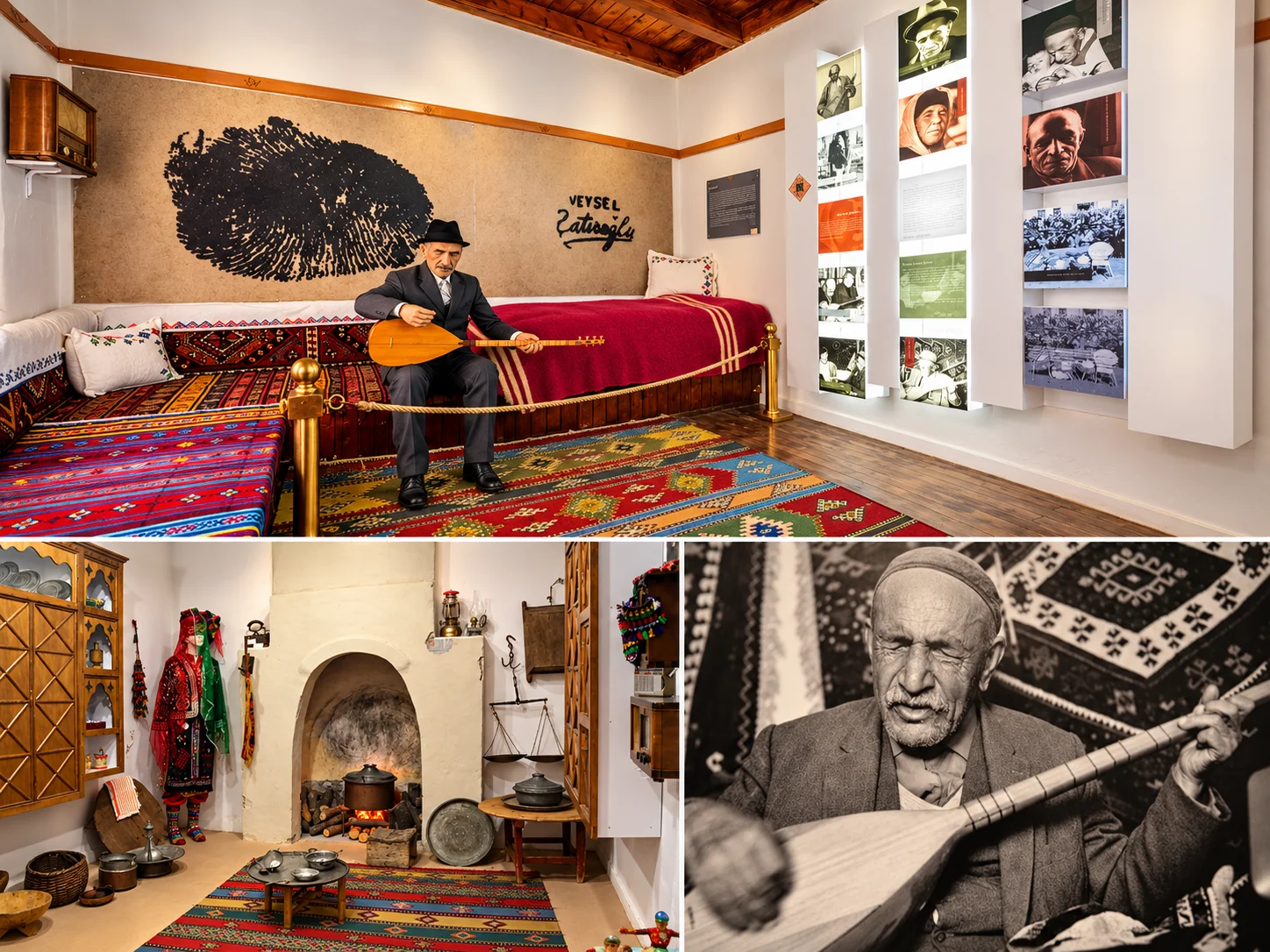
The Âşık Veysel Museum is in Sivrialan village, in Şarkışla district of Sivas. The house Veysel had built in 1960 was restored by the Sivas Museum Directorate in 2012 and opened to visitors on 7 December 2012. The house is described as containing the room where he died, his bed, personal belongings and his sazes. An adjoining annex is said to have accessibility arrangements including Braille text. Veysel was buried in Sivrialan, and commemorations are held at his grave on the anniversary of his death. We could not verify the museum's current hours, so ask the Sivas Museum Directorate before you go.
Âşık Veysel Şatıroğlu was born around 1894 in Sivrialan and died in 1973. He is among the best-known minstrels in Turkish folk literature, in the tradition of poets who sing with the saz. One of his best-known pieces is "Uzun İnce Bir Yoldayım". We do not quote lyrics on this page for copyright reasons.
We found no other reliably verified visitor stop in Şarkışla. Hittite-era archaeological sites such as Kuşaklı Höyük (Sarissa) may be important academically, but we do not present them as a sightseeing stop with visitor access.
Kangal: The Dog, the Balıklı Spring and Sıcak Çermik
The Kangal Shepherd Dog
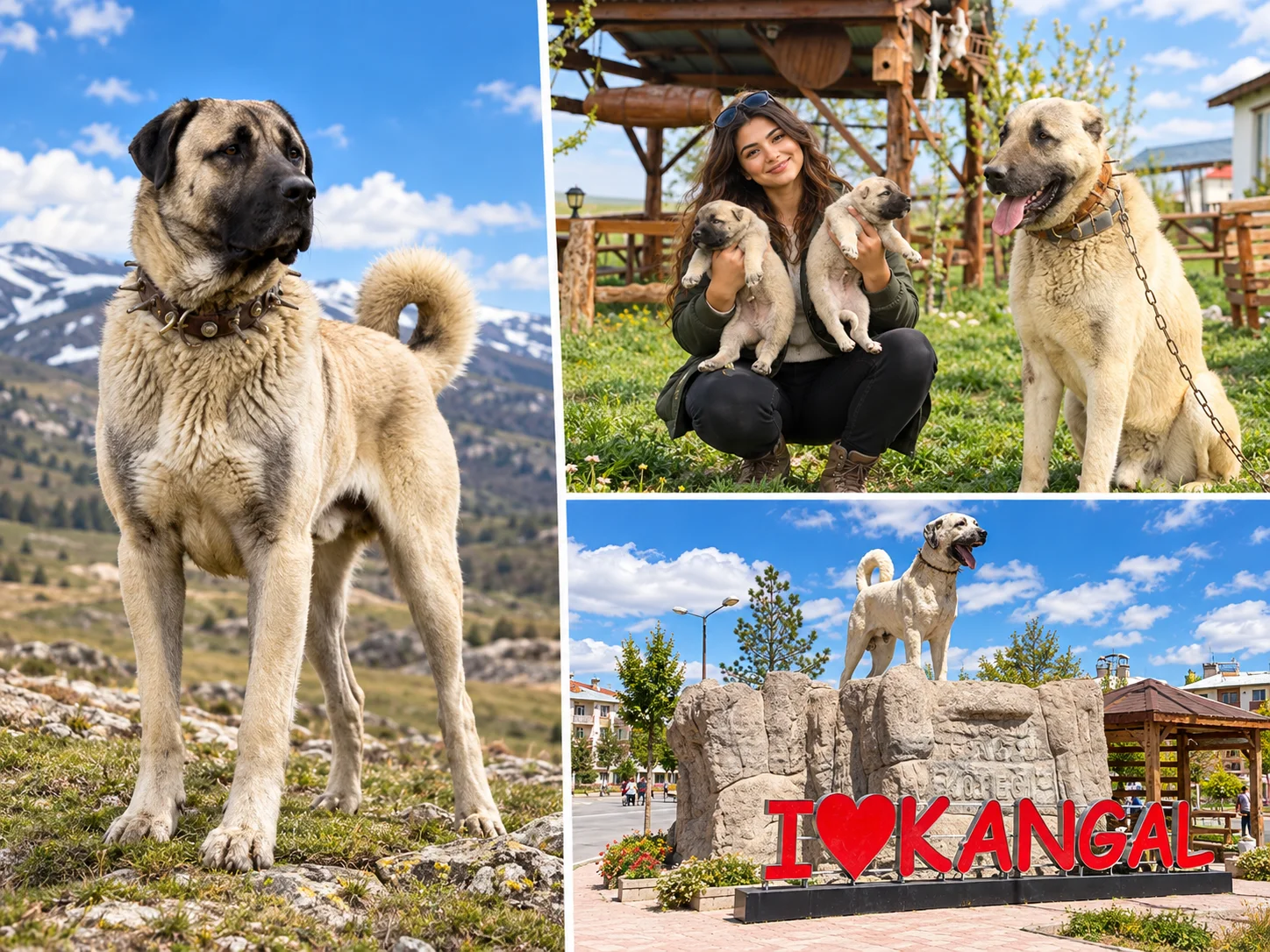
Kangal is both a district name and the name of a shepherd-dog breed. In FCI records the breed appears as "Kangal Shepherd Dog" under standard no. 331, of Turkish origin. The FCI list shows its acceptance in 1989 and the current standard's publication in 2018. The FCI standard gives its main purpose as guarding sheep. Sources also note a naming split: some clubs call the breed the "Anatolian Shepherd Dog".
We do not use claims such as "the world's strongest dog", "bite force" or "never attacks humans", because they are not backed by an authoritative source. If you meet shepherd dogs, keep away from the flock and do not pet an animal without its owner's consent.
Balıklı Thermal Spring
The Kangal Balıklı Spring is about 13 km from Kangal town and about 98 km from the Sivas city centre (sources range from 10 to 17 km). Water temperature is given in sources as 36-37 °C. The site is said to have eight pools and two hotels, and the operator says it is open all year. The facility is known above all for its "doctor fish" experience.
No treatment claims: we removed the old health and healing wording entirely. This guide makes no health or treatment claims. If you have a health concern, ask your doctor. We give visitor information only.
Sıcak Çermik and Soğuk Çermik
Two separate çermik names appear in Sivas. According to sources, the Sıcak Çermik spa lies 24-31 km from the city centre, while Soğuk Çermik is about 17 km north-east of the city and is a facility run by the municipality. Do not confuse them with the Çermik district of Diyarbakır. We removed the old health-benefit wording entirely. Check current facility and accommodation conditions with the municipality.
Yıldız Dağı, Eğriçimen Plateau and the Source of the Kızılırmak
Yıldız Dağı Winter Sports and Tourism Centre
The ski centre is in Yakupoğlan village of Yıldızeli district, about 58 km from the city centre. The old content's distance and district were right. For altitude, sources give about 2,552 metres (lift stations are quoted at 2,551 metres and other lines at different values, so it depends on the point measured). According to DHA, the centre has two chairlifts, an 804-metre drag lift, a sledding run, a conveyor and a T-bar. The old content's word "cable car" (teleferik) was the wrong term; the correct word is chairlift (telesiyej).
The operator is named as Buruciye A.Ş. We could not officially verify the number of pistes, total length, equipment rental, ski school or the 2026 season opening date, so we do not state them. In general the season is expected to run from December to March, but snow varies each year. Check current snow and operating status before you go. Prices change, so we state none.
Eğriçimen Plateau: In Koyulhisar
The old content put Eğriçimen Plateau in Yıldızeli. The correct district is Koyulhisar. The plateau is about 17-20 km from the district centre and is described as a pine-forested area at about 1,800 metres. It is reached by a stabilised plateau road. It is mentioned for summer coolness and, in winter, for snowy scenery. Check road and snow conditions in advance.
İmranlı and the Source of the Kızılırmak
The Kızılırmak rises from springs at about 2,000 metres on the slopes of Mount Kızıldağ in İmranlı district of Sivas. Kızıldağ's highest point is about 2,950 metres. At roughly 1,355 km, the river is the longest in Turkey that flows entirely within its borders. A walking section called the "Upper Kızılırmak Culture and Nature Trail" also exists between Zara and İmranlı. This is why the old line "the most notable place in İmranlı is the Şuğul Valley" was cleaned out; Şuğul is in Gürün. İmranlı is remote and high, and winter conditions need special care.
Suşehri and Other Districts
We removed the old "trekking, camping, paragliding" lines for Suşehri because we found no reliable source for them. You can treat Suşehri as a stopping point.
Old Claim or Verified Fact? Statements You May Have Seen
Some statements in the old Sivas content, and in many guides, came out differently in our research. The table below sums up the differences.
| Common Statement | Research Result |
|---|---|
| "The Gök Madrasa was built in 1291." | Sources give 1271 (Sahib Ata Fahreddin Ali). |
| "The Great Mosque of Sivas has wooden columns." | According to sources it is a stone building with stone piers and pointed arches. The ceiling is timber. |
| "The Şuğul Valley is in İmranlı." | It is in Gürün. |
| "Eğriçimen Plateau is in Yıldızeli." | It is in Koyulhisar. |
| "Divriği has 10,000 different motifs." | We found no documented count. We give no exact number. |
| "Patients in the hospital were treated with water and music." | We found no reliable source. We do not state it as fact. |
| "The Balıklı Spring treats skin diseases." | We make no health claims and give only visitor information. |
| "The scientific name of madımak is Sideritis congesta." | Wrong. Madımak is Polygonum cognatum (Polygonaceae). The genus Sideritis is a different plant group. |
| "Madımak was given geographical indication by the Ministry of Agriculture in 2020." | Geographical indications are registered by TÜRKPATENT, not the Ministry of Agriculture. We found no registration record for madımak, so we do not say it has a GI. To check, use the TÜRKPATENT GI portal. |
| "Divriği pilaf is made with bulgur." | According to the GI document it is made with rice, with meat, chickpeas and raisins at the base. |
| "Yıldız Dağı has a cable car." | The correct term is chairlift. A drag lift and T-bar are also mentioned. |
When to Visit Sivas
| Season | Advantage | Watch For |
|---|---|---|
| Spring | Greening steppe, plenty of water, waterfalls | Rain is variable. Water levels at Sızır and Gürün change with the season. |
| Summer | Gürün, Sızır, Divriği and highland routes. Long daylight. | It can be hot in low-lying areas. Summer afternoons are mentioned for the shadow effect at Divriği's west portal. |
| Autumn | Comfortable weather for city heritage and rural routes | Evenings can turn cool. |
| Winter | Yıldız Dağı, snowy landscapes | It is high, roads can ice over and darkness comes early. Take care on remote routes such as Divriği and Gürün. |
Safety in Nature
- Stay inside the railings and marked routes at waterfalls and in canyons.
- Do not walk onto a frozen lake. Ice thickness cannot be trusted.
- Do not assume you can camp anywhere. Do not camp outside official areas and rules.
- For winter travel, check road conditions and your chain and fuel needs in advance.
What to Eat in Sivas
In the old content the food section was thin and in places wrong, and a restaurant list that did not belong to Sivas had been placed in the sidebar by mistake. That entire list has been removed. Below are dishes tied to Sivas that we could support with sources. We name no restaurants, because we have no currently verified list.
| Dish | What It Is | Note |
|---|---|---|
| Sivas köftesi | A traditional grilled meatball made from veal or mutton leg meat, with no additives. | Registered with TÜRKPATENT as an indication of origin on 31 January 2011 (no. 140). The registrant is the Sivas Chamber of Commerce and Industry. |
| Sivas katmer | A local layered pastry. | News reports say it received a geographical indication. We could not verify the date or number. |
| Sivas kelle | Oven-baked sheep's head, known as "fırında kelle", from Akkaraman sheep. | Reported to have been registered as a GI by TÜRKPATENT on 6 February 2026. |
| Divriği pilaf (Alatlı pilaf) | Boiled meat is mixed with spices and laid at the base of the pot, chickpeas and Besni raisins are added, and rice goes on top before cooking. | The definition in the GI document. Other recipes exist. |
| Peskütan soup | A soup made from a winter food prepared by cooking yoghurt with cracked wheat. Served with sizzled butter. | We could not verify its application status. Because different recipes are described, we do not give a single one such as "yoghurt, wheat and chickpeas". |
| Madımak aşı | A dish made from madımak (Polygonum cognatum), gathered in spring. It has local variants. | We could not verify a GI record. We give no single recipe and make no health claims. |
| Hıngel, pezik pickle, pickle mıhlama | The official Sivas tourism brochure lists these among local flavours. | We did not separately verify recipes or GI status. |
| Hurma (kalburabastı) dessert, kazan simit | Local flavours mentioned in the brochure. | Details not verified. |
What we left out: The old "lamb tandır Sivas kebab" description was not carried over as a generic lamb-tandır account, because the brochure lists "vegetable Sivas kebab". We did not promote Kangal cheese or Sivas honey as general provincial products and removed all health-benefit wording. The brochure mentions Tozanlı Valley organic honey. We could not separate kete and katmer from general Anatolian pastries with a local source, so we did not give them their own entries. The Sivas knife (TÜRKPATENT no. 401, 2018) is not food but is a local product.
Where to Stay in Sivas
Choose accommodation by area rather than by ranking. We give no ratings or prices, because these should be read live from a booking site. Check a hotel's current name, brand and location on its official website.
| Area | Advantage | Watch For |
|---|---|---|
| Historic square and old centre | Madrasas and the Congress building within walking distance | Evening options may be limited. |
| Station and central modern areas | Trains and city transport | You may need a short ride or walk to the historic centre. |
| Divriği | If you plan only an overnight | Options are described as limited. Verify beforehand. |
| Yıldız Dağı | During the ski season | Verify current accommodation with the operator. |
Hotels named in 2026 booking listings include Behrampaşa Otel (in a historic han building), Elite World Nest Sivas, Ramada by Wyndham Sivas and The Green Park Hotel Sivas. This is not a recommendation. We did not review their official sites one by one. Confirm facilities (spa, pool, breakfast and so on) from official sources. Names from the old list, such as 4 Eylül Otel, Savona, Sultan, Malia, Buruciye and Revag Palace, were not carried over because we could not verify them as current.
How to Get to Sivas and Get Around
High-Speed Train (YHT) and Regular Train
The Ankara-Sivas high-speed line opened on 26 April 2023 and is about 405 km long. According to third-party sources the journey takes about 2 hours 32 minutes to 2 hours 41 minutes, with 3-4 services a day (sources differ). Direct Istanbul-Sivas YHT services have been reported since 4 May 2024 and take about 7 hours 18 minutes. Extra services were announced for 3 July to 14 September 2026. Check TCDD Taşımacılık for current trains and fares. Regional (conventional) trains are separate from the YHT. The Sivas-Divriği regional services fall in this category.
Sivas Nuri Demirağ Airport
According to booking sites, the airport is about 22 km from the city centre. Taxi and bus options are mentioned, and a Havaş shuttle is also said to run. From Istanbul, Turkish Airlines flights are listed from Istanbul Airport and Pegasus and AJet flights from Sabiha Gökçen. Check DHMİ, Turkish Airlines and Havaş for current times and airport transport. We give no flight schedule because we could not verify one from an official source.
Getting Around the City and Districts
The square area is walkable. For points such as Eğri Bridge, think of a taxi or your own vehicle. Divriği, Gürün, Kangal, Zara, Şarkışla and Gemerek are far from one another. How practical public transport or minibuses are depends on the route. For Gökpınar, Şuğul, Tödürge and the highlands, think of your own car, a rental or private transfer. Ask the operator whether a seasonal shuttle runs to Yıldız Dağı.
1, 2, 3 and 4 Day Sivas Itineraries
1 Day: Sivas Centre
| Order | Stop | Note |
|---|---|---|
| 1 | The old square and the Twin Minaret facade | Start early for morning light. |
| 2 | Şifaiye Madrasa | Directly opposite. Check which parts are open. |
| 3 | Buruciye Madrasa | A short walk. |
| 4 | Gök Madrasa | Confirm in advance whether it is open. |
| 5 | Congress building | Check official hours on muze.gov.tr. |
| 6 | Great Mosque of Sivas | Parts may be closed because of restoration. |
| 7 | Behrampaşa Han and the old bazaar area | The han is used today as a hotel and café. |
2 Days
| Day | Plan |
|---|---|
| Day 1 | The city-centre route above. |
| Day 2 | Divriği as a day trip, or with an overnight. The round trip is roughly 340-370 km and takes a long time. The regional train is also an option. |
3 Days
| Day | Plan |
|---|---|
| Day 1 | Sivas centre. |
| Day 2 | Divriği. |
| Day 3 | Gürün: Şuğul Canyon and a look at Lake Gökpınar from the outside. Do not assume any activity at Gökpınar. |
4 Days: Choose One Extra Cluster
| Day | Plan |
|---|---|
| Days 1-3 | The 3-day route. |
| Day 4 | One of: Şarkışla and the Âşık Veysel Museum, Gemerek and Sızır, Zara and Tödürge, or Kangal. Do not squeeze them all into one day. |
Winter Route
| Day | Plan |
|---|---|
| Day 1 | Sivas centre, mainly indoor sites. |
| Day 2 | A ski day at Yıldız Dağı. Check the season and road conditions in advance. |
Plan remote district routes (Divriği, Gürün) carefully in winter. Do not mix the summer nature routes with the winter route.
A Short Video Look at Sivas
The video below gives a general overview of places in Sivas. The information on this page has been compared with the old content and updated. Hours, prices and business details in the video may be out of date.
If you are building Sivas into a wider route, the Turkey travel guide is a general starting point for the next stage of your trip.
A Short Transport Note for Remote Routes
Cab Istanbul is an independent private transport provider. Our drivers act as chauffeurs and are not licensed tourist guides. We have no official partnership with Sivas Municipality, UNESCO, the Divriği Great Mosque administration, the Yıldız Dağı operator or hotels, and this page does not speak on their behalf. For intercity travel within Turkey, see our intercity car with driver service and our chauffeur service page. We do not claim to run a local service in Sivas. Please verify transport details with official sources first when you plan your trip.
Frequently Asked Questions About Visiting Sivas
What are the must-see places in Sivas?
On a first visit, the Twin Minaret, Şifaiye, Buruciye and Gök madrasas around the old square, the Congress building and the Great Mosque stand out. With an extra day, add Divriği Great Mosque and Hospital, then a nature route such as Gürün or Sızır.
How many days do you need in Sivas?
One day covers the city centre. Two days add Divriği, three add Gürün, and four allow one more district cluster. Do not squeeze remote districts into one day.
Can you walk around central Sivas?
The madrasas around the old square are within walking distance. For points such as Eğri Bridge you may need a taxi or a car.
Which period does the Twin Minaret Madrasa belong to?
Its inscription gives 1271-72, and it was commissioned by the Ilkhanid vizier Shams al-Din Juvayni. So it belongs to the period of Mongol overlordship in Anatolia, not to the Seljuk dynasty itself.
When was the Buruciye Madrasa built?
It dates to 1271 and is linked to Muzaffer Burucerdi. Sources sometimes confuse it with the Şifaiye.
Was the Gök Madrasa built in 1291?
No. Sources give 1271. It was commissioned by Sahib Ata Fahreddin Ali under Giyaseddin Keyhusrev III.
What was the Şifaiye Madrasa built for?
It was built in 1217-18 by Sultan Izzeddin Keykavus I as a hospital (darüşşifa). The sultan's tomb is inside. It was later used as a madrasa.
When was the Great Mosque of Sivas built?
An inscription found in the 1955 repairs gives 1196-97. Some researchers propose earlier dates. Attribution (Seljuk or Danishmend) differs by source.
Does the Great Mosque of Sivas have wooden columns?
No. According to sources it is a stone building divided by stone piers and pointed arches. The ceiling is timber. The wooden-column mosque type applies to other buildings.
Why is the minaret of the Great Mosque of Sivas leaning?
The cause is debated. Sources mention about 116-117 cm of tilt. It may have been deliberate or developed later. For an exact angle, consult engineering reports. A restoration that began in 2025 is reported.
Where was the Sivas Congress held?
It met in the building that was then the high school and is described today as a museum. The congress opened on 4 September 1919, and sources give 11 or 12 September as its end.
Is the Congress building open as a museum?
The building is described as working as a museum, but we could not verify its current official name, hours or fees. Check muze.gov.tr.
Is Divriği Great Mosque a UNESCO World Heritage site?
Yes. It was inscribed as Divriği Great Mosque and Hospital in 1985 (criteria i and iv).
When were Divriği Great Mosque and Hospital built?
According to UNESCO, in 1228-29 under the Mengujekid emir Ahmed Shah. One UNESCO document says the hospital was founded by his wife Turan Melek. The chief architect was Hürremşah of Ahlat.
Does Divriği Great Mosque really have 10,000 different motifs?
The figure is common but we found no documented count. We give no exact number.
Is the praying-figure shadow at Divriği deliberate?
A silhouette is described forming at the west portal in summer. We found no evidence that it was the architect's deliberate design, so we treat it as an observation.
Was music therapy practised at the Divriği hospital?
Volunteer guides repeat this. We could not confirm it from a historical or academic source, so we do not state it as fact.
Is the Divriği Great Mosque restoration finished?
Yes. It began in 2015 and was completed in 2024. The mosque and hospital reopened on 6 May 2024.
Can you visit Divriği as a day trip from Sivas?
It is possible but long. It is about 170-184 km from the city centre. An overnight stay or the regional train may be more comfortable.
Which district is Lake Gökpınar in?
Gürün district.
Can you swim or dive in Lake Gökpınar?
Sources conflict. Older reports describe a swimming ban and permitted dives; a more recent one says the lake was closed to diving tourism. We could not confirm the current rule, so do not assume any activity and check official announcements.
Which district is the Şuğul Valley in?
Gürün district, not İmranlı. It is about 5 km from the Gürün centre.
Which district is Sızır Waterfall in?
It lies in the Sızır township of Gemerek district. It was registered in 2019 as a Natural Site - Qualified Natural Protection Area.
Can you camp at Lake Hafik?
We do not recommend it, because we found no official facility or rule. The lake is described as a protected bird breeding area.
Which district is Lake Tödürge in?
Zara district. It is about 12 km from Zara and about 17 km from Hafik.
Is it safe to walk on Lake Tödürge when it freezes?
No. Ice thickness varies and no part of the lake has been officially declared safe. Take photos from the shore.
Which district is Eğriçimen Plateau in?
Koyulhisar district, not Yıldızeli. It is about 17-20 km from the district centre.
Where is the Âşık Veysel Museum?
In Sivrialan village of Şarkışla district. The house he had built in 1960 was restored in 2012 and opened as a museum. Confirm current hours with the Sivas Museum Directorate.
Why is the Kangal dog famous?
It is a livestock-guarding shepherd breed, listed by FCI as the Kangal Shepherd Dog under standard no. 331. We do not use exaggerated strength claims.
Which district is the Balıklı Spring in?
Kangal district. It is about 13 km from Kangal town and about 98 km from the Sivas centre.
Does the Kangal Balıklı Spring cure skin diseases?
This guide makes no medical claims. The facility is known for its doctor-fish experience. Ask your doctor on health matters.
Where is Sıcak Çermik, and are its health benefits proven?
It is a spa area 24-31 km from the city centre. We make no health-benefit claims.
Is there a ski centre in Sivas?
Yes. The Yıldız Dağı Winter Sports and Tourism Centre is in Yakupoğlan village of Yıldızeli district, about 58 km from the centre. Confirm the current season with the operator.
What should you eat in Sivas?
Sivas köftesi, Divriği pilaf, peskütan soup, madımak aşı, hıngel and oven-baked sheep's head stand out. Sivas köftesi and Sivas kelle are registered with TÜRKPATENT.
What is the scientific name of madımak?
Polygonum cognatum. The old content's Sideritis congesta was wrong.
Does madımak have a geographical indication?
We found no TÜRKPATENT record, so we do not state that it does. Geographical indications are registered by TÜRKPATENT, not the Ministry of Agriculture.
Can you get to Sivas by high-speed train, and is there one from Istanbul?
Yes. The Ankara-Sivas line opened in 2023, and direct Istanbul-Sivas services have been reported since 2024. Check TCDD Taşımacılık for current trains.
How far is Sivas Airport from the centre?
About 22 km according to booking sites. Taxi and bus options are mentioned. Check DHMİ and Havaş for current service.
Where should you stay in Sivas?
Around the old square for walking, around the station and central areas for transport, and Yıldız Dağı for winter. Confirm hotel details on official sites.
When is the best time to visit Sivas?
Spring and autumn are comfortable for city heritage. Summer suits nature routes and winter suits skiing. There are no weather guarantees.