
Istanbul · Historic Peninsula · World Heritage
Suleymaniye Mosque — The Pinnacle of Ottoman Architecture
Commissioned by Suleiman the Magnificent in 1550 and completed by chief architect Mimar Sinan in just seven years, Suleymaniye Mosque crowns Istanbul's Third Hill above the Golden Horn and the Bosphorus. Far more than a mosque, it is a complete Ottoman complex — with theological schools, a hospital, a soup kitchen, a caravanserai and mausolea — and one of the finest demonstrations of 16th-century engineering in the world. It forms part of UNESCO's World Heritage listing for Istanbul's Historic Areas.
Key Facts
Suleymaniye Mosque — At a Glance
| Built | 1550–1557 |
|---|---|
| Architect | Mimar Sinan (Chief Imperial Architect) |
| Patron | Suleiman the Magnificent (10th Ottoman Sultan) |
| Location | Suleymaniye Quarter, Fatih, Istanbul — Third Hill of the Historic Peninsula |
| Main Dome Diameter | ~26.5 m |
| Main Dome Interior Height | ~47 m |
| Windows | 138 |
| Minarets | 4 minarets — 10 balconies (şerefe) in total |
| Complex Structures | 6 madrassas, soup kitchen, hospital, bath house, caravanserai, mausolea |
| UNESCO Status | Historic Areas of Istanbul — 1985 (group listing) |
| Admission | Free |
| Opening Hours | 09:00–17:00 (between prayer times) |
| Closed | Friday noon prayer (~12:30–13:30) and ~30–45 min at each prayer time |
Location and City Skyline
Istanbul's Third Hill
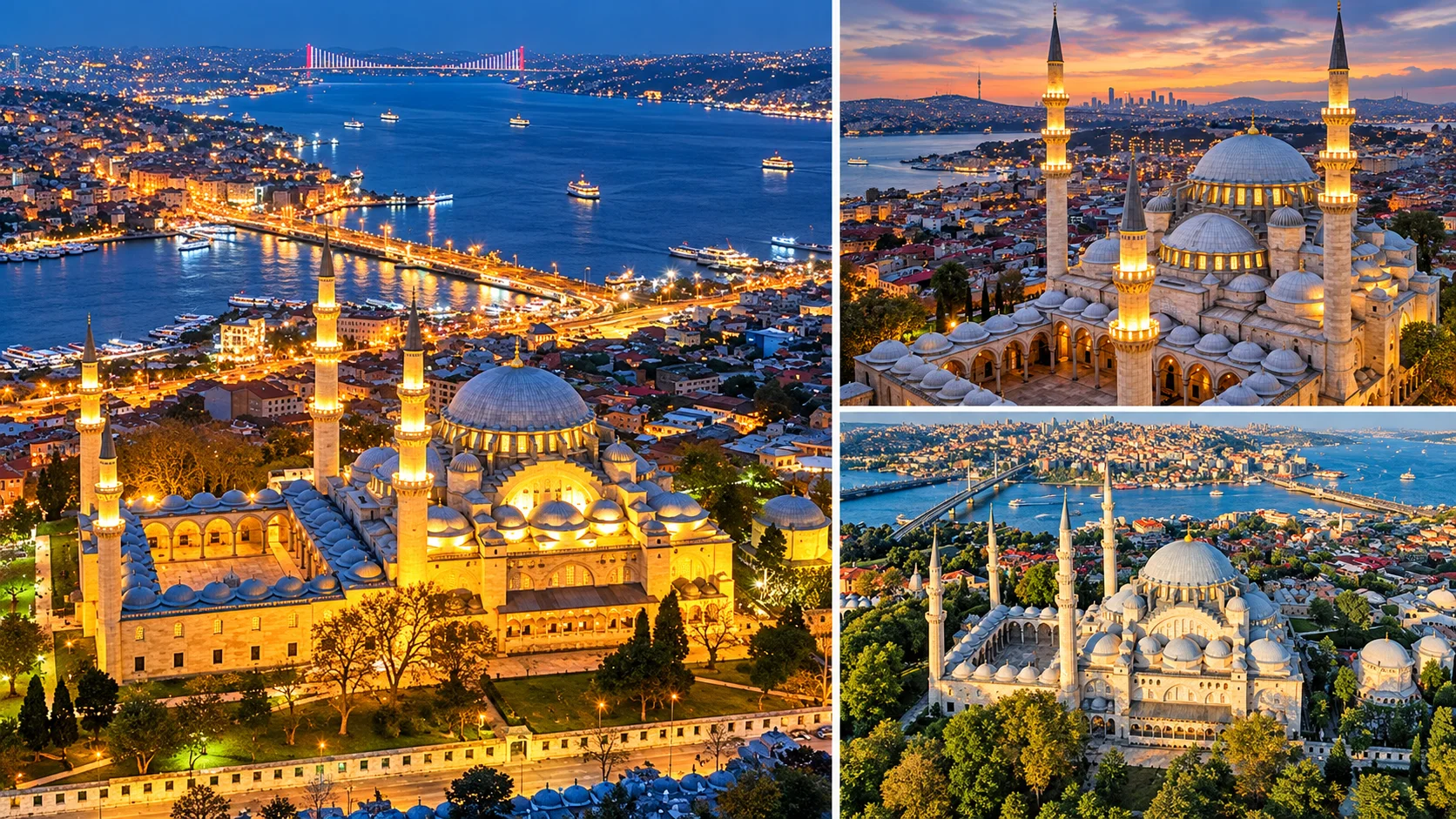
Istanbul, legendary city of seven hills, places Suleymaniye atop its third. From the Eminönü waterfront and the Golden Horn below, the mosque's domes and minarets have defined the city's skyline since the 16th century. Sinan designed the complex not just as a building but as a statement in the urban landscape — its positioning is as deliberate as every calculated arch and window ratio inside.
Unlike Sultanahmet Square, the Suleymaniye neighbourhood retains a quieter, more lived-in character. The streets around the complex are still lined with tea houses, small bookshops and stone-built madrassas that have been in continuous use for nearly five centuries. A terrace garden behind the mosque delivers a panoramic view of the Golden Horn, Galata Tower and the Karaköy waterfront in a single frame.
The mosque sits roughly midway between Eminönü and the Grand Bazaar — within easy walking distance of most of the Historic Peninsula's major sites. A full day itinerary can comfortably combine Suleymaniye with Hagia Sophia, Sultanahmet and the Grand Bazaar on foot.
1550–1557
Construction: An Imperial Monument in Seven Years
By 1550, Suleiman the Magnificent had ruled the Ottoman Empire for three decades. His realm stretched from Hungary to Mesopotamia; his treasury overflowed from conquest. To mark his era on Istanbul's skyline and to serve the city's growing population, he commissioned a külliye — a full social and religious complex — on the Third Hill. Mimar Sinan was appointed chief architect.
Construction involved roughly 3,000 workers, craftsmen and labourers. Sinan personally oversaw everything from ground surveys and water drainage to stone selection and window proportions. Some sources suggest that materials from Byzantine structures were incorporated; modern analysis indicates such reuse was limited. The foundations were sunk deep to account for seismic loads, in places reaching bedrock directly.
The mosque was completed in 1557 and opened in a grand ceremony attended by Suleiman himself. The court poet Bâkî composed a celebratory ode for the occasion. With the full complex operational, Suleymaniye instantly became not just a place of worship but the social and intellectual hub of 16th-century Istanbul.
Mimar Sinan
Mimar Sinan and His "Journeyman's Work"
Mimar Sinan (c. 1490–1588) served as Chief Imperial Architect of the Ottoman Empire for roughly half a century. He designed over 300 structures — mosques, bridges, caravanserais, fountains, palaces — shaping the built environment of an empire that stretched across three continents.
According to his biographical text, the Tezkiretü'l-Bünyan, Sinan described Suleymaniye as his journeyman's work and the Selimiye Mosque in Edirne as his masterwork. Whether this reflects true humility or rhetorical modesty attributed by the biographer is debated; what is certain is that Suleymaniye represents a landmark in structural engineering and spatial design regardless of the label.
Sinan drew on the Byzantine tradition — the Hagia Sophia dome system served as a starting point — but departed from it fundamentally. The load distribution, the window strategy and the way the interior space opens up are genuinely original solutions. For a broader look at Sinan's Istanbul legacy, our guide to Istanbul's historic mosques covers his other major works in the city.
Sinan's own tomb stands not inside the complex but just outside its northeast boundary on Mimar Sinan Street — a small mausoleum he most likely designed himself, looking toward the mosque he built.
Dome System and Structure
Architectural Design: Dome, Half-Domes and the Load System
The main dome measures approximately 26.5 metres in diameter and rises to an interior height of around 47 metres above the floor. It is flanked on the east and west by two half-domes, each of which is in turn supported by smaller quarter-domes. This cascading system redistributes the dome's outward thrust stepwise through buttresses and into the ground, allowing the walls between to be much thinner than in earlier mosque designs.
Four massive piers at the corners of the central bay carry the vertical load. Between them, large window openings replace solid wall. This combination of structural logic and visual restraint gives the interior its sense of weightlessness: the dome appears to float rather than press down. The optical effect is deliberate — Sinan concealed the mechanical reality behind a carefully composed spatial experience.
The 138 windows are arranged across three levels: at arcade level, at gallery level, and at the upper clerestory. This layered lighting design ensures that natural light reaches deep into the interior, shifting as the sun moves. The concentration of windows in the qibla wall frames the mihrab in particular radiance. The stained glass is traditionally attributed to Ibrahim the Drunkard, a glazier contemporary with Sinan.
From outside, the building reads as a measured progression of domes stepping up to the central crown, flanked by four minarets. Sinan resolved the tension between outer mass and inner openness — what appears heavy and monumental from the street becomes light and serene inside.
Courtyard and Minarets
The Porticoed Courtyard and Four Minarets
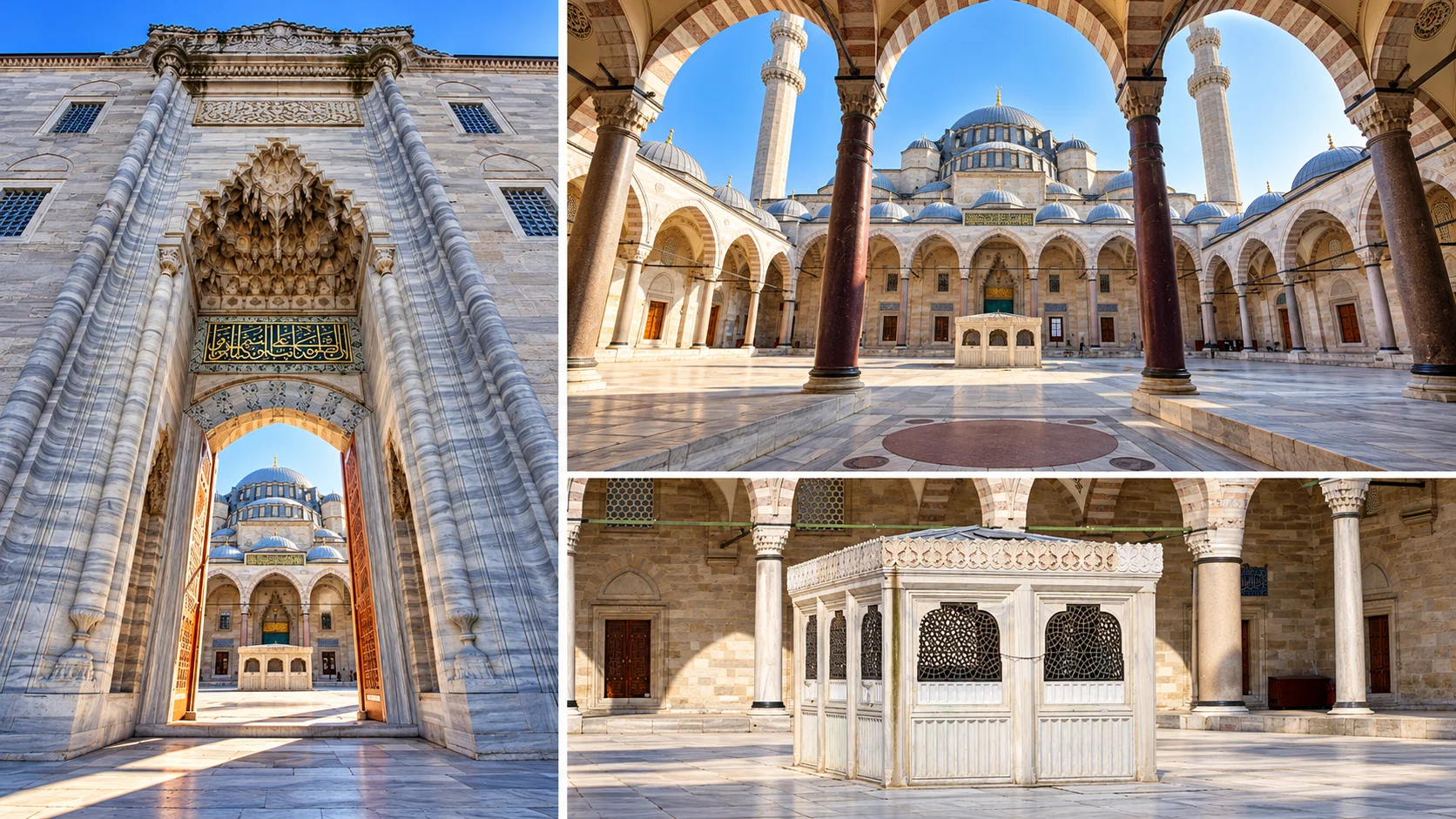
Entry to the mosque is through a large colonnaded courtyard. Arcaded porticos run along all four sides; in the centre stands a marble ablution fountain (şadırvan). The courtyard is not merely a transitional space — it is an architectural composition in its own right. On an early morning, when the revak shadows fall across the stone pavement, it rivals the mosque interior as the most compelling space in the complex.
The four minarets rise from the front and rear corners of the mosque. The two at the front carry three balconies each; the two at the rear carry two. Ten balconies in total. According to popular tradition, this number symbolises Suleiman the Magnificent's status as the tenth ruler of the Ottoman dynasty. Whether this interpretation is supported by any documented Ottoman source is unclear; it persists in tour guides and popular histories as an established narrative.
The calligraphic inscriptions above the portal and on the minarets are attributed to Ahmed Karahisari, one of the foremost calligraphers of the period. The compositions render Quranic verses in a script that complements the stone architecture rather than competing with it.
Interior
Light, Tile and Calligraphy: The Interior Language
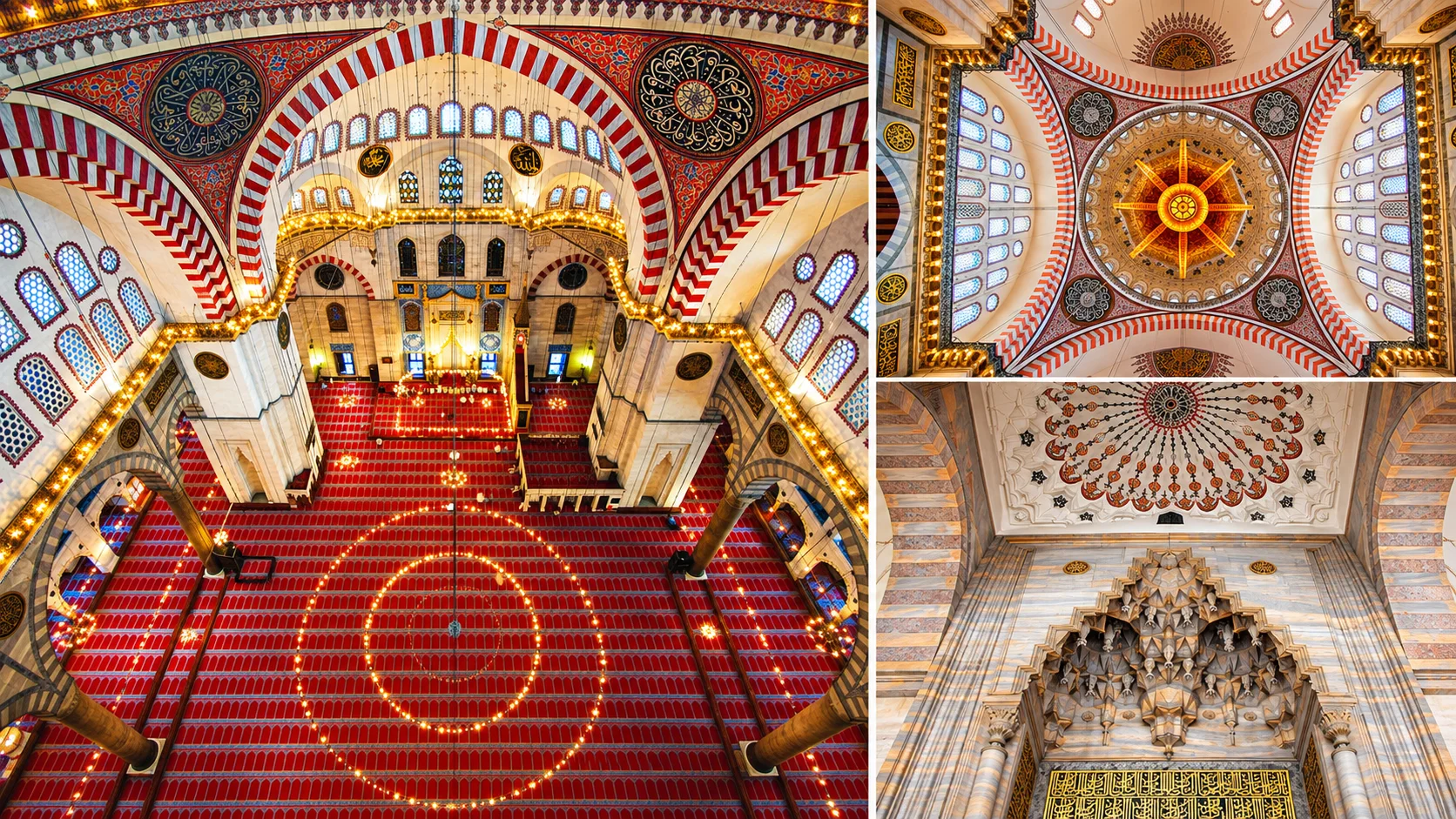
Step inside and the first impression is space. Suleymaniye's interior is one of the most open of any Ottoman mosque: columns are kept to a minimum, and the main bay is a single vast hall beneath the floating dome. The dome sits roughly 47 metres above you; the piers carrying it are set wide and kept visually slim. The effect — a canopy hanging without apparent support — is achieved through rigorous structural engineering made deliberately invisible.
Iznik tiles frame the mihrab and run across the qibla wall: deep blue and white grounds with red-outlined botanical motifs, the product of 16th-century Iznik kilns at their peak. Painted arabesques continue across the inner dome surface and the pendentives supporting it. The carved wooden minbar and the inlaid door panels rank among the finest examples of Ottoman decorative craftsmanship.
The coloured glass windows — attributed to Ibrahim the Drunkard, a glazier who was reportedly a contemporary of Sinan — break incoming light into amber and blue bands that transform the interior at different hours of the day. Morning sun entering from the east and midday light concentrating on the qibla wall create the most dramatic effects.
Some sections were altered during the Fossati restoration of 1847, including the repainting of certain original Iznik tiles — a point of ongoing scholarly debate. The fundamental architectural fabric remains largely intact.
16th-Century Engineering
The Soot Room, Acoustics and Hidden Design Details
Suleymaniye's engineering legacy runs much deeper than what the eye can see. Beneath the dome and within the walls, technical solutions survive that continue to surprise visitors and researchers alike.
The Soot Room — Documented Fact
In the vestibule above the entrance portal, soot (lamp black) carried by flue channels from the candles and oil lamps throughout the mosque collects in a small dedicated chamber. This prevents the soot from depositing on the walls and ceilings. Historical sources record that the collected soot was harvested over the centuries for use in producing ink and pigment. It is one of the best-documented examples of Ottoman environmental engineering.
Acoustic Design
Some architectural surveys have reported ceramic vessel fragments embedded in the mosque's walls and niches, thought to have been placed to regulate sound dispersion and control reverberation. Observations of similar practices in other Ottoman mosques exist in the literature. A definitive study of the acoustic system at Suleymaniye specifically remains a subject for further research.
Air and Water Infrastructure
Window placement and roof angles are calculated to drive natural airflow through the interior. The complex's water infrastructure — fountains, the ablution courtyard, the bath house and stables — is served by interconnected channel systems. Sinan's water engineering across Istanbul formed part of the same disciplined technical tradition as his structural design.
Historical Accuracy
Fact or Legend?
Suleymaniye attracts a large body of popular lore alongside its well-documented history. The table below assesses the most widely circulated claims against available historical and architectural evidence.
| Claim | Status | Notes |
|---|---|---|
| "Suleymaniye has never been damaged by an earthquake" | False | The 1766 Istanbul earthquake caused significant structural damage, particularly to the dome drum, requiring major repairs. |
| Soot room — soot collected and used for ink and pigment production | Documented Fact | Confirmed in architectural and historical sources; an original Ottoman engineering solution. |
| 4 minarets + 10 balconies = symbolism of Suleiman as 10th sultan | Popular Tradition | Widely repeated in tour guides; no documented Ottoman official source confirming this interpretation has been identified. |
| A Byzantine cross concealed in the red stonework | No Documented Evidence | A folk story in circulation; no supporting find in academic architectural studies. |
| Golden ratio (φ ≈ 1.618) deliberately applied | Unverified | Ottoman architects used specific proportional systems; a specific academic source confirming golden ratio use at Suleymaniye has not been identified. |
| Ostrich eggs hung in mosque lamps | General Ottoman Practice | Hanging ostrich eggs in mosque lamps as an insect deterrent is a well-documented Ottoman tradition; Suleymaniye was part of this practice. |
| Sinan called Suleymaniye his "journeyman's work" | Source-Based | The term appears in the Tezkiretü'l-Bünyan. Whether the words are Sinan's own or the biographer's remains debated; the textual source exists. |
The Suleymaniye Complex
Not a Mosque — A City Within a City
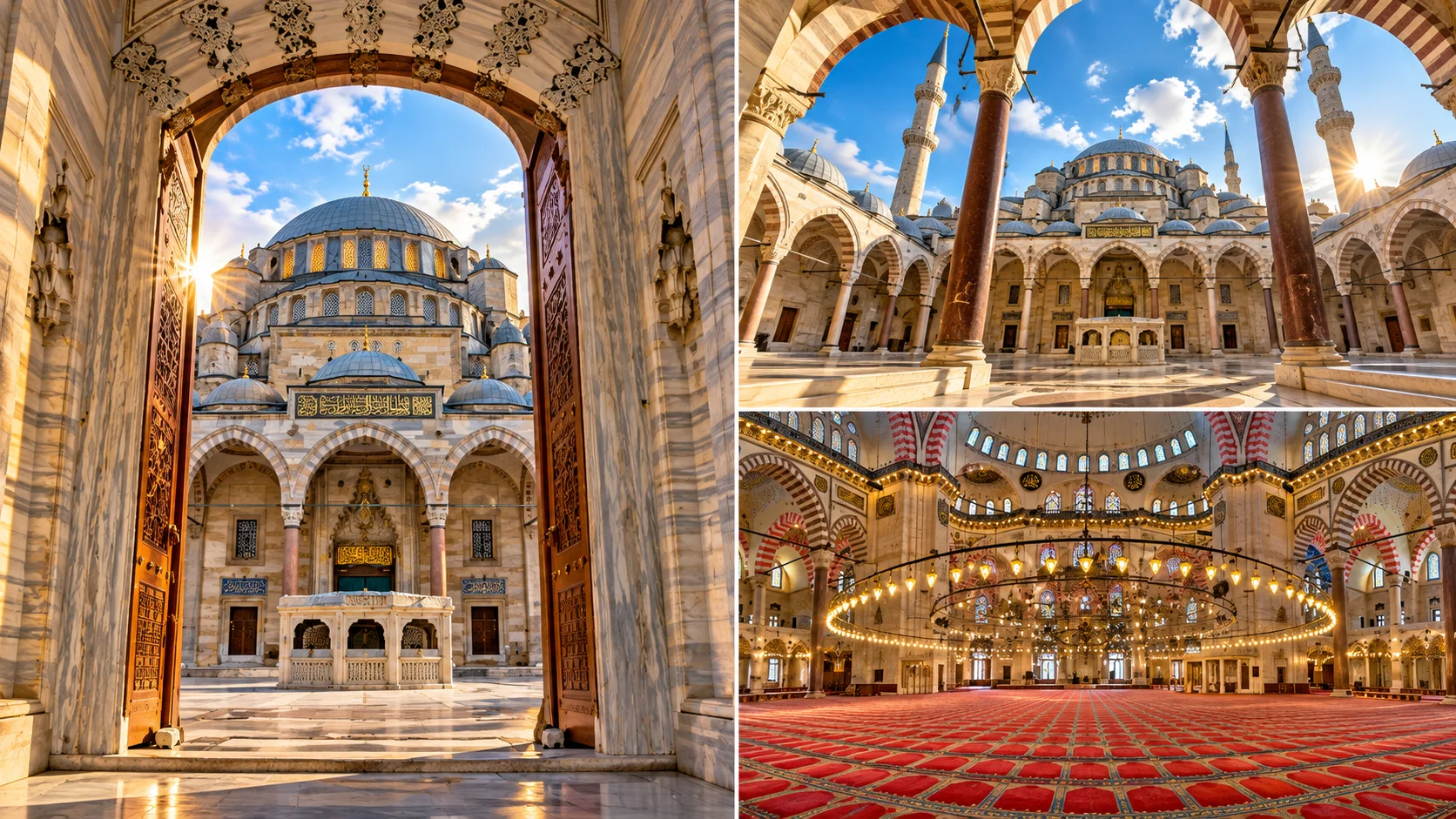
The Suleymaniye Külliye is Ottoman social architecture at its most ambitious. Enclosed within high boundary walls, it comprises six madrassas (theological schools), a darüşşifa (hospital), an imaret (public soup kitchen), a bath house, a caravanserai, a market and the mausolea — all interconnected within a single precinct.
The six madrassas were each dedicated to a different discipline: medicine, mathematics, hadith, jurisprudence and other fields. Several still operate as research institutes under Istanbul University. The darüşşifa was one of the most sophisticated medical facilities of its era, treating both physical and psychological conditions. The imaret served two meals a day to the poor, to students and to travellers free of charge; its capacity made it one of the largest charitable food operations in 16th-century Istanbul.
The garden terrace at the rear of the complex, overlooking the Golden Horn, is one of the least-crowded and most rewarding viewpoints in Istanbul. The panorama takes in the Golden Horn, Galata Tower and the Karaköy waterfront in a single sweep. Most visitors miss it entirely.
Mausolea
Suleiman the Magnificent, Hurrem Sultan and Mimar Sinan
Two royal mausolea stand in the garden southeast of the mosque; Sinan's own tomb lies just outside the complex boundary.
Mausoleum of Suleiman the Magnificent
Built by Sinan following Suleiman's death in 1566, the mausoleum stands outside the mosque's main courtyard in the southeast garden. The octagonal structure is lined with Iznik tiles and represents Ottoman funerary architecture at its most refined. It is open to visitors, accessed from the outer wall of the complex.
Mausoleum of Hurrem Sultan
The tomb of Hurrem Sultan (Roxelana), Suleiman's consort, stands immediately beside his mausoleum in the same garden. Hurrem died in 1558, eight years before Suleiman. Her mausoleum is somewhat smaller than his but decorated in a comparable tile programme. It is also open to visitors.
Mimar Sinan's Tomb
Sinan's tomb is not inside the complex. It occupies a small mausoleum on Mimar Sinan Street, just northeast of the complex boundary — on land Sinan owned. He almost certainly designed it himself. The tomb is visible from the street and carries an inscription identifying him. A short walk from the complex entrance.
Restoration History and World Heritage
Earthquakes, Major Restorations and UNESCO
Suleymaniye has undergone several significant interventions since its 1557 inauguration. Their history reflects both the building's resilience and the changes it has absorbed across the centuries.
The 1766 earthquake caused serious structural damage to the mosque, particularly to the dome drum and certain arches. Subsequent repairs preserved the essential structure. The claim that Suleymaniye "has never been damaged by an earthquake" is historically inaccurate.
The Fossati restoration (1839–1847): At Sultan Abdülmecid's direction, Swiss architects Gaspare and Giuseppe Fossati carried out a comprehensive renovation. The work is controversial — certain original Iznik tiles were overpainted — but it prevented more severe deterioration. The Fossati brothers restored Hagia Sophia during the same commission.
Modern restorations: Various repair campaigns have been carried out since the mid-20th century. Work in the 2000s and 2010s has prompted debate in conservation circles over aesthetic choices, though the structural aims of the interventions are sound.
UNESCO status: Suleymaniye forms part of the Historic Areas of Istanbul inscribed on the UNESCO World Heritage List in 1985. This is a group listing covering the Sultanahmet area, Hagia Sophia, Topkapi Palace, Zeyrek Mosque and other major sites of the Historic Peninsula — not a standalone designation for Suleymaniye alone.
Practical Information
Visitor Guide 2026
Hours and Admission
- General visiting: 09:00–17:00 between prayer times
- Closed for approximately 30–45 minutes at each of the five daily prayer times
- Friday noon prayer (~12:30–13:30): mosque closed to non-worshippers
- The mausolea keep the same hours; access from the outer garden
- Admission is free of charge
Dress Code
- Shoulders and knees must be covered — for all visitors
- Women must cover their heads; free headscarves and wraps are available at the entrance
- Shoes are removed at the entrance; plastic bags are provided
- Short shorts and sleeveless tops are not permitted
Photography and Conduct
- Photography is permitted outside prayer times
- Flash is discouraged; large tripods are not advisable
- Keep voices low and avoid disrupting worshippers
Best Time to Visit
- Weekday mornings 09:00–11:00: fewest visitors, best light
- April–May and September–October: ideal weather and moderate crowds
- Avoid Friday lunchtime entirely
Getting There
How to Reach Suleymaniye Mosque
By Tram
Take the T1 tram line and alight at Vezneciler or Eminönü. From Vezneciler the walk is around 7–10 minutes. The Eminönü route is slightly longer but passes the Egyptian Bazaar (Spice Market).
By Metro
Take the M2 line to Yenikapı and transfer to the T1 tram toward Kabataş, alighting at Eminönü or Vezneciler. From Aksaray (M1A) it is a roughly 20-minute walk to Suleymaniye.
Walking from Sultanahmet
After visiting Hagia Sophia or the Blue Mosque, walk through or around the Grand Bazaar to reach Suleymaniye in 15–20 minutes. The route passes through five centuries of continuous urban history.
By Private Transfer
For direct, comfortable transport from the airport or your hotel, book a private Istanbul airport transfer. A car with driver lets you cover Suleymaniye, the Grand Bazaar, Hagia Sophia and more in a single well-paced day.
What's Nearby?
Around the Complex: Sights, Routes and Kuru Fasulye
Suleymaniye sits at the centre of the Historic Peninsula's densest cluster of sights. The mosque visit pairs naturally with the following stops.
Suleymaniye Kuru Fasulye
The neighbourhood is inseparable from a simple, slow-cooked white bean dish: kuru fasulye (dried beans) with rice pilaf, ladled from copper pots and served in no-frills lokanta restaurants that have been feeding students, tradespeople and visitors for generations. Arrive early at lunch — queues form. An honest, filling Istanbul meal that costs almost nothing.
Vefa Bozacısı and Eminönü
A 10-minute walk leads to Vefa Bozacısı, open since 1876, where the fermented wheat drink boza is served in winter months — a neighbourhood ritual. Continue down to Eminönü for the Egyptian Bazaar (Spice Market), the fish sandwich boats moored at the waterfront and the Galata Bridge crossing.
Grand Bazaar and the Historic Peninsula
The Grand Bazaar is a 10-minute walk to the south. Beyond it lie Hagia Sophia and the Blue Mosque. North and east of Suleymaniye, the Fatih neighbourhood and Zeyrek extend the walk into less-visited territory. The full Historic Peninsula circuit is manageable on foot in a day with good shoes.
Frequently Asked Questions
Suleymaniye Mosque — FAQ
Where is Suleymaniye Mosque?
Suleymaniye Mosque is in the Suleymaniye quarter of Fatih district, on the Third Hill of Istanbul's Historic Peninsula. It overlooks Eminönü and the Golden Horn. The walk from Beyazıt Square takes around 10 minutes; from Sultanahmet, around 20 minutes on foot.
Is entry to Suleymaniye Mosque free?
Yes, admission is entirely free. The mausolea of Suleiman the Magnificent and Hurrem Sultan, located in the garden beside the mosque, are also free to visit.
What are the opening hours?
The mosque is generally open from 09:00 to 17:00. It closes for approximately 30–45 minutes at each of the five daily prayer times. On Fridays, it is closed to non-worshippers during the noon prayer (approximately 12:30–13:30).
What is the dress code?
Shoulders and knees must be covered. Women are required to cover their heads; free headscarves are available at the entrance. Shoes are removed before entering the prayer hall; plastic bags are provided at the door.
Who built Suleymaniye Mosque and when?
It was commissioned by Suleiman the Magnificent and construction began in 1550. Chief Imperial Architect Mimar Sinan supervised every stage. The mosque was completed in 1557 and inaugurated in a formal ceremony attended by Suleiman himself.
How big is the dome?
The main dome is approximately 26.5 metres in diameter. From the floor to the apex of the dome, the interior height is around 47 metres. The dome is supported on east and west by two half-domes in a cascading structural system.
Why does Suleymaniye have 4 minarets and 10 balconies?
Popular tradition holds that the 10 balconies (şerefe) symbolise Suleiman's status as the tenth Ottoman sultan. Whether this interpretation appears in any documented Ottoman source is uncertain; it is a well-established popular narrative repeated in guidebooks and tour commentary.
Where is Mimar Sinan's tomb?
Sinan's tomb is not inside the complex. It stands on Mimar Sinan Street, just northeast of the complex boundary, in a small mausoleum on land Sinan owned. He almost certainly designed it himself. It is a short walk from the main entrance of the complex.
Where is Suleiman the Magnificent buried?
The Mausoleum of Suleiman the Magnificent stands outside the mosque's main courtyard, in the southeast garden of the complex. Hurrem Sultan's mausoleum is immediately adjacent. Both are open to visitors and are accessed from the complex's outer wall.
Was Suleymaniye Mosque ever damaged by an earthquake?
Yes. The 1766 Istanbul earthquake caused significant structural damage, particularly to the dome drum. Major repairs were carried out in the aftermath. The claim that the mosque has "never been damaged by an earthquake" is historically incorrect.
How does Suleymaniye differ from the Blue Mosque?
The Blue Mosque (Sultan Ahmed Mosque) was built in 1616 and sits on Sultanahmet Square, drawing significantly higher tourist volumes. Suleymaniye was completed in 1557, occupies a quieter neighbourhood and encompasses a far more extensive social complex. Architecturally, Suleymaniye is generally considered the purer expression of Sinan's structural and spatial thinking.
What is the Suleymaniye complex (külliye)?
The külliye comprises six madrassas (theological schools), a hospital (darüşşifa), a public soup kitchen (imaret), a bath house, a caravanserai, a market and the mausolea — all enclosed within a shared precinct. Several madrassas are still active as research institutes under Istanbul University.
What should I eat near Suleymaniye?
The neighbourhood is famous for kuru fasulye: slow-cooked white beans with rice pilaf, served in historic lokanta restaurants at lunch. A short walk away, Vefa Bozacısı (open since 1876) serves boza (fermented wheat drink) in winter. Eminönü's waterfront and Spice Market add further options to a full-day itinerary.
Is Suleymaniye Mosque a UNESCO World Heritage Site?
Yes — as part of the Historic Areas of Istanbul, inscribed on the UNESCO World Heritage List in 1985. This is a group listing covering Sultanahmet, Hagia Sophia, Topkapi Palace and other key sites of the Historic Peninsula. Suleymaniye is included within this umbrella designation.
When is the best time to visit Suleymaniye?
Weekday mornings between 09:00 and 11:00 offer the least crowded conditions and the best interior light. Spring (April–May) and autumn (September–October) are ideal for weather and manageable visitor numbers. Avoid Friday lunchtime.
What other historic mosques should I visit in Istanbul?
Key sites include Hagia Sophia, the Blue Mosque, Fatih Mosque and the smaller but extraordinary Rüstem Paşa Mosque — its walls almost entirely covered in Iznik tiles. Our guide to Istanbul's historic mosques covers a broader itinerary across the city.
Can I take photographs inside?
Photography is permitted during visiting hours outside prayer times. Flash is discouraged and large tripod setups are not advisable. Avoid positions or equipment that might disturb worshippers.
Explore Istanbul
From Suleymaniye to the Historic Peninsula
Plan a complete Historic Peninsula day covering Suleymaniye, Hagia Sophia, the Blue Mosque and the Grand Bazaar with a comfortable private transfer or a full-day chauffeur service. Direct airport transfers and flexible hours make it easy to organise your Istanbul visit from start to finish.