
Uzungöl is one of the most visited highland destinations in Turkey's Black Sea region — a natural lake at 1,090 metres in Çaykara district, Trabzon province, surrounded by forested mountains, a photogenic mosque whose reflection in the still water has made it one of Turkey's most replicated images, and a chain of highland valleys that climb toward the Kaçkar peaks. Declared a nature park in 1989, Uzungöl offers lake scenery, yayla atmosphere, and accessible mountain terrain across all four seasons.
Where Is Uzungöl?
Uzungöl is in the Çaykara district of Trabzon province, in Turkey's Eastern Black Sea region. It lies approximately 99 kilometres from Trabzon city centre and 19 kilometres from the Çaykara district town. The drive from central Trabzon typically takes around two hours depending on traffic and road conditions.
Çaykara and Uzungöl sit in the Haldizen Valley — a deep mountain valley cut by the Haldizen Stream (Haldizen Deresi) between the high ridge systems of the Eastern Black Sea range. The valley walls are steep and heavily forested, and the road from Çaykara climbs steadily before arriving at the lakeside settlement. For international visitors, Trabzon is the main arrival point: the airport lies roughly 90 kilometres from Uzungöl, with a drive of approximately 1.5 hours under normal conditions.
For a broader look at Trabzon's other highlights — Sümela Monastery, the old city, Akçaabat — our guide to places near Trabzon covers the wider province. Uzungöl pairs naturally with a Trabzon-based trip.
How Was Uzungöl Formed?
Uzungöl was not always a lake. The valley was shaped by the Haldizen Deresi, which drains southward from the high plateau toward lower ground. A landslide — rock and earth falling from the steep surrounding slopes — blocked the stream and created a natural dam. Water backed up behind this obstruction and gradually filled the valley floor to form the lake as it exists today.
The name reflects the shape: uzun (long) + göl (lake). From the shore the elongation is not immediately obvious, but from the Garester Yaylası viewpoint above the lake, the true shape stretches clearly down the valley. The lake sits at 1,090 metres above sea level.
In October 1989, the Turkish government designated 1,625 hectares encompassing the lake and its surrounding forests as Uzungöl Tabiat Parkı (Uzungöl Nature Park). The park covers 12,550 dekar of forest and forest clearings, 3,070 dekar of highland pasture, and 630 dekar of settlement area — a protected landscape that continues to shape how the area develops.
The Lake, the Mosque and the Shore Walk
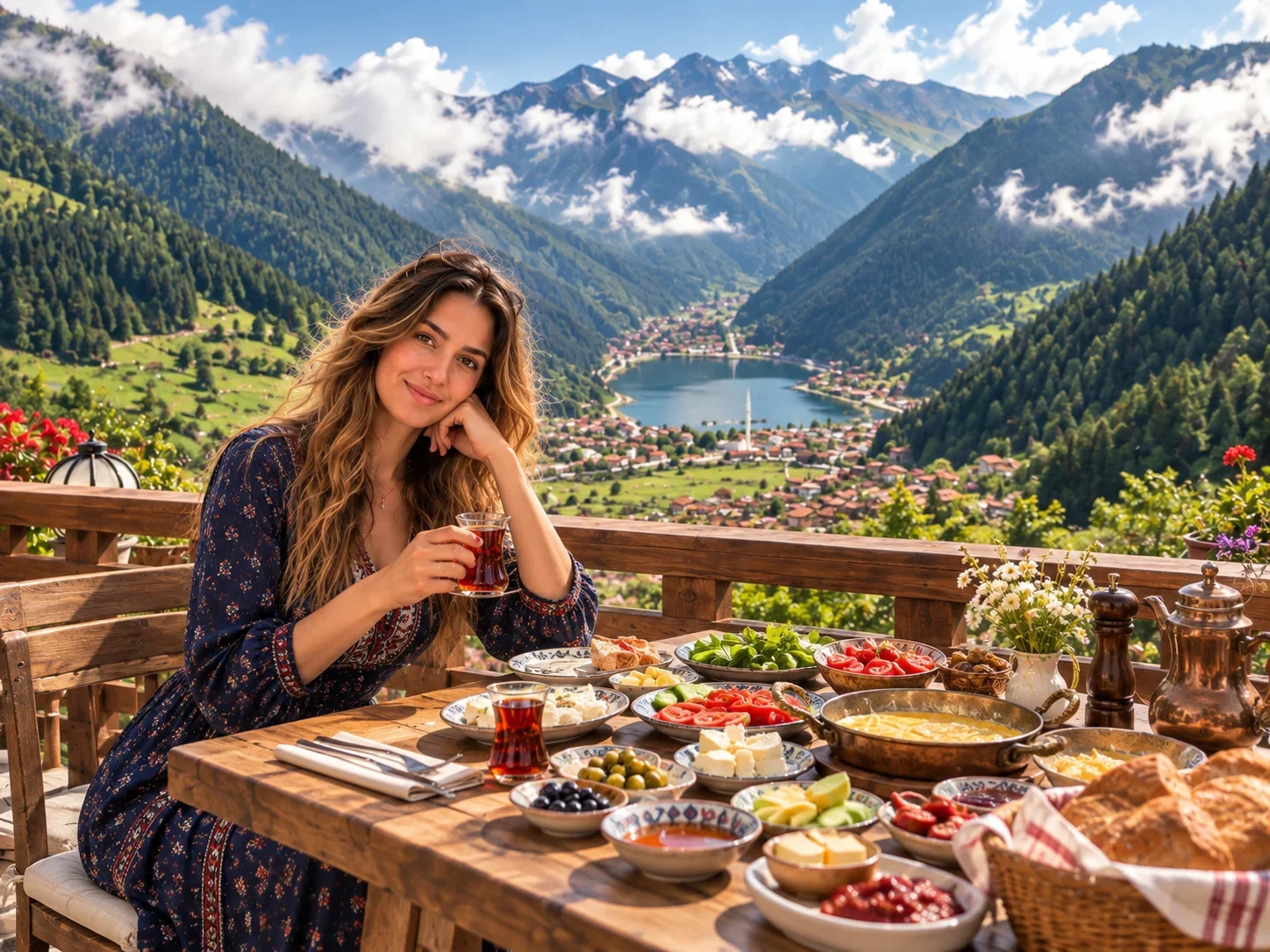
The most photographed scene at Uzungöl is the juxtaposition of the lakeside mosque and its reflection in still water. Uzungöl Camii, built in 2002, stands at the lakeshore with its minaret visible from a distance. In calm morning conditions — before wind disturbs the surface — the reflection is a near-perfect mirror image, with forested slopes framing both the mosque and its double in the water.
Walking around the lake shore is the most natural first activity. The lakeside circuit is approximately 3 kilometres and flat — completable in under an hour at a relaxed pace, and one of the few Turkish highland walks accessible to all fitness levels including families with pushchairs. The path loops around both shores, passing through the settlement and offering changing angles of the lake, the mosque, and the surrounding ridgelines.
The lake surface is most still in the early morning before tourist activity and wind disturb it. Arriving before 9 am for the lakeside walk and mosque reflection is consistently rewarding regardless of season.
Viewing Terrace and Photo Spots
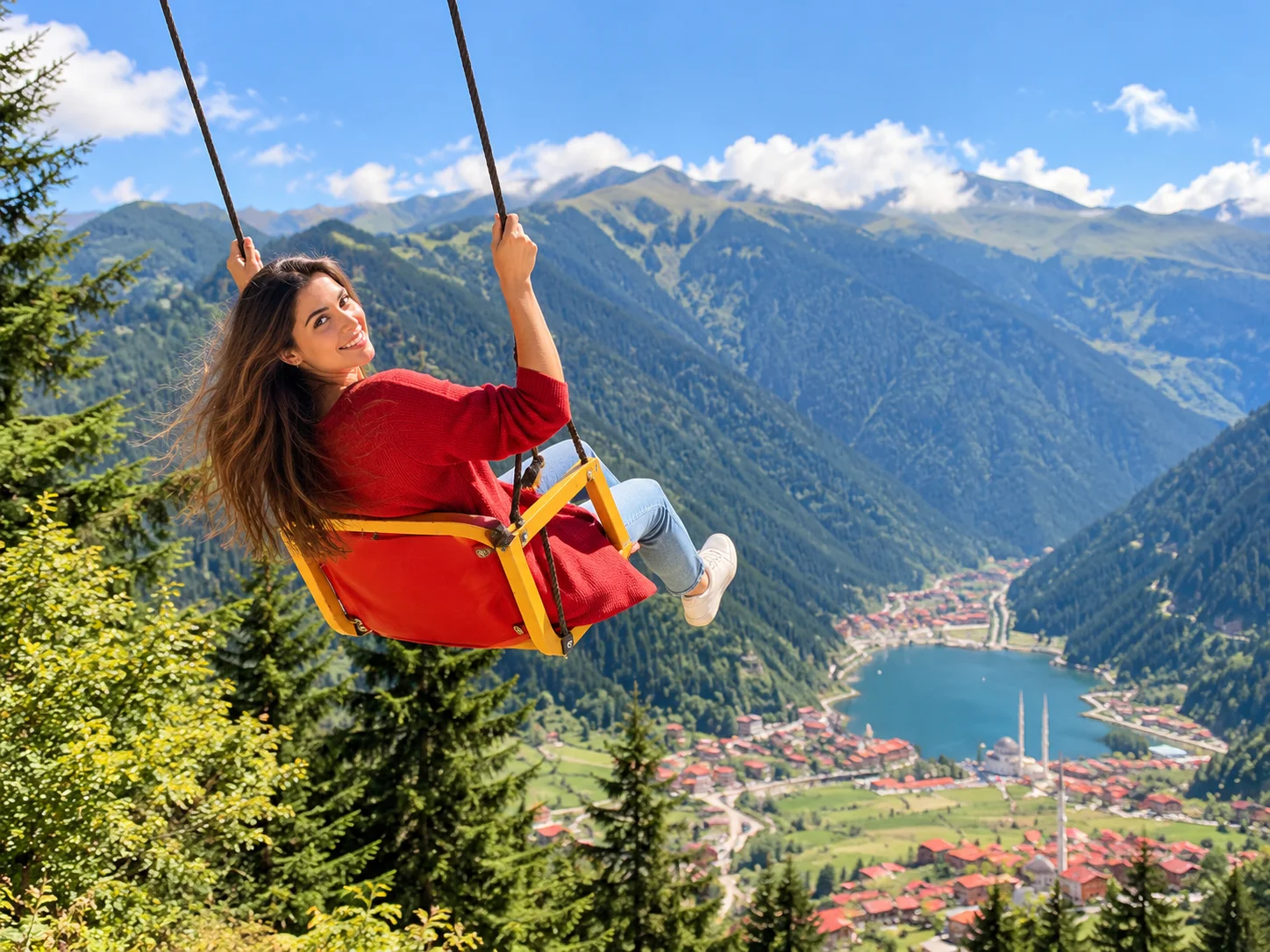
The seyir terası (viewing terrace) on the hill above the lake offers a bird's-eye perspective of Uzungöl's full form — the elongated shape, the settlement at its edges, and the mountains closing in on three sides. This view is different from anything available at lake level and alone makes the short climb worthwhile.
Around the lake and on the surrounding slopes, wooden swings (salıncaklar) and purpose-built photo stops have become a fixture of the Uzungöl experience. These are tourist photography installations — set up at spots with lake or mountain backdrops. The views from them are genuinely good even if the structures themselves have no historical significance. The swing with the lake visible below, particularly in morning light, produces one of the most replicated photos in the region.
For photography: early morning for the mosque reflection; mid-morning for the viewing terrace in good light; overcast or foggy days for a more atmospheric mood with the forest closing in. The Eastern Black Sea is famously photogenic precisely because of its mist and cloud.
Garester Yaylası — The Highland Above the Lake
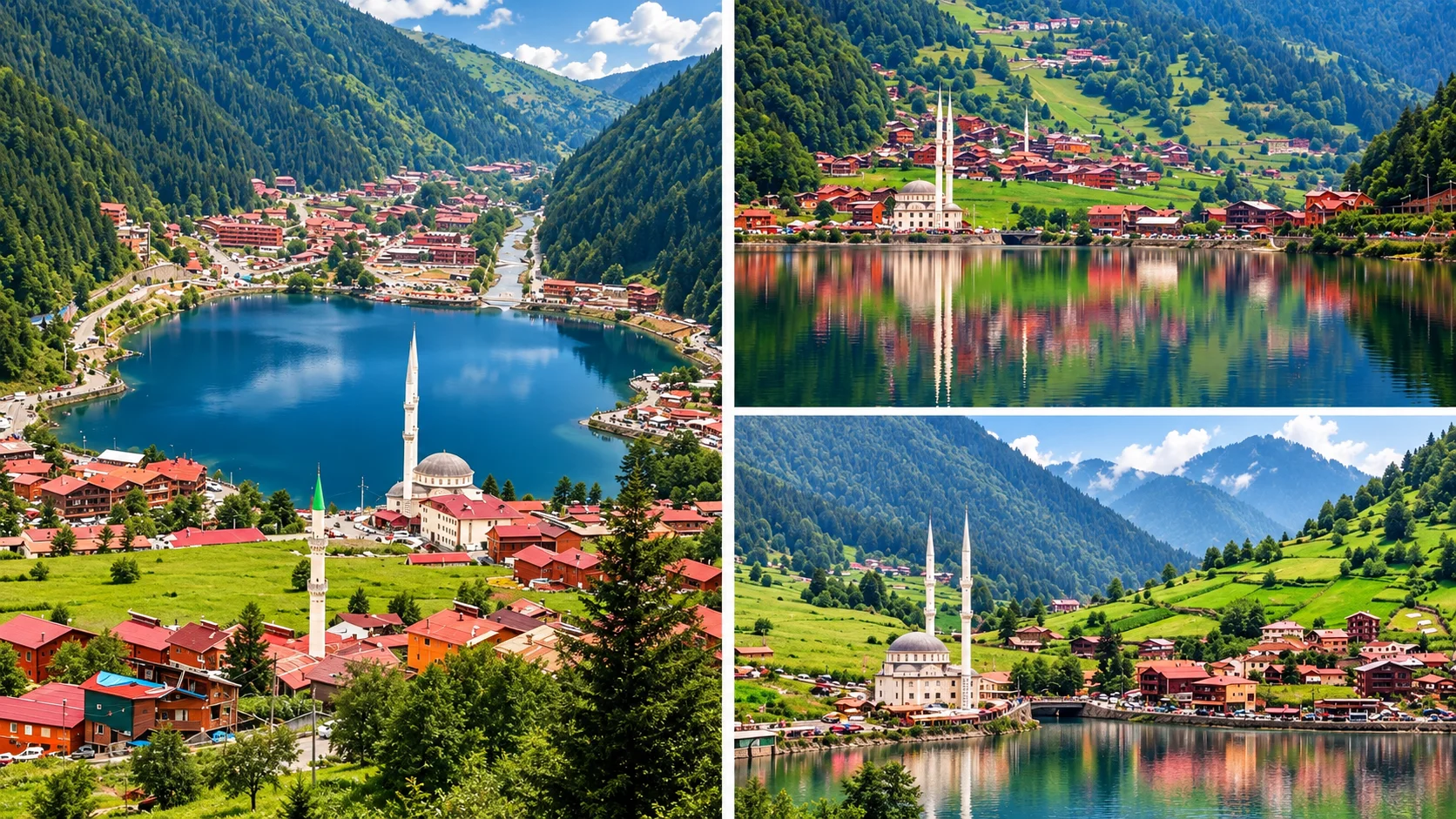
Garester Yaylası (also written Karester in local and tourist usage — both names refer to the same place) rises above Uzungöl to the south. At around 2,300 metres, it offers one of the best panoramic views in the region: the lake clearly visible below, the Kaçkar range on one side, and the valley descending toward the coast on the other.
The drive from Uzungöl follows signs near the mosque and climbs a rough mountain road for approximately 45 minutes. The road is steep in sections and not suitable for low-clearance vehicles. On foggy days — common in the Black Sea highlands — Garester sits above the cloud layer while Uzungöl disappears beneath it, creating a dramatic above-the-clouds atmosphere. In summer, local families run small guesthouses and a restaurant at the plateau, and fresh dairy products are available.
Garester is a worthwhile half-day extension from Uzungöl. The vertical rise from 1,090 metres at the lake to 2,300 metres at the plateau — in under an hour's drive — is characteristic of the Eastern Black Sea's compressed topography and offers a genuinely different perspective on the landscape. The road is generally not passable in winter.
Haldizen Valley and Demirkapı
Above Uzungöl, the Haldizen Valley continues climbing toward the high plateau. The village of Demirkapı (administratively renamed; historically the Haldizen settlement) sits approximately 16 kilometres from Uzungöl at around 1,900 metres. The route follows the Haldizen Stream through increasingly remote and forested terrain — the valley narrows, the road becomes a stabilised track, and the landscape becomes wilder and quieter.
Demirkapı is a staging point for the higher terrain above. The route continuing from here connects to other valleys and eventually to the İkizdere valley — a route used by trekkers and mountain bikers as well as vehicles with appropriate clearance. The upper Haldizen Valley is rich in bird life and botanical diversity. For those who want to go beyond the standard Uzungöl visit, the valley above Demirkapı is where exploration begins.
The Seven Lakes of Haldizen
In the high mountain terrain above Demirkapı, a cluster of crater lakes known as the Yedi Göller (Seven Lakes) occupies the upper Haldizen range. These include Balıklı Göl (the most accessible — named for its natural trout population), Aygır Gölü, Pirömer Gölü, Sarıçiçek Gölü, Dipsiz Göl, and the Çifte Göller. The lakes sit roughly 20 kilometres from Uzungöl and 7 kilometres from Demirkapı.
The crater lakes were formed by geological processes distinct from Uzungöl's landslide origin. Reaching them requires a 4x4 vehicle from Demirkapı or a hiking approach — they are not reachable by standard car from Uzungöl in a single trip. For those with the right equipment and time, the Seven Lakes represent one of the more remarkable day-level objectives in the Eastern Black Sea.
Sultan Murat Yaylası
Sultan Murat Yaylası is a highland area in Çaykara district at around 2,000 metres, approximately 25 kilometres from the Çaykara town centre. The name dates to 1635, when Ottoman Sultan Murad IV camped here with his army during his campaign against Persia — pausing for Friday prayers. The plateau has basic facilities including small pensions, a bakkal, a café, and a mosque.
Sultan Murat Yaylası and Uzungöl are both in Çaykara district but are reached by different roads and are not conveniently visited in the same short trip. For visitors with two days in the Uzungöl area, Sultan Murat can form a separate half-day excursion, particularly for those interested in the broader highland landscape of the district.
Things to Do in Uzungöl
Activities divide between the lake level and the surrounding highlands:
- Lakeside circuit walk (~3 km, flat, all fitness levels): best done in the early morning before the crowds build
- Mosque reflection photography: at sunrise or early morning, from the lakeshore
- Seyir Terası (viewing terrace): a short climb above the settlement for the panoramic perspective
- Paragliding: tandem flights over the lake and valley are offered by local operators; availability is seasonal and subject to weather
- Jeep / 4x4 safari: guided tours with 4x4 vehicles to Garester, Demirkapı, and the surrounding highlands — the practical way to access terrain not reachable by standard car
- Hiking: trails toward Garester and into the upper Haldizen Valley; longer mountain routes for those with equipment and experience
- Highland breakfast: the yayla kahvaltısı at lakeside guesthouses is one of Uzungöl's most consistently recommended experiences
Uzungöl in Winter
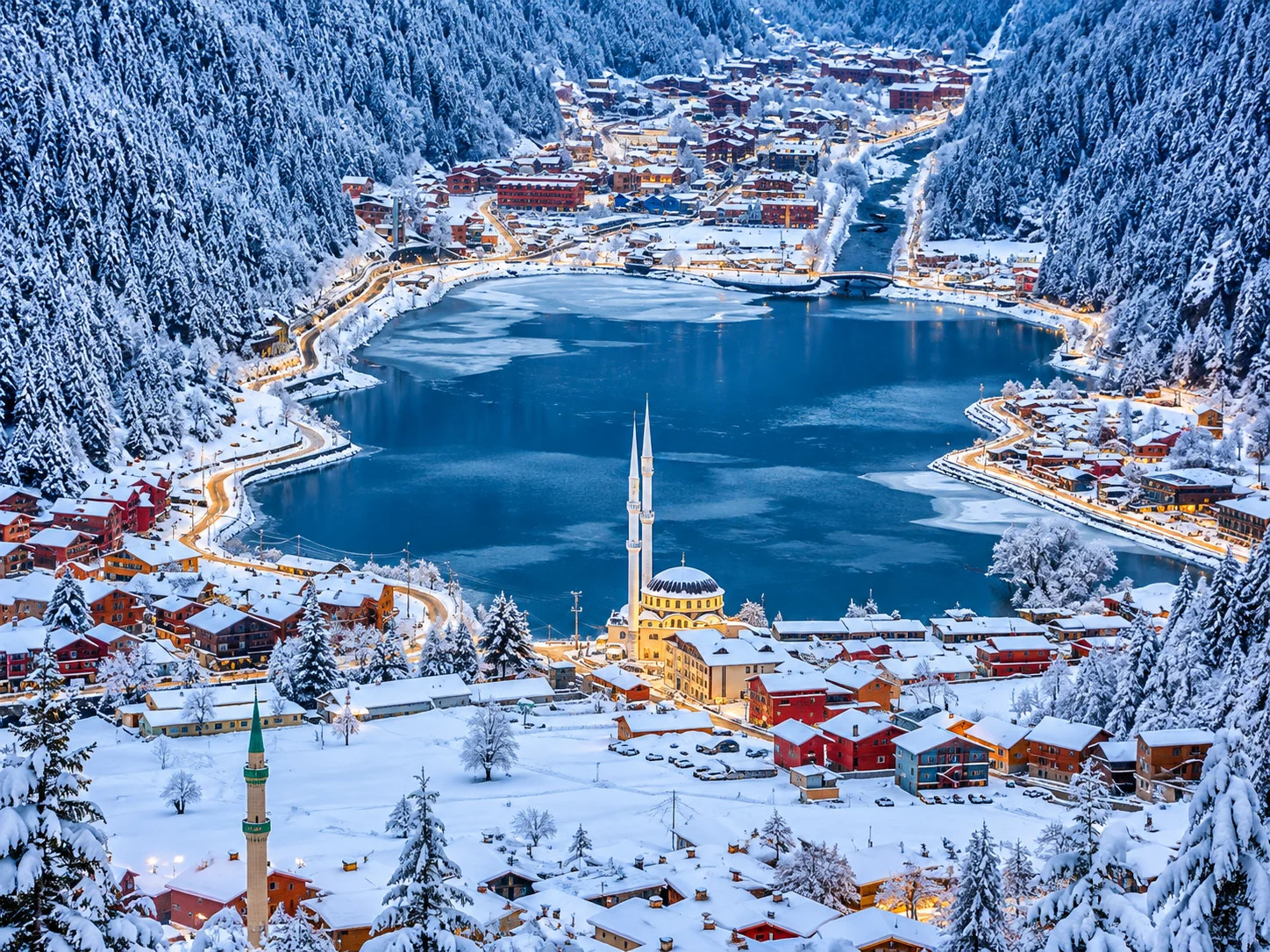
Winter transforms Uzungöl into a quieter, more atmospheric destination. Snow typically covers the settlement and surrounding peaks between December and March, though timing and depth vary year to year. The wooden houses and guesthouse rooftops under snow, with the lake as a backdrop, create a scene with its own appeal entirely distinct from the summer crowds.
The lake does not reliably freeze every winter — temperatures at 1,090 metres can drop well below zero, and the surface may partially or fully freeze in hard winters, but this is not guaranteed on any specific visit. The mosque reflection in cold, still conditions — frost on the banks, snow on the rooftops, mist over the water — is photographically rewarding in ways that summer cannot replicate.
Practical considerations: road conditions between Çaykara and Uzungöl can be affected by snow and ice — check before travelling and consider whether snow tyres or chains are appropriate. Some accommodation and restaurants remain open year-round, but choice narrows compared to summer. The Garester road is not passable in winter. Layered clothing and waterproof footwear are essential.
When to Visit Uzungöl
- Spring (April–May): New leaf growth makes the forests vivid green. Waterfalls in the surrounding valleys are at peak flow. The lake surface is clear and uncluttered. Some highland roads may still be soft or muddy from snowmelt.
- Summer (June–August): Peak season. Uzungöl receives large numbers of visitors in July and August — including many from Gulf countries seeking highland relief from summer heat. The area is lively but can be very crowded; accommodation fills quickly and parking near the lake is limited by mid-morning. Book well in advance for July and August.
- Autumn (September–October): The crowds thin after the first week of September. Autumn colour in the surrounding forests — beech, fir, and broadleaf species — is striking from late September into October. Weather becomes more variable but the atmosphere is considerably quieter than summer.
- Winter (November–March): Snow, stillness, and very few visitors. The lake and mosque under snow is a different and rewarding destination. Road conditions require advance checking.
The Eastern Black Sea climate is famously wet and changeable. Even in summer, afternoon cloud and light rain are common. A waterproof jacket and layered clothing are useful in every season. Average temperatures at Uzungöl run significantly cooler than the Trabzon coast — an asset in summer, a consideration in autumn and winter.
What to Eat at Uzungöl
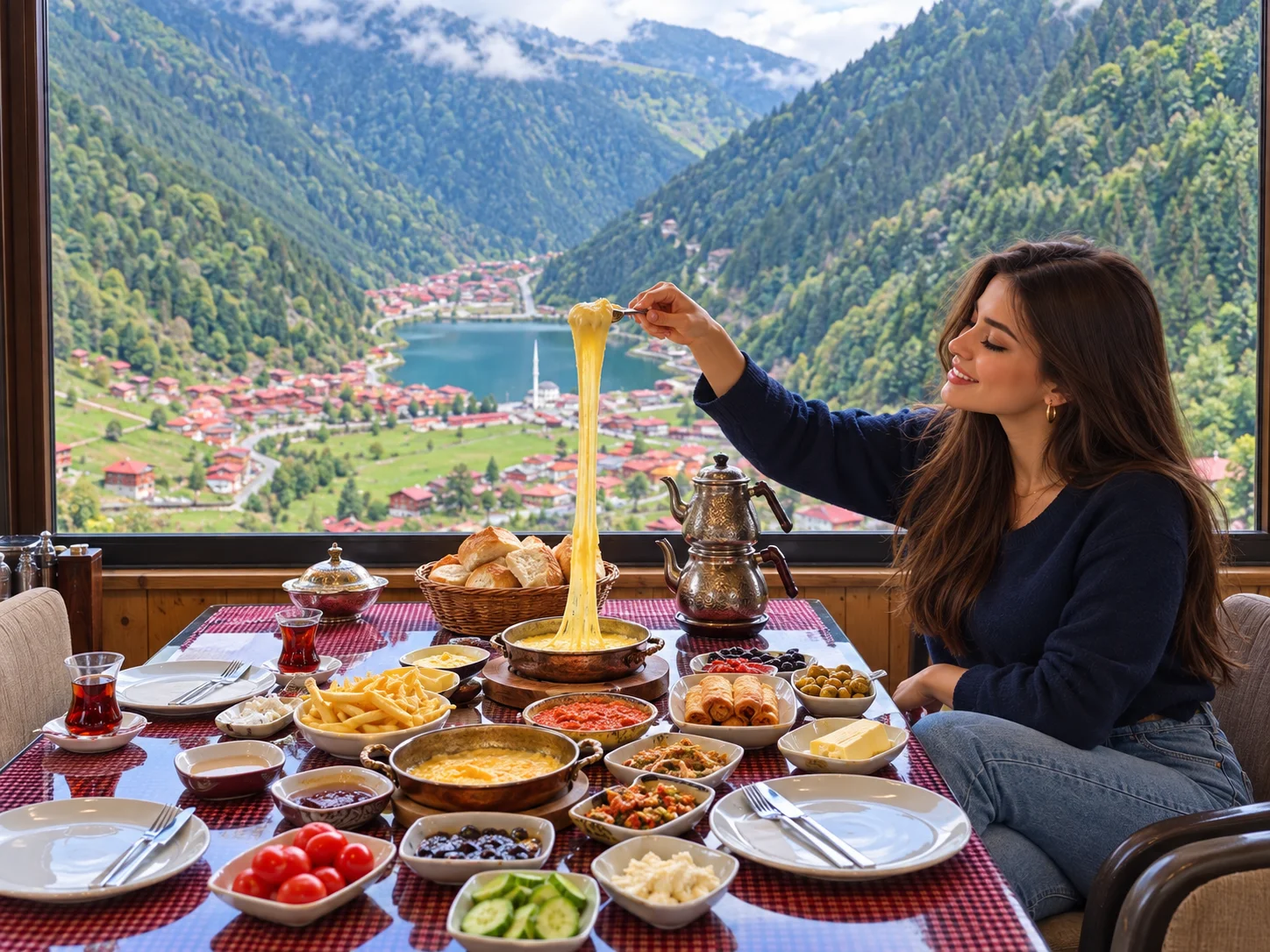
Uzungöl's food culture is one of its strongest draws. The lakeside and surrounding restaurants serve a cuisine built on Black Sea highland staples:
Alabalık (trout) is the signature dish. The Haldizen Stream and its tributaries support natural trout populations, and the restaurants at Uzungöl serve trout pan-fried in local butter as the default main course. If you eat one thing at Uzungöl, it should be this.
Kuymak (also called mıhlama) — the traditional Black Sea dish of cornmeal, local cheese, and butter cooked together over direct heat into a creamy, stretchy mass — is the region's definitive cooked dish. Available at breakfast and as a starter.
The highland breakfast (yayla kahvaltısı) is Uzungöl's most talked-about food experience: fresh butter, local honey, yayla peyniri (highland cheese), kaymak (clotted cream), mısır ekmeği (cornbread), and Rize tea, served with mountain air. Guesthouses and morning cafés on the lakeside serve this from early morning.
Other regional staples: karalahana (collard greens cooked in butter), laz böreği (custard pastry unique to the Eastern Black Sea), and fresh dairy products from the surrounding highland pastures.
Accommodation at Uzungöl
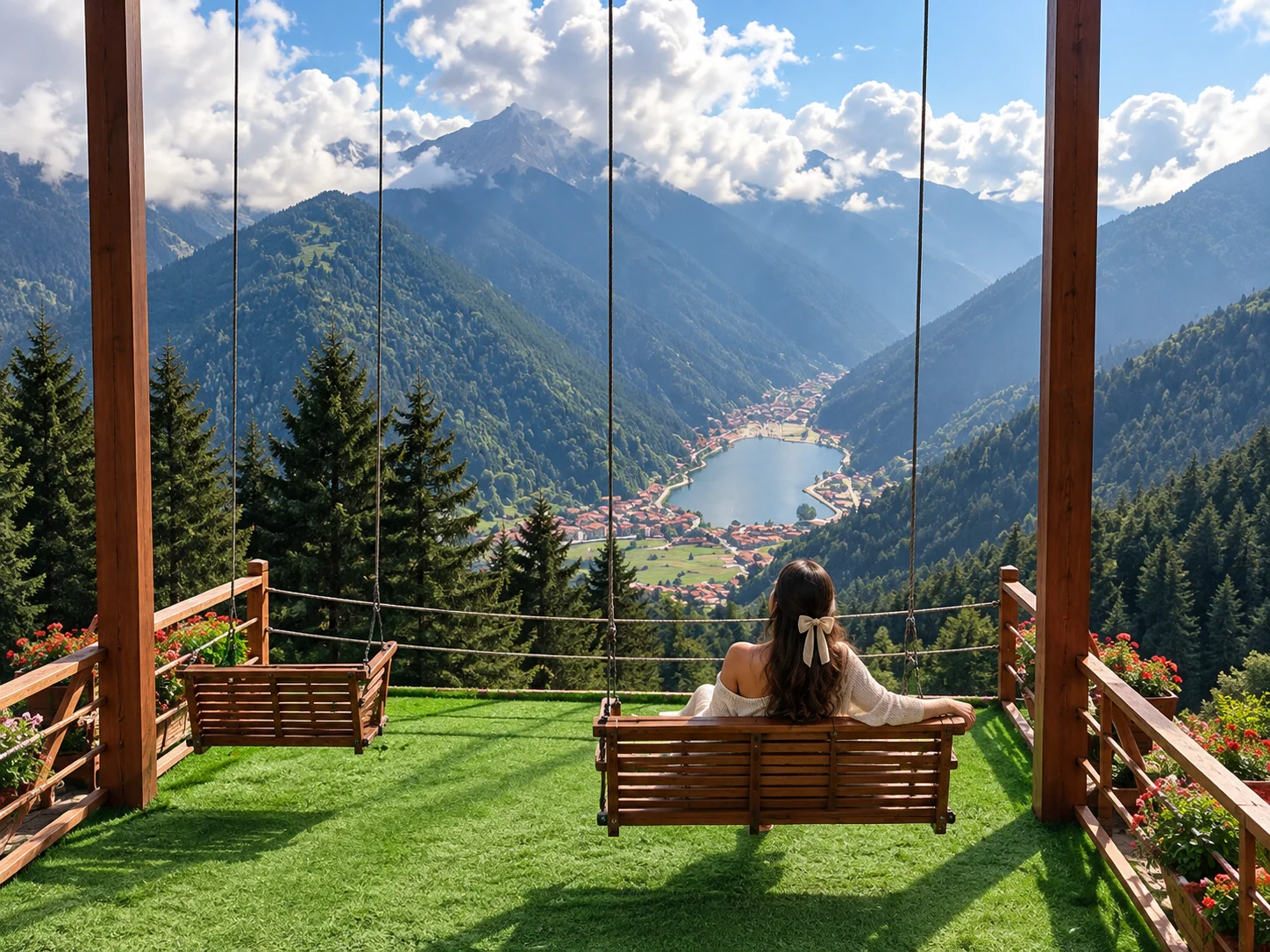
Uzungöl has a well-developed accommodation range despite its highland location. Options span lakeside hotels with direct water views, quieter guesthouses set back on the hillsides, and traditional wooden chalet-style pensions. The most sought-after rooms face the lake — they fill quickly for July and August and warrant advance reservation.
The settlement has grown considerably over the past two decades. Traditional wooden architecture — the style that defines Uzungöl's character — remains the most common accommodation type, though some newer buildings have less regard for the traditional aesthetic. Families will find Uzungöl's layout — flat lakeside walks, short drives to viewpoints, early-morning calm — suits multi-night stays well.
For a quieter experience, guesthouses slightly away from the lake centre or on the hillsides above the settlement offer more calm without sacrificing proximity. In peak season, arriving early in the day is worth doing — the main lakeside area can become congested with vehicles by mid-morning.
How Long to Stay and Sample Itineraries
Uzungöl can be visited as a day trip from Trabzon, but one or two nights reveals significantly more:
- Day trip: Feasible from Trabzon (99 km each way). Time for the lakeside walk, mosque, seyir terası, and lunch. The drive is scenic. Not enough for Garester or the upper valley.
- One night: Adds early-morning lake walk (best light for reflection photography), dinner, and time for Garester Yaylası.
- Two nights: Day 1 — lake, mosque, viewpoint, Garester. Day 2 — Haldizen Valley toward Demirkapı, with Sultan Murat Yaylası as a possible final stop.
Sample 1-Day Itinerary
Arrive early → lakeside circuit walk → mosque reflection → seyir terası → breakfast at a lakeside guesthouse → drive to Garester (if conditions allow, 45 min each way) → return for trout lunch → depart for Trabzon or onward.
Sample 2-Day Itinerary
Day 1: Arrive mid-morning → lakeside walk → seyir terası → afternoon drive to Garester Yaylası → return for dinner and overnight in Uzungöl.
Day 2: Early morning lake reflection walk → highland breakfast → drive up Haldizen Valley to Demirkapı → return; optionally visit Sultan Murat Yaylası direction before departing.
Interesting Facts About Uzungöl
- The name "Uzungöl" literally means "long lake" in Turkish (uzun = long; göl = lake) — a description of its elongated, narrow form most clearly visible from above at Garester Yaylası.
- Uzungöl Tabiat Parkı, declared on 3 October 1989, covers 1,625 hectares — one of the earlier nature parks established in Turkey's Black Sea highlands.
- The lake was created by a natural landslide on the Haldizen Stream — not by glaciation or human engineering. Similar landslide lakes exist elsewhere in the Eastern Black Sea highlands, but Uzungöl is the most visited by far.
- Sultan Murat Yaylası, in the same Çaykara district, is named after Ottoman Sultan Murad IV who camped there during his 1635 Persian campaign — connecting the immediate highland neighbourhood to one of the major Ottoman military expeditions of the 17th century.
- The Garester Yaylası sits at around 2,300 metres — more than 1,200 metres above the lake — yet the two are connected by a vehicle road. This vertical compression within a short horizontal distance is characteristic of the Eastern Black Sea topography.
- Uzungöl became widely popular among Gulf country visitors from the 2000s onward, significantly shaping the area's hospitality landscape. This has influenced accommodation styles, food offerings, and the general atmosphere of the settlement, particularly in summer.
- The upper Haldizen range above Demirkapı contains crater lakes (Yedi Göller), including Balıklı Göl with its natural trout — a different geological story from the landslide lake below, and a rewarding destination for those who venture further into the valley.
Getting to Uzungöl
From Trabzon Airport
Trabzon Havalimanı (TZX) is the main gateway. The airport is approximately 90 kilometres from Uzungöl — around 1.5 hours by car under normal conditions. There is no direct bus service from the airport to Uzungöl. The public transport route requires reaching Trabzon city bus terminal (otogar) first, then taking a minibus or dolmuş toward Çaykara, and finally connecting to a local Uzungöl service — a multi-stage journey that takes considerably longer. A private intercity transfer from Trabzon airport directly to Uzungöl is the most straightforward approach, particularly for families or late arrivals.
From Trabzon City Centre
From central Trabzon, the distance is approximately 99 kilometres. The drive follows the coastal highway east, then turns inland toward Çaykara and climbs through the Haldizen Valley. Public minibuses from Trabzon's otogar run toward Çaykara and Uzungöl; services are more frequent in summer and require a connection at Çaykara. Winter road conditions may require checking in advance.
From Istanbul
From Istanbul, fly to Trabzon (TZX) — direct flights from both IST and SAW take approximately 1.5–2 hours. From Trabzon Airport, arrange a private transfer or use the public transport connections described above. An Istanbul airport transfer to the flight is the first step for most visitors — Trabzon is well connected by domestic routes. Driving from Istanbul to Uzungöl (~1,000 km) is a multi-day undertaking.
Video: Uzungöl — the lake, the mosque reflection, and the Haldizen highland landscape from above.
For visitors arriving via Trabzon Airport, a private intercity transfer to Uzungöl avoids the multi-stage public transport connections and is particularly practical for families, evening arrivals, or those with luggage.
Responsible Travel at Uzungöl
Uzungöl is a designated nature park (Tabiat Parkı) — a status that reflects the ecological significance of the lake, its surrounding forest, and the highland pastures above. A few straightforward guidelines:
- Do not leave litter anywhere in or around the lake, its shoreline, or the highland paths above — the nature park requires it and the setting rewards it.
- Stay on marked paths when hiking in the upper Haldizen Valley; highland meadows and forest floor are easily damaged by off-trail traffic.
- Protect water sources — the streams and springs that feed the lake are ecologically sensitive.
- Observe wildlife quietly; the nature park supports diverse bird species and the higher meadows have undisturbed flora worth leaving that way.
- In peak season, arriving early (before 9 am) is both better for photography and more comfortable for the experience generally.
Frequently Asked Questions: Uzungöl
Where is Uzungöl — which province and district?
Uzungöl is in the Çaykara district of Trabzon province, in Turkey's Eastern Black Sea region. It is approximately 99 km from Trabzon city centre and 19 km from the Çaykara district town. Trabzon is the correct province — Uzungöl is not in any adjacent province.
How do I get from Trabzon Airport to Uzungöl?
Trabzon Airport (TZX) is approximately 90 km from Uzungöl — around 1.5 hours by car. There is no direct bus from the airport to Uzungöl. The public transport route requires reaching Trabzon's otogar first, then a minibus to Çaykara, then a local dolmuş to Uzungöl — significantly longer overall. A private intercity transfer from the airport is the most practical option, especially with luggage or late arrivals.
How many days should I spend at Uzungöl?
A day trip from Trabzon covers the essentials — lakeside walk, mosque, viewpoint, and lunch. One night adds the early-morning reflection walk and time for Garester Yaylası. Two nights is the natural frame: Day 1 for the lake and Garester, Day 2 for the upper Haldizen Valley and Demirkapı direction.
Is Uzungöl worth visiting in winter?
Yes — winter Uzungöl is a different and rewarding experience. Snow transforms the settlement and the wooden houses, and the mosque reflection in cold still conditions has its own appeal. The lake may partially freeze in cold winters but this cannot be guaranteed. Some accommodation and restaurants remain open year-round. Check road conditions before travelling.
What is Garester Yaylası and how do I get there?
Garester Yaylası (also written Karester) is the highland above Uzungöl at around 2,300 metres. It offers one of the best panoramic views of the lake. From Uzungöl, follow the sign near the mosque and drive approximately 45 minutes on a rough mountain road. The road is not suitable for low-clearance vehicles and is generally impassable in winter. In summer, there are small guesthouses and a restaurant at the plateau.
What is the best time of year to visit Uzungöl?
June and July offer the best combination of green scenery, full access to all highland roads, and pleasant temperatures. July and August are the busiest months — book accommodation well in advance. September is quieter, cooler, and pleasantly uncrowded. May is excellent for waterfalls. Winter is for those seeking snow scenery and a calm atmosphere.
Is Uzungöl suitable for families with children?
Yes. The 3-kilometre lakeside walk is flat and suitable for all ages including pushchairs. The mosque, photo spots, and highland breakfast are all accessible without difficult walking. Driving excursions to Garester and Demirkapı are car-based. In peak season, arriving early makes the experience better for everyone — the lakeside becomes congested by mid-morning.
Can you swim in Uzungöl?
Uzungöl is a designated nature park and swimming in the lake is not standard practice — it is a cold mountain lake at 1,090 metres in a protected environment. Visitors come primarily for the scenery, walks, highland air, and food rather than water activities.
What should I eat at Uzungöl?
The must-order dish is trout (alabalık) pan-fried in local butter. The highland breakfast — kuymak/mıhlama, local honey, yayla cheese, mısır ekmeği, Rize tea — is the most distinctive food experience. Other regional staples: karalahana (collard greens), laz böreği (custard pastry), and fresh dairy. Most lakeside restaurants serve this menu.
Is there public transport from Trabzon to Uzungöl?
Yes, but with connections required. From Trabzon's otogar, minibuses run toward Çaykara; from Çaykara, local dolmuş services run to Uzungöl. Services are more frequent in summer and thin out in the evenings. There is no direct bus from Trabzon Airport to Uzungöl — a private transfer is considerably more practical from the airport.