
Antalya Province · Aksu · Pamphylia
Perge Ancient City is a ticketed archaeological site in Aksu, east of Antalya centre—in ancient Pamphylia, not Lycia and not the Kemer coast. Twin Hellenistic towers, a long colonnaded street with a water canal, agora, large Roman baths, nymphaea and a well-preserved stadium still frame a major inland city plan. This 2026 English guide corrects stale Turkish-lira prices and old opening times, states clearly that the theatre is currently closed for restoration, and keeps Cab Istanbul to transport only.
Cab Istanbul provides intercity car with driver transport only. Drivers are not licensed archaeological guides and tickets are not included. Pair Perge with other places to visit in Antalya or the wider list of ancient cities near Antalya—including coastal contrast at Phaselis—when daylight allows.
At a glance
Popular places around Perge
| Place / area | Best for | Location context | Practical note |
|---|---|---|---|
| Perge Örenyeri | Full Pamphylia city walk | Aksu / Antalya | Ticket or MüzeKart first |
| Hellenistic Gate / twin towers | Signature entrance photos | Southern monumental approach | 3rd c. BC towers |
| Colonnaded main street | Core archaeology axis | ~500 m toward nymphaeum | Uneven paving; heat |
| Agora / macellum | Market square photos | Central civic zone | Central tholos-type remains |
| South baths | Roman bathing complex | Southern urban fabric | Among region’s largest |
| Stadium | Large-scale spectacle ruin | Outside walls near theatre approach | ~12,000 official museum figure |
| Theatre | Cavea / stage views | Beside stadium approach | Closed for restoration |
| Acropolis | Viewpoint climb | Above the lower city | Fewer standing buildings |
| Antalya Museum | Perge sculptures & finds | Antalya city | Best for statues off-site |
| Aspendos / Side corridor | Combined Pamphylia day | East of Antalya | Do not overpack |
Geography & identity
Where Perge is — Pamphylia, not the Kemer coast
Official mapping places Perge at Barbaros Mahallesi, Perge Caddesi, Aksu / Antalya, on the historic Aksu / Kestros river corridor east of the modern city. Ancient Perge belonged to Pamphylia—the fertile coastal plain cities of today’s Antalya east belt—not Lycia’s pine harbors around Kemer or Tekirova. Museum texts also note UNESCO Tentative World Heritage listing. Do not treat Perge as a beach ruin day; it is an inland urban archaeology walk with heat, little continuous shade on the main axis, and uneven stone underfoot.
History
Settlement layers, legend, Rome and Apollonius
Scholarship and tourism encyclopedias place settlement deep into prehistory and Bronze Age layers. Older “founded around 1000 BC” lines should stay qualified—not a surveyed foundation certificate.
Argonauts foundation: present only as legend / tradition, not historical fact. Do not rewrite myth as excavation proof.
Hellenistic Perge is visible in the twin towers / South Gate complex, officially dated to about the 3rd century BC. Alexander the Great is linked to the Pamphylia campaign route; keep that as qualified campaign geography, not invented gate-welcome drama.
Roman Perge peaked in the 2nd–3rd centuries AD with colonnaded streets, baths, nymphaea and spectacle buildings. Apollonius of Perga is a historical mathematician and astronomer—not a mythic founder story. Early Christian tradition and official museum notes connect the city with visits associated with St Paul; phrase that as verified tradition in museum Christian-history copy, not courtroom biography. Decline was gradual; this guide does not invent a single earthquake abandonment year.
A notable West Street excavation find is a mosaic scene linked to Iphigenia and Agamemnon in a cult-room context. Treat the date softly as a ~2010s excavation find—do not lock an exact “2015 only” press year. Many freestanding sculptures from Perge are displayed in the Antalya Museum, not left in situ.
Archaeology on site
Gate, colonnaded street, agora, baths and stadium
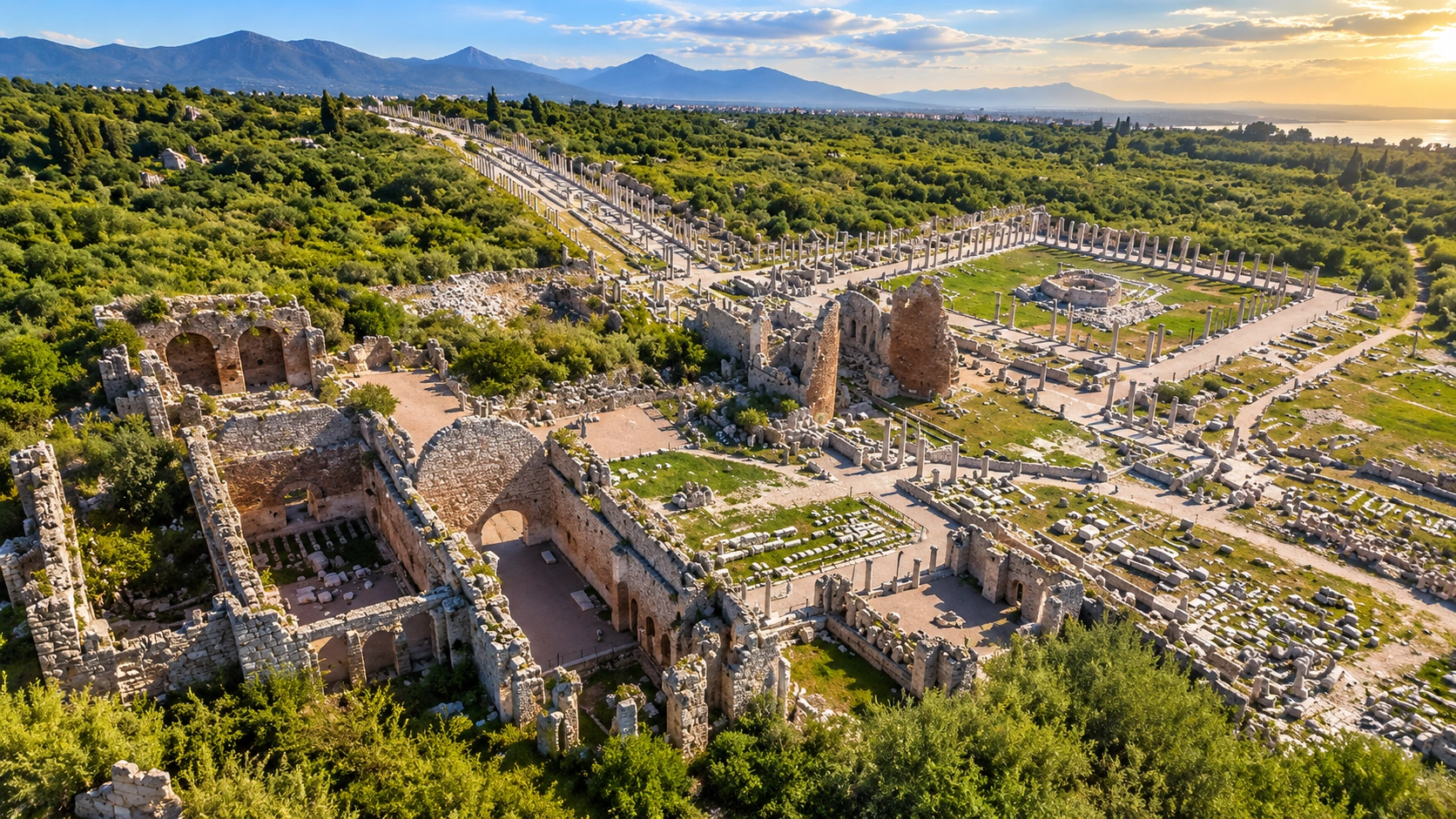
Visitor Perge is a lower-city walk first: enter by the monumental Hellenistic approach, follow the canal-lined colonnaded street, then branch to agora, baths and the stadium/theatre zone—remembering the theatre itself is closed.
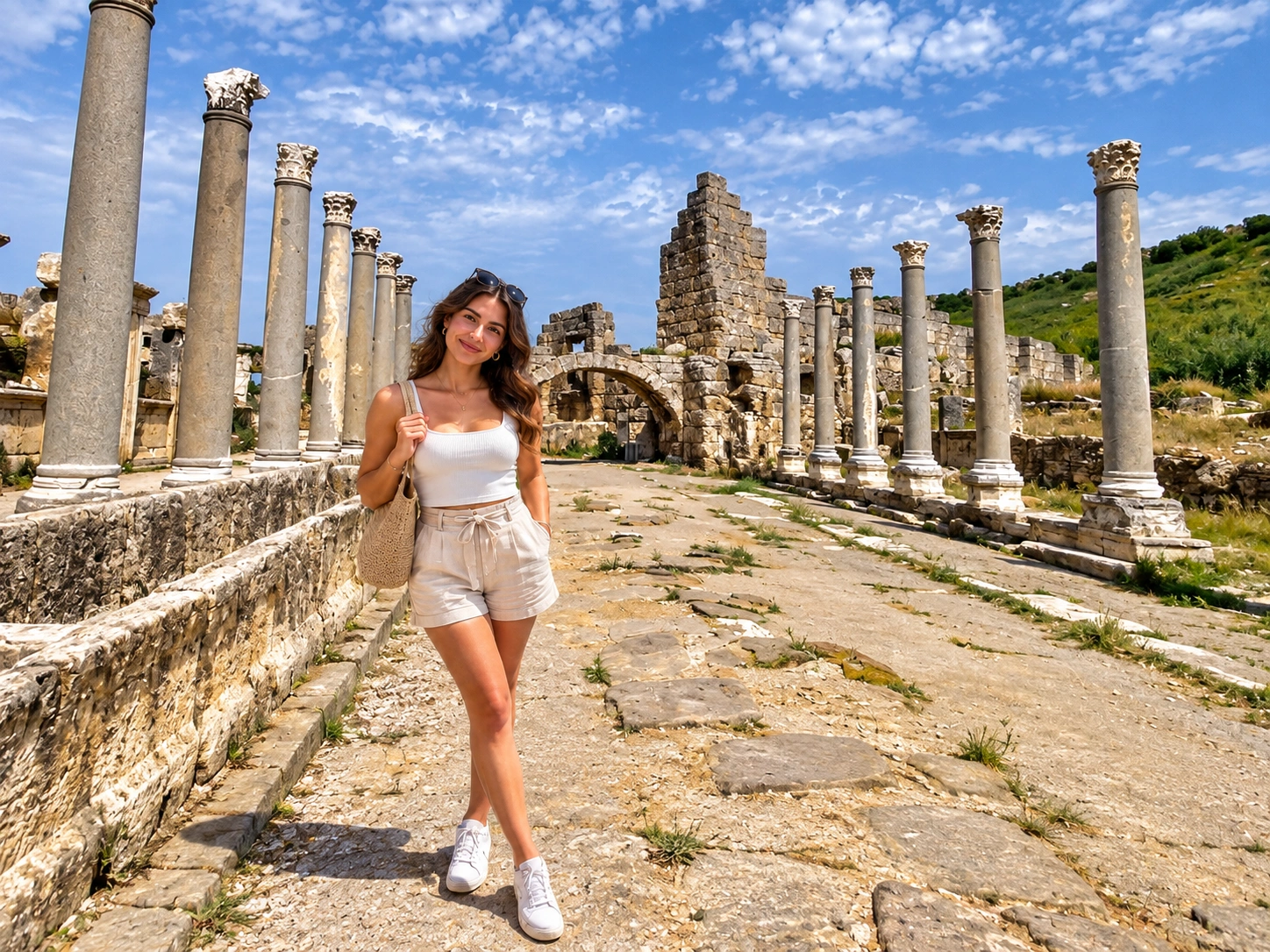
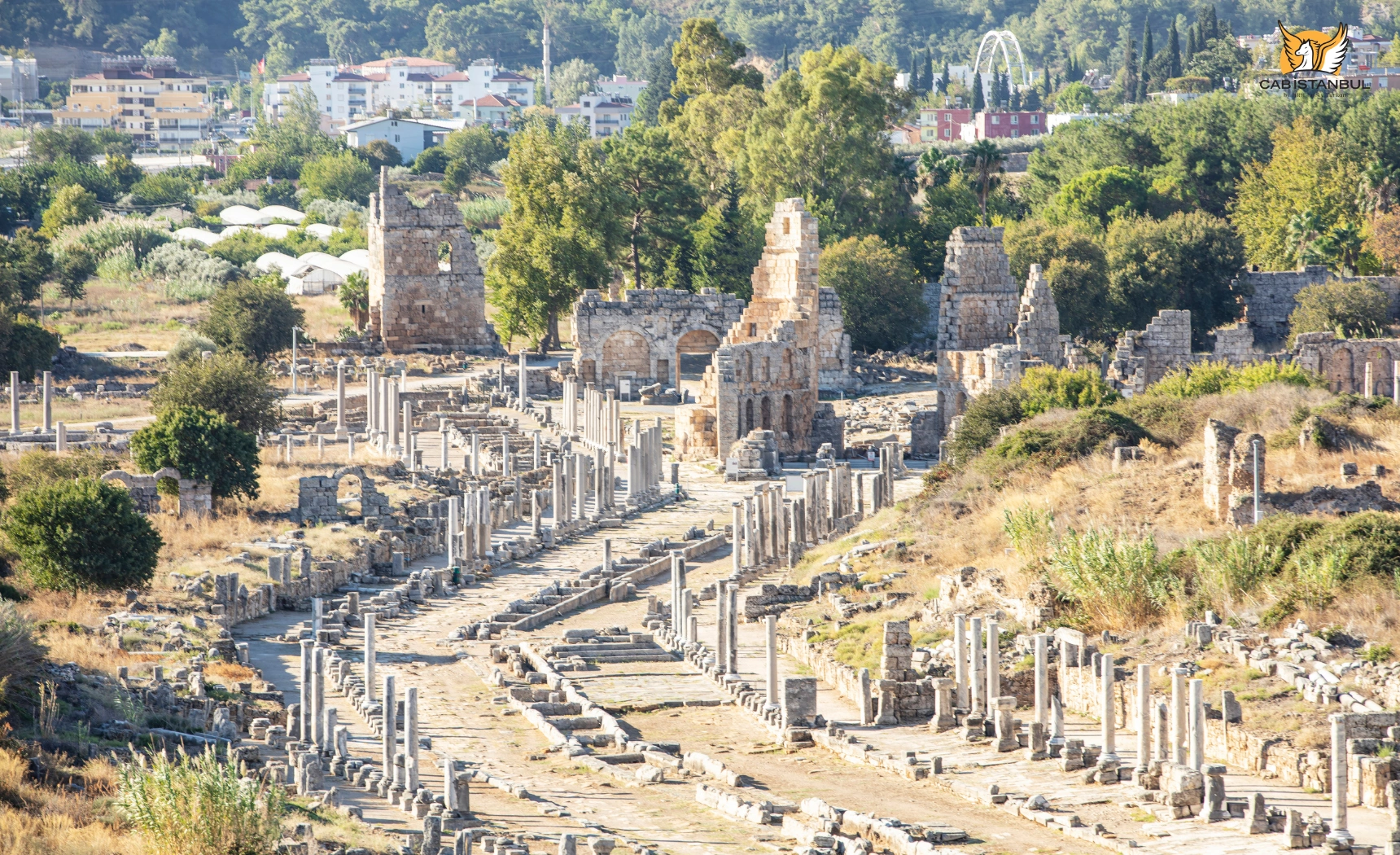
- Hellenistic Gate / twin towers: the site’s best-known skyline; 3rd-century BC fortification architecture.
- Colonnaded main street: museum copy often cites about 500 m with shops and a central water canal toward a street-end nymphaeum.
- Agora / macellum: square market complex with central tholos-type remains—core photo stop.
- South baths: large Roman bathing sequence (frigidarium–caldarium class); among the region’s major bath complexes per museum description.
- Stadium: well preserved outside the walls near the theatre approach. Official museum capacity is about 12,000; excavation press sometimes cites much larger arena/crowd figures—qualify those higher totals and do not freeze conflicting numbers as one hard fact. Soften “best stadium in Western Turkey” to among the best-preserved of its type in Anatolia.
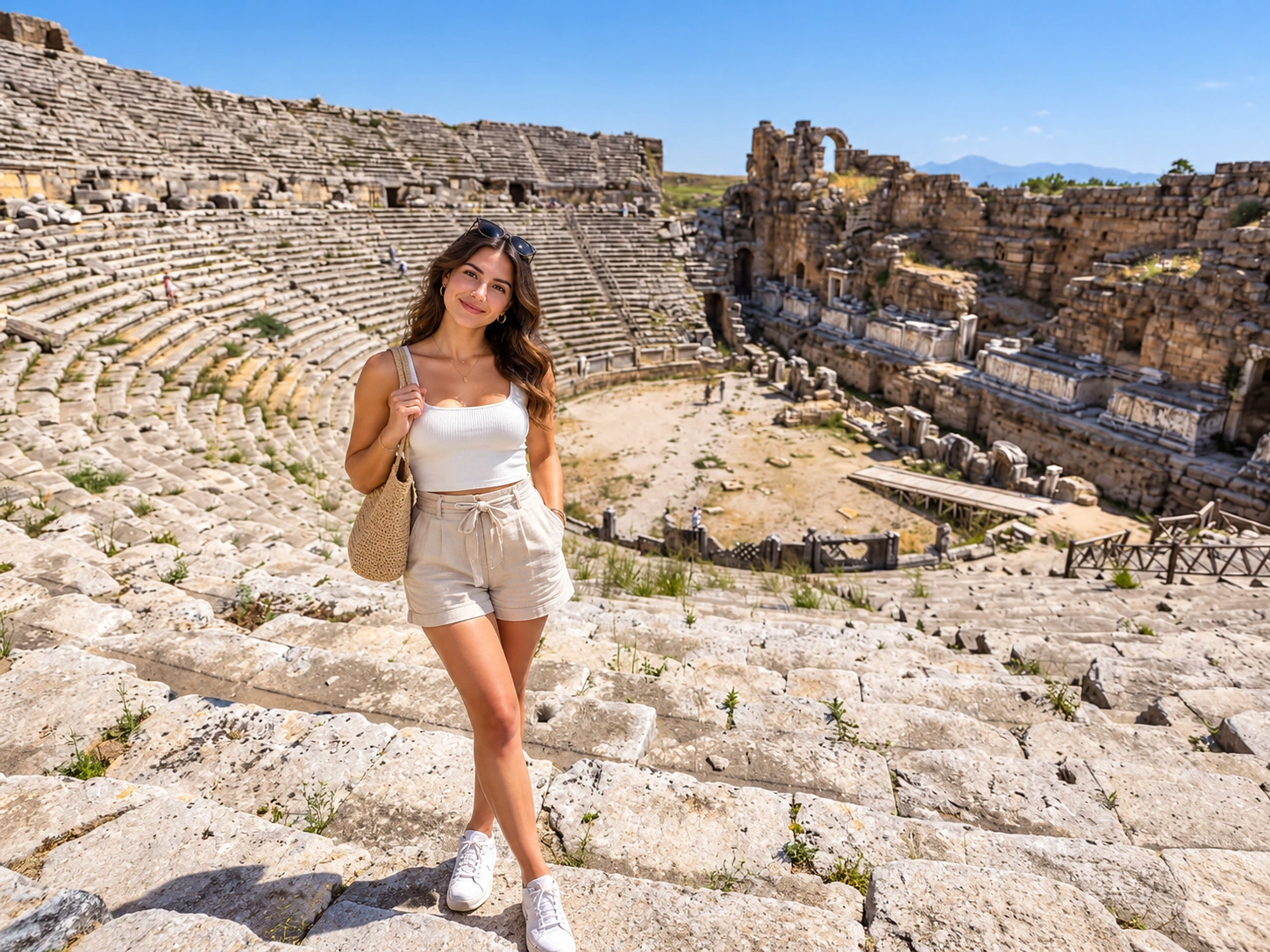
- Theatre: scholarly capacity ranges often sit around 11,000–14,000 without national size rankings. Currently closed for restoration until works finish (muze.gov.tr, checked Sep 2026)—plan photos from allowed exterior approaches only if barriers permit.
- Nymphaea & acropolis: fountain displays and an upper viewpoint with fewer standing buildings; sculptures largely in Antalya Museum.
- Basilicas / churches: early Christian layer (South Basilica often cited); some pockets may be restricted.
| Monument / area | Period / function | Why it matters | Visitor note |
|---|---|---|---|
| Hellenistic Gate / towers | 3rd c. BC fortification | Signature Perge skyline | Confirm barriers |
| Colonnaded street + canal | Roman urban axis | Shops, water display, nymphaeum approach | Heat; uneven stones |
| Agora / macellum | Civic / commercial | Market square with central remains | Core photo stop |
| South baths | Roman bathing | Major regional complex | Sequence of rooms |
| Stadium | Roman spectacle | ~12,000 official; qualify larger press totals | Outside walls |
| Theatre | Roman cavea + stage | Major monument—no Turkey ranking here | Closed for restoration |
| Nymphaea | Water architecture | Street-end / Kestros displays | Sculptures in museum |
| Acropolis | Upper city / viewpoint | Landscape overview | Uneven climb |
| West Street mosaic zone | Late Roman cult room | Iphigenia / Agamemnon find | Access may be limited |
| Basilicas | Early Christian | Later religious layer | Respect restrictions |
Videos are atmosphere only. They do not confirm today’s ticket price, hours or theatre access.
Museum note
Where the sculptures went
Perge’s freestanding statues and many architectural sculptures are conserved and displayed in the Antalya Museum. On site you walk streets, baths and stadium fabric; for the famous portrait and deity pieces, plan a separate museum stop in the city rather than expecting a full sculpture park among the ruins.
Practical 2026
Tickets, hours, accessibility and timing
| Practical detail | Current information |
|---|---|
| Location | Barbaros Mah., Perge Cad., Aksu / Antalya (Pamphylia) |
| Open days | Daily (muze.gov.tr) |
| Listed hours | 08:00–20:00; ticket desk 19:30 (muze.gov.tr, checked Sep 2026) |
| 2026 season note | Ministry tourism-season table may list 21:00 closing—confirm same day |
| Foreign ticket | €11 (DOSIM official table) |
| Turkish citizens | MüzeKart valid (muze.gov.tr / DOSIM) |
| Stale prices / hours | Ignore old 250 TL and 08:30-start CMS lines |
| Theatre | Temporarily closed for restoration (muze.gov.tr) |
| Parking | Entrance-area parking typical; confirm fee/rules on site |
| Accessibility | Uneven stones, heat, little shade on main axis—not wheelchair-easy overall |
| Visit duration | ~2–4 h typical; deeper half day |
| Best season | Spring/autumn walking; summer early/late for heat |
Bring water, sun protection and sturdy shoes. Old “08:30” and “250 TL” visitor tips are stale for 2026 planning.
Getting there
Transport and realistic itineraries
| Route | Practical options | Important note |
|---|---|---|
| Antalya center → Perge | Car / taxi / chauffeur; Aksu-direction local bus patterns | ~15–25 km / ~30–45 min typical |
| Antalya Airport → Perge | Car / taxi / chauffeur | Convenient east-of-city transfer |
| Aksu → Perge | Short local transfer | Closest modern district base |
| Combine with Aspendos / Side | Shared Pamphylia day corridor | Do not overpack one day |
| Public transport | Aksu-direction services exist | No invented route numbers |
This guide does not invent bus route numbers. Cab Istanbul remains intercity chauffeur transport only—not a local Perge tour or licensed guide product.
| Itinerary | Stops | Best for | Important note |
|---|---|---|---|
| Half day | Hellenistic gate → colonnaded street → agora → baths → stadium exterior | First visit | Theatre closed—skip interior plans |
| Deeper half day | Above + acropolis viewpoint + museum sculptures later in Antalya | Ruin + museum balance | Heat pacing in summer |
| Regional Pamphylia | Perge morning + Aspendos (or Side) afternoon | Two-site inland day | Only with daylight margin |
FAQ
Perge Ancient City frequently asked questions
In Aksu district, Antalya Province—at Barbaros Mahallesi, Perge Caddesi—on the Pamphylia plain east of Antalya centre, not in Kemer or Tekirova.
Pamphylia. Treat coastal Lycian sites such as Phaselis as related Antalya-region contrast, not the same ancient district.
Deep prehistoric and Bronze Age layers are discussed in scholarship; Argonauts foundation stories are legend only. Soften any single “~1000 BC foundation” claim.
Only in tradition. Present Argonauts as legend, not verified history.
A historical mathematician and astronomer associated with the city—not a mythic character.
The city sits on Alexander’s Pamphylia campaign geography; keep details qualified and avoid invented welcome-scene drama.
No—muze.gov.tr currently lists the theatre as closed for restoration. Confirm before you go; plan the rest of the site without interior theatre access.
Capacity is often discussed in scholarly ranges around 11,000–14,000. This guide does not assign national size rankings—and the cavea is currently closed for restoration anyway.
Official museum copy cites about 12,000. Larger press excavation figures exist—qualify them rather than treating conflicting totals as one hard number.
DOSIM lists €11 for foreign visitors; MüzeKart is valid for Turkish citizens. Old 250 TL figures are stale—confirm the day’s tariff at the gate.
muze.gov.tr lists 08:00–20:00 with desk closing 19:30. A 2026 tourism-season table may note 21:00—verify before you go. Ignore outdated 08:30 start times.
About 2–4 hours for a solid ruins walk; allow a deeper half day if you add the acropolis and move slowly in heat.
Roughly 15–25 km east of Antalya centre, typically about 30–45 minutes by road depending on traffic and start point.
Many major statues and architectural sculptures are in the Antalya Museum; the örenyeri shows urban fabric more than a full outdoor sculpture court.
A real West Street cult-room find showing Iphigenia/Agamemnon themes. Date it softly to excavations in the 2010s; access may be limited or gated.
Not as a fully accessible site. Expect uneven paving, heat and little continuous shade on the main street axis.
Yes as a common Pamphylia day if timing stays realistic—do not force Perge + Aspendos + Side into one rushed loop without daylight margin.
No. Perge is inland Pamphylia at Aksu; Phaselis is a pine-harbor site near Tekirova/Kemer. Different geography, monuments and visitor experience.
Official museum Christian-history notes preserve the tradition of Pauline association—present it as verified tradition in that context, not as excavated diary proof.
Cab Istanbul offers intercity chauffeur transport only—no local tour package, guide or tickets included.
Perge rewards visitors who treat it as a Pamphylia city plan first: walk the Hellenistic towers and canal street, use the official ~12,000 stadium figure carefully, leave the theatre closed until restoration ends, and save the famous sculptures for the Antalya Museum without recycling stale ticket or hour myths.