
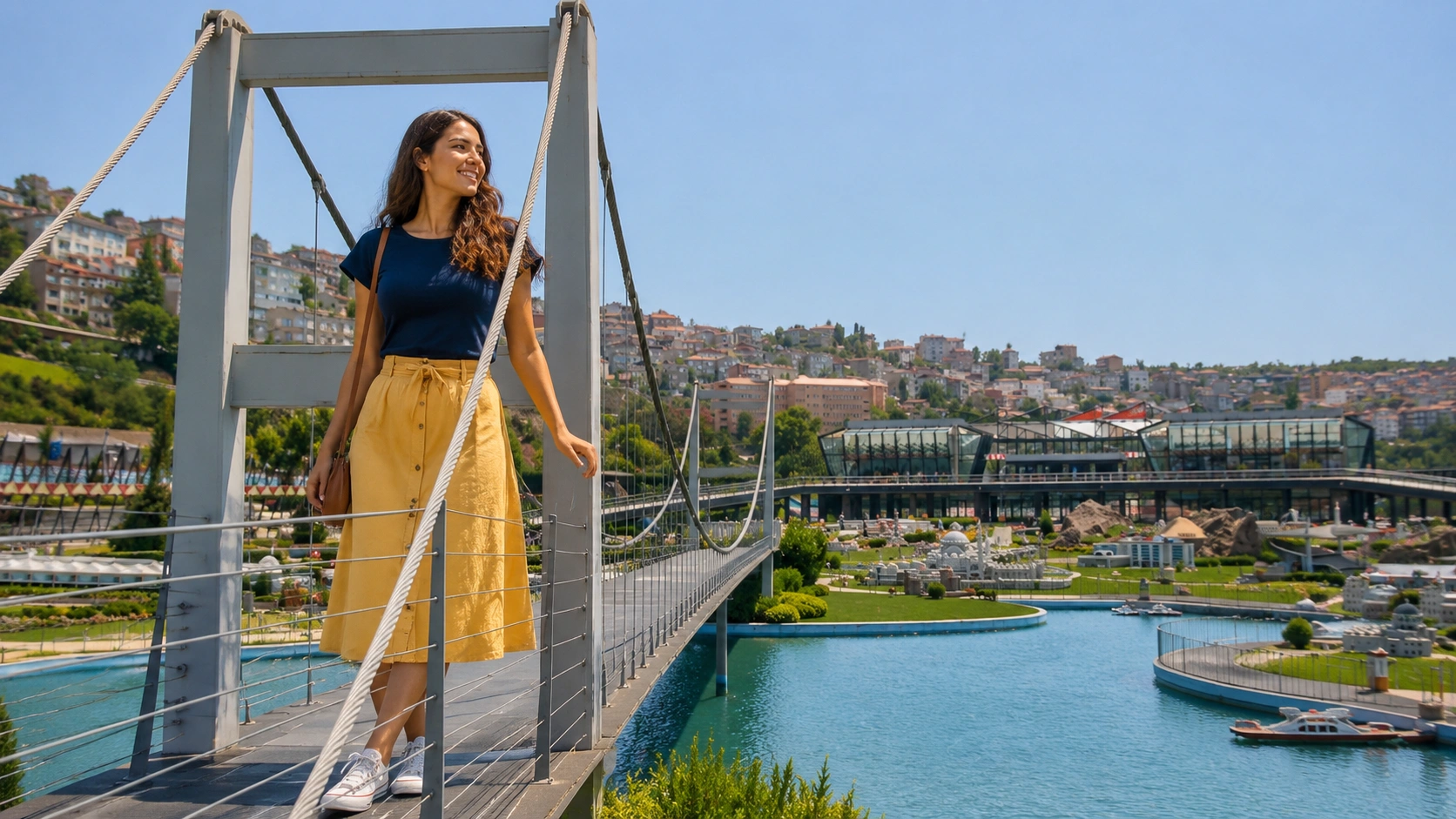
Miniatürk sits on the Golden Horn in Sütlüce, Beyoğlu — an open-air park where around 135 miniature models at 1/25 scale let you walk beside a knee-high Hagia Sophia, a tabletop Bosphorus Bridge, and stone-carved Mardin houses in the space of a single afternoon. Add the Crystal Istanbul Museum, the Panorama Victory Museum, and the Istanbul Historical Peninsula Model Exhibition, and you have one of Istanbul's most original cultural parks — worth far more than the brief mention it usually gets in standard tourist itineraries.
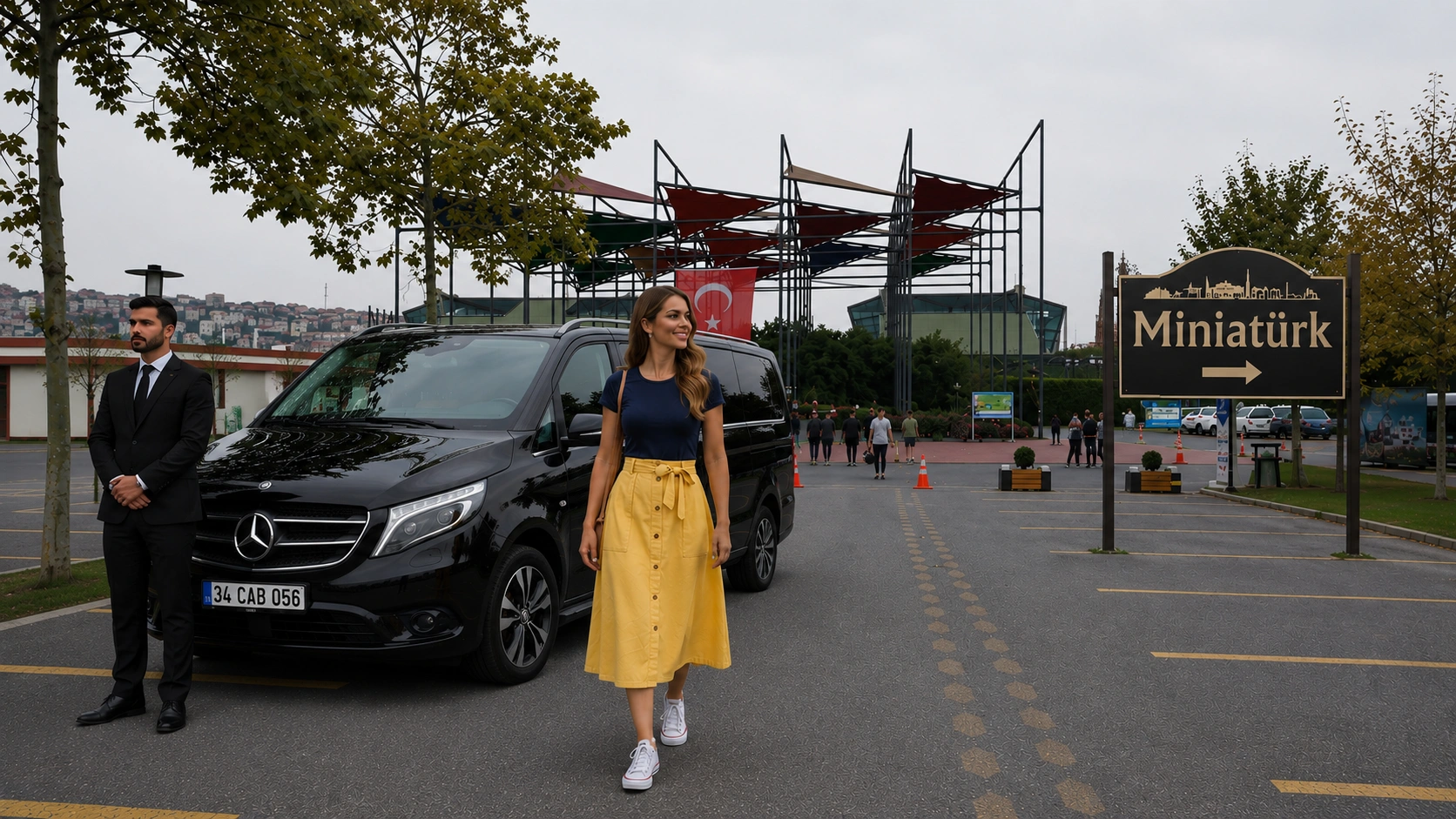
What is Miniatürk? Istanbul's Open-Air Miniature Park on the Golden Horn
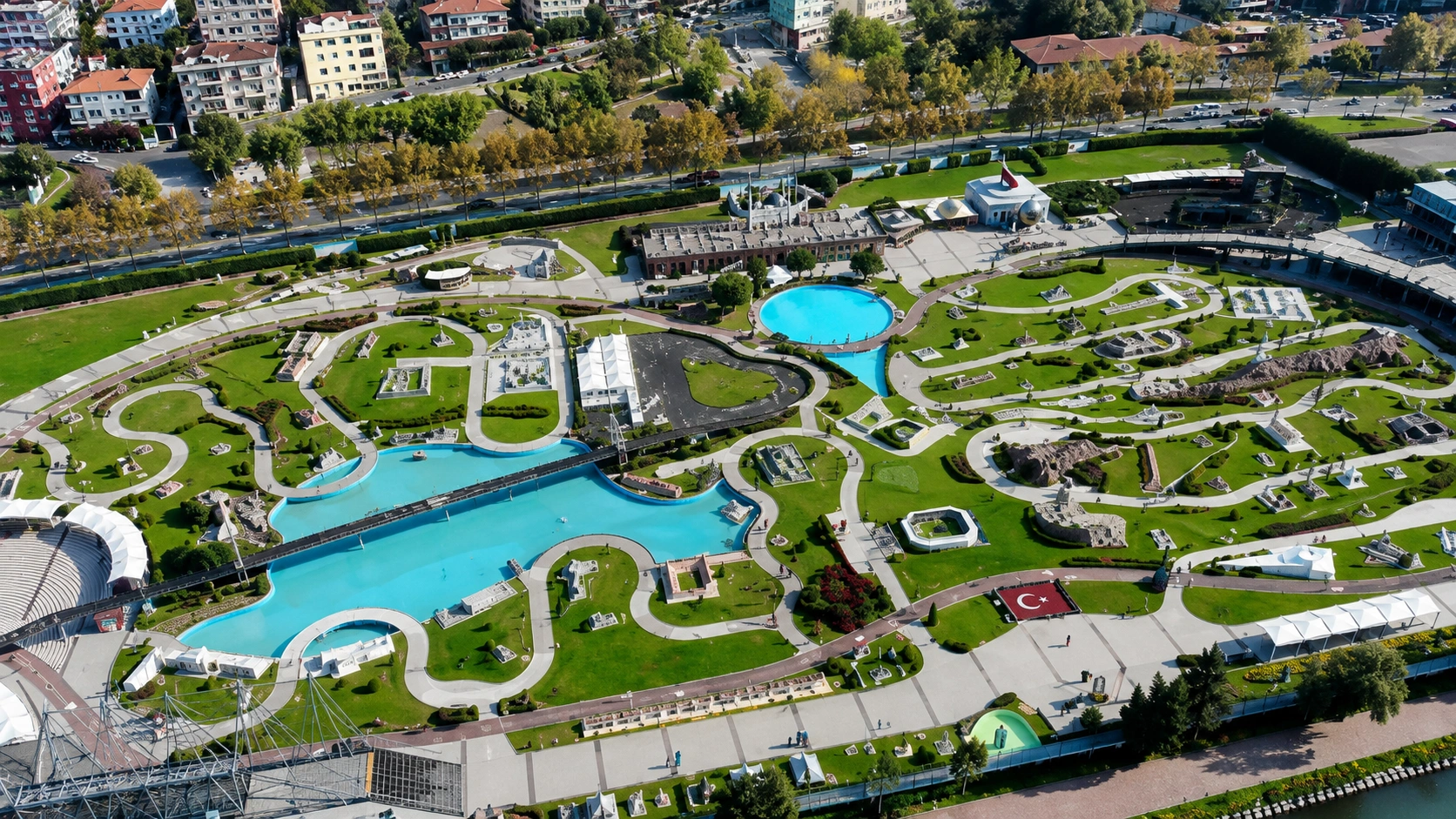
Miniatürk opened in 2003 as an initiative of Istanbul Metropolitan Municipality (İBB) under the Kültür AŞ cultural enterprises arm. The concept was straightforward but ambitious: bring Turkey's most important architectural landmarks together into one walkable outdoor space, reproduced in miniature. The park spans 60,000 square metres on the western bank of the Golden Horn in the Sütlüce neighbourhood of Beyoğlu — a location that puts it within 10–15 minutes of Eyüp Sultan Mosque, the Rahmi M. Koç Museum, and the Balat and Fener historic districts.
The collection comprises around 135 miniature models, all at a scale of 1/25 — meaning a 100-metre structure becomes a four-metre model you can examine at arm's length. The breakdown covers roughly 60 models from Istanbul, around 63 from across Anatolia, and approximately 13 from former Ottoman territories beyond modern Turkey's borders. The range is considerable: you can walk from a miniature Hagia Sophia to a reduced-scale Selimiye Mosque in Edirne, then across to a model of the Mostar Bridge, in the space of twenty minutes.
Beyond the open-air model circuit, Miniatürk contains three enclosed museum and exhibition spaces — the Crystal Istanbul Museum, the Panorama Victory Museum, and the Istanbul Historical Peninsula Model Exhibition (which opened in April 2023 and is worth planning time for specifically). Add cafés, a souvenir shop, children's activity areas, a miniature train, and a Flyride helicopter simulator, and the park becomes a half-day minimum for focused visitors and a full day for families.
The Golden Horn waterfront location matters. The park looks across the water toward Eyüp and the hills behind it, and the wider circuit — combining Miniatürk with Eyüp Sultan, Pierre Loti Hill, Santralistanbul, and Balat — makes this one of Istanbul's best and most underrated full-day itineraries.
Best Things to Do at Miniatürk — Matched to Visitor Type
Miniatürk works well for genuinely different types of visitors, but what to prioritise within the park depends on who you are and how long you have. The table below gives an honest guide.
| Visitor type | Best Miniatürk plan | Why it fits | Watch out for |
|---|---|---|---|
| Families with young children | Morning models circuit → Flyride simulator → children's playground → café lunch | 1/25-scale buildings feel enormous to small children; activity areas burn energy effectively | Summer afternoon heat on the open-air circuit; arrive early and plan indoor museums for midday |
| History and architecture enthusiasts | Full model circuit with QR audio guide → Crystal Istanbul Museum → Panorama Victory Museum → Historical Peninsula Exhibition | QR audio commentary provides architectural and historical depth at each model in 9 languages | Allow 3.5–4 hours; the detail rewards slow viewing and the audio adds significant time per model |
| Photographers | Arrive at opening; morning light from the east; prioritise the Bosphorus Bridge, domed mosques, and the Galata Tower with real skyline behind | Low-angle shooting at 1/25 scale creates convincing full-size compositions; early hours mean minimal crowds | Weekend post-10:00 crowd density makes clean shots difficult; blue-sky light is best in spring and early autumn |
| Short-stay visitors (under 48 hours in Istanbul) | 2.5-hour focused circuit: top 12–15 models with QR guide + Panorama Victory Museum | Efficiently previews Turkey's most important monuments before or after Sultanahmet visits; adds context to what you've seen elsewhere | Don't rush the models — the scale effect only registers when you slow down and look from multiple angles |
| School groups and educational visits | Pre-book group ticket → download official audio app → structured model circuit → Historical Peninsula Exhibition | QR audio guide provides curriculum-relevant historical commentary in Turkish and English; the Historical Peninsula Exhibition has 11-language QR access | Weekday mornings are significantly quieter than weekends; contact the park in advance for group discount information |
The Miniature Models You Should Not Miss
With approximately 135 models distributed across a large open-air circuit, a selective approach produces a more rewarding visit than attempting to see everything at the same pace. The following are the strongest exhibits in terms of architectural detail, photographic interest, and the additional context the QR audio guide provides.
Istanbul and the Bosphorus
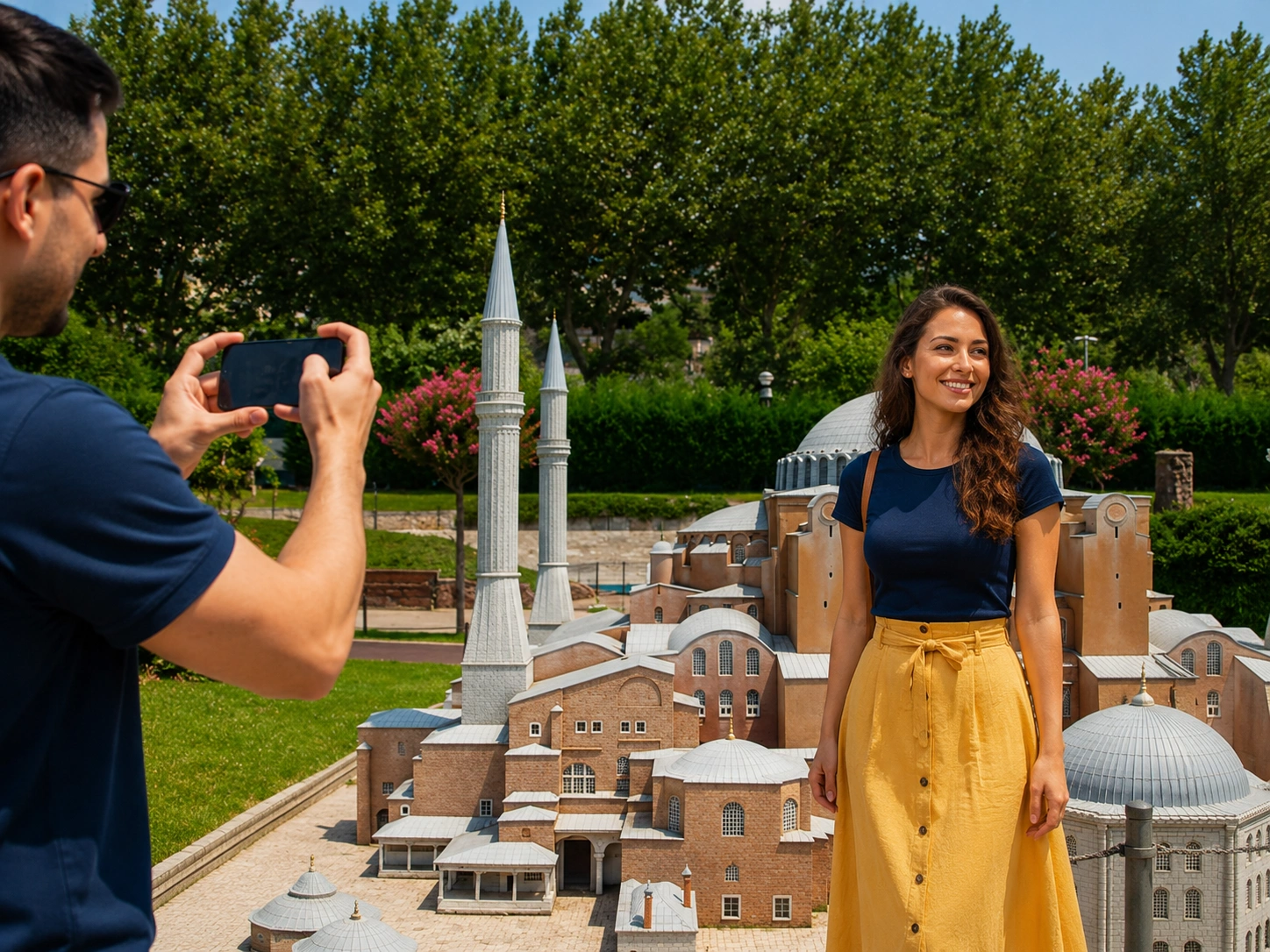
Hagia Sophia is typically positioned early on the circuit and is the model that resonates most strongly with visitors who have already seen the real building in Sultanahmet. At 1/25 scale, the dome system, the four minarets, and the relationship between the central mass and the buttresses all read clearly. The model rewards slow circling from different heights and angles. The Blue Mosque (Sultan Ahmed Mosque) stands close by — recognisable immediately from its six minarets, with the decorated façade rendered in detail.
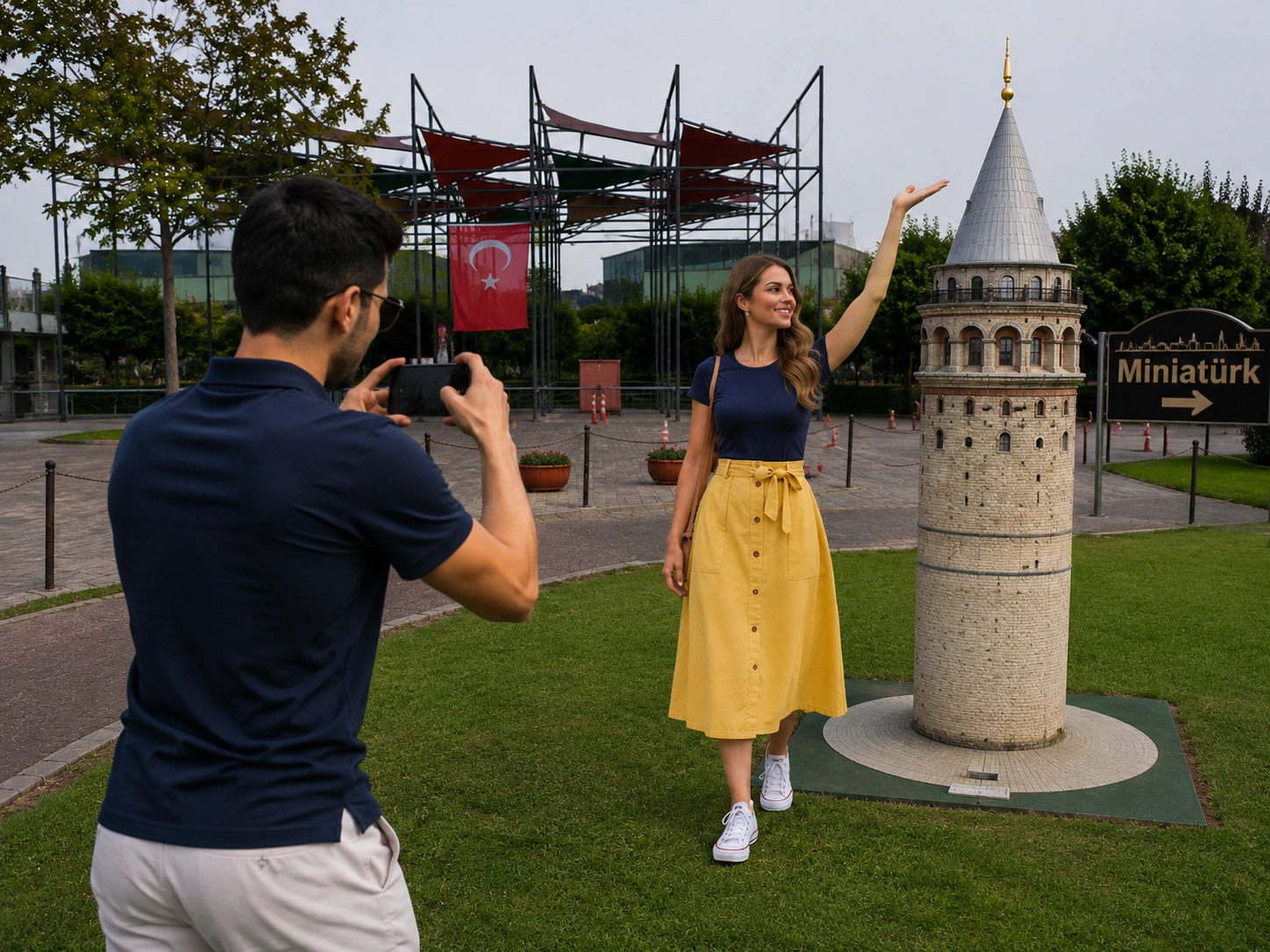
The Bosphorus Bridge (15 July Martyrs' Bridge) is one of the most photographed models in the entire park. From the right position and focal length, it is straightforward to produce a photograph that reads convincingly as the actual bridge. The Galata Tower miniature — reproduced in accurate stone tones — offers an unusual compositional opportunity: on clear days, the real Galata Tower is visible on the Istanbul skyline in the background.
Also not to miss: Topkapı Palace (the Imperial Gate and the Tower of Justice are clearly differentiated at scale), Dolmabahçe Palace (the model allows the entire length of the seafront façade to be grasped in a single view — something the real building on Beşiktaş shore makes difficult), and the Maiden's Tower on its reproduction islet.
Anatolia
Cappadocia's fairy chimneys are displayed in landscape clusters that convey the valley setting more effectively than a single rock formation could. Pamukkale's travertine terraces use a white mineral-finish surface to suggest the thermal pools. Nemrut Mountain reproduces the giant stone heads on the tumulus with reasonable faithfulness to their weathered condition.
Sümela Monastery, the Aspendos Theatre, and the Ephesus Celsus Library all translate well to 1/25 scale — structures designed to impress at full size tend to retain their proportional authority in miniature.
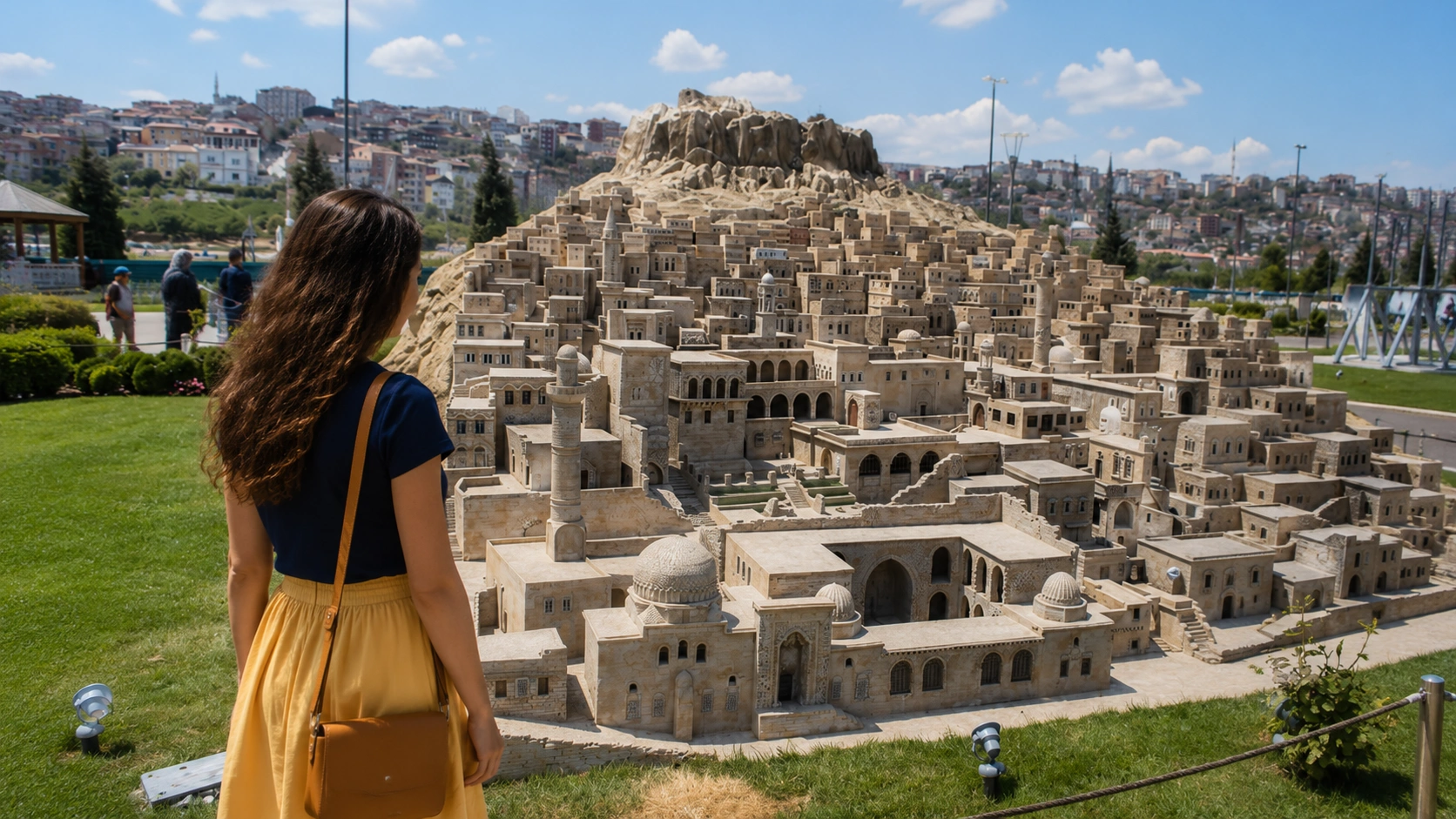
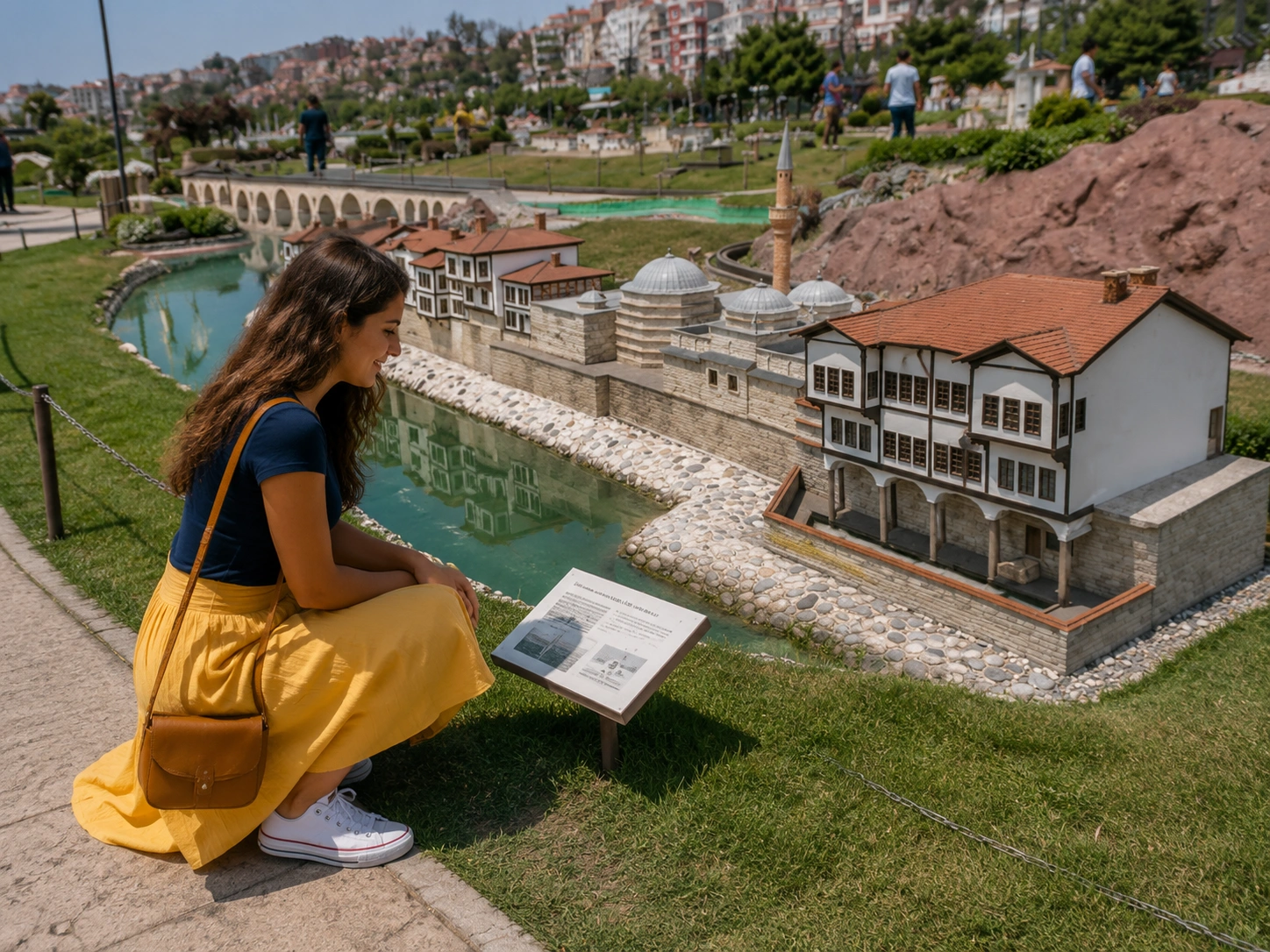
The domestic architecture sections are some of the collection's less obvious highlights. The Amasya riverside Ottoman houses — carved balconies and stepped façades above a miniature Yeşilırmak river — are one of the quieter pleasures of the circuit. The Mardin stone houses reproduce the honey-coloured limestone vernacular of southeastern Turkey's old city with notable accuracy.
Ottoman Geography
The Ottoman-geography section extends the circuit beyond modern Turkey's borders. The Mostar Bridge is the most recognisable international structure in the collection, with its stone arch proportions accurately rendered. The Masjid al-Aqsa and the Hejaz Railway Station add historical breadth to a collection that might otherwise focus narrowly on Anatolian Seljuk and Ottoman architecture.
Models by category — a planning reference
| Model | Category | Time to allow | Why it matters | Visitor note |
|---|---|---|---|---|
| Hagia Sophia | Istanbul | 10 min | Dome and minarels system clearly readable at 1/25 | Compare with the real building if you have visited Sultanahmet |
| Blue Mosque | Istanbul | 8 min | Six minarets distinctive; courtyard detail accurate | Best photographed in late morning light from the west side |
| Bosphorus Bridge | Istanbul | 10 min | Strong photographic subject; scale illusion works well | Low angle from the east side; wider lens recommended |
| Galata Tower | Istanbul | 5 min | Real tower sometimes visible in background on clear days | Unique real-vs-miniature layered composition possible |
| Topkapı Palace | Istanbul | 10 min | Imperial Gate and Tower of Justice both well-proportioned | The model clarifies the palace layout better than some in-person visits |
| Cappadocia fairy chimneys | Anatolia | 8 min | Cluster presentation gives landscape rather than single-rock context | Best used as a preview before visiting real Cappadocia |
| Amasya riverside houses | Anatolia | 8 min | Ottoman domestic architecture rarely covered at this level of detail | Often missed by crowds heading straight to landmark mosques |
| Mostar Bridge | Ottoman geography | 5 min | Most recognisable international Ottoman structure in the collection | Stone arch proportions accurately reproduced |
| Sümela Monastery | Anatolia | 8 min | Cliff-face setting reproduced with convincing vertical relief | One of the more technically impressive builds in the Anatolian section |
| Safranbolu houses | Anatolia | 5 min | UNESCO-listed vernacular domestic architecture; latticed windows at detail | Quiet section; rewards visitors who slow down past the landmark mosques |
The QR Audio Guide: How to Get More From Every Model
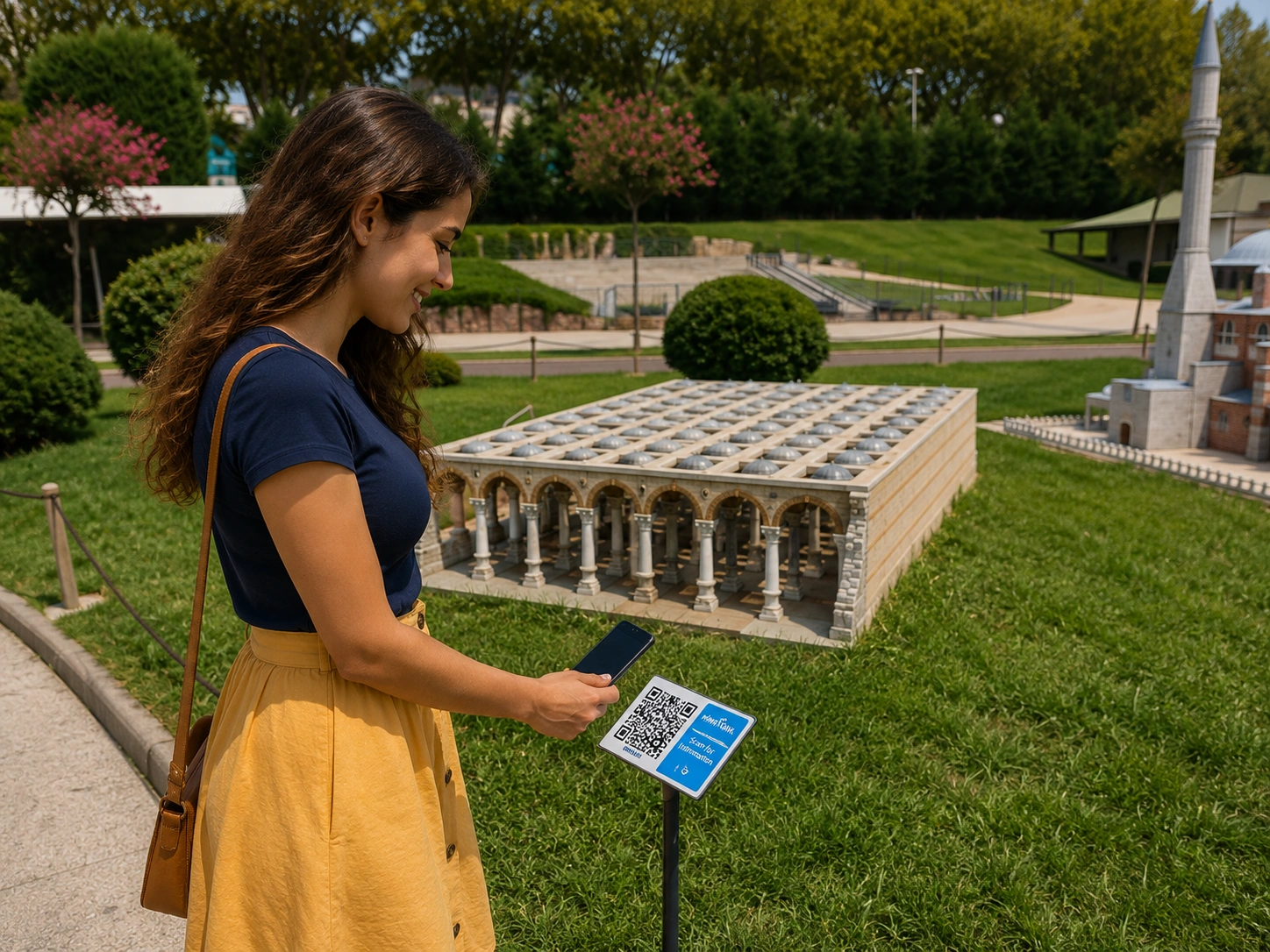
Each miniature model in the park is accompanied by a QR code. Scanning the code with the official Miniatürk mobile app (available free on Apple App Store and Google Play) opens an audio commentary for that specific model. The app supports nine languages: Turkish, English, French, German, Russian, Arabic, Persian, Japanese, and Spanish.
The commentary is not simply architectural data. It provides historical context, explains the significance of each building within Turkish and Ottoman history, and often describes features or periods that are no longer visible at the real site. For a model like the Hattusha Lion Gate or the Aspendos Theatre, this context transforms a 30-second look into a genuinely informative encounter. For visitors who are seeing Turkish monuments for the first time, the audio guide is the difference between passing through and actually understanding the collection.
How to use the audio guide effectively
- Download before arrival. In-park connectivity can be unreliable during busy periods. Download and open the Miniatürk app at your hotel or café before leaving.
- Headphones are essential. The commentary is designed for individual listening. Without headphones, you lose half the detail in crowded or windy conditions.
- Scan and move. You do not need to finish each commentary standing at the model. The app lets you continue listening while walking to the next exhibit — useful for longer commentaries.
- Read the physical boards too. Each model has a bilingual Turkish/English information panel with basic facts. The board is useful for a quick scan if you decide to skip the audio for a particular model.
- The Historical Peninsula Exhibition uses a separate QR system in 11 languages, accessible by personal device. It is not part of the main park app — the exhibition provides its own QR access at the entrance of the hall.
Crystal Istanbul Museum, Panorama Victory Museum, and the Historical Peninsula Exhibition
Miniatürk contains three museum and exhibition spaces that significantly extend the visit beyond the open-air model circuit. Each addresses a different dimension of Istanbul's and Turkey's history, and all three are included in the standard entrance ticket.
Crystal Istanbul Museum
The Crystal Istanbul Museum presents sixteen of Istanbul's most significant historical structures as three-dimensional laser-engraved sculptures inside crystal glass blocks. The subjects include Hagia Sophia, the Galata Tower, the Blue Mosque, the Süleymaniye Mosque, and eleven further Istanbul landmarks. The display is set in a darkened gallery with individual lighting for each piece — the laser engraving picks out architectural lines at a level of detail that is surprisingly precise given the medium. The museum describes itself as the world's only three-dimensional crystal museum integrating historical subjects with laser glass technology. For visitors with an interest in contemporary craft or design alongside history, this is the most unusual component of the Miniatürk complex.
Panorama Victory Museum
Established as a gift marking the 80th anniversary of the Turkish Republic, the Panorama Victory Museum presents key episodes from Turkey's War of Independence — including the Gallipoli campaign and the decisive battles of the independence struggle — through panoramic, three-dimensional compositions with sound and light effects. A substantial photographic exhibition of Atatürk accompanies the panoramas, covering his role as a military commander and founding leader of the Republic. The panoramic format gives a sense of physical scale and environmental reality to historical events that photographs alone cannot. Entry is included in the main Miniatürk ticket.
Istanbul Historical Peninsula Model Exhibition
Opened in April 2023 inside a dedicated hall within the Miniatürk complex, this exhibition is described as Turkey's largest movable model exhibition. The subject is the Istanbul historical peninsula as it appeared between the 16th and 19th centuries — reproducing the area from Topkapı Palace to the Grand Bazaar with extraordinary spatial and architectural detail. The models are animated: thousands of miniature human figures, horse-drawn carriages, fire scenes, and episodes of Janissary uprisings are in motion within the diorama. Audio commentary is available in 11 languages via QR code on a personal device. For visitors with a particular interest in Ottoman Istanbul's urban life, this exhibition is the most intellectually substantial component of the entire Miniatürk visit — more informative in some respects than walking through the same district in the modern city.
Miniatürk for Families and Children
The park was conceived from the outset as a family venue, and the facilities reflect a genuine commitment to that purpose. Beyond the model circuit — which children often engage with more seriously than adults expect, since the 1/25 scale produces a world in which they are temporarily the largest figures present — the park contains a substantial set of recreational facilities.
Activity facilities for children and families
- Mini Land Children's Playground: A dedicated, age-appropriate playground area with safe equipment for younger children.
- Travel Train: A small-gauge train carrying up to 20 passengers (adults and children) on a circuit of the park — useful for covering ground without walking fatigue, particularly in summer heat.
- Ferryboat and operated boats: A ferryboat ride and remote-controlled boat sessions on the park's internal water feature. The ferryboat in particular tends to be popular with younger children.
- Flyride Helicopter Simulation: A 3D helicopter experience with realistic wind, rain, and touch effects, simulating a flight over Istanbul. This is the most popular activity in the park beyond the models themselves, and it generates queues on weekends and school-holiday periods. Worth queuing for early in the day. A separate charge is likely — verify on-site.
- Mini Football Stadium: Miniature reproductions of the stadiums of Turkey's four largest football clubs — Galatasaray, Fenerbahçe, Beşiktaş, and Trabzonspor — displayed side by side. Unusual and popular with football-following visitors of all ages.
- Fairy Tale Tree: A decorative feature in the children's area, also used as a photograph point for families.
- Labyrinth Park and Chess Area: Outdoor games suitable for older children and adults; add to the activity range without requiring staff or a fee.
For families visiting in summer, the open-air model circuit can be warm — parts of the park have limited shade in the mid-afternoon. A practical approach: arrive early and complete the model circuit in the morning, use the covered museum spaces (Crystal Istanbul, Panorama Victory) during the hottest midday period, and use the children's activity areas and café in the afternoon. Carry water for all family members.
Prices and Practical Costs at Miniatürk — TRY and Approximate USD
The table below reflects prices as understood at mid-2026. Turkish Lira prices for cultural venues have changed frequently in recent years; USD figures are approximate conversions and will move with the exchange rate. Always verify current prices at miniaturk.com.tr before your visit.
| Cost item | Local price / range | Approx. USD | Notes |
|---|---|---|---|
| Entry — foreign visitor | ~900 TRY | ≈ $24–26 | Includes park + Crystal Istanbul Museum + Panorama Victory Museum + Historical Peninsula Exhibition. Museum Pass not valid. |
| Entry — Turkish citizen | ~250–330 TRY | ≈ $7–9 | Sources vary; 250 TRY and 330 TRY both cited. Verify current rate at the ticket desk. |
| Discounted entry (students, teachers, soldiers, police) | ~90 TRY | ≈ $2–3 | Valid ID required at ticket desk. |
| Children under 5 (some sources say under 6) | Free | Free | Confirm the exact age limit on-site — most sources cite under 5 or under 6 with a paying adult. |
| Payment method | Card or İstanbulkart only | — | No cash accepted at ticket booths. Have a working card available. |
| Official QR audio guide app | Free (download) | Free | Available on Apple App Store and Google Play — download on Wi-Fi before entering. |
| Flyride helicopter simulator | Separate charge; not confirmed | — | Likely additional fee — verify on-site at the Flyride desk. |
| Café / snack / meal | Approx. 80–300 TRY per item | ≈ $2–8 | Three café and restaurant locations within the park; standard Turkish cultural venue pricing. |
| Parking | On-site, ~300-car capacity | — | Parking charge not confirmed from primary source; verify at the car park entrance. |
Food, Cafés, and Where to Rest Inside Miniatürk
Miniatürk has three café and restaurant locations within the park perimeter: one near the car park on the Golden Horn shoreline, one at the entrance area, and one towards the far end of the model circuit. All three serve Turkish snacks, tea, coffee, and basic meals. The Golden Horn-side café has the best position — a terrace looking across the water toward Eyüp — and is the most comfortable resting point for adults mid-visit.
For a proper meal, the options inside the park are functional rather than exceptional. Most visitors planning a longer day eat light inside the park for convenience and save a proper meal for the evening — Eyüp and Balat both have good local restaurants within 10–15 minutes by taxi. The Golden Horn waterfront restaurants in the Balat direction are particularly pleasant in good weather and are worth the short journey.
Bring water, particularly in summer. The open-air model sections of the park offer limited shade and the circuit walkways can be warm in July and August. The park has water points at some locations, but carrying at least half a litre per person from the start of the visit is advisable, particularly for families with young children.
Nearby Attractions Around the Golden Horn
Miniatürk's position in Sütlüce places it within a natural circuit of Golden Horn attractions that can be combined in a single organised day. Each of the following places is either walking distance or a short taxi ride from the park entrance.
Rahmi M. Koç Museum
Turkey's principal industrial heritage museum, housed in a historic Ottoman anchor foundry and adjacent shipyard buildings in Hasköy — approximately 1.5 km south of Miniatürk along the Golden Horn. The collection spans vintage automobiles, aviation history, a decommissioned submarine, maritime exhibits, and interactive technology displays. It is a genuinely substantial museum requiring two to three hours. Open Tuesday–Friday 09:30–17:00, Saturday–Sunday 10:00–18:00; closed Monday. For families with school-age children wanting two full museums in a day, Miniatürk in the morning and Rahmi M. Koç in the afternoon is an effective pairing — the two collections complement rather than repeat each other.
Pierre Loti Hill
The Pierre Loti Hill, named after the 19th-century French writer who visited Istanbul repeatedly, offers panoramic views of the Golden Horn from a hillside terrace in the Eyüp district. A cable car from the Eyüp valley ascends to the top, where a historic café — still serving tea and Turkish coffee — looks across the water and the Haliç. Afternoon light is the most rewarding time for both the view and photography. Taxis from Miniatürk reach Eyüp in around 10–12 minutes.
Eyüp Sultan Mosque and the Surrounding Area
One of Istanbul's most spiritually significant mosques — historically important as the burial place of Eyüp Sultan (Abu Ayyub al-Ansari), a companion of the Prophet Muhammad and a companion of the Caliph Umar. The mosque courtyard and the Eyüp district carry a distinctly different atmosphere from tourist-intensive Sultanahmet. The Eyüp bazaar, the Ottoman hillside cemetery, and the pathway up through the cemetery to Pierre Loti are all worth allowing time for. From Miniatürk: around 10 minutes by taxi.
Balat and Fener
The Balat and Fener neighbourhoods on the Golden Horn's southern shore are among Istanbul's most atmospheric historic districts. Balat retains the character of the former Ottoman Jewish quarter; Fener is historically the Greek Orthodox heart of the city, centred on the Ecumenical Patriarchate. Both areas have narrow streets and colourful buildings, independent cafés, antique dealers, and street life that rewards unhurried exploration on foot. From Miniatürk: approximately 2 km south, best reached by taxi (around 10 minutes) or the Golden Horn ferry service.
Santralistanbul
A converted early 20th-century electrical power station in Eyüp, now a contemporary art museum, event venue, and university cultural centre. The building architecture is notable in its own right; the temporary exhibition programme changes regularly. Best combined with a visit to Eyüp Sultan and Pierre Loti. From Miniatürk: 10–15 minutes by taxi.
| Nearby attraction | Best for | Transport from Miniatürk | Add to the same day? |
|---|---|---|---|
| Rahmi M. Koç Museum | Industrial history, aviation, maritime, families with older children | ~5 min taxi or 15–20 min walk south along the Golden Horn | Yes — morning Miniatürk, afternoon Rahmi M. Koç; allow 2–3 hours for the museum |
| Pierre Loti Hill | Panoramic views, photography, afternoon tea or coffee with Golden Horn panorama | ~10–12 min taxi to Eyüp cable-car base; cable car to hilltop | Yes — ideal as the late-afternoon finish after Miniatürk and Eyüp Sultan |
| Eyüp Sultan Mosque | Cultural and religious significance, Ottoman cemetery, different atmosphere from Sultanahmet | ~10 min taxi | Yes — natural intermediate stop between Miniatürk and Pierre Loti |
| Balat and Fener | Street photography, neighbourhood atmosphere, cafés, Byzantine and Ottoman architecture | ~10 min taxi or Golden Horn ferry (when running) | Yes, as a separate afternoon leg — Balat rewards at least 90 minutes on foot |
| Santralistanbul | Contemporary art, converted industrial architecture, cultural programme | ~10–15 min taxi | Optional — check current exhibition before visiting; best combined with Eyüp Sultan |
| Galata Tower | Panoramic views from the Beyoğlu side; Karaköy and Galata district access | ~20–25 min by bus or taxi via the Golden Horn | Better on a different day, or at the end of a Beyoğlu itinerary |
Itineraries: Half-Day and Full Family Day with the Golden Horn
Half-Day Miniatürk Itinerary (2.5–3 hours)
This plan suits independent travellers, couples, or visitors with limited time who want to see the park without committing a full day to the Golden Horn area.
- 09:00–09:30: Arrive at opening. The ticket desk can be slower than expected on busy days — arriving early avoids queuing. Pick up a printed map at the entrance.
- 09:30–11:30: Main model circuit with QR audio guide app. Priority stops: Hagia Sophia, Blue Mosque, Topkapı Palace, Dolmabahçe, Bosphorus Bridge, Galata Tower, Cappadocia, Amasya houses, Mardin houses, Sümela Monastery, Mostar Bridge. Allow extra time at models where the QR commentary adds substantial historical depth.
- 11:30–12:00: Crystal Istanbul Museum — 20–25 minutes is sufficient for the crystal gallery.
- 12:00–12:30: Panorama Victory Museum — 25–30 minutes.
- 12:30–13:00: Café break at the Golden Horn terrace before departure.
Full Family Day: Miniatürk and the Golden Horn Circuit
This plan suits families with children or visitors who want to cover the key Golden Horn attractions in a single, well-organised day.
- 09:00: Arrive at Miniatürk opening. Begin the model circuit at a relaxed pace — let children lead at their own tempo through the Istanbul models first.
- 10:30: Flyride helicopter simulation — queue before weekend crowds build.
- 11:00–12:00: Continue model circuit through the Anatolian section; finish with the Ottoman geography models.
- 12:00–12:30: Istanbul Historical Peninsula Model Exhibition — particularly engaging for children over ten with some interest in Ottoman history.
- 12:30–13:30: Lunch at the park café, or a short taxi to a local Eyüp restaurant.
- 14:00–15:30: Taxi to Eyüp Sultan Mosque — allow 30–40 minutes for the mosque courtyard, the surrounding market streets, and a walk through the Ottoman cemetery above.
- 15:30–16:30: Cable car up to Pierre Loti Hill — late afternoon tea with Golden Horn views looking back toward Miniatürk and the city.
- 17:00 onwards: Return to hotel or taxi to Balat for dinner in one of the neighbourhood's local restaurants.
| Address | İmrahor Caddesi No. 7, Sütlüce, Beyoğlu, Istanbul |
|---|---|
| Opening hours | Approximately 09:00–18:00. Hours may be extended in summer. Monday closure has been reported by several sources — verify at miniaturk.com.tr before travelling. |
| Foreign visitor ticket | ~900 TRY (≈ $24–26 USD). Museum Pass is not valid. Check whether the ticket includes the internal museums/exhibitions before visiting. |
| Discounted ticket | ~90 TRY for eligible visitors such as students, teachers, soldiers and police with valid ID. Children under 5 are usually free; verify before travel. |
| Payment | Credit/debit card or İstanbulkart may be required. Cash acceptance can change; verify current payment rules before visiting. |
| By bus from Eminönü | Buses such as 47, 47E, 47N or 47Ç may serve the route; alight near Miniatürk / İmrahor Caddesi. Journey time is usually around 25–35 minutes depending on traffic. |
| By bus from Taksim | Bus 36T toward Sütlüce is commonly used. Journey time is usually around 20–30 minutes depending on traffic. |
| By metro + bus | Take M2 metro to Şişhane, then continue by bus or taxi north along the Golden Horn. Another option is metrobus to Halıcıoğlu, then a local bus toward Miniatürk. |
| By car | Miniatürk has on-site parking according to several visitor sources. For private transfers, drop-off is usually easiest near the entrance gate. |
| Official website | miniaturk.com.tr — check current hours, prices, payment rules and seasonal closures before travelling. |
Getting to Miniatürk from Istanbul's Airports and City Centre
From Istanbul Airport (IST)
Istanbul Airport is approximately 50–65 km northwest of Miniatürk. By public transport: the M11 metro connects the airport to Gayrettepe (transfer to M2 metro), then to Şişhane, then a bus or taxi north to Sütlüce — total journey typically 75–105 minutes including all connections. For visitors with luggage, families with children, or those arriving after a long flight who want to go directly to Miniatürk, a private airport transfer is more practical than managing multi-connection public transport on arrival: travel time by private car is typically 45–70 minutes to Sütlüce depending on traffic.
From Sabiha Gökçen Airport (SAW)
SAW is on the Asian side of the city, approximately 55–70 km from Sütlüce. By public transport: shuttle bus to Kadıköy or Taksim, then ferry or bus connections across to Beyoğlu, followed by bus to Miniatürk — total journey can be 90–120 minutes in normal traffic. A direct Sabiha Gökçen airport transfer by private car reaches Sütlüce in approximately 60–80 minutes depending on the Bosphorus bridge crossing.
From Taksim and Beyoğlu
Bus 36T from Taksim runs toward Sütlüce and stops near Miniatürk. Journey time is typically 20–30 minutes. A taxi from Taksim to Miniatürk takes around 15–20 minutes in moderate traffic and costs a modest metered fare.
From Sultanahmet and the Old City
Buses 47 and 47E depart from Eminönü — on the southern shore of the Golden Horn — and reach Miniatürk in approximately 25–35 minutes. A taxi from Sultanahmet takes 20–30 minutes depending on traffic on the Horn approach roads. The Golden Horn ferry (Haliç vapur) stops at Sütlüce on some routes, which is both atmospheric and traffic-independent.
Getting around the Golden Horn circuit by private car
Visitors combining Miniatürk with Eyüp Sultan, Pierre Loti, and Balat in a single day will find that the 1–3 km distances between these points do not map neatly onto a single public bus route. Each transfer requires separate navigation. A car with driver handles the between-stop transfers efficiently and keeps the day focused on the visits rather than the logistics.
- Opening hours are not fully consistent across sources. Some report Monday closure; others give daily hours. Do not rely on third-party booking sites for current hours — check miniaturk.com.tr directly before travel.
- Summer heat. The miniature model circuit is largely open-air. July and August afternoon temperatures on the Golden Horn can be intense. Arrive early, wear sun protection, and plan the indoor museum spaces for the midday period.
- Prices change. TRY ticket prices for Istanbul's cultural venues have been revised frequently in recent years. The 900 TRY foreign visitor figure is the most consistently cited at time of writing — verify before paying.
- No cash at ticket booths. Credit/debit card or İstanbulkart only. This is confirmed by multiple sources. Have a working card on hand before queuing.
- Weekend crowds. Turkish families and school groups use Miniatürk heavily on Saturday and Sunday mornings. Weekday mornings are considerably quieter and the photography is easier.
- Traffic on approach roads. İmrahor Caddesi along the Golden Horn can slow in morning and evening rush periods. Allow extra journey time if arriving by taxi from the European side at peak hours.
- Photography: Standard visitor photography is permitted throughout the park. Commercial photography and drone use require prior approval from park management.
Reaching Miniatürk Without Managing the Connections
Cab Istanbul is not affiliated with Miniatürk, Istanbul Metropolitan Municipality, or any museum, café, restaurant, or attraction mentioned in this guide. We operate private transfer and car-with-driver services for visitors who prefer a direct, luggage-friendly alternative to managing bus or metro connections in an unfamiliar city.
For Miniatürk specifically, a private transfer is most practical in three situations: arriving directly from Istanbul Airport or Sabiha Gökçen on the same day as your visit; travelling with young children for whom multiple connections on unfamiliar public routes are impractical; and combining Miniatürk with Eyüp Sultan, Pierre Loti, and Balat in a single day, where a car with driver handles the short transfers between stops without requiring separate navigation for each segment.
Our Istanbul Airport transfer and Sabiha Gökçen transfer services operate around the clock. For a full Golden Horn day combining Miniatürk with other stops, our private Istanbul tour service can be structured around your priorities. All bookings are confirmed in advance at a fixed price.
Further reading and useful resources
- Official Miniatürk website: miniaturk.com.tr — current hours, prices, news and the model list
- Official QR audio guide app: Search "Miniatürk" on Apple App Store or Google Play
- Istanbul transport (İETT): iett.istanbul — bus route and timetable planner for Golden Horn routes
- Rahmi M. Koç Museum: rmk-museum.org.tr — current opening hours and exhibitions
Related guides on this site: Istanbul Panorama 1453 History Museum · Istanbul Museums guide · Balat neighbourhood guide
Is Miniatürk worth visiting in Istanbul?
Yes, for most visitor types. Miniatürk works particularly well for families with children, first-time visitors to Turkey who want an overview of the country's architectural heritage before or after visiting specific sites, and photographers interested in the creative potential of 1/25-scale subjects. The three internal museum and exhibition spaces — Crystal Istanbul, Panorama Victory Museum, and the Istanbul Historical Peninsula Model Exhibition — give the park substance beyond a simple novelty attraction. For visitors who have already spent time in Sultanahmet, seeing Hagia Sophia, Topkapı, and the Blue Mosque at 1/25 scale adds a perspective that reinforces rather than replaces the real experience. That said, if you have only one afternoon and are choosing between Miniatürk and a second visit to the Sultanahmet monuments, the historical peninsula wins for historical impact. Miniatürk is strongest as a complementary experience or as the main destination for a Golden Horn day that combines it with Eyüp and Pierre Loti.
How many miniature models are in Miniatürk?
The official Miniatürk website cites approximately 135–138 models, all at 1/25 scale. The breakdown is roughly 60 Istanbul models, around 63 from Anatolia, and approximately 13 from former Ottoman territories outside modern Turkey. Some older online sources — including some previously published content — cited 139 or 268 models; neither figure corresponds to the current official collection count. The most reliable reference is the current model list on miniaturk.com.tr. Note that the Istanbul Historical Peninsula Model Exhibition, which opened in April 2023 inside a dedicated hall, is a separate animated model display and is not included in the park's standard model count.
What are Miniatürk's opening hours and is it closed on Monday?
The most consistently cited hours are approximately 09:00–18:00, with some sources reporting summer extension to 20:00. Several current sources also state that Miniatürk is closed on Mondays. However, there is genuine inconsistency between sources on this point, and hours can change seasonally or due to events. The only reliable check before travel is the official website at miniaturk.com.tr. Do not plan a Monday visit without confirming current operation directly with the park. This uncertainty is noted explicitly here because several third-party booking platforms do not reflect accurate or current hours.
How much does Miniatürk cost in 2026?
As of mid-2026: foreign visitors approximately 900 TRY (roughly $24–26 USD at current rates); Turkish citizens approximately 250–330 TRY (sources vary — verify at the desk); discounted ticket for students, teachers, military, and police approximately 90 TRY with valid ID; children under 5 or 6 (confirm age limit on-site) enter free with a paying adult. The Istanbul Museum Pass is not valid at Miniatürk. Payment is by credit/debit card or İstanbulkart only — no cash is accepted. The standard ticket includes the park entry, Crystal Istanbul Museum, Panorama Victory Museum, and the Istanbul Historical Peninsula Model Exhibition. All prices are subject to change; verify at miniaturk.com.tr before travel.
What is the Crystal Istanbul Museum inside Miniatürk?
The Crystal Istanbul Museum is a gallery within the Miniatürk complex displaying sixteen of Istanbul's most significant historical landmarks — including Hagia Sophia, the Galata Tower, the Blue Mosque, and the Süleymaniye Mosque — as three-dimensional laser-engraved sculptures inside crystal glass blocks. The display is arranged in a darkened gallery with individual lighting for each piece. The laser engraving captures architectural linework at a level of precision that is striking for the medium. The museum describes itself as the world's only crystal museum combining historical subjects with three-dimensional laser glass technology. Entry is included in the standard Miniatürk ticket — no separate charge.
What is the Istanbul Historical Peninsula Model Exhibition?
Opened in April 2023 in a dedicated hall within Miniatürk, the Istanbul Historical Peninsula Model Exhibition is described as Turkey's largest movable model exhibition. It presents the historical Istanbul peninsula as it appeared between the 16th and 19th centuries — including Topkapı Palace, the Blue Mosque, the Grand Bazaar, and surrounding neighbourhoods — in extraordinary miniature detail. The models are animated: thousands of miniature human figures, horse-drawn carriages, fire scenes, and episodes of Janissary uprisings are shown in motion within the diorama. Audio commentary in 11 languages is accessible by QR code on a personal device. This exhibition is included in the main Miniatürk entrance ticket and is arguably the most historically rich component of the entire complex.
Is the Miniatürk audio guide free?
The official Miniatürk mobile app is free to download on Apple App Store and Google Play. It provides QR-linked audio commentary at each model in nine languages: Turkish, English, French, German, Russian, Arabic, Persian, Japanese, and Spanish. Each model's QR code opens the relevant commentary within the app. Download the app on Wi-Fi before arriving at the park — do not rely on in-park connectivity. Some third-party booking platforms also sell combined entry-plus-digital-audio-guide packages using separate audio systems; these may differ in language coverage and content depth from the official free app.
How long should I spend at Miniatürk?
A focused visit covering the main model circuit and the Crystal Istanbul Museum takes approximately 2.5 hours. Adding the Panorama Victory Museum and the Istanbul Historical Peninsula Model Exhibition extends this to around 3.5–4 hours. Families with young children who use the playground, travel train, and Flyride simulator should plan a minimum of 4 hours and realistically a full morning plus early afternoon. Visitors who move slowly through the circuit using the QR audio commentary at most models often spend 4–5 hours without rushing — this is time well used rather than inefficiency. Build in café time, particularly in summer.
Does Miniatürk display the Eiffel Tower, Leaning Tower of Pisa, or Sydney Opera House?
No. The current Miniatürk collection focuses on Turkish and former Ottoman geography — Istanbul, Anatolia, and historical Ottoman territories. Some older online content, including some previously published on this site, incorrectly listed international landmarks such as the Eiffel Tower, the Leaning Tower of Pisa, and the Sydney Opera House as part of the collection. Based on current official sources and the park's published model inventory, these international structures are not part of the verified current collection. Miniatürk's strength is its focused depth in Turkish and Ottoman architectural heritage — which is considerably broader and more informative than a generic "world landmarks" park would be.
What family activities are available at Miniatürk beyond the miniatures?
The park includes: a dedicated children's playground (Mini Land) with age-appropriate equipment; a travel train carrying up to 20 passengers on a park circuit; a ferryboat and remote-controlled boats on internal water features; the Flyride 3D helicopter simulator (a separate-charge attraction with realistic wind and touch effects); a mini football stadium displaying miniature versions of the grounds of Turkey's four biggest clubs; a Fairy Tale Tree and Labyrinth Park; and a chess area. For children aged roughly 3–12, these facilities are a significant part of the value of the visit and justify a substantially longer stay than the model circuit alone would require.
How do I get from Istanbul Airport to Miniatürk?
Istanbul Airport (IST) is approximately 50–65 km from Miniatürk in Sütlüce. By public transport: M11 metro from the airport to Gayrettepe, transfer to M2 metro toward the city centre, exit at Şişhane, then bus or taxi north along the Golden Horn to Sütlüce — total journey approximately 75–105 minutes including connections. By private transfer: travel time is typically 45–70 minutes depending on traffic, with drop-off at the Miniatürk entrance gate. A private transfer eliminates the need to navigate connections with luggage on the first day of an Istanbul visit.
What else is near Miniatürk on the Golden Horn?
Within 5–15 minutes of Miniatürk by taxi: the Rahmi M. Koç Museum (Turkey's premier industrial heritage museum, with vintage vehicles, a submarine, and maritime history, in Hasköy); Eyüp Sultan Mosque and its Ottoman cemetery and market district; the Pierre Loti Hill cable car and hilltop café in Eyüp; Santralistanbul (contemporary art in a converted power station). The Balat and Fener historic neighbourhoods are around 10 minutes by taxi along the Golden Horn. The full day combining Miniatürk, Rahmi M. Koç Museum, Eyüp Sultan Mosque, and Pierre Loti is one of Istanbul's best-structured cultural day itineraries — and one of the most underused by visitors who spend all their time in Sultanahmet.
From Airport to Miniatürk — or a Full Golden Horn Day
Private transfers from Istanbul Airport (IST) and Sabiha Gökçen (SAW) directly to Miniatürk, Beyoğlu, or any point on the Golden Horn. Car with driver for a full Miniatürk + Eyüp + Pierre Loti + Balat day without managing separate bus connections between each stop.