
Citizenship · Real estate · 2026
Türkiye’s exceptional citizenship route for investors includes a real-estate option: acquiring qualifying property of at least USD 400,000 (or equivalent foreign currency), registering a three-year no-sale commitment on the title deed, obtaining an eligibility certificate, and then applying for citizenship subject to a Presidential decision. This page is an informational guide — not legal advice, not an offer of citizenship, and not a promise of approval timelines or investment returns.
Rules and practice change. Confirm every requirement with competent Turkish authorities and a qualified independent lawyer before you pay a deposit or sign a sales agreement. Cab Istanbul provides private transportation only (airport, hotel, viewing, bank, notary, and land-registry logistics). We are not a citizenship agency, immigration lawyer, real-estate broker, or investment adviser.
Legal frame
What “citizenship by investment” means in Türkiye
Under Turkish Citizenship Law No. 5901 Article 12 and the implementing regulation (commonly discussed as Article 20), certain foreign investors may apply for citizenship by exceptional acquisition. Meeting a published investment condition may create a path to apply; it does not itself “ensure” or “guarantee” citizenship. Final decisions are made by the President of the Republic after administrative review.
The Presidency’s Investment Office summarizes current investment routes and the real-estate pathway on its official page Acquiring Property and Citizenship (Invest in Türkiye). That official summary is the backbone of the figures and route list below (checked 11 September 2026).
- A defined real-estate investment threshold and holding rule
- A documented land-registry and eligibility-certificate sequence
- Possibility to include spouse and qualifying minor children in many files
- Alternative non-property investment routes with different attesting ministries
- Automatic citizenship after paying USD 400,000
- A guaranteed passport at title deed transfer
- A fixed 4–6 month government completion promise
- That every USD 400,000 property or seller structure qualifies
Investment routes
Current exceptional investment routes (official summary)
Foreigners who meet any one of the following criteria may be eligible to apply for Turkish citizenship, subject to Presidential decision. Amounts below are stated in USD or equivalent foreign currency as published by Invest.gov.tr (framework published Official Gazette 18 September 2018; still cited on the official page as of this research date).
| Investment route | Current minimum | Holding / condition | Confirming authority |
|---|---|---|---|
| Fixed capital investment | USD 500,000 | As attested | Ministry of Industry and Technology |
| Real estate purchase | USD 400,000 | Title restriction: no resale for at least 3 years | Ministry of Environment, Urbanization and Climate Change |
| Job creation | At least 50 employees | Maintain employment as attested | Ministry of Labor and Social Security |
| Bank deposit | USD 500,000 | Not withdrawn for at least 3 years | Banking Regulation and Supervision Agency (BRSA) |
| Government debt instruments | USD 500,000 | Not sold for at least 3 years | Ministry of Treasury and Finance |
| Real estate or venture capital investment fund shares | USD 500,000 | Not sold for at least 3 years | Capital Markets Board (CMB / SPK) |
| Private pension system contribution | USD 500,000 | Remain in the system for at least 3 years | Insurance and Private Pension Regulation and Supervision Agency |
This article focuses on the real-estate route. Other routes exist and have their own attesting authorities — do not mix bank-deposit or fund rules into a property file without counsel.
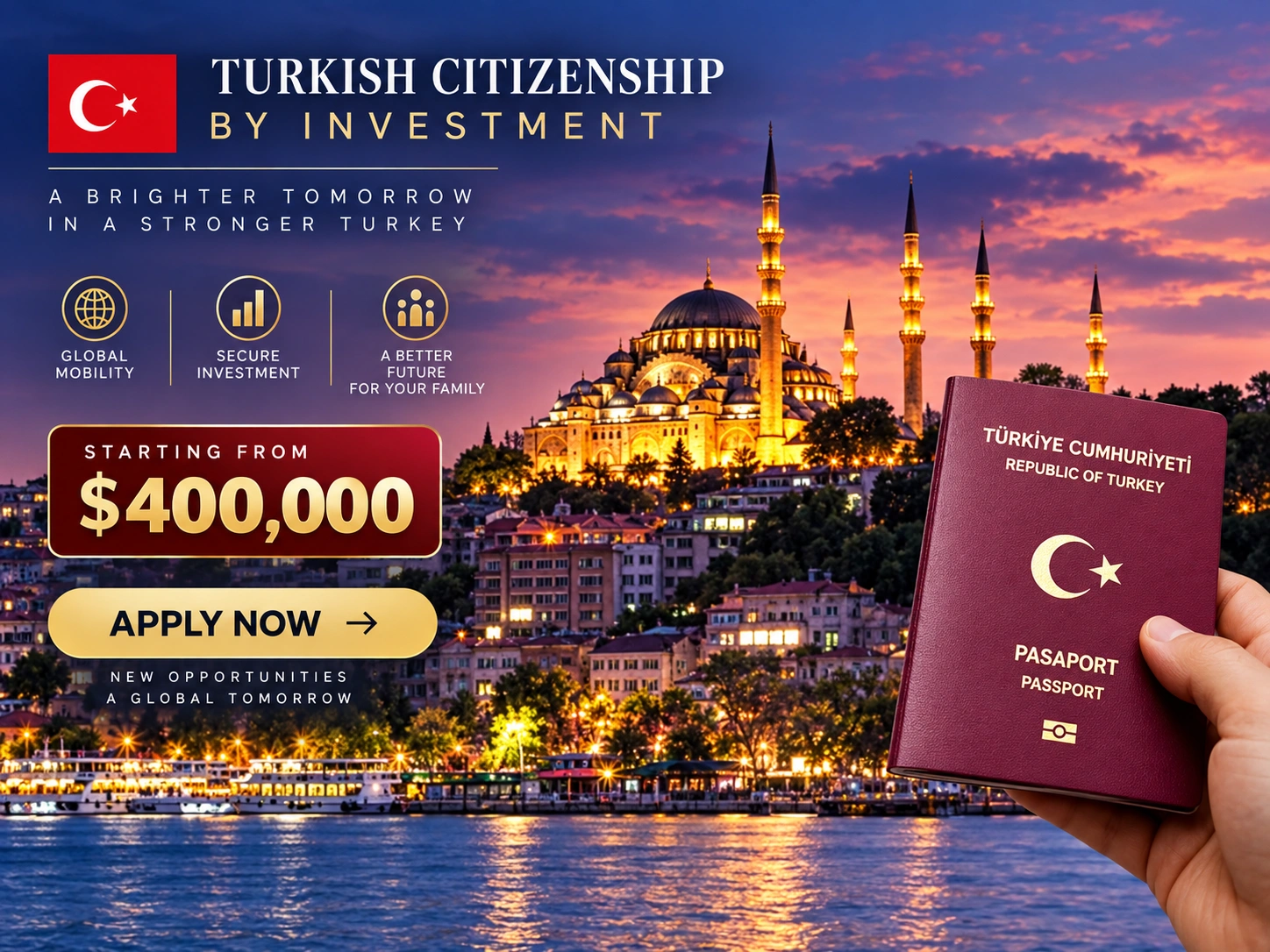
USD 400,000 route
Real-estate requirements that matter in practice
According to the Investment Office summary, natural persons of foreign origin may pursue exceptional citizenship after purchasing real estate worth at least USD 400,000, declaring the citizenship purpose in the acquisition process, and accepting a three-year no-sale annotation on the title deed. After land-registry procedures, the owner may seek residence and/or citizenship steps using the certificate of eligibility issued for that purpose.
Historical note only: an earlier lower real-estate threshold of USD 250,000 applied before the September 2018 update. Marketing that still quotes USD 250,000 as a current citizenship offer is outdated.
| Requirement | Current 2026 rule (summary) | Why it matters |
|---|---|---|
| Minimum value | At least USD 400,000 or equivalent foreign currency | Below-threshold files fail conformity / eligibility |
| Title annotation | No resale for at least three years recorded on the deed | Core statutory condition for the real-estate route |
| Purpose declaration | Acquisition stated for citizenship purposes in the process | Ordinary purchases are not automatically citizenship files |
| Eligibility certificate | Issued after land-registry steps for residence/citizenship claims | Needed to progress the administrative file |
| Final citizenship decision | Presidential resolution after review | Investment compliance ≠ automatic approval |
| Value evidence (practice) | Sale price, official value determination / appraisal processes, and payment trail must align with threshold rules | Inflated contracts or weak payment evidence are common rejection risks |
| FX / bank evidence | Foreign-currency purchase and banking documentation rules apply in current practice (often discussed as DAB / bank FX sale steps) | Cash-only narratives and mismatched accounts create serious compliance gaps |
Do not convert USD 400,000 into a TRY “today’s rate” figure on this page. Use the official foreign-currency-equivalent wording and let banks/authorities apply the operative conversion rules for your transaction date.
Eligibility traps
Not every property — and not every seller — qualifies
Older marketing often claimed that “seller nationality does not matter” or that “any property over USD 400,000 works.” That is unsafe. Citizenship-linked acquisitions can fail when the asset structure, prior use, ownership history, encumbrances, or buyer–seller relationship conflicts with current land-registry and conformity practice.
Property structures that need careful review
- Completed units vs off-plan / promise-to-sell structures
- Shared ownership fractions and co-ownership designs
- Vacant land (project obligations may apply for foreigners)
- Commercial vs residential assets
- Properties previously used in a citizenship application
- Mortgage, seizure, lien, usufruct, or other annotations
Seller / transfer issues to verify early
- Whether the seller can lawfully transfer for this purpose
- Related-party or circular transfer concerns
- Foreign-to-foreign transfer limitations where applicable
- Developer company status and authority to sell
- Payment account identity matching the seller
- Prior citizenship annotation history on the parcel/unit
Multiple properties
Practice guidance used by land-registry practitioners has long recognized that more than one property may be used to reach the minimum threshold when procedures, values, and annotations are correctly structured. Treat aggregation as procedure-dependent, not as a casual shopping cart. Confirm with counsel and the competent offices before assuming several smaller purchases will combine for one conformity certificate.
Off-plan / notarized promise to sell
Preliminary contracts do not transfer ownership by themselves (Invest.gov.tr). A notarized promise-to-sell route for citizenship has been used for units with condominium ownership or construction servitude when prepaid amounts, annotations, and later title steps comply. If your target is still under construction, obtain written legal confirmation that the current conformity path still supports that structure — do not rely on brochure language alone.
Mortgages and seizures
Burdens that prevent a clean sale should be checked before Tapu procedures. A blanket slogan that “any mortgaged property is always ineligible” or “always eligible if net equity exceeds USD 400,000” is too crude. Encumbrances can block transfer, reduce qualifying value, or delay conformity. Only a file-specific legal review can answer this.

Foreign buyers
Foreign property ownership limits (separate from citizenship)
Even before citizenship rules, foreigners face land-registry limits summarized by Invest.gov.tr:
- Eligible nationalities are determined by Cabinet / Presidential authority; some nationalities cannot acquire.
- A foreign natural person may generally acquire up to 30 hectares nationwide (larger only if specially permitted).
- Foreign acquisitions in a district may not exceed 10% of the private-property area of that district.
- Acquisition and leasing inside prohibited military zones / military security zones is not available to foreign natural persons; special security zones may require governor permission.
- Vacant land without existing construction can trigger a project-development obligation within two years.
Reciprocity claim audit: older guides said foreigners could buy only if their country offered reciprocity to Turkish citizens. That general reciprocity condition was removed by later legislation (often cited as Law 6302). What remains is nationality eligibility under current Presidential/Cabinet determinations — not the old generic reciprocity slogan. Check your nationality against current practice before assuming any district purchase is open.
Military clearance claim audit: older buyer guides described a routine “apply for military clearance after notarization” letter for every foreign purchase. Current practice relies heavily on registry systems and zone records (and online parcel inquiry tools such as parselsorgu.tkgm.gov.tr for basic parcel status). Do not plan your timeline around an obsolete universal military-letter ritual; instead verify whether the specific parcel is in a restricted zone.
Videos on this page are atmospheric context only. Thresholds, fees, eligibility, and timelines must come from current official sources and counsel — not from video narration.
Process
Practical application sequence (real-estate route)
Exact ordering can vary by case (power of attorney, family composition, off-plan vs completed unit, bank FX steps). The table below is a practical planning sequence aligned with official high-level steps — not a guaranteed timeline.
| Stage | What happens | Key evidence / authority |
|---|---|---|
| 1. Independent due diligence | Title, zoning, debts, seller authority, prior annotations, restricted-zone check | Independent lawyer; parcel inquiry; municipal/tax checks |
| 2. Structure the purchase | Confirm citizenship purpose, value pathway, payment plan, single vs multiple units | Counsel + written agreements |
| 3. Valuation / value determination | Official value processes required for the transaction type | Land-registry / valuation systems (TTB practice as applicable) |
| 4. Banking & FX compliance | Traceable transfers; foreign-exchange purchase documentation where required | Banks operating in Türkiye; payment receipts |
| 5. Title deed transfer or promise route | Tapu appointment; interpreter if needed; photos/IDs; DASK where applicable | Land Registry Directorate (TKGM) |
| 6. Three-year annotation | No-sale commitment recorded on the deed for citizenship purpose | Title deed record |
| 7. Eligibility / conformity certificate | Certificate issued for residence/citizenship claims after Tapu steps | Competent ministry / land-registry attestation chain |
| 8. Residence / filing stage | Residence permit steps where required for the exceptional route, then citizenship filing | Migration / NVI processes as directed for the case |
| 9. Authority review | Security and administrative review of the file | Competent ministries / Presidency |
| 10. Decision & passport | If citizenship is granted, civil-status registration then passport application | Presidential decision → NVI / passport authority |
Processing time: there is no official government promise of “citizenship in four to six months.” Duration varies with documentation quality, family composition, security checks, and workload. Treat third-party anecdotes as anecdotes.
Passport timing: a passport is applied for after citizenship is granted and civil records are updated — not automatically at the moment of Tapu transfer.

Residence vs citizenship
Property ownership is not automatic residence — and not automatic citizenship
- Title registered at Land Registry
- Subject to foreign-acquisition limits and zone rules
- Does not by itself equal a passport
- Short-term residence for property owners is addressed under Law 6458 (Invest.gov.tr)
- Exceptional citizenship requires a qualifying investment route + Presidential decision
- Ordinary naturalization after long residence is a different legal path
Older marketing claimed that a USD 100,000 property purchase yields a three-year residence permit and then citizenship after five years of continuous residence. That neat package is not retained here as a current citizenship pathway. Residence permit categories, property-based residence thresholds, and ordinary naturalization rules are separate regimes; none of them should be sold as a shortcut “mini-CBI.” Confirm any residence strategy with immigration counsel independently of citizenship marketing.
Family
Spouse, children, and who is usually not included
Exceptional citizenship files commonly allow the main investor to include a spouse and dependent children under 18 when documents, custody/consent, and civil-status records are complete. Do not assume that adult children, parents, or extended relatives are automatically includable. Custody disputes, previous marriages, and name inconsistencies are frequent delay causes.
- Spouse: typically includable with marriage evidence and translations/legalizations as required.
- Children under 18: typically includable with birth records and parental consent/custody proof where needed.
- Parents / adult dependents: do not treat as automatic dependents of the real-estate CBI file unless current practice for your case expressly allows a separate legal basis.
Costs 2026
Taxes, fees, and costs to budget (not a single “citizenship package price”)
There is no honest single number for “total citizenship cost.” Separate the statutory investment threshold from transaction taxes and from private professional fees.
| Cost / requirement | Current 2026 rule or amount | Who / when | Important note |
|---|---|---|---|
| Real-estate investment threshold | USD 400,000+ (or equivalent FX) | Buyer — at acquisition | Statutory route minimum — not a tax |
| Title deed transfer tax (Tapu harcı) | Statutory total often discussed as 4% of declared sale value (2% buyer + 2% seller) | Parties at Tapu; contracts may shift who pays | Declared value must meet legal bases; do not under-declare |
| Land-registry revolving fund / service fees | Variable by office and year (confirm at Tapu) | At transfer appointment | Secondary 2026 calculators exist — verify live |
| Official valuation / value determination | Fee varies with system and property | Usually before / with Tapu steps | Part of compliance, not optional marketing |
| Mandatory earthquake insurance (DASK) | Required for buildings at Tapu where applicable | Buyer / process | Listed among land-registry requirements by Invest.gov.tr |
| Sworn interpreter | Private fee if a party does not speak Turkish | At Tapu / notary as needed | Official requirement when language barrier exists |
| Notary / promise-to-sell / POA | Variable private statutory notary tariffs + translations | As structure requires | Higher for off-plan promise routes |
| Independent lawyer | Private professional fee (variable) | Throughout | Cab Istanbul does not supply legal counsel |
| Residence / citizenship filing fees | Confirm on current NVI / Migration fee schedules | At application stages | Do not invent a fixed “passport fee package” |
| Annual property tax | Municipal rates on property value bases | Ongoing ownership | Separate from citizenship filing |
Check date for this cost table: 11 September 2026. Fees and revolving-fund amounts change; treat Tapu and official portals as controlling on the day of your appointment.
Before you pay
Due-diligence checklist
- Confirm your nationality is eligible to acquire the target asset
- Verify title ownership, share structure, and seller authority
- Search mortgages, liens, seizures, leases, and citizenship annotations
- Check military / security zone status for the parcel
- Review zoning, occupancy permit (iskan), and condominium status where relevant
- Assess earthquake insurance, municipal dues, and utility debts
- Confirm whether the unit/parcel was previously used for a citizenship file
- Map how sale price, value determination, and bank payments will each satisfy threshold rules
- Plan FX / bank documentation with the seller’s correct accounts
- Use an independent lawyer — not only a developer sales office
- Refuse pressure to sign before legal review of Turkish and translated texts
Completing this checklist reduces risk; it does not eliminate all risk or guarantee approval.
Risk signals
Common red flags in citizenship-property marketing
- “Guaranteed citizenship,” “guaranteed passport,” or “approval in X months for sure”
- Claims that any property above USD 400,000 automatically qualifies
- Artificially inflated valuations disconnected from payment evidence
- Requests for large cash payments outside bank channels
- Seller / payment-account mismatch
- Property previously used for citizenship without clear current eligibility
- Undocumented “guaranteed rental return” bundled with the passport pitch
- “All-inclusive passport package” with no fee breakdown
- Pressure to skip independent legal review
- Nominee / related-party structures that obscure beneficial ownership

After three years
Resale, dual nationality, and inheritance — careful framing
The real-estate route requires a recorded commitment not to sell for at least three years. After that holding period, resale may become contractually and registry-possible under the annotation rules that applied to your deed. Do not assume citizenship is forever unaffected by later fraud findings, misrepresentation, or other legal issues — compliance and honesty remain material.
Dual citizenship: Türkiye generally permits multiple nationality. Whether you can keep your existing citizenship depends on the law of your current nationality. Confirm both sides before you apply.
Inheritance: Invest.gov.tr states that foreigners’ inheritance rights are protected, but an heir who is not eligible to acquire/keep the immovable property under nationality or area limits may have to transfer it; otherwise Treasury procedures can sell and reimburse. This is not individualized estate advice.
Documents often requested (illustrative, not exhaustive)
- Passport / identity; biometric photos
- Birth and marriage / civil-status records (translated, apostilled/legalized as required)
- Tax number; power of attorney if represented
- Title deed / promise documents; valuation / value determination outputs
- Bank transfer receipts and FX purchase documentation where required
- Eligibility / conformity certificate
- Residence application materials where the route requires them
Family composition and country of origin often add documents. Ask counsel for a case-specific list.
Transport logistics
How Cab Istanbul can help — and what we do not do
Foreign buyers who already work with their own lawyer and real-estate professionals often need reliable private transport between Istanbul Airport (IST) or Sabiha Gökçen (SAW), hotels, property viewings, banks, notaries, and land-registry appointments. That logistics layer is where Cab Istanbul operates.
- Istanbul Airport (IST) private transfer
- Sabiha Gökçen (SAW) airport transfer
- Car with driver in Istanbul for viewing and appointment days
- Related reading: investment overview on Cab Istanbul
Cab Istanbul does not select qualifying properties, issue valuations, file citizenship applications, or provide immigration/legal advice. Transportation arrangements do not imply endorsement of any property, developer, or citizenship outcome.
FAQ
Citizenship by investment — frequently asked questions
What is Turkey’s citizenship-by-investment program?
It is an exceptional citizenship route under Law 5901 for foreigners who meet investment conditions set by regulation (real estate, capital, deposits, bonds, funds, jobs, or private pension contributions). Approval is by Presidential decision after review — not automatic upon payment.
Is the real-estate threshold still USD 400,000 in 2026?
Yes, the Investment Office’s current official summary still states a minimum real-estate acquisition of USD 400,000 or equivalent foreign currency with a three-year resale restriction, attested through the competent ministry chain. Always re-check the official page before you commit.
Does buying any USD 400,000 property qualify?
No. Value is only one condition. Structure, seller history, encumbrances, payment evidence, annotations, nationality eligibility, and conformity practice all matter.
Can I buy more than one property?
Aggregation of multiple properties to reach the threshold has been recognized in land-registry practice guidance, but it is procedure-dependent. Confirm before assuming several purchases will combine for one eligibility certificate.
Can I buy an off-plan property?
Possibly, via a compliant notarized promise-to-sell structure for units with condominium ownership or construction servitude — if current conformity rules for your case still support it. Preliminary contracts alone do not transfer ownership.
Can a mortgaged property qualify?
Encumbrances can block or impair qualification. There is no safe one-line answer without reviewing the specific annotations, release conditions, and value evidence.
Who can sell a qualifying property?
Not every seller structure works. Prior citizenship use, related-party issues, and foreign-transfer limits can matter. Seller identity is not “irrelevant.”
Can a property previously used for citizenship qualify again?
Treat prior citizenship use as a high-risk red flag. Verify current eligibility with counsel and competent offices; do not assume reuse is allowed.
How is property value determined?
Citizenship practice looks beyond marketing list prices. Official value-determination / appraisal processes and payment amounts must support the USD 400,000 threshold. Inflated paperwork without matching funds is a classic failure mode.
Is an appraisal / official value report required?
Official value processes are part of modern Tapu/citizenship compliance. Do not rely on outdated phrasing such as “any appraiser registered with TKGM.” Use the current land-registry valuation systems and counsel.
What is a Certificate of Conformity / eligibility certificate?
After land-registry procedures for a citizenship-purpose acquisition, an eligibility certificate is used to claim residence or citizenship rights in the administrative process (as summarized by Invest.gov.tr). Exact naming and offices can vary — follow the certificate issued for your file.
What is the three-year holding rule?
The title deed carries a restriction that the property will not be sold for at least three years. It is a core condition of the real-estate investment route.
Can I sell after three years?
After the annotated period, resale may become possible under the deed rules that applied to your acquisition. Citizenship outcomes can still be affected by fraud or misrepresentation findings — do not treat the three-year mark as a magic immunity shield.
Can citizenship be guaranteed?
No. Meeting investment conditions may allow an application; the final decision remains discretionary after government review.
How long does an application take?
Processing time varies by case, documentation, and authority review. There is no official guaranteed 4–6 month completion for every file.
Is residence required first?
The exceptional route is linked to investment-based residence categories under Law 6458 in the statutory framing. Exact sequencing for your file should be confirmed with counsel — do not invent a DIY order from blogs.
Can my spouse be included?
Typically yes, when marriage evidence and translations/legalizations are in order. Confirm current dependent rules for your file.
Which children can be included?
Dependent children under 18 are the usual category. Adult children are not automatically included.
Can my parents be included?
Do not assume parents are dependents of the real-estate CBI application. Ask counsel whether any separate legal basis exists for your case.
Does Türkiye allow dual citizenship?
Türkiye generally permits multiple nationality. Your other country may not. Check both legal systems.
What documents are normally needed?
Identity, civil-status records, photos, tax number, title/promise documents, valuation outputs, bank/FX evidence, and eligibility certificate materials are common building blocks. Country-specific legalization rules apply.
Does payment have to come through a bank?
Traceable banking evidence is central to modern compliance. Large undocumented cash stories are a major red flag.
Is a foreign-exchange purchase certificate required?
Current practice commonly requires foreign-currency amounts to be sold to a bank operating in Türkiye with supporting documentation (often discussed as DAB). Confirm the exact banking steps with your bank and counsel for the transaction date.
What taxes and fees should I budget for?
Beyond the USD 400,000+ investment, budget Tapu transfer tax (commonly discussed as 4% total statutory shares), revolving-fund fees, valuation, interpreter, notary, insurance, lawyer fees, and later filing fees. There is no single package price.
Can foreigners buy property anywhere in Türkiye?
No. Nationality eligibility, 30-hectare and 10% district caps, and military/security zone rules apply. Being in Istanbul does not override those limits.
Are military/security-zone restrictions still relevant?
Yes. Foreign natural persons may not acquire in prohibited military / military security zones; special security zones may need governor permission.
Does reciprocity still apply?
The old general reciprocity slogan is outdated. Nationality eligibility under current Presidential/Cabinet determinations remains decisive.
Can property ownership alone give citizenship after five years?
Do not treat ordinary long residence or a low-value property purchase as an automatic citizenship machine. Exceptional investment citizenship and ordinary naturalization are different paths with different rules.
What other investment routes exist?
Fixed capital, job creation, bank deposit, government bonds, real-estate/venture capital fund shares, and private pension contributions — each with its own minimum and attesting authority (see table above).
Does Cab Istanbul provide citizenship or legal advice?
No. Cab Istanbul is a transportation company. Engage a qualified independent lawyer and, where needed, licensed real-estate and immigration professionals.
Can Cab Istanbul provide transport for viewings and official appointments?
Yes. Airport transfers and chauffeur-driven cars between hotel, viewings, bank, notary, and Tapu appointments are the appropriate service layer.
This FAQ is informational. It does not create an attorney–client relationship and cannot replace advice tailored to your nationality, family, and property file.