
Istanbul Historic Peninsula
Gülhane Park: From Imperial Garden to Istanbul's Beloved City Park
Gülhane Park (Gülhane Parkı) is a roughly 24-hectare historic green space in Istanbul's Fatih district, hugging the outer walls of Topkapı Palace at the tip of the Old City peninsula. Three civilisations left their mark here: the Byzantines built a cistern beneath its soil; the Ottomans made it an exclusive imperial garden; and in 1839 the Ottoman Empire's most transformative legal document — the Tanzimat Edict — was proclaimed on its grounds.
The Column of the Goths, a Byzantine-era cistern now reborn as an art space, the world-class Museum of Islamic Science and Technology, and the Istanbul Archaeology Museums complex are all within walking distance. Entry to the park itself is free, and it is open year-round.
At a Glance
Gülhane Park — Essential Information
| Detail | Information |
|---|---|
| Address | Alemdar Mah., Fatih / Sarayburnu, Istanbul (adjacent to Topkapı Palace) |
| Entry Fee | Free (museums inside charge separately) |
| Park Hours | Open year-round; accessible from early morning |
| Gülhane Sanat (Cistern) | Tue–Sun 10:00–19:00 · Closed Mondays · Usually free (fees may apply for special events) |
| Best Transport | T1 Tram — Gülhane Stop (Bağcılar–Kabataş line); 2–3 min walk to gate |
| Alternative | Marmaray — Sirkeci Station (~10 min walk); Eminönü buses |
| Area | Approximately 24 hectares |
| Historic Significance | Site of the Tanzimat Edict proclamation (3 November 1839) |
| UNESCO | Part of the Historic Areas of Istanbul (inscribed 1985) |
| Nearby | Topkapı Palace, Sultanahmet, Sirkeci, Grand Bazaar (~15 min walk) |
History
From Imperial Garden to Modern Park: A Brief History of Gülhane
The name Gülhane comes from Ottoman-Persian: gül (rose) combined with hane (house, place) — meaning "house of roses" or "rose garden." The name reflects the site's historic identity as a private floral garden reserved for the Ottoman court.
The area's story predates the Ottomans. The Gülhane Cistern, dated to the 5th–7th century, confirms that the Byzantines developed this land long before the Ottoman conquest of 1453. After the Ottomans took Constantinople, the grounds became the Hasbahçe — the private outer garden of Topkapı Palace — accessible only to the sultan and palace residents.
The park's transformation into a public space unfolded gradually. Some sources mention partial public access during the reign of Sultan Abdülmecid (1839–1861), but it was the mayor of Istanbul, Cemil Topuzlu Pasha, who oversaw its formal conversion into a modern municipal park in 1912. Topuzlu landscaped the grounds and opened them to the public alongside Sultanahmet Park and Yıldız Grove — marking Istanbul's first organised public green spaces.
In the 1950s the park briefly housed a small zoo. Subsequent decades saw the İBB (Istanbul Metropolitan Municipality) carry out extensive landscaping and restoration works that shaped Gülhane as it stands today.
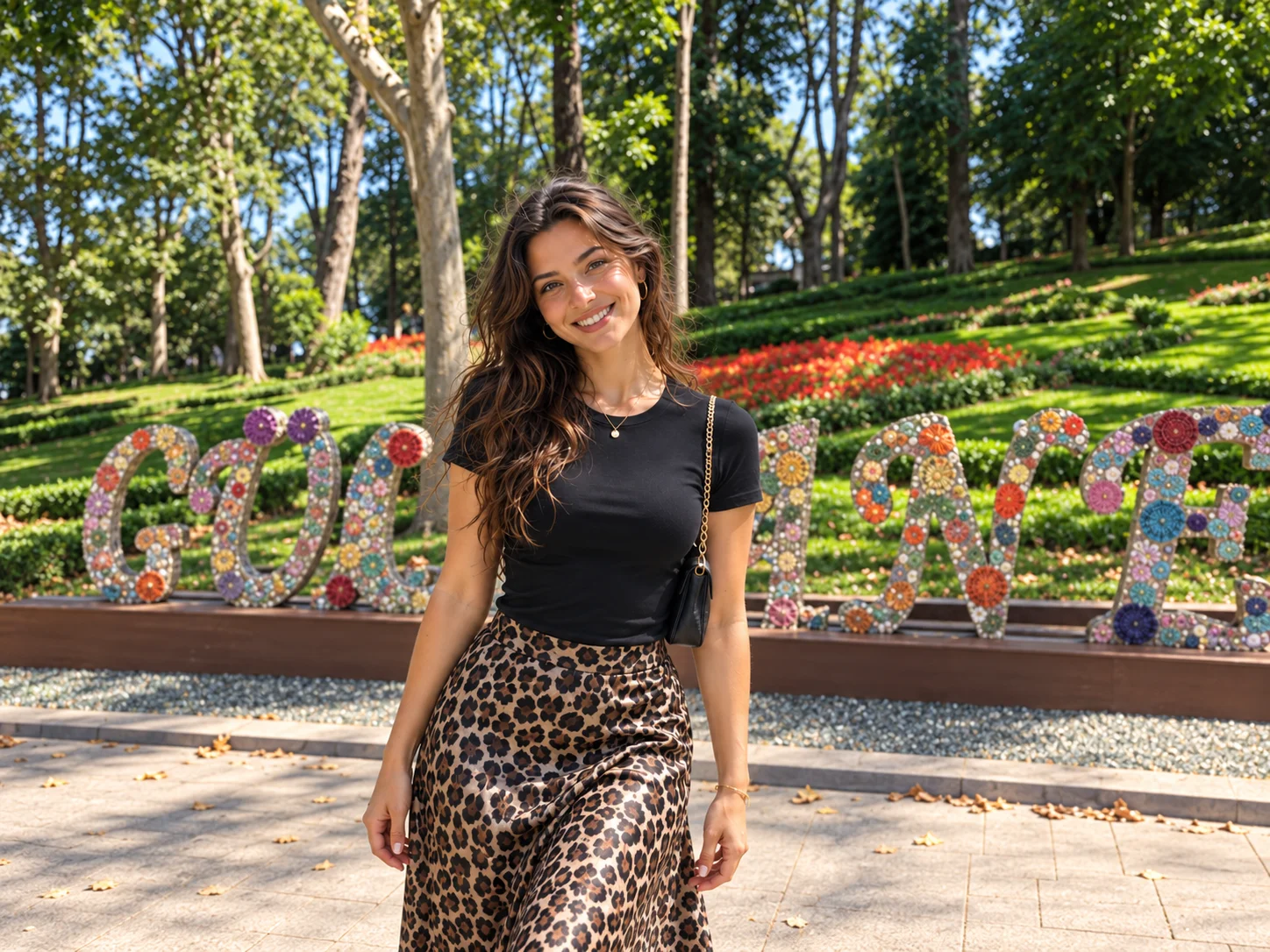
3 November 1839
The Tanzimat Edict: A Turning Point Proclaimed in Gülhane
Gülhane Park gave its name to one of the most consequential documents in Ottoman and Turkish legal history: the Gülhane Hatt-ı Hümayunu, known in the West as the Tanzimat Edict or the Imperial Rescript of Gülhane. On 3 November 1839, during the reign of Sultan Abdülmecid, Foreign Minister Koca Mustafa Reşid Pasha read the edict aloud to an assembly of state dignitaries, religious leaders, ethnic community representatives and foreign ambassadors gathered in the park's open grounds.
The document took the name "Gülhane" precisely because of where it was proclaimed. It is also known as Tanzimat-ı Hayriye — the Beneficial Reorganisations.
The edict's core significance lies in its guarantee, for the first time in Ottoman history, of security of life, property and honour to all subjects regardless of religion, alongside reforms to taxation and military service. It is considered a foundational milestone on the path to constitutional governance.
- Security of life, property and honour guaranteed to all Ottoman subjects
- Taxation to be regulated by law, abolishing arbitrary levies
- Military service to be subject to clear rules and fixed terms
- Equal treatment in law for Muslim and non-Muslim subjects
- Prohibition of arbitrary execution and confiscation of property
A commemorative marker in the park today identifies the site where the edict was proclaimed, giving visitors a tangible connection to this historic moment.
Palace & Peninsula
Topkapı Palace Relationship and Sarayburnu
Gülhane Park and Topkapı Palace share a deep historical bond, but today they are separate visitor destinations. Topkapı requires a paid ticket and separate entrance gates; Gülhane is free and directly accessible from Alemdar Caddesi. Sections of the original palace walls still form part of the park's boundary.
The Istanbul Archaeology Museums — which sit between the park and the palace — serve as a visible link between the two sites. The slope they occupy, named after the pioneering Ottoman museologist Osman Hamdi Bey, connects the park's lower reaches to the palace's outer precinct.
At the park's seaward edge lies Sarayburnu — the promontory where the Bosphorus, the Golden Horn and the Sea of Marmara converge. The park's most celebrated landmark here is the Atatürk Monument, sculpted by Austrian artist Heinrich Krippel and unveiled on 3 October 1926. It stands as one of Istanbul's first Atatürk monuments. With Topkapı Palace behind it, the statue's placement symbolises the transition from the Ottoman sultanate to the Turkish Republic.
The view from Sarayburnu — especially in April when tulips frame the Bosphorus panorama — is among the most photographed scenes in Istanbul.
Video: Istanbul's Gülhane Park — scenes from inside the park.
Historic Landmarks
Column of the Goths, Âşık Veysel Monument and Alay Köşkü
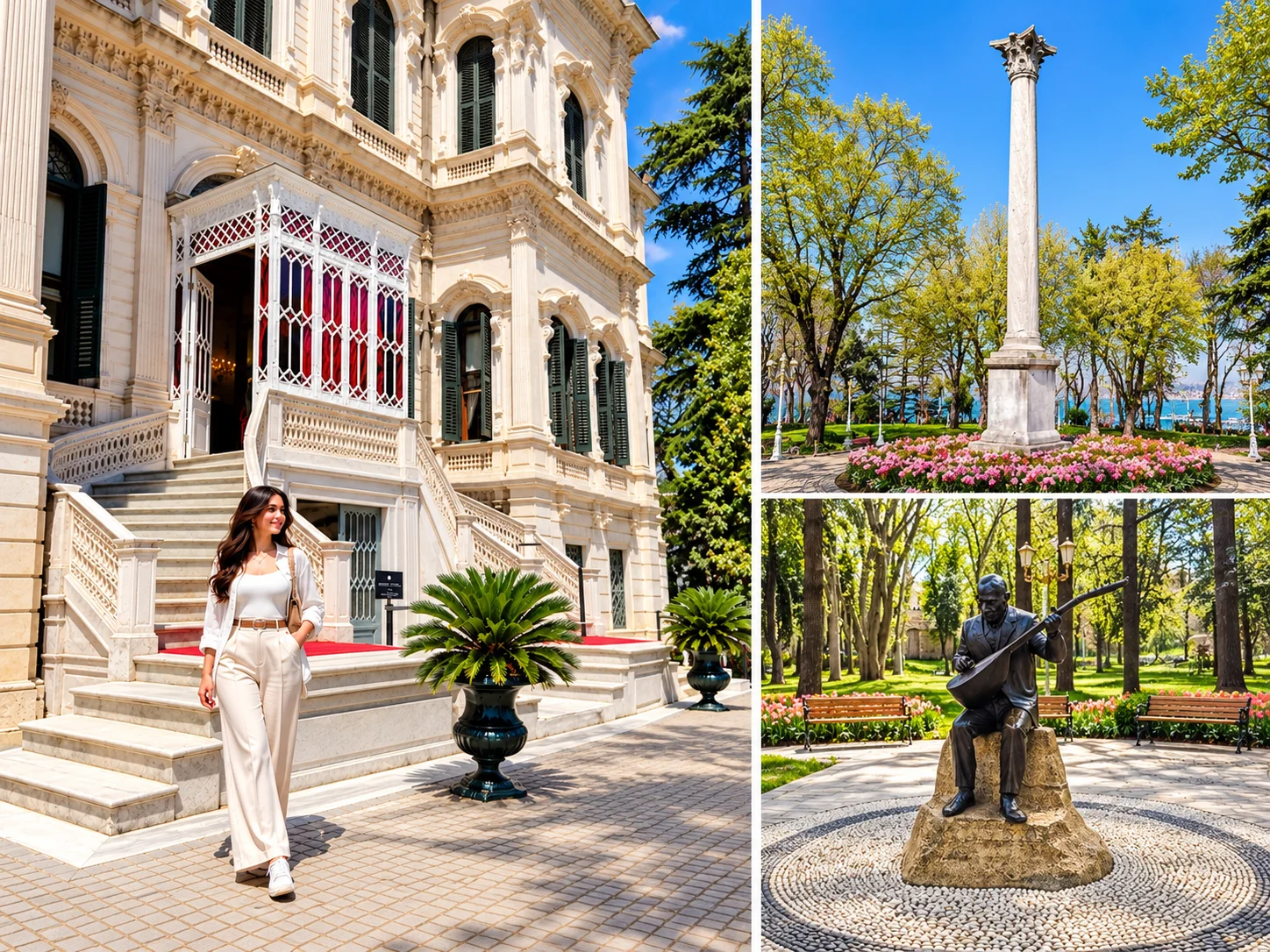
Column of the Goths
Rising near the Sarayburnu entrance to the park, the Column of the Goths is among the oldest surviving Roman monuments in Istanbul. Carved from a single block of Proconnesian marble (quarried on Marmara Island), the column stands 18.5 metres tall. Its Latin inscription — FORTUNAE REDUCI OB DEVICTUS GOTHOS — translates roughly as "erected in honour of the Fortune who returned, on account of the Goths having been conquered."
Scholars debate the column's exact date: it is most commonly attributed to the reign of Emperor Claudius II (268–270 AD), who defeated the Goths in battle, though others argue for the reign of Constantine I (306–337 AD). Art historian Semavi Eyice places it in the 3rd–4th century range. What is certain is that the column has survived centuries without major alteration — making it one of Istanbul's most intact ancient structures.
Âşık Veysel Monument
On the right-hand side of the path descending toward the Bosphorus stands a statue of Âşık Veysel Şatıroğlu, the beloved blind Turkish folk poet and saz master. The monument honours his lasting contribution to Turkish cultural heritage.
Alay Köşkü and the Tanpınar Library
Near the Alemdar Caddesi boundary of the park, the Alay Köşkü (Procession Kiosk) stands atop the outer wall of Topkapı Palace. Built in the early 19th century under Sultan Mahmud II for viewing royal processions, its interior today houses the Ahmet Hamdi Tanpınar Literature Museum Library, opened on 12 November 2011. The library holds manuscripts, letters and personal items belonging to Ahmet Hamdi Tanpınar, Yahya Kemal Beyatlı, Orhan Pamuk and other giants of Turkish literature.
Byzantine Legacy
Gülhane Cistern and Gülhane Sanat Art Space
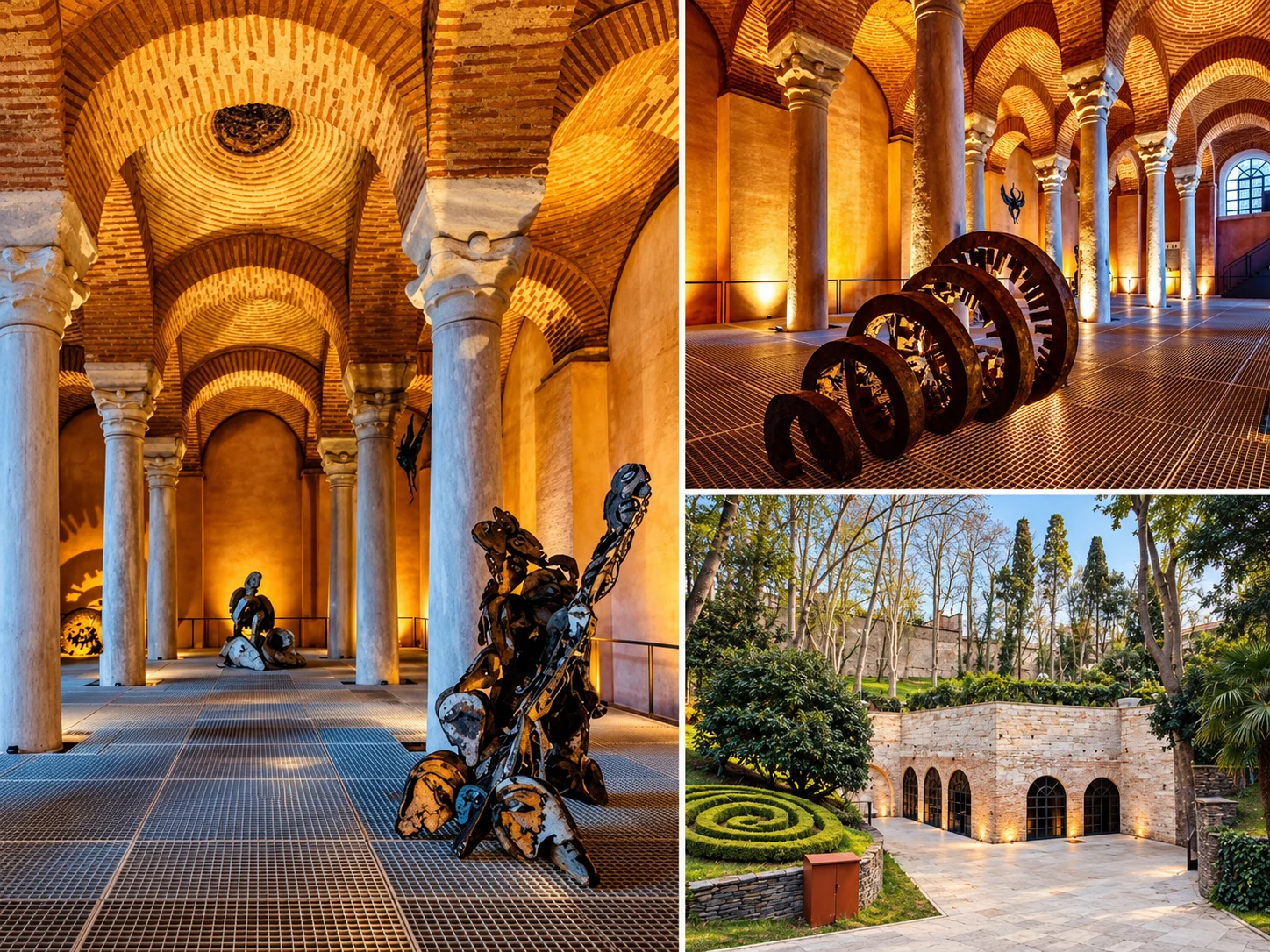
Just north of the Istanbul Archaeology Museums, beside a historic fountain bearing the monogram of Sultan Mehmed V, the Gülhane Cistern is one of the park's most remarkable hidden structures. Its exact construction date is unknown, but archaeologists generally place it in the 5th–7th century — the Early Byzantine period. The rectangular cistern measures approximately 18 × 13 × 7 metres and is supported by 12 columns.
Wall remnants above the cistern suggest that a further structure once stood on top of it in the Byzantine era. Long neglected, it was transformed by the İBB Miras (Istanbul Metropolitan Municipality Heritage) teams through a thorough restoration project, and reopened on 1 April 2023 under the name "Gülhane Sanat" as a cultural and arts venue.
Gülhane Sanat now hosts talks, concerts, sculpture exhibitions and multidisciplinary events. Unlike the Basilica Cistern, which is a large-scale tourist destination, Gülhane Sanat operates on a smaller, more local scale — making it a quieter and often overlooked gem worth seeking out.
| Gülhane Sanat | Info |
|---|---|
| Open | Tue–Sun 10:00–19:00 |
| Closed | Mondays |
| Entry | Usually free (special events may be ticketed) |
| Managed by | İBB Kültür A.Ş. |
Museum Map
Museums Near Gülhane Park: What's Where?
Several important museums cluster around Gülhane, but their exact locations can be confusing. The table below clarifies which museum is where — and which ones are sometimes incorrectly described as being inside the park.
| Museum | Location | Entry | Note |
|---|---|---|---|
| Museum of Islamic Science and Technology | Inside Gülhane Park — Has Ahırlar Building | Paid (Müzekart accepted) | Separate entrance within the park |
| Gülhane Cistern (Gülhane Sanat) | Inside Gülhane Park | Usually free | Exhibition and events space |
| Istanbul Archaeology Museums | Between Gülhane and Topkapı — Osman Hamdi Bey Slope | Paid (Müzekart accepted) | 3 buildings: Archaeology, Ancient Orient, Tiled Kiosk |
| Tanpınar Literature Museum Library | Alay Köşkü — Alemdar Caddesi, on the park boundary | Usually free | Library and literary archive |
| Topkapı Palace Museum | Adjacent to Gülhane — separate entrance required | Paid (Müzekart accepted) | Enter from the Sultanahmet side |
| Museum of Turkish and Islamic Arts | Sultanahmet — İbrahim Pasha Palace (NOT in Gülhane) | Paid | Often confused with the Gülhane museum — different institution entirely |
Has Ahırlar Building — Gülhane Park
Museum of the History of Islamic Science and Technology
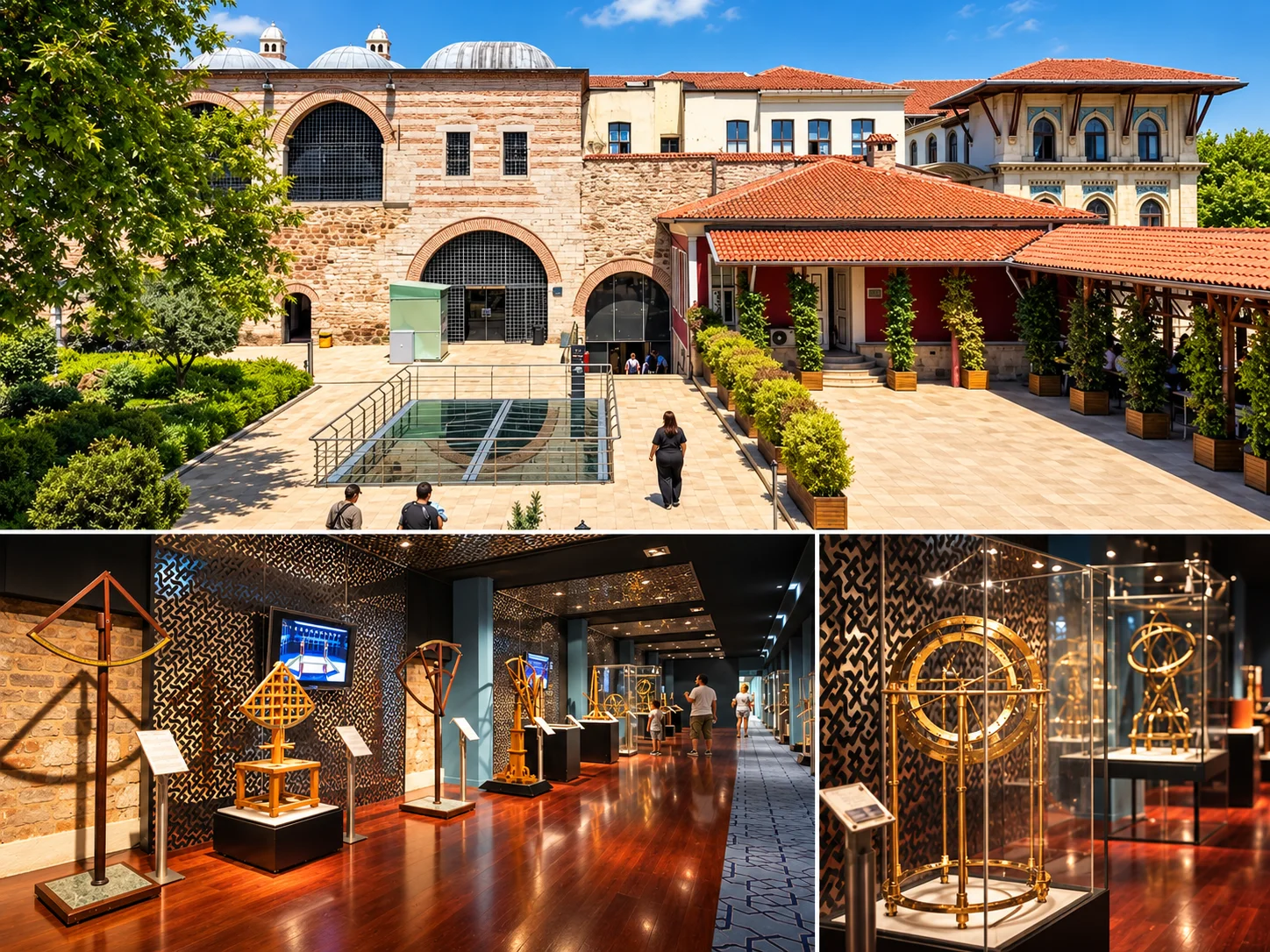
Housed in the restored Has Ahırlar Building (former imperial stables) inside Gülhane Park, this museum was inaugurated on 24 May 2008 thanks to the scholarship and vision of Turkish historian of science Prof. Dr. Fuat Sezgin. Across approximately 3,500 m² of exhibition space, more than 570 replicas, models and instruments illustrate the scientific and technological legacy of the Islamic world between the 9th and 16th centuries.
It is the second-largest museum of its kind in the world — the first is in Frankfurt. The upper floor covers astronomy, clock-making, maritime technology, military engineering and medicine; the lower floor focuses on mineralogy, physics, mathematics and geometry, optics, chemistry and geography.
Highlights include:
- Astronomy: Astrolabes and sundials attributed to al-Jazari, Taqi al-Din and Ali Qushji
- Medicine: Surgical instruments associated with Ibn Sina (Avicenna) and al-Zahrawi
- Geography: References to Piri Reis's world maps and navigational tools
- Engineering: Automata and water-pump models by al-Jazari
- Optics: Apparatus related to Ibn al-Haytham's light-refraction experiments
The museum is included in the Müzekart programme. Check the official website for current opening hours before your visit.
Osman Hamdi Bey Slope
Istanbul Archaeology Museums
Climbing the slope between Gülhane Park and Topkapı Palace, the Istanbul Archaeology Museums complex is Turkey's largest museum group. Officially opened on 13 June 1891, it is reachable by a short walk from inside the park. The complex comprises three distinct buildings.
Archaeological Museum
The centrepiece is the Alexander Sarcophagus (late 4th century BC) — named for its carved battle scenes depicting Alexander the Great, not because it was his tomb (it almost certainly belonged to a Sidonian king). The museum also holds the Treaty of Kadesh, widely regarded as the oldest known written peace treaty, dating to the 13th century BC between the Hittites and Egypt.
Istanbul Archaeological Museum Guide →Museum of the Ancient Orient
Home to approximately 74,000 cuneiform tablets from Mesopotamia and artefacts from pre-Islamic Egypt and Arabia. A copy of Hammurabi's Code and fragments from Babylon's Ishtar Gate are among the standout pieces in this rarely matched ancient Near Eastern collection.
Tiled Kiosk
Built in 1472 by Sultan Mehmed II, the Tiled Kiosk is one of the oldest surviving secular Ottoman structures in Istanbul. Its superb collection of 15th–16th-century İznik tiles and Seljuk-era ceramics is exceptional. Note that the kiosk is sometimes closed for restoration; confirm its status before visiting.
Every Season Different
Gülhane's Nature and the Best Times to Visit
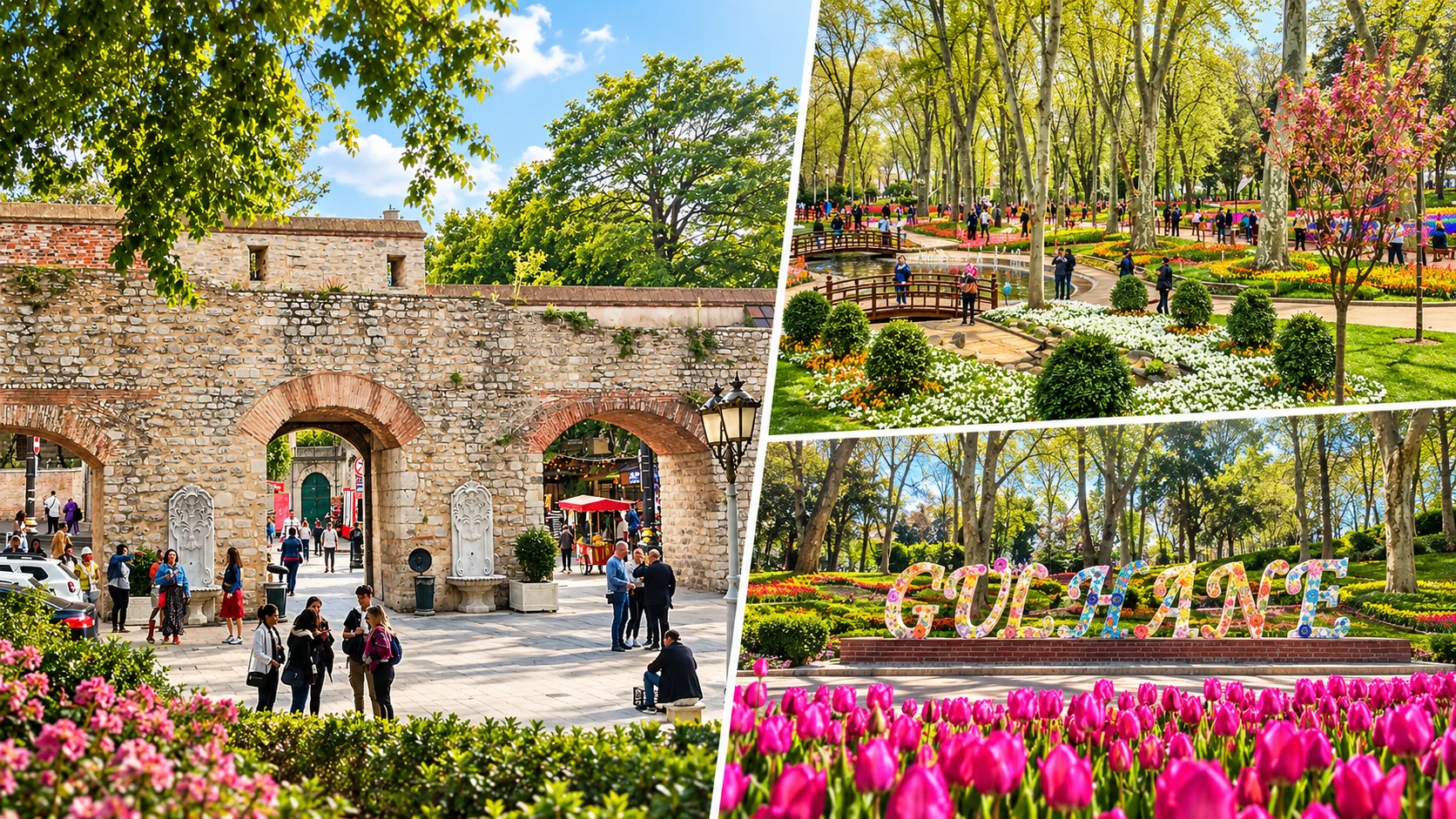
Ancient Oriental plane trees (Platanus orientalis), flower beds and broad lawns give Gülhane a different character in every season. Its walking paths and the descent toward Sarayburnu offer a genuine escape from the city's noise.
Spring: Tulips and Blossoms
During the Istanbul Tulip Festival each April, Gülhane is carpeted with thousands of tulips in vivid colours — the park's most visited season by far. As temperatures rise and the plane trees come into leaf, mornings here draw joggers, families and photographers alike. The tulip display is one of the most spectacular in the whole city.
Autumn: Golden Leaves
Between September and November the plane trees turn shades of amber and gold, framing the park's Ottoman monuments in warm autumn light. This is a photographer's paradise and a quieter alternative to the spring crowds. Cooling temperatures make it perfect for longer walks and a tea break at one of the park's riverside cafés.
Families and Accessibility
A playground area is available within the park. The Column of the Goths, Gülhane Cistern and the short Sarayburnu trail make for an engaging and educational route for children. Paths are largely flat and manageable with a pushchair. For visitors with mobility needs, the main walkways around the park are accessible; the slope toward Sarayburnu is more gentle than it appears.
Myth vs. Fact
Nâzım Hikmet and the "Walnut Tree" Poem
Among the most celebrated poems in the Turkish canon, "Ceviz Ağacı" (Walnut Tree) by Nâzım Hikmet Ran opens with the unforgettable line: "I am a walnut tree in Gülhane Park / ancient and knotted…" The poem was later made famous by singer Cem Karaca and has made Gülhane synonymous with romantic longing in Turkish cultural memory.
A popular story surrounds the poem: that Nâzım arranged to meet his beloved Piraye under a walnut tree in Gülhane Park while on the run from police; that he climbed the tree to hide; and that this moment of suspended longing inspired the poem. It is a beautiful story — but researchers have established that it does not match the historical record.
The verified facts are these: Nâzım Hikmet wrote "Walnut Tree" on 1 July 1957 in Balçık, Bulgaria. At the time he was accompanied not by Piraye Altınoğlu, but by Münevver Andaç. The poem's connection to Gülhane is metaphorical — the park becomes a symbol of a distant homeland seen from exile, not a literal autobiographical scene.
The legend's enduring power speaks to the emotional resonance of both the poem and the place. Visitors still search for "the walnut tree of Gülhane" — and understanding the real story makes the poem's imagery all the richer.

Getting There
How to Get to Gülhane Park
Alight at Gülhane Stop on the Bağcılar–Kabataş T1 line; a 2–3 minute walk brings you to the main gate. Direct connections run from Sultanahmet, Çemberlitaş, Eminönü and the Grand Bazaar area.
Alight at Sirkeci Station and walk approximately 10 minutes to the park. A convenient option if you are coming from the Asian side of Istanbul or connecting via the Marmaray tunnel from the airport line.
Arriving directly from Istanbul Airport or your hotel by private car is the most comfortable option. Our Istanbul airport transfer service or a car with driver can drop you at the park gate — leaving you free to spend the whole day exploring on foot.
IETT bus lines running through Eminönü (28, 30D, 46Ç, 99, 99A) stop at Sirkeci or Eminönü — both within easy walking distance of the park. Visitors arriving by car will find limited paid parking in the Sultanahmet area; approaching by public transport or private transfer is strongly recommended.
What's Nearby
Attractions Near Gülhane Park
Gülhane sits at the centre of Istanbul's densest concentration of historic monuments. A single day's walk from the park can take in centuries of world history.
Topkapı Palace
The administrative heart of the Ottoman Empire for over four centuries, Topkapı is Gülhane's immediate neighbour. The Harem, Treasury and Sacred Relics Section each deserve a separate visit — plan a full day for the palace complex.
Topkapı Palace Guide →Sultanahmet and Hagia Sophia
Walk south from the park to reach Sultanahmet Square, with Hagia Sophia and the Blue Mosque facing each other across the Hippodrome. This is one of the most historic squares on earth and a natural extension of any Gülhane visit.
Hagia Sophia Guide →Grand Bazaar and Sirkeci
Round off a Gülhane visit with a browse through the Grand Bazaar — the world's largest covered market — or explore the Ottoman-era Sirkeci neighbourhood and its celebrated railway station, the eastern terminus of the Orient Express.
Frequently Asked Questions
Gülhane Park Istanbul — FAQ
Where is Gülhane Park?
Gülhane Park is in the Fatih district of Istanbul, on the Historic Peninsula (Tarihi Yarımada) at Sarayburnu, right next to Topkapı Palace. The nearest tram stop is Gülhane on the T1 line. The park is within easy walking distance of Sultanahmet, Sirkeci and Eminönü.
Is entry to Gülhane Park free?
Yes. The park itself is free to enter. The Museum of Islamic Science and Technology inside the park, and the Istanbul Archaeology Museums adjacent to it, charge separate admission fees. A Müzekart (Museum Pass Turkey) covers most of these.
What are the opening hours?
The park is accessible year-round from early morning. Gülhane Sanat (the cistern art space) is open Tuesday to Sunday, 10:00–19:00, closed on Mondays.
What is the Tanzimat Edict and why was it proclaimed at Gülhane?
The Tanzimat Edict (Gülhane Hatt-ı Hümayunu) was a landmark Ottoman reform document proclaimed on 3 November 1839 by Foreign Minister Koca Mustafa Reşid Pasha in the presence of state dignitaries and foreign ambassadors. It guaranteed security of life, property and honour to all Ottoman subjects regardless of religion and is considered a cornerstone of Ottoman modernisation. Gülhane — then the outer garden of Topkapı Palace — was chosen as a ceremonially significant setting. The edict took the park's name as its official title.
What is Gülhane Cistern and is it worth visiting?
The Gülhane Cistern is a Byzantine-era structure dating to the 5th–7th century, roughly 18 × 13 × 7 metres and supported by 12 columns. Restored by the İBB and reopened in April 2023 as Gülhane Sanat, it now hosts art exhibitions and cultural events. Entry is usually free. Unlike the much larger Basilica Cistern, it is quieter and more intimate — definitely worth a visit if you are already in the park.
What is the Column of the Goths?
The Column of the Goths stands near the Sarayburnu entrance to the park. Carved from a single block of Proconnesian marble, it rises 18.5 metres and bears a Latin inscription attributing it to a victory over the Goths. Most scholars date it to the 3rd–4th century AD — making it one of the oldest standing Roman monuments in Istanbul. It has survived without major alteration for over 1,600 years.
Are the Istanbul Archaeology Museums inside Gülhane Park?
Not exactly. The museums are located on the slope between Gülhane and Topkapı Palace (Osman Hamdi Bey Slope) and are adjacent to the park, reachable by a short walk from inside it. They are a separate complex with their own paid entrance and include three buildings: the main Archaeological Museum, the Museum of the Ancient Orient and the Tiled Kiosk.
Did Nâzım Hikmet really write "Walnut Tree" in Gülhane Park?
No. The popular story — involving a secret meeting with his beloved Piraye, police surveillance and a tree-climbing escape — is not corroborated by historical evidence. Nâzım Hikmet wrote the poem on 1 July 1957 in Balçık, Bulgaria, while accompanied by Münevver Andaç. The park appears in the poem as a metaphor for a longed-for homeland, not as a literal location of events.
When is the Istanbul Tulip Festival at Gülhane?
The Istanbul Tulip Festival takes place every April; exact dates vary year to year. Gülhane Park is one of the primary venues, with thousands of tulips planted across its lawns. April is the most crowded time to visit the park, but also the most visually spectacular.
Can I visit Gülhane Park and Topkapı Palace on the same day?
Yes — they are side by side, though they have separate entrances. Gülhane is free; Topkapı Palace requires a ticket (or Müzekart). A full day is advisable: spend the morning in Gülhane and the Archaeology Museums, then visit Topkapı in the afternoon, finishing with Sultanahmet at dusk.
What is the Museum of Islamic Science and Technology?
It is housed in the Has Ahırlar Building inside Gülhane Park and was established through the work of Professor Fuat Sezgin, who spent decades reconstructing Islamic scientific instruments. Over 570 models and replicas cover astronomy, medicine, engineering, optics and geography from the 9th to 16th centuries. It is the world's second-largest museum of its type. Müzekart is accepted.
What is the Alay Köşkü and the Tanpınar Library?
Alay Köşkü (Procession Kiosk) is a 19th-century pavilion built atop the Topkapı Palace outer wall near the park's Alemdar Caddesi boundary. It was used by sultans to watch state processions. Today it houses the Ahmet Hamdi Tanpınar Literature Museum Library, opened in 2011, which holds manuscripts, letters and personal effects of major Turkish writers including Tanpınar, Yahya Kemal and Orhan Pamuk.
Is Gülhane Park suitable for children?
Yes — the park has a dedicated playground area. The Column of the Goths, the cistern, and the Sarayburnu trail offer short, engaging discovery routes for children. Walking paths are mostly flat and pushchair-friendly. Combine it with a stop at the Archaeology Museums, which have engaging exhibitions even for younger visitors.
Is there parking at Gülhane Park?
There is no dedicated visitor car park at the park entrance. Those arriving by car should use the paid car parks in the wider Sultanahmet area. Public transport (tram or Marmaray) is strongly recommended; private transfer drop-off is also a practical option.
What is the best time of year to visit Gülhane Park?
Spring (April–May) for the tulips and fresh greenery; autumn (September–November) for golden plane-tree foliage and fewer crowds. Summer mornings and evenings are pleasant. Winter is quiet, atmospheric and ideal for those who prefer solitude. The park is enjoyable in every season.
Are there cafés and food options in or near the park?
The park has its own tea garden and café with views toward the Marmara Sea. The Sirkeci, Eminönü and Sultanahmet neighbourhoods immediately surrounding the park offer a wide range of restaurants, cafés and street-food stalls — from traditional Turkish breakfast spots to international options.
How do I get from Istanbul Airport to Gülhane Park?
The most comfortable option is a private airport transfer direct to your hotel near the park, or directly to the park entrance. By public transport, take the Istanbul Airport Metro to Gayrettepe, then the M2 metro to Vezneciler, and transfer to the T1 tram to Gülhane — total journey approximately 60–75 minutes.
Cab Istanbul
Explore Istanbul in Comfort
Planning to visit Gülhane Park, Topkapı Palace, Sultanahmet and Istanbul's historic sites? Cab Istanbul provides premium private transfers and chauffeur-driven vehicles — from airport pickups to full-day guided city tours.