
Kadıköy, Istanbul — Asian Shore
Haydarpaşa Railway Station Istanbul Guide 2026: History, Architecture, Restoration & Visitor Information
Built between 1906 and 1908 by German architects on the Anatolian shore of the Bosphorus, Haydarpaşa Station is one of Istanbul's most recognised landmarks. It served as the western terminus of the Ottoman Baghdad Railway, handled millions of passengers over a century, survived an explosion, two fires, and a nearby tanker disaster — and is now undergoing a major restoration expected to open its first phase in 2027.
Three Eras, One Landmark
Haydarpaşa at a Glance
From a modest 1872 railway terminus to a monumental German-built station, and now a cultural heritage restoration site — Haydarpaşa's story spans 150 years of Istanbul history.
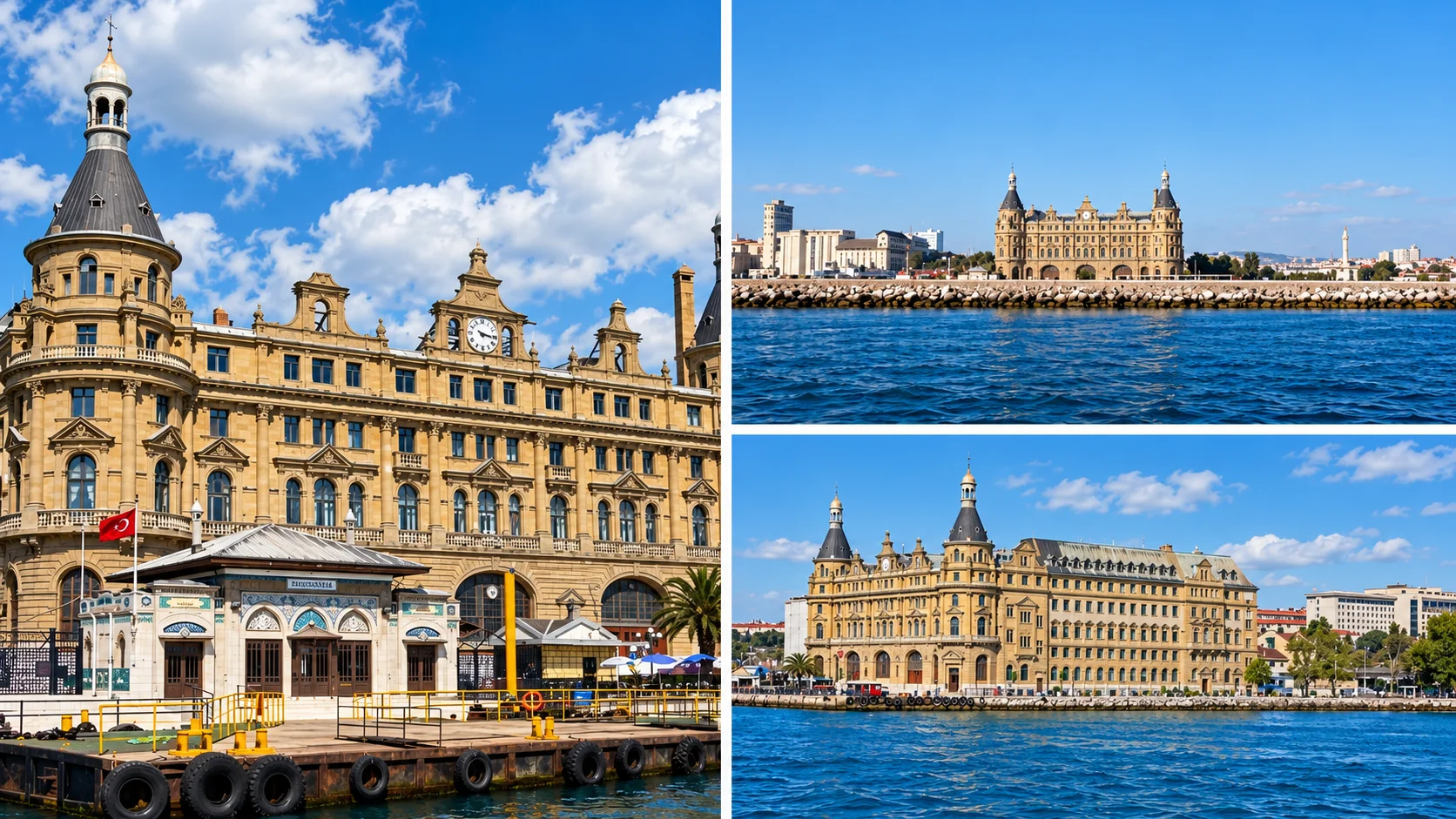
The Station on the Shore
Haydarpaşa occupies a peninsula jutting into the Bosphorus. The current building (1906–1908) is a Grade I listed monument, roughly 200 metres long, and rests on approximately 1,100 wooden piles driven into the seabed.
Ottoman–German Grand Project
Haydarpaşa was the European terminal of the Berlin–Baghdad Railway — one of the late Ottoman Empire's most ambitious infrastructure investments, financed under an Ottoman–German concession signed in 1903.
Active Restoration, First Phase 2027
Minister of Culture Ersoy confirmed in September 2026 that the first phase of the ongoing restoration will open in 2027. Sea-facing scaffolding has been removed. Archaeological discoveries under the station have required redesign of visitor infrastructure.
The Railway Begins
1872: The First Haydarpaşa Station
The story of Haydarpaşa begins not with the grand stone building visitors know today, but with a much simpler structure built for the Haydarpaşa–İzmit railway line — one of the earliest railways in Anatolia.
Construction on the line started on August 7, 1871, under a concession granted to British investors. The railway opened on September 22, 1872, and an initial wooden station building served passengers at the Haydarpaşa terminus. This was later replaced by a stone structure designed by Italian architect Giovanni Battista Barborini.
The name "Haydarpaşa" predates the railway: the area was named after a historical Ottoman dignitary, Haydar Paşa, who during the reign of Suleiman the Magnificent established the Hadâik-i Sultaniye — the Sultan's Gardens — on this stretch of the Asian shore. A small türbe (tomb) in the vicinity, popularly known as "Haydar Baba Türbesi," marks the connection to this early Ottoman past.
- Line opened: September 22, 1872
- Route: Haydarpaşa → İzmit
- Initial concession: British investors
- First stone station: designed by Barborini
- Later acquired by Ottoman Anatolian Railway Company (Anatolian Railway)
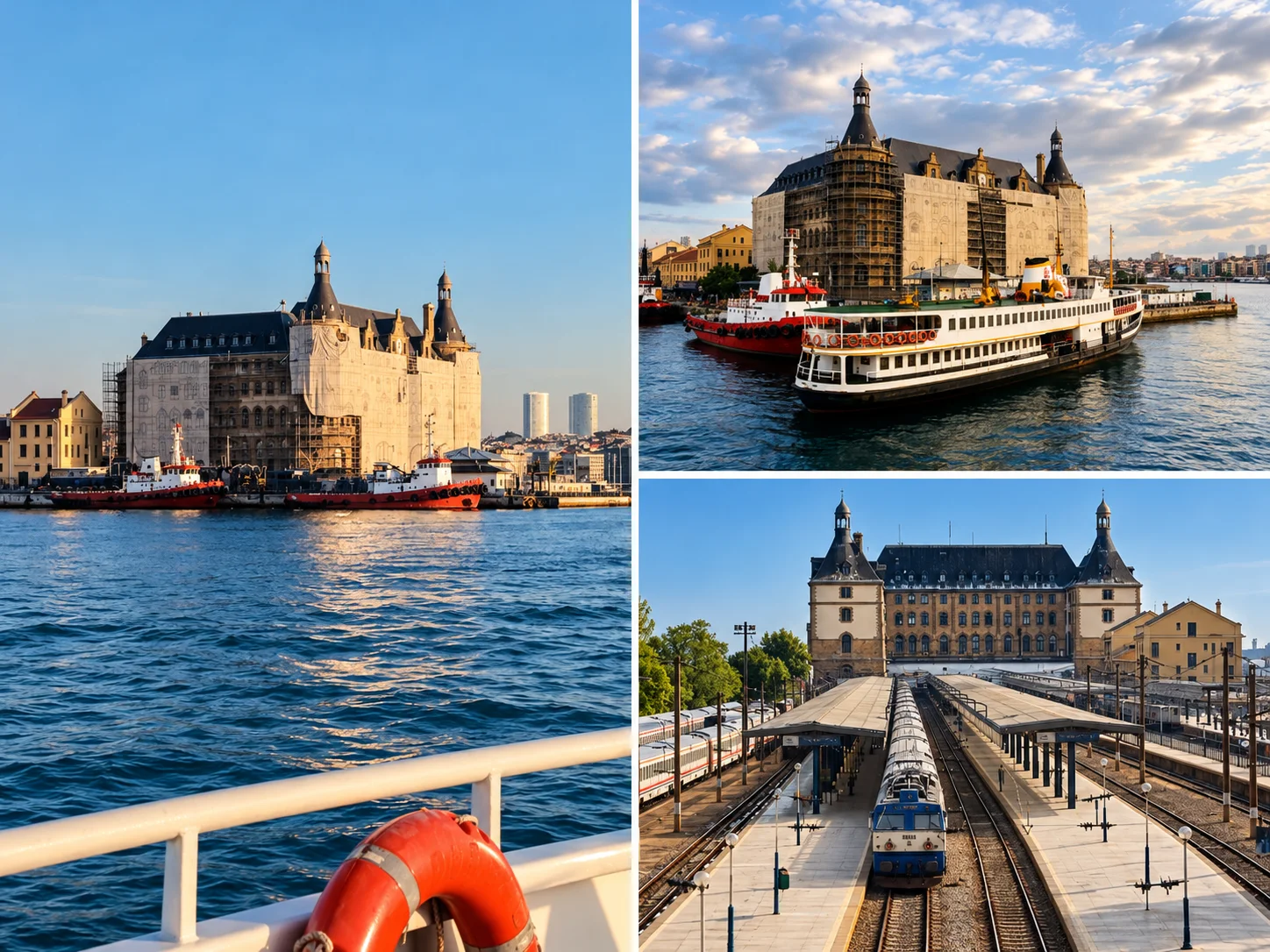

German-Ottoman Ambition
1906–1909: Building the Monumental Station
By the early twentieth century, the Barborini station was inadequate for the scale of the Baghdad Railway project. The Ottoman government commissioned a new, monumental terminus befitting the empire's most important rail concession.
German architects Otto Ritter and Helmut Cuno (Berlin) won the commission. Construction was carried out by the Frankfurt engineering firm Philipp Holzmann. Work began on May 30, 1906.
The engineers faced a formidable problem: the site was reclaimed shoreline. To stabilise the building, approximately 1,100 wooden piles were driven into the seabed beneath the foundations — a feat of late-Ottoman engineering that underpins the station to this day (though a 2026 assessment found roughly 80% of those original piles have degraded over time).
The main structure was completed on August 19, 1908. An early fire in 1909 caused damage that was repaired, and the station was formally reopened on November 4, 1909.
- Construction start: May 30, 1906
- Architects: Otto Ritter + Helmut Cuno (Berlin)
- Builder: Philipp Holzmann (Frankfurt)
- ~1,100 wooden piles driven into seabed
- Structural completion: August 19, 1908
- Formal reopening after fire repairs: November 4, 1909
Stone, Glass & Symbolism
Architectural Details
Haydarpaşa's architecture is a confident statement of late-Ottoman ambition expressed in German idiom. Every detail — from the stained glass to the rooftop eagle — carries historical meaning.
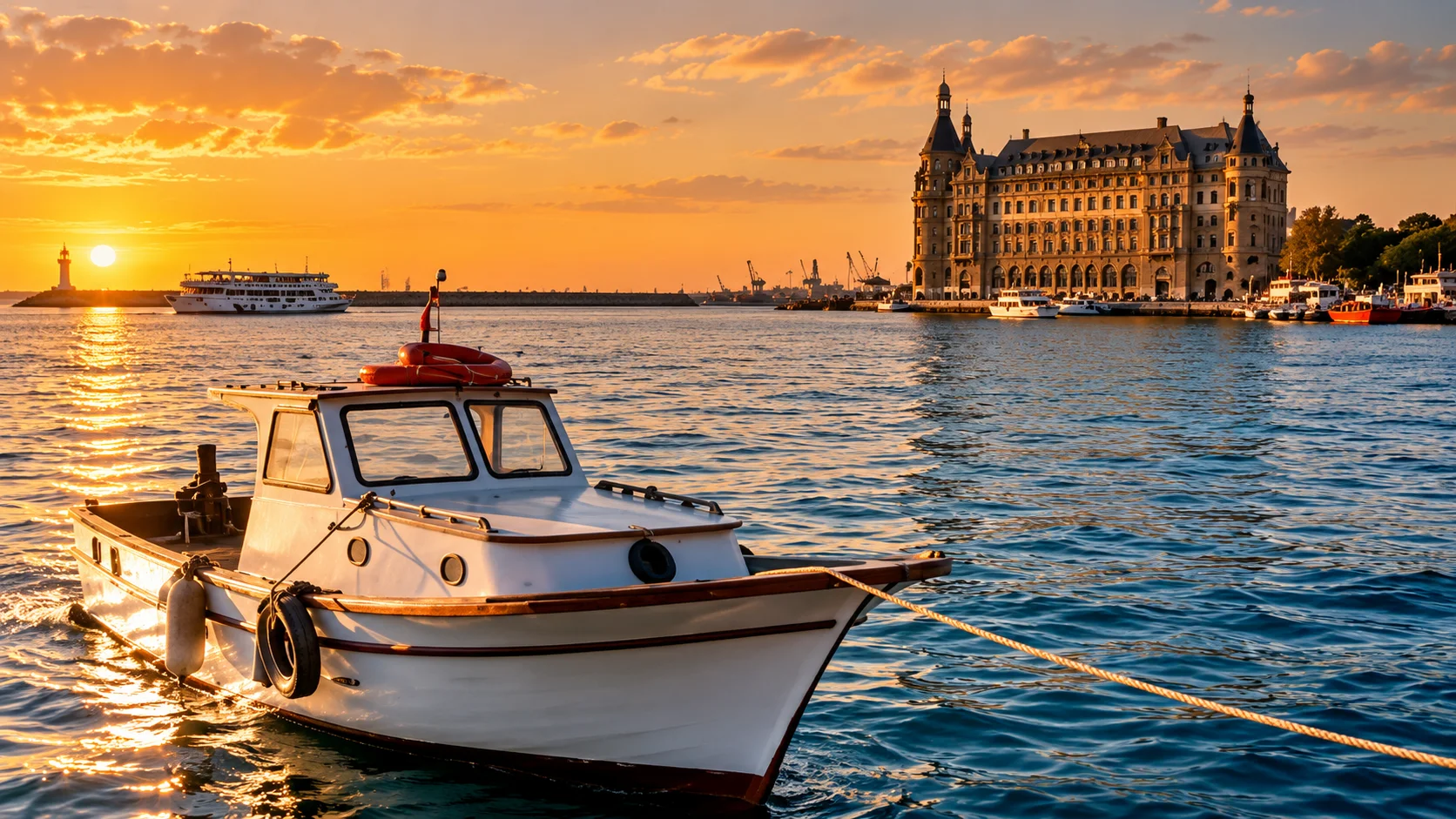
German New Renaissance — Eclectic
The building follows an elongated U-shaped plan, with high-ceilinged corridors flanked by offices and waiting halls. The style blends German New Renaissance, Baroque, and Neoclassical elements. The steep pitched roof is clad in dark slate (arduvaz), Italian stonemasons were brought in for the masonry, and the entire facade faces the Bosphorus dramatically.
Light Through Leaded Glass
The passenger hall's celebrated stained-glass windows were created by the O. Linnemann studio in Frankfurt — the same workshop that produced ecclesiastical glass across Germany and Central Europe. When natural light enters, the hall fills with coloured patterns that have been a defining feature of the station's atmosphere since 1908.
German Railway Symbol → TCDD Logo
A large stone eagle crowns the central facade, gripping a wheel in its talons — the symbol of the German Imperial Railways. Over time this motif was adapted: the eagle-and-wheel transformed into the winged wheel that became the official emblem of TCDD (Turkish State Railways), making Haydarpaşa's crown the indirect ancestor of every Turkish railway logo.
Geopolitics in Steel
The Baghdad Railway & the Hejaz Railway
Haydarpaşa was not merely a station — it was the fulcrum of two of the late Ottoman Empire's most consequential railway projects, each with very different objectives.
The Baghdad Railway
Haydarpaşa was designed as the western terminus of the Anatolian–Baghdad Railway. The concession, granted to the Deutsche Bank–led Anatolian Railway Company, planned a continuous rail corridor from Istanbul to Baghdad via Konya, Adana, Aleppo, and Mosul. The project was a centrepiece of German Drang nach Osten policy and a source of anxiety for Britain and Russia, both of whom feared German strategic reach toward the Persian Gulf.
The line was never fully completed before World War I disrupted construction — but the first half of the route was operational, and Haydarpaşa served as the departure point for trains heading deep into Anatolia and Syria.
The Hejaz Railway
The Hejaz Railway was a separate project, built by the Ottoman state (not foreign concessionaires) and funded in part by Muslim charitable contributions worldwide. Its route ran from Damascus south to Medina, serving Muslim pilgrims travelling to the holy cities. While trains to Hejaz Railway destinations could be connected via the Anatolian Railway from Haydarpaşa, the Hejaz Railway's administrative and operational hub was Damascus — not Istanbul. The two projects should not be conflated: they had different ownership, different financing, and different purposes.
- Baghdad Railway: Ottoman–German concession; economic + strategic; Haydarpaşa → Baghdad route
- Hejaz Railway: Ottoman state project; religious + pilgrimage; Damascus → Medina route
- Haydarpaşa was the Baghdad Railway's European terminus — not the Hejaz Railway's starting point
- Explore the area's Bağdat Caddesi (Baghdad Avenue): Bağdat Street Attractions →
World War I, September 1917
The 1917 Explosion: Accident or Sabotage?
On September 6, 1917, Haydarpaşa was rocked by a catastrophic explosion — one of the deadliest incidents in the station's history.
The explosion killed over 1,000 soldiers who had been assembled at the station for deployment to the Palestine Front, and destroyed the ammunition and military supplies loaded for their campaign. The blast caused severe damage to the station building and surrounding port facilities.
Official Classification vs. Historical Evidence
Ottoman authorities officially classified the explosion as an accident — a falling ammunition crate triggering a chain reaction. This classification served two purposes: it concealed a potential security failure at the empire's most important military logistics hub, and it preserved the Ottoman Anatolian Railway Company's ability to make insurance claims (policies excluded war-related sabotage).
Subsequent historical analysis, including academic research published in defence studies journals, concludes that archival evidence points strongly toward a coordinated British–French intelligence operation. The explosion occurred at a critical juncture in the Palestinian campaign — the period leading up to the fall of Jerusalem in December 1917 — and was effective in disrupting Ottoman logistical capacity at a key moment.
The historical consensus treats the "accident" classification as a strategic cover, while acknowledging that definitive documentary proof from the Allied side remains incomplete.
Two More Crises
1979 Independenta & the 2010 Fire
November 1979: The Independenta Disaster
On November 15, 1979, the Romanian crude oil tanker MV Independenta — carrying 94,000 tonnes of crude oil from Libya — collided with the dry cargo vessel Evriali approximately 800 metres from Haydarpaşa Harbour, while waiting for a Bosphorus maritime pilot. The collision triggered a series of explosions and a fire that burned for 27 days, killed 43 crew members, and caused a catastrophic oil spill in the Bosphorus. The blast wave shattered windows in buildings along the nearby coastline, including at the station itself.
The disaster became one of the principal arguments in later debates over the environmental risks of tanker traffic through the Istanbul Strait.
November 2010: Fire at the Station
On November 28, 2010, fire broke out in the station roof at 14:30. Istanbul's fire department determined the cause as an electrical short circuit during ongoing renovation works. The roof partially collapsed and the building's fourth floor was rendered unusable. Two construction workers were subsequently convicted of negligence and sentenced to ten months each. The fire accelerated discussions about the station's long-term future and contributed to its eventual closure to train services.
End of Train Services
Intercity train services from Haydarpaşa were discontinued on February 1, 2012. Suburban (banliyö) services on the Haydarpaşa–Gebze line ended on June 19, 2013. No regular train services have operated from Haydarpaşa since.
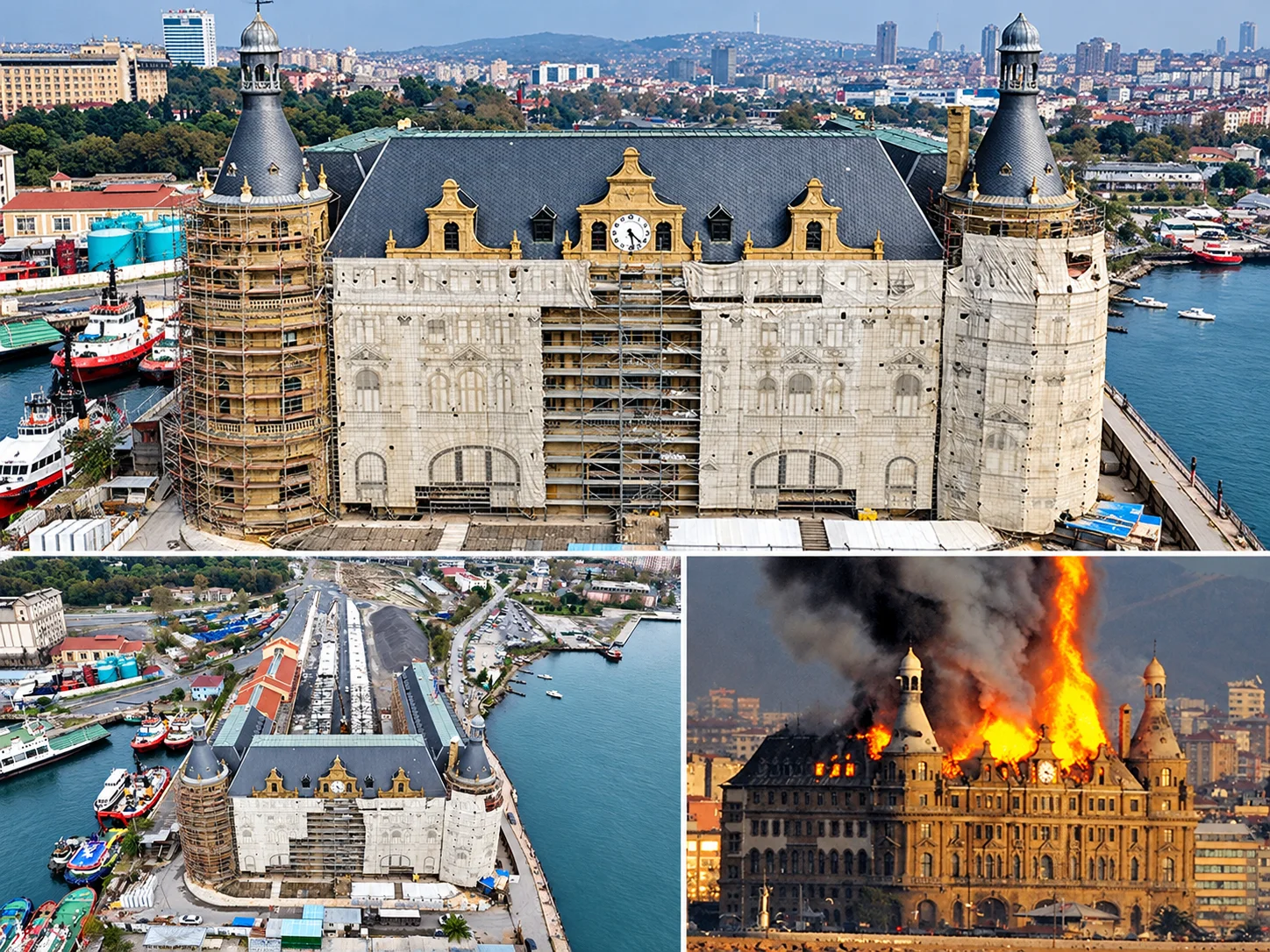
Current Status
2026 Restoration: What's Happening Now
Haydarpaşa is one of Turkey's most complex heritage restoration projects — combining structural engineering, archaeological excavation, and urban planning under a single programme.
- September 2026: Minister Ersoy confirmed the first phase will open in 2027 — delayed from an earlier 2026 target.
- Scaffolding removed from all three sea-facing facades; exterior stonework restoration and conservation on those elevations is complete.
- Interior work, structural reinforcement, and landscape works are continuing.
- A 2026 assessment found approximately 80% of the original ~1,100 wooden piles have degraded — only around 200 remain intact. Foundation work has required re-engineering.
- New archaeological finds in the Archaeopark zone have required revised designs for underground infrastructure and visitor routes.
- The planned use after restoration includes hotel, culture/arts spaces, and a heritage visitor programme — train operations are not part of the current plan.
The project has been subject to repeated timeline revisions since work began after the 2010 fire. The scale of challenges — degraded foundations, unexpected archaeological depth, and the complexity of restoring a Grade I listed building while simultaneously excavating beneath it — has made Haydarpaşa one of the most demanding heritage projects in modern Istanbul.
Ancient City Beneath the Station
Khalkedon: The Archaeological Discoveries
Beneath Haydarpaşa lies one of the most significant urban archaeological sites in Istanbul — the ancient Greek colony of Khalkedon (Latin: Calcedon, modern Kadıköy), founded around 685 BC.
A Greek Colony Under Istanbul
Khalkedon (modern Kadıköy) was one of the oldest Greek settlements on the Bosphorus, predating Byzantium/Constantinople by decades. The excavations at Haydarpaşa revealed a remarkably deep stratified sequence — from 5th-century BC Greek layers through Byzantine, Ottoman, and Late Ottoman periods.
High-Speed Train Project Triggered the Dig
The excavations were conducted as part of the High-Speed Train Project infrastructure works on the Haydarpaşa rail platforms — not the Marmaray tunnel project. The dig covered approximately 300 dönüm (300,000 m²) and employed 20 archaeologists and 400 workers.
Church, Coins, Fortress & Graves
Major discoveries include architectural remains of a 5th-century church believed to be the Sainte Bassa church-monastery (an important Byzantine Christian site), a T-shaped structure interpreted as a possible fortress, over 6,000 bronze coins, mass graves, and architectural elements spanning 2,500 years of continuous habitation.
The Archaeopark planned for the site will allow future visitors to view excavated remains in situ — though the redesign triggered by new finds in 2025–2026 has delayed its integration into the restoration opening schedule.
Cinema, Memory & Identity
Haydarpaşa in Turkish Film & Culture
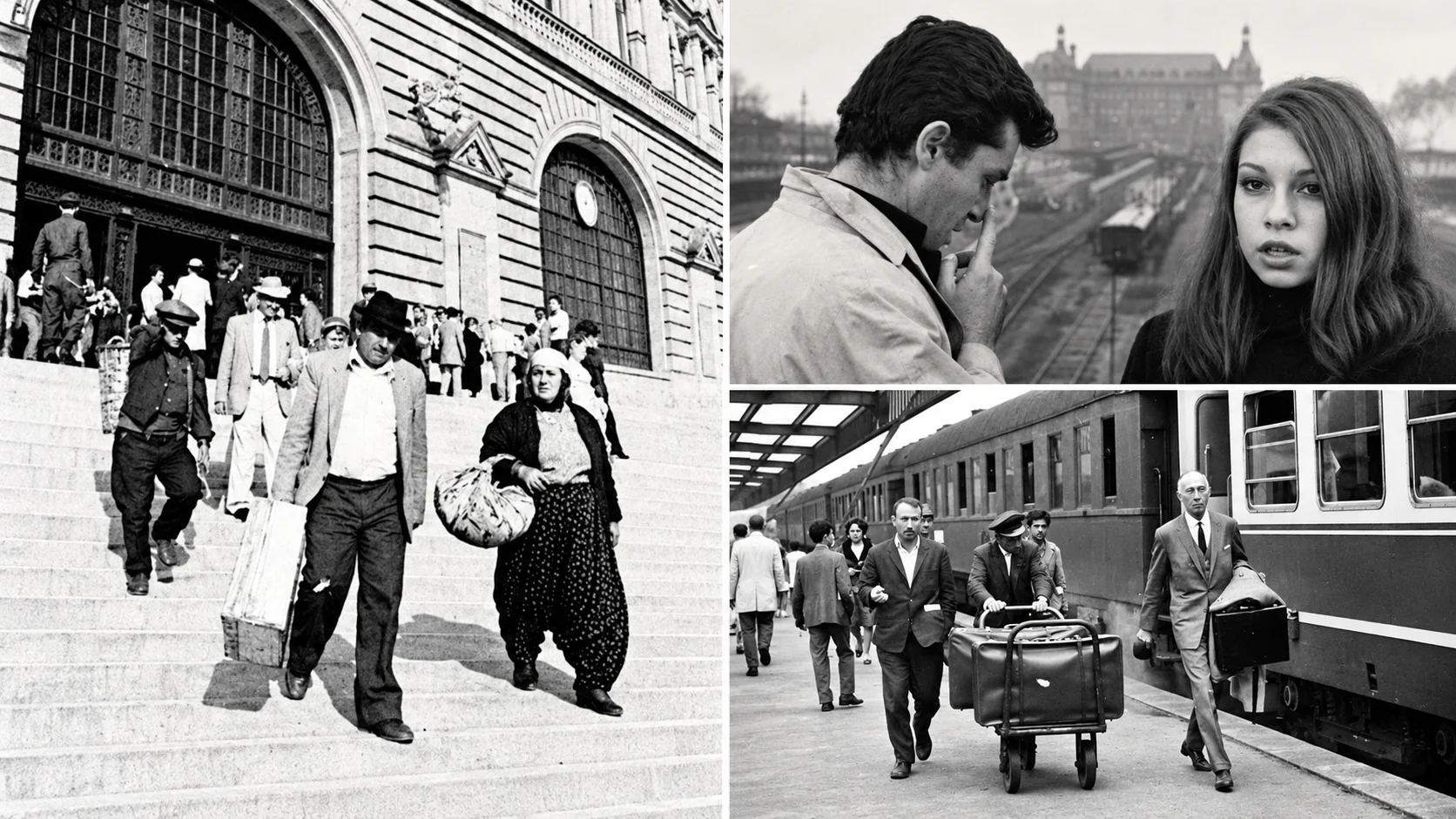
For most of the twentieth century, Haydarpaşa was not simply a train station — it was the emotional gateway between Istanbul and Anatolia. Travellers arriving from interior Turkey stepped off trains here into a city many had never seen. Soldiers left for distant fronts from these platforms. Migrants said goodbye to their villages at these ticket windows.
This charged atmosphere made Haydarpaşa irresistible to filmmakers. Film historian Agah Özgüç identified 34 Yeşilçam films in which Haydarpaşa appears; broader surveys count over 67 films from 1930 to 2010.
- Şehvet Kurbanı (1940) — directed by Muhsin Ertuğrul; earliest known Yeşilçam use of the station as a cinematic location
- Gurbet Kuşları (1964) — directed by Halit Refig; the definitive film of internal migration, with Haydarpaşa as the defining symbol of arrival in Istanbul
- Demiryol (1979) — the station as workplace, not backdrop
- Eşkıya (1996) — directed by Yavuz Turgul; the station appears in the context of contemporary Istanbul dislocation
- The 1956 film Simplon Orient Express used Haydarpaşa's steam locomotive facilities
The station has also appeared in international productions and documentaries about Istanbul — its Bosphorus-facing silhouette among the most photographed in the city.
Video: Haydarpaşa Station, Istanbul — a visual portrait of one of Turkey's most iconic landmarks.
The Surrounding Area
Neighbourhoods Around Haydarpaşa
Haydarpaşa sits within a cluster of historically significant and culturally distinctive neighbourhoods on Istanbul's Asian shore — none of which should be reduced to "just near Kadıköy."
- Yeldeğirmeni: Directly north of Haydarpaşa, Yeldeğirmeni ("windmills") was a late-Ottoman Greek and Armenian neighbourhood whose wooden-windmill hilltops gave it its name. Today it is one of Istanbul's liveliest bohemian quarters — street murals, independent cafes, and Rum (Greek) architectural traces.
- Selimiye: The district around Selimiye Barracks — where Florence Nightingale worked during the Crimean War — lies just east of Haydarpaşa. The barracks complex is a significant monument in its own right.
- Harem: The major intercity bus terminal at Harem connects Istanbul's Asian side to Anatolian bus routes. Harem iskele (ferry dock) runs services across the Bosphorus. The area is immediately adjacent to Haydarpaşa.
- Ayrılık Çeşmesi (Farewell Fountain): This Ottoman-era fountain at a road junction near Haydarpaşa takes its melancholy name from the practice of travellers — and soldiers — stopping here to say farewell before the long journey into Anatolia. The Marmaray station of the same name is now one of the key transport interchange points in the area.
- Kadıköy: The main commercial and cultural centre of the Asian shore, about 15 minutes' walk north — ferry terminal, produce market, restaurants, galleries, and nightlife.
Visitor Access & Transport
Getting to Haydarpaşa Station
Haydarpaşa is not currently open for regular train travel — but the exterior and surrounding waterfront are accessible, and the station building is visible from the water on any Bosphorus crossing.
Public Transport Options
- Marmaray (nearest station: Söğütlüçeşme) — approximately 10 minutes' walk from Haydarpaşa. Söğütlüçeşme connects to the Marmaray cross-Bosphorus line running from Gebze to Halkalı.
- M4 Metro → Ayrılıkçeşmesi — transfer from the M4 (Kadıköy–Sabiha Gökçen direction). Ayrılıkçeşmesi is also adjacent to Haydarpaşa.
- Ferry from Eminönü or Beşiktaş → Kadıköy — the most scenic approach; the ferry passes Haydarpaşa station directly. From Kadıköy ferry terminal, the station is approximately 15–20 minutes on foot or a short minibus ride.
- Bus: Multiple IETT routes serve the Haydarpaşa and Harem area from Kadıköy and Üsküdar.
Note: No trains currently depart from or arrive at Haydarpaşa. For rail travel in Turkey, use Istanbul Airport Transfer for connections to domestic flight routes, or plan via other Istanbul rail terminals.
Arriving by Air? Cab Istanbul Can Help
Cab Istanbul provides private car and driver services connecting Istanbul's airports to the Asian shore and all major destinations:
- Istanbul Airport (IST) Transfer →
- Sabiha Gökçen Airport (SAW) Transfer → — SAW is on the Asian side, approximately 40 km from Haydarpaşa
- Car with Driver for Sightseeing →
Cab Istanbul is an independent private transportation provider. We do not sell tickets, arrange tours, or provide guided visits to Haydarpaşa — but we can get you to the door in comfort.
Plan Your Visit to Istanbul
Arrive in Style — Private Transfer from Any Istanbul Airport
Whether you're visiting Haydarpaşa, exploring the Asian shore, or connecting to any Istanbul destination — Cab Istanbul's professional drivers are available 24 / 7 in fixed-price private vehicles.
Frequently Asked Questions — Haydarpaşa Station
What is the current status of Haydarpaşa Station in 2026?
Haydarpaşa Station is closed to train services and currently undergoing a major heritage restoration. As of September 2026, Turkey's Minister of Culture announced that the first phase of the restoration is now expected to open in 2027, delayed from an earlier 2026 target. Sea-facing scaffolding has been removed; interior and structural works continue.
When was Haydarpaşa Station first opened?
The original Haydarpaşa station opened on September 22, 1872, serving the newly built Haydarpaşa–İzmit railway line. The current monumental building was structurally completed in August 1908 and formally reopened on November 4, 1909, following repair of fire damage.
Who were the architects of Haydarpaşa Station?
The current station building was designed by German architects Otto Ritter and Helmut Cuno, both based in Berlin. Construction was carried out by the Frankfurt engineering firm Philipp Holzmann. The earlier 1872 station was a separate building, later replaced by a stone structure attributed to Italian architect Giovanni Battista Barborini.
What is the difference between the 1872 station and the current building?
These are two completely different structures built 34 years apart. The 1872 station was a modest terminus for the first Anatolian railway line; it began as a wooden structure and was later rebuilt in stone by Barborini. The current building is a grand monumental station built 1906–1908 specifically as the terminus of the Baghdad Railway project, designed by German architects in an eclectic Central European style.
Is Haydarpaşa Station open to visitors?
The station building's interior is not currently open for regular public visits — it is an active restoration site. The exterior waterfront area is accessible, and the building is clearly visible from the Bosphorus ferry. Visitor access to restored areas is expected to begin in 2027 when the first phase opens.
Does Haydarpaşa Station still operate trains?
No. Intercity train services from Haydarpaşa ended on February 1, 2012. Suburban (banliyö) services on the Haydarpaşa–Gebze line ended on June 19, 2013. There are no current or planned train operations at Haydarpaşa. The post-restoration use is expected to focus on culture, heritage tourism, and hospitality — not active rail service.
What is the architectural style of Haydarpaşa Station?
Haydarpaşa is built in an eclectic style combining German New Renaissance, Baroque, and Neoclassical elements — typical of prestigious German public buildings of the late-Wilhelmine era. Key features include a steep slate-covered roof, a symmetrical U-shaped plan, stone masonry worked by Italian craftsmen, Linnemann stained glass, and a rooftop eagle. The style has variously been described as "Central European Baroque," "German New Renaissance," and "eclectic historicism."
Who made the stained glass in Haydarpaşa?
The celebrated stained-glass windows in the passenger hall were produced by the O. Linnemann studio in Frankfurt — a firm known for ecclesiastical and prestige architectural glass across Germany and Central Europe. The windows admit coloured light into the main hall in a pattern that has defined the station's interior atmosphere since 1908.
What was the role of Haydarpaşa in the Baghdad Railway?
Haydarpaşa was the western terminus of the Anatolian–Baghdad Railway — the planned rail corridor connecting Istanbul to Baghdad via Anatolia and Mesopotamia. The project was a joint Ottoman–German venture, with the concession held by Deutsche Bank-linked interests. Haydarpaşa was built specifically to serve as this line's Istanbul departure point, and its scale and grandeur reflected the geopolitical ambitions behind the Baghdad Railway project.
What is the relationship between Haydarpaşa and the Hejaz Railway?
The Hejaz Railway and the Baghdad Railway were separate projects with different ownership, financing, and purposes. The Hejaz Railway was an Ottoman state project funded partly by Muslim charitable contributions, running from Damascus to Medina for pilgrim transport. While passengers could travel to Hejaz Railway junction points via connecting services from Haydarpaşa, Haydarpaşa was never the administrative or operational hub of the Hejaz Railway. Conflating the two projects is a common error in popular accounts.
What happened in the 1917 explosion at Haydarpaşa?
On September 6, 1917, a massive explosion at Haydarpaşa killed over 1,000 Ottoman soldiers assembled for deployment to the Palestine Front and destroyed significant military supplies. Ottoman authorities officially classified the event as an accidental ammunition crate incident. Historical research published in defence studies journals suggests the explosion was most likely a coordinated British–French intelligence operation timed to disrupt Ottoman logistics ahead of the fall of Jerusalem — though the "accident" classification was maintained for insurance and security reasons.
What was the Independenta disaster and how did it affect Haydarpaşa?
On November 15, 1979, the Romanian crude oil tanker MV Independenta — carrying 94,000 tonnes of oil — collided with another vessel approximately 800 metres from Haydarpaşa Harbour. The resulting fire burned for 27 days, killed 43 crew, and caused a major Bosphorus oil spill. The explosion's blast wave shattered windows in coastal buildings including the station. The disaster became a landmark case in debates over the safety of tanker traffic through the Istanbul Strait.
What caused the 2010 fire at Haydarpaşa?
On November 28, 2010, a fire broke out in the station roof caused by an electrical short circuit during renovation work. The roof partially collapsed and the fourth floor was rendered unusable. Two construction workers were convicted of negligence and sentenced to ten months each. The fire contributed to the eventual suspension of all rail services from the station.
What ancient city was discovered beneath Haydarpaşa Station?
Archaeological excavations beneath Haydarpaşa revealed substantial remains of Khalkedon (also spelled Chalcedon; modern Kadıköy) — an ancient Greek colony founded around 685 BC on the Asian shore of the Bosphorus. Khalkedon predated the foundation of Byzantium/Constantinople across the strait and was one of the most significant early Greek settlements in the region.
What archaeological finds were made at Haydarpaşa?
The excavations — conducted as part of the High-Speed Train Project infrastructure works — covered approximately 300,000 m² and were carried out by 20 archaeologists and 400 workers. Key finds include the remains of a 5th-century Byzantine church believed to be the Sainte Bassa church-monastery, a T-shaped structure interpreted as a possible fortress, over 6,000 bronze coins spanning multiple eras, mass graves, and architectural remains from the Classical, Hellenistic, Byzantine, and Ottoman periods.
Why is the station called Haydarpaşa?
The area's name derives from Haydar Paşa, an Ottoman dignitary from the reign of Suleiman the Magnificent (16th century), who established the Hadâik-i Sultaniye (Sultan's Gardens) on this stretch of the Asian shore. The station and its surrounding district took the name from these historic gardens. A small tomb popularly known as "Haydar Baba Türbesi" in the vicinity preserves this Ottoman-era association.
What is the significance of the German eagle on Haydarpaşa Station?
The stone eagle at the apex of the central facade, gripping a wheel in its talons, was the symbol of the German Imperial Railways — placed here as an expression of German involvement in the Baghdad Railway project. Over time the design was adapted: the eagle-and-wheel motif evolved into the winged wheel that became the official emblem of TCDD (Turkish State Railways). Haydarpaşa's rooftop eagle is thus the origin point of the logo still used by Turkey's national railway.
How do you get to Haydarpaşa Station from Istanbul Airport?
From Istanbul Airport (IST), the most comfortable option is a private transfer directly to the Haydarpaşa area — approximately 45–70 minutes depending on traffic. By public transport: take the Airporter bus or M11 metro to Gayrettepe, transfer to the M2 metro toward Kadıköy direction, or connect via Marmaray. From Sabiha Gökçen Airport (SAW), which is on the Asian side, the journey is approximately 40–50 minutes by car. Cab Istanbul provides private airport transfers from both airports: Istanbul Airport Transfer →
What neighbourhoods are worth visiting near Haydarpaşa?
Key areas within walking distance include: Yeldeğirmeni (bohemian arts quarter, street murals, independent cafes); Selimiye (historic barracks, Crimean War museum); Harem (major bus terminal, ferry dock, Bosphorus views); and Ayrılık Çeşmesi (the historic "Farewell Fountain" and Marmaray interchange). Kadıköy's main commercial and food district is a 15-minute walk northward. See our Asian Side of Istanbul Guide for more.
When will Haydarpaşa Station reopen and what will it contain?
The first phase of the Haydarpaşa restoration is now targeted for 2027, following delays caused by degraded foundation piles and new archaeological discoveries that required redesign of visitor infrastructure. The planned post-restoration programme includes a heritage hotel, cultural and arts spaces, and a visitor experience incorporating the Archaeopark archaeological findings. Train services are not part of the reopening plan.