
Fatih / Eminönü, Istanbul — Historic Peninsula
Sirkeci Railway Station Istanbul Guide 2026: Orient Express, Architecture, Museum & Visitor Information
Sirkeci Station opened on November 3, 1890, as the eastern terminus of Europe's most famous train route. Designed by German architect August Jasmund in a richly ornate Orientalist style, it served as Istanbul's European rail gateway for over a century — handling everything from Orient Express luxury carriages to the trains that carried hundreds of thousands of Turkish guest workers to Germany. Today it operates as a working railway station on the T6/U3 Sirkeci–Kazlıçeşme line, a Marmaray interchange, and an active cultural conversion project.
Quick Overview
Sirkeci Station at a Glance
One of the world's most storied railway terminals — built in 1890 to receive the Orient Express, now a layered historical site, active rail stop, and emerging cultural hub.
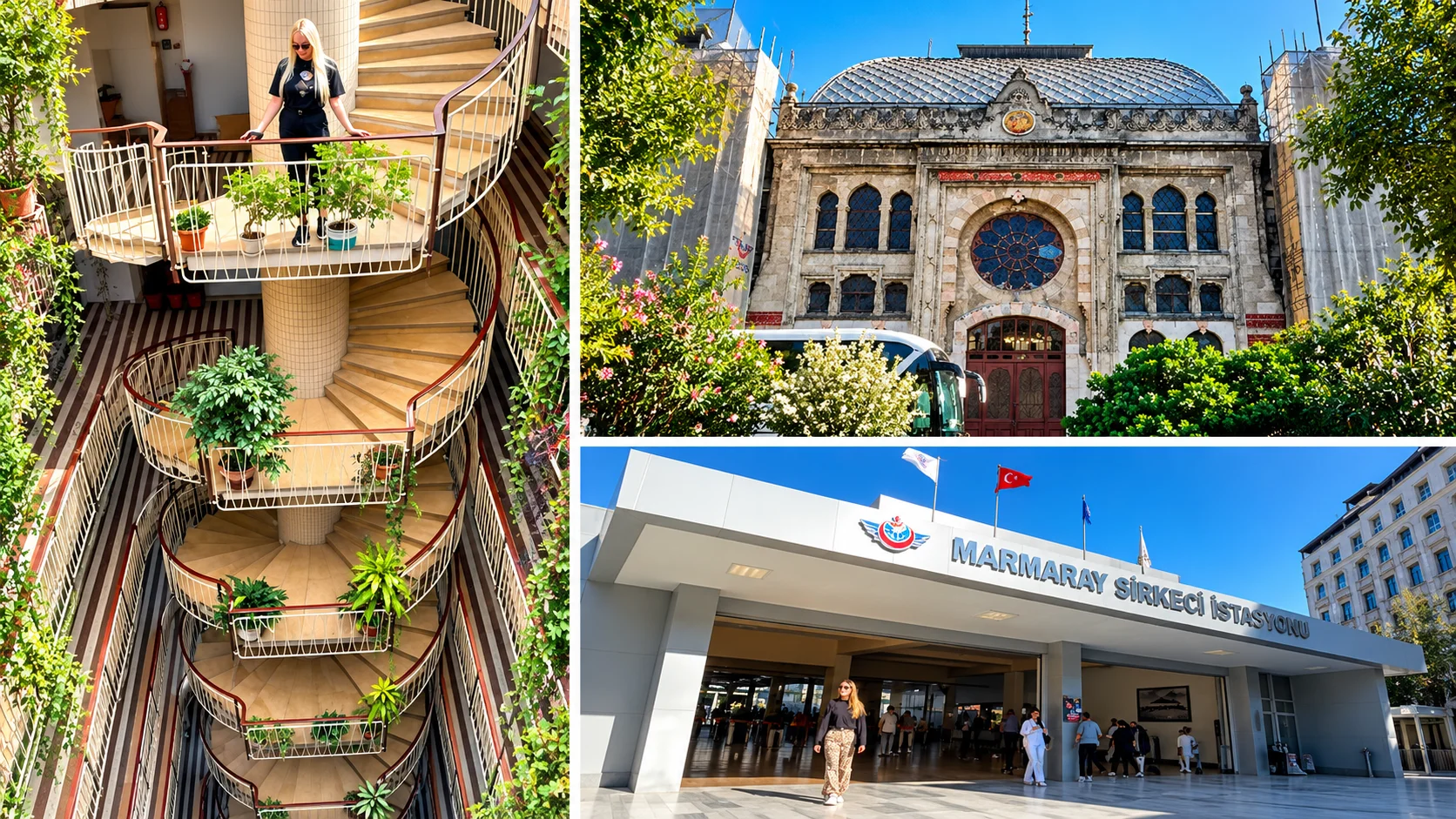
The Station & Its Underground Twin
The historic terminal building (1890) sits on the shoreline of the Golden Horn. Directly below, the underground Sirkeci Marmaray station — at approximately 60 metres deep and reachable by 63-metre escalators — connects Istanbul's two shores. Above and below, the same name, two very different architectural eras.
The Eastern End of a Legend
From 1890 until 1977, when the last Orient Express direct service ran, Sirkeci was the train's Istanbul terminus. Diplomats, writers, royalty, and spies passed through these platforms. The building was designed specifically for this role — its architecture a deliberate statement of Ottoman sophistication meeting European ambition.
Active Transport, Culture in Progress
Sirkeci operates on two active rail systems (T6/U3 surface line + Marmaray underground). The historic terminal halls are undergoing cultural conversion as part of the Gar Kültür Sanat Project. The Railway Museum closed in 2025 for renovation. The Orient Express Restaurant remains open.
Reference
Sirkeci Station — Quick Reference 2026
| Feature | Verified Detail |
|---|---|
| Historic building opened | 3 November 1890 |
| First station at this site | 22 July 1872 (Rumeli Railway, an earlier simpler building) |
| Architect | August Carl Friedrich Jasmund (German) — mimar, not engineer |
| Architectural style | Orientalist / Historicist eclectic — horseshoe arches, stained glass, Ottoman ornamental motifs |
| Orient Express role | Eastern terminus, 1890–1977 (direct service era) |
| T6/U3 rail line | Active — opened 26 Feb 2024; 8 stations to Kazlıçeşme |
| Marmaray (underground) | Active — Sirkeci station ~60 m deep; 63 m escalators from Cağaloğlu entrance |
| Railway Museum | CLOSED since 2025 (restoration/cultural conversion) |
| Orient Express Restaurant | Open — in or adjacent to historic terminal |
| Gar Kültür Sanat Project | In progress — target completion 2026 Kültür Yolu Festival |
| Migration Museum (Göç Müzesi) | Planned — not yet open |
| T1 tram (nearest stop) | Gülhane or Sirkeci — check current Metro İstanbul stop map |
Istanbul's First European Rail Connection
1872 and the Rumeli Railways
The Sirkeci site's railway history begins nearly two decades before the famous 1890 building — with the Rumeli (European) Railways and Istanbul's first connection to the European rail network.
The Rumeli Demiryolları (European Railways of Turkey) operated lines connecting Istanbul westward toward Edirne and the Balkans. The first station at Sirkeci opened on 22 July 1872, serving these Rumelian lines. It was a functional but unremarkable building — adequate for the traffic of the day, but not designed for the prestige of what was to come.
As rail connections expanded through Bulgaria and Romania toward Vienna and Paris in the 1880s, and as the concept of a luxury express train between Paris and Constantinople began to take shape, a more impressive terminal became necessary. The decision to build a new monumental station was taken in the late 1880s, with the commission given to August Jasmund by Rumeli Railways director Sarrazin around 1889.
The Balkan Railway Connection
By the time Sirkeci was being planned, the railway corridor from Istanbul ran through the Ottoman Balkans — Edirne, Sofia, Belgrade — connecting to the broader European network at Budapest and Vienna. Istanbul was not isolated from Europe by geography; it was the eastern anchor of a continent-spanning rail system. This context is essential for understanding why Sirkeci was built to impress: it had to represent the Ottoman Empire's place in a connected European world.
- First Sirkeci station: 22 July 1872
- Operator: Rumeli Demiryolları (European Railways of Turkey)
- Route: Istanbul → Edirne → Sofia → Belgrade → Vienna
- Foundation of current building: 11 February 1888
- Commission for new building: ~1889, by director Sarrazin, to architect Jasmund
- New building opened: 3 November 1890
Correcting a Common Misconception
Orient Express: The Real 1883–1890 Chronology
The Orient Express began in 1883 — but it did not arrive at the current Sirkeci Station in 1883, because that building did not yet exist. Understanding the correct sequence matters.
First Orient Express — Paris to Giurgiu
The inaugural Orient Express departed Paris Gare de l'Est on October 4, 1883. Its route ended at Giurgiu, Romania (on the Danube). Passengers then crossed by ferry to Bulgaria, took a connecting train to the Black Sea port of Varna, and boarded a steamship to Constantinople. The journey was extraordinary — but it was not a single unbroken train ride to Istanbul.
First Direct Rail Paris → Constantinople
The first uninterrupted direct rail journey from Paris to Constantinople was achieved in 1889 — six years after the Orient Express debuted. The route no longer required the Varna steamship detour. Passengers could travel entirely by train. The existing old Sirkeci station served as terminus; the new monumental building was under construction.
The Monumental Station Opens
The Sirkeci terminal building we know today opened on 3 November 1890 — seven years after the first Orient Express ran. It was built precisely to receive the newly established direct service in appropriate grandeur. From 1890, the Orient Express arrived at and departed from this building until regular direct service ended in 1977.
Legend & Legacy
The Orient Express & Sirkeci — Myth and Reality
For most of the 20th century, the Orient Express was the world's most glamorous train — connecting Paris to Istanbul via Vienna, Budapest, and Belgrade in around 68 hours. Sirkeci was its eastern terminus from 1890 to 1977, when direct service was suspended due to political instability in Yugoslavia.
Multiple Orient Express Services
The name "Orient Express" covers several distinct trains: the original Orient Express (1883), the Direct Orient Express (established 1932, Paris direct to Athens and Istanbul), the Simplon Orient Express (post-1919, routing through Switzerland's Simplon Pass), and later limited heritage services. Each had different routes and eras. Today's Venice Simplon-Orient-Express (VSOE) is a luxury tourist service operated by Belmond — a different entity from the original state-operated CIWL trains.
Şark Ekspresi ≠ Doğu Ekspresi
In Turkish, the Orient Express is called Şark Ekspresi ("Eastern Express" — from the French Orient). This should not be confused with the modern Doğu Ekspresi, a popular tourist train running from Ankara to Kars in eastern Turkey. They are entirely different services.
Agatha Christie & Sirkeci
Agatha Christie famously used the Orient Express as the setting for her 1934 novel Murder on the Orient Express. Christie did travel on the real Orient Express to Istanbul on multiple occasions, staying at the Pera Palace Hotel — her room there is preserved as a museum exhibit. The connection to Sirkeci Station is real but indirect: she would have arrived and departed from these platforms. The novel's plot, however, was inspired by a real Orient Express snowstorm delay in 1929, not by any specific event at Sirkeci itself.
Video: The Orient Express and Istanbul — the story of Europe's most legendary train and its Istanbul connection.

August Jasmund, 1888–1890
Architecture: Orientalism Meets European Railway Design
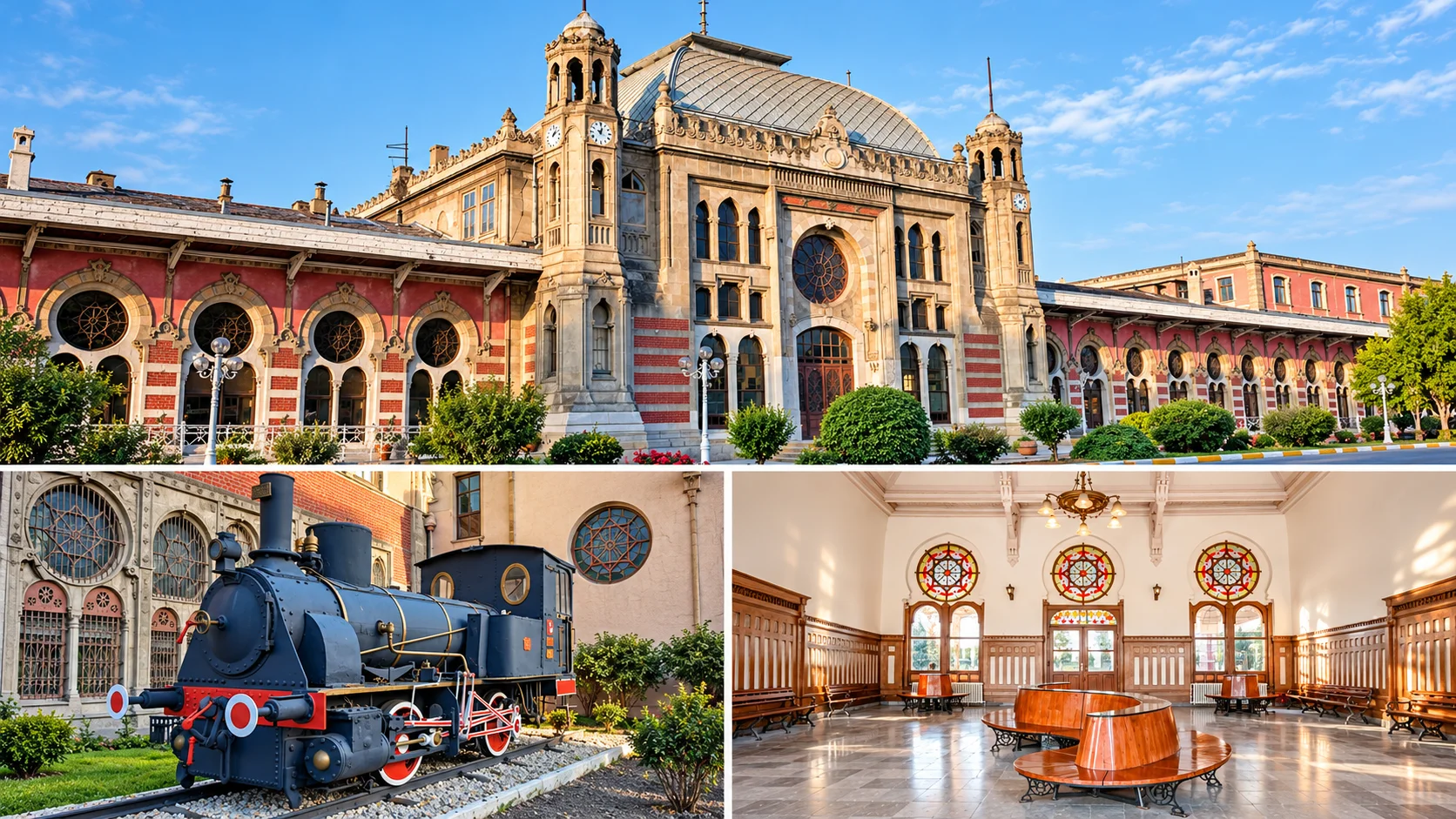
The building's architect, August Carl Friedrich Jasmund, was a German architect who served in the Ottoman state from 1888 to 1907. Sirkeci Station is his most celebrated work. He was charged with designing a building that would feel both European enough to impress arriving Western travellers and Oriental enough to announce that they had arrived somewhere distinct — the East.
The result is one of the most accomplished examples of Orientalist historicist architecture in Istanbul: a deliberate fusion of Islamic and Central European railway design vocabulary.
Key Architectural Features
- Horseshoe arches (at nalı kemerleri) — the defining motif of the facade and interior openings; drawn from Moorish and Ottoman architectural tradition
- Stained-glass windows decorated with geometric and floral patterns drawn from the Ottoman ornamental repertoire — arabesques, palmettes, and interlaced geometric forms
- Central clock tower — a European railway terminal convention placed over the main entrance, giving the facade clear station identity
- Polychrome stone facade — imported stone, including stone from Marseille, combined with local materials
- U-shaped plan adapted to the harbour-front site, with the main hall facing the Golden Horn
- Roof — pitched in the Central European railway idiom, contrasting with the Islamic arch vocabulary below
The "Seljuk motifs" sometimes mentioned in popular descriptions are more precisely described as elements of the broader Ottoman and Islamic ornamental vocabulary — palmettes (palmet), Rumi interlaces, geometric lattice patterns — which Jasmund incorporated as deliberate references to the local cultural context.
TCDD — Opened 2005 / Currently Closed
Istanbul Railway Museum
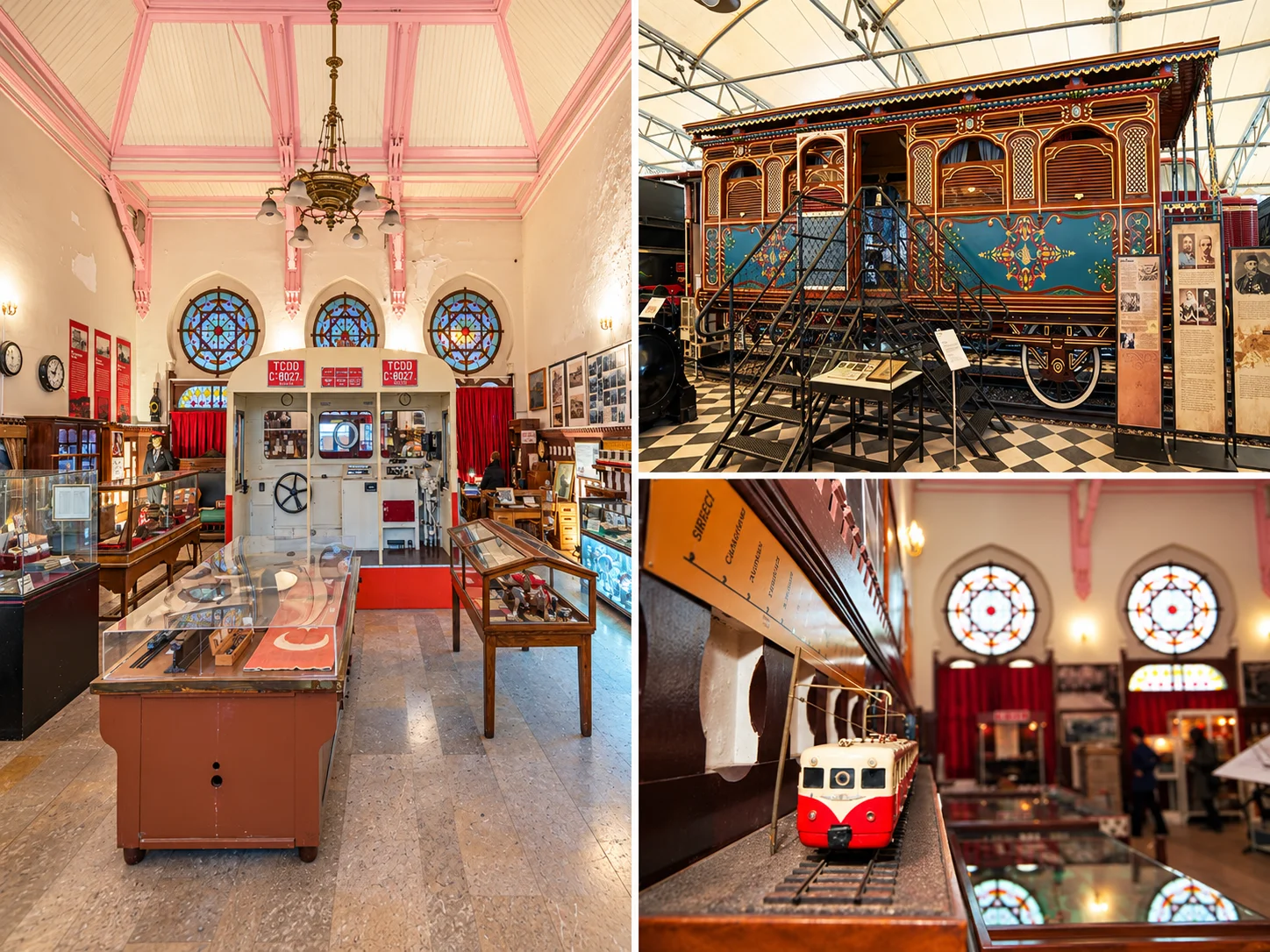
The TCDD Sirkeci Station Railway Museum (İstanbul Demiryolu Müzesi) opened on 23 September 2005 in the historic terminal building. For nearly two decades it was one of Istanbul's most accessible and atmospheric small museums — free to enter, occupying halls that had once received the Orient Express.
The Collection
The museum held approximately 400 railway-related objects and documents spanning the Ottoman and early Republican periods, including:
- Original Ottoman-era railway documents, maps, and construction plans
- Signal lanterns, switch levers, and operational equipment
- Tile stoves, ticket machines, and period station furnishings
- A working scale-model train
- Objects associated with international railway history, including the Orient Express era
Current Status (2026)
The museum is currently closed to visitors. It closed in 2025 as part of the Ministry of Culture and Tourism's Gar Kültür Sanat Project renovation. The collection has been placed in temporary storage — reportedly at Haydarpaşa — while the station undergoes its cultural conversion. A future railway-related display may be integrated into the new cultural programme, but no confirmed reopening date has been announced.
Visitors planning to see the museum should verify the current status directly with TCDD before travelling.
Archive Video
Sirkeci Station & Its Museum Collection
The video at right offers an archive view of the railway museum and the station's historic spaces — captured when the museum was open. The building's ornate halls, the layout of the collection, and the atmosphere of the platforms are documented here for visitors who cannot yet see them in person.
The same spaces that once held Ottoman locomotive parts and Orient Express memorabilia now await their transformation into the new cultural programme. When the Gar Kültür Sanat areas open, these halls will take on a new public life while retaining their architectural character.
Note: The Railway Museum is currently closed (2025–). Verify current access with TCDD before visiting.
Beyond the Orient Express
Sirkeci and the Labour Migration to Europe
Sirkeci was not only a gateway for aristocrats and diplomats. From the 1960s onwards it became the departure point for hundreds of thousands of Turkish workers emigrating to Western Europe under the guest-worker (Gastarbeiter) agreements.
Beginning with the 1961 bilateral agreement between Turkey and West Germany, Turkish workers boarded trains at Sirkeci for the long journey to Munich, Frankfurt, and the industrial heartland of Europe. Similar agreements followed with the Netherlands, Belgium, Austria, and Sweden. The platform scenes at Sirkeci — families saying farewell, workers carrying a single suitcase — became a defining image of mid-20th-century Turkish social history.
The planned Migration Museum (Göç Müzesi) at Sirkeci is intended to document this history precisely because the station is where it was lived. The choice of venue is not arbitrary: workers left from these platforms, and the museum — when it opens — will physically anchor the story to its starting point.
Sirkeci's full transport history also includes its role in the Balkan Wars (1912–1913) as a military mobilisation centre, its use for diplomatic and state travel throughout the Ottoman and early Republican periods, and its function as the hub of the Sirkeci–Halkalı suburban railway that served Istanbul's European residential corridors for decades.
- 1961: Turkey–Germany bilateral labour migration agreement; Sirkeci becomes a key departure point
- 1960s–1970s: Labour migration extends to Netherlands, Belgium, Austria, Switzerland
- Sirkeci platforms = symbolic departure point for an estimated 2+ million Turkish migrants to Europe
- Last direct Orient Express service from Sirkeci: 1977
- Planned Göç Müzesi: to document this migration history — not yet open
Transport in 2026
Which Trains Use Sirkeci Today?
Sirkeci serves two active rail systems today — the T6/U3 surface line along the Marmara coastline, and the deep underground Marmaray cross-Bosphorus rail.
Sirkeci–Kazlıçeşme (Opened Feb 2024)
The Sirkeci–Kazlıçeşme rail line opened on 26 February 2024, reviving surface rail at the historic station. The line uses the designation U3 (Ministry of Transport) and T6 (Metro İstanbul tram network map). 8 stations cover 8.3 km in approximately 18–21 minutes, with roughly 25-minute service intervals. The route runs along the Marmara Sea coast through Cankurtaran, Kumkapı, Yenikapı, Cerrahpaşa, Kocamustafapaşa, and Yedikule to Kazlıçeşme.
Cross-Bosphorus Rail via Sirkeci Marmaray
The underground Sirkeci Marmaray station is a completely separate structure from the historic 1890 terminal above. Located approximately 60 metres below street level (deepest at the Cağaloğlu entrance — reachable via 63-metre escalators), it connects to the Marmaray commuter rail line running from Gebze on the Asian side to Halkalı on the European side. This is one of the world's deepest and most architecturally complex urban railway stations.
Sirkeci vs Halkalı for International Trains
Regular international train services to/from Europe currently use Halkalı station, not Sirkeci. Sirkeci no longer serves as an active international rail terminus. Occasional luxury or heritage Orient Express tourist trains may visit Istanbul; current operators and their terminals should be verified for any specific season.
Cultural Transformation
Gar Kültür Sanat Project & Migration Museum
The station is in the middle of a significant cultural conversion — adding arts and heritage programming to its existing transport function, without displacing the trains.
Gar Kültür Sanat Project
A 2024 protocol between TCDD and the Ministry of Culture and Tourism transferred use of parts of the historic terminal to the ministry for cultural programming. Under the Gar Kültür Sanat Projesi, the station's historic halls — many long underused — are being converted into exhibition spaces, concert areas, and workshop rooms. The project targets completion in time for the 2026 Kültür Yolu Festival, a major Istanbul cultural programme.
The transformation aims to keep the station's core transport function intact while activating it as a cultural destination. Active progress was visible in 2025–2026, with sections of the station gradually opening for events while other areas remained under renovation.
Migration Museum (Göç Müzesi) — Planned, Not Yet Open
The most significant planned addition is a Turkish Migration Museum (Göç Müzesi) within the station complex. The concept is compelling: Sirkeci was the literal departure point for hundreds of thousands of Turkish workers who emigrated to Germany and other European countries from the 1960s onward. Housing the museum here anchors it to its historic and emotional site.
As of October 2026, the Migration Museum has not opened. No formal opening date has been confirmed publicly. Visitors interested in this project should check current announcements from the Ministry of Culture and Tourism.
Dining at the Station
Orient Express Restaurant
One of Sirkeci's most distinctive features is the Orient Express Restaurant — a dining establishment within the historic terminal that has maintained a continuous identity connected to the station's golden era. As of 2025–2026, it remains operational.
The restaurant occupies an interior space decorated in a style that evokes the late-19th-century Orient Express aesthetic — dark wood, period-appropriate furniture, and a setting that makes it one of Istanbul's more atmospheric dining options. It serves Turkish and continental cuisine.
For visitors combining a meal with a station visit, this is the clearest way to experience the ambience of the historic terminal as it once was: a place of transit, of arrival, of departure — and of dining at the edge of Europe and Asia.
Current hours and reservations should be verified directly with the restaurant before visiting, as schedules may change during the ongoing renovation works.

The Surrounding District
Sirkeci, Hocapaşa & the Nearby Heritage Routes
Sirkeci station sits at the meeting point of four powerful heritage clusters — making it the ideal starting point for almost any Istanbul itinerary.
| Place | Direction from Station | Why Visit |
|---|---|---|
| Hocapaşa | Immediately north | Historic streets between Sirkeci and Cağaloğlu; traditional restaurants, old Ottoman commercial buildings |
| Büyük Postane | 5 min on foot NE | Grand Post Office designed by Vedat Tek (opened 1909); First National Architectural Movement; houses PTT Museum |
| İş Bankası Museum | 5 min walk | Turkish banking and economic history; beautifully curated archive collection |
| Gülhane Park | 5 min walk E | Former outer gardens of Topkapı Palace; ancient plane trees; ideal prelude to palace visit |
| Topkapı Palace | 10–15 min walk via Gülhane | Ottoman imperial palace; one of Istanbul's essential museums |
| Spice Bazaar (Mısır Çarşısı) | 10 min walk W | 17th-century covered market; spices, Turkish delights, lokum; strong Eminönü atmosphere |
| Eminönü & Yeni Camii | 10 min walk W | Major transport hub; ferries to Asian shore; Yeni Camii (17th c.); galata ferry pier |
| Galata Bridge | 12–15 min walk W | Spans the Golden Horn (Haliç) — not the Bosphorus; lower-deck restaurants; scenic crossing to Karaköy/Galata |
| Hagia Sophia & Sultanahmet | 15–20 min walk SE | Byzantine masterpiece, Blue Mosque, Sultanahmet Meydanı; uphill from Sirkeci |
Suggested Itinerary Routes
- Route 1 — Sirkeci + Gülhane + Topkapı: Station exterior → Gülhane Park → Istanbul Archaeological Museums → Topkapı Palace (allow 3–4 hours minimum)
- Route 2 — Sirkeci + Eminönü Heritage Walk: Station → Büyük Postane → İş Bankası Museum → Spice Bazaar → Yeni Camii → Eminönü ferry pier (2–3 hours)
- Route 3 — Sirkeci + Sultanahmet: Station → Gülhane → Hagia Sophia → Sultanahmet Camii → Historic Peninsula (half-day)
- Route 4 — Sirkeci + Galata extension: Station → Eminönü → cross Galata Bridge → Karaköy → Galata Tower (1.5–2 hours)
- Route 5 — T6/U3 Heritage Line: Take the Sirkeci–Kazlıçeşme train and explore Kumkapı, Yenikapı, and Yedikule (Walls of Constantinople) along the Marmara coast
See also: Topkapı Palace Guide → | Blue Mosque & Sultanahmet →
Practical Access
Getting to Sirkeci Station
Public Transport
- Marmaray: Sirkeci station is directly served by the underground Marmaray line. Access via the Cağaloğlu entrance (63-metre escalators).
- T6/U3 surface train: Sirkeci terminus — first/last stop on the Kazlıçeşme line. Active service, every ~25 minutes.
- T1 Heritage Tram: The T1 tram serves the Historic Peninsula — check Metro İstanbul for the current nearest stop (Gülhane or Sirkeci area). The tram runs along Kennedy Caddesi / Sultanahmet axis.
- Ferry: Eminönü ferry terminal (10 minutes' walk) connects to the Asian shore (Kadıköy, Üsküdar) and the Bosphorus. There is no direct ferry dock at Sirkeci station itself.
- Bus: Multiple IETT routes connect Sirkeci to all major Istanbul points. Eminönü is Istanbul's largest bus interchange, a short walk away.
By Private Car
The Historic Peninsula is densely trafficked and parking is very limited. Private car visitors are advised to use the Marmaray or tram and not rely on street parking near Sirkeci. For airport-to-Sirkeci transfers, the journey is typically 45–75 minutes from Istanbul Airport (IST) and 50–60 minutes from Sabiha Gökçen (SAW) — highly variable with traffic.
From the Airports — Cab Istanbul
Cab Istanbul provides private door-to-door transfers connecting both Istanbul airports to Sirkeci, Sultanahmet, Eminönü, and all Historic Peninsula destinations:
- Istanbul Airport (IST) Private Transfer →
- Sabiha Gökçen Airport (SAW) Transfer →
- Car with Driver for Historic Peninsula & Beyond →
Cab Istanbul is an independent private transportation provider. We operate professionally licensed private vehicles — not taxis, not shared shuttles. Our drivers do not provide guiding or tour commentary; they provide reliable, professional point-to-point transport so you can focus on exploring Istanbul.
Plan Your Istanbul Visit
Private Transfer to Sirkeci & the Historic Peninsula
Arrive directly at the heart of Istanbul's history — Sirkeci, Sultanahmet, Eminönü — in a private vehicle from either airport. Fixed price, professional driver, no shared vehicle.
Frequently Asked Questions — Sirkeci Railway Station
What is the current status of Sirkeci Station in 2026?
Sirkeci Station operates as an active railway station on the T6/U3 Sirkeci–Kazlıçeşme surface line and as a Marmaray underground interchange. The historic terminal building is undergoing cultural conversion (Gar Kültür Sanat Project). The Railway Museum is closed (2025). The Orient Express Restaurant remains open. The Migration Museum (Göç Müzesi) is planned but not yet open.
When was Sirkeci Station built and when did it open?
The current monumental building's foundation was laid on 11 February 1888, and it opened on 3 November 1890. A simpler earlier station had occupied the Sirkeci site since 22 July 1872, serving the Rumeli Railways. The 1890 building was commissioned specifically to serve the newly established direct Orient Express rail route from Paris.
Who was the architect of Sirkeci Station? August Jasmund or August Jachmund?
The correct name is August Carl Friedrich Jasmund — "Jasmund" is the accurate spelling. "Jachmund" appears in some sources as a transcription variant but is not authoritative. Jasmund was a German architect (not an engineer) who served in the Ottoman state from 1888 to 1907. Sirkeci Station was his most celebrated commission, received from Rumeli Railways director Sarrazin around 1889.
Did the Orient Express arrive at Sirkeci Station in 1883?
No. The first Orient Express departed Paris on 4 October 1883, but its route ended at Giurgiu, Romania. Passengers then crossed the Danube by ferry, took a train to Varna on the Black Sea, and boarded a steamship to Constantinople. The current Sirkeci building did not even exist in 1883 — its foundation was not laid until 1888. The first direct rail connection from Paris to Constantinople (without ship or ferry) was established in 1889. The monumental Sirkeci terminal opened in 1890, after direct service was already running.
What is the architectural style of Sirkeci Station?
Sirkeci Station is an example of Orientalist Historicist architecture — a deliberate fusion of European railway design conventions with Islamic and Ottoman ornamental motifs. Key features include horseshoe arches drawn from Moorish and Ottoman tradition, stained-glass windows with geometric and floral Islamic patterns, a Central European-style pitched roof, and a polychrome stone facade. The style blends Western structural logic with Eastern decorative vocabulary.
What is the T6/U3 Sirkeci–Kazlıçeşme line?
The Sirkeci–Kazlıçeşme Raylı Sistem Hattı is a surface rail line that reopened on 26 February 2024. It uses two designations: U3 (Ministry of Transport, displayed on station signage) and T6 (Metro İstanbul tram network maps). The line has 8 stations over 8.3 km, running along the Marmara Sea coast through Cankurtaran, Kumkapı, Yenikapı, Cerrahpaşa, Kocamustafapaşa, Yedikule, and Kazlıçeşme. Service frequency is approximately every 25 minutes; journey time is 18–21 minutes end to end.
Is the T6/U3 line the same as the old Sirkeci–Halkalı suburban service?
No. The old Sirkeci–Halkalı suburban service (banliyö) operated for decades before it was suspended for the Marmaray project in 2013. The T6/U3 Sirkeci–Kazlıçeşme line is a new, shorter service that restored rail use to the historic station in 2024, running only as far as Kazlıçeşme (not Halkalı). The two services serve overlapping but not identical route segments.
Is the historic Sirkeci terminal the same as Sirkeci Marmaray station?
No — they are two entirely separate structures sharing the same name and general location. The historic 1890 terminal is the surface building designed by Jasmund. The Sirkeci Marmaray station is an underground facility approximately 60 metres below street level, accessible via 63-metre escalators from the Cağaloğlu entrance. They connect the same urban area but are different buildings serving different rail systems.
How deep is Sirkeci Marmaray station and how do you access it?
Sirkeci Marmaray station reaches approximately 60 metres below street level at its deepest (the Cağaloğlu entrance). The 63-metre escalators at Cağaloğlu are among the longest in European metro/rail systems. The station also has lifts for disabled access. It connects to the Marmaray commuter rail line running cross-Bosphorus from Gebze (Asian side) to Halkalı (European side).
Is the Istanbul Railway Museum open in 2026?
No. The TCDD Sirkeci Station Railway Museum closed in 2025 for the Gar Kültür Sanat renovation project. Its collection of approximately 400 objects — Ottoman railway documents, signal lanterns, Orient Express-era memorabilia, and technical equipment — has been placed in temporary storage. No official reopening date has been announced. Verify current status with TCDD before planning a visit.
Is the Orient Express Restaurant at Sirkeci still operating?
Yes — as of 2025–2026, the Orient Express Restaurant at Sirkeci Station remains operational. It offers dining in a period-style setting connected to the station's international railway heritage. Confirm current hours before visiting, as renovation works may affect access or schedules.
Is the Migration Museum (Göç Müzesi) at Sirkeci open?
Not yet. As of October 2026, the planned Migration Museum at Sirkeci remains in the project phase — it has not opened to the public. The museum is intended to document the history of Turkish labour migration to Europe from the 1960s onward, with Sirkeci as the symbolic and literal departure point. Its opening is anticipated as part of the longer-term Gar Kültür Sanat programme, but no confirmed date has been announced.
What is the difference between the Orient Express (Şark Ekspresi) and the Doğu Ekspresi?
These are completely different trains. The Orient Express / Şark Ekspresi was the historic Paris–Istanbul luxury express; its last direct Istanbul service ran in 1977. The Doğu Ekspresi ("Eastern Express") is a contemporary Turkish TCDD tourist train running from Ankara to Kars in northeastern Turkey — beloved for winter scenery. They share only the word "eastern/orient" in their names and have no operational or historical connection.
Does the Orient Express still come to Sirkeci?
Regular international Orient Express direct service to Sirkeci ended in 1977. Modern luxury heritage train operators (such as Belmond's Venice Simplon-Orient-Express) occasionally run special seasonal services to Istanbul, but these use different terminals. Sirkeci is no longer Istanbul's active international rail terminus — current international trains from Europe use Halkalı. Verify any specific current luxury service with the operating company directly.
What is Sirkeci's connection to the labour migration to Europe?
From 1961 onward, under bilateral guest-worker agreements with West Germany (and later the Netherlands, Belgium, Austria, and others), hundreds of thousands of Turkish workers departed from Sirkeci Station for Western Europe. The station's platforms are closely associated with the emotional farewell scenes that defined a generation of Turkish social history. The planned Göç Müzesi (Migration Museum) is intended to document this history specifically because Sirkeci was where it was lived.
Is there a genuine connection between Agatha Christie and Sirkeci Station?
Yes, but the connection is to the journey rather than to the station specifically. Christie travelled on the Orient Express to Istanbul on multiple occasions. Her novel Murder on the Orient Express (1934) was inspired by the real Orient Express experience — particularly a 1929 incident when the train was stranded in a snowdrift. She stayed at Istanbul's Pera Palace Hotel, where her room is preserved as a museum exhibit. She would have arrived at and departed from Sirkeci Station — but no documented significant event involving Christie occurred at the station itself.
How do you get to Sirkeci Station from Istanbul Airport (IST)?
By private transfer: approximately 45–75 minutes depending on traffic. By public transport: take the M11 metro or Havaist bus to Gayrettepe, then M2 toward the city, transfer to Marmaray or tram for the final stretch. The Historic Peninsula is also accessible by bus from Yenikapı after the M2. For a direct, luggage-friendly connection, Cab Istanbul provides private airport-to-Sirkeci transfers: Istanbul Airport Transfer →
What are the best things to see near Sirkeci Station?
Within 15 minutes' walk: Büyük Postane (Grand Post Office, 1909, by Vedat Tek), İş Bankası Museum, Gülhane Park, Topkapı Palace (via Gülhane), Spice Bazaar (Mısır Çarşısı), Yeni Camii, and Eminönü ferry pier. Within 20 minutes: Hagia Sophia, Sultanahmet Mosque (Blue Mosque), Galata Bridge (spanning the Golden Horn/Haliç, not the Bosphorus). See our Topkapı Palace Guide →
How does Sirkeci compare to Haydarpaşa Station historically?
The two stations were Istanbul's twin rail gateways: Sirkeci on the European shore handled westward rail to Europe (Rumelian / Balkan routes); Haydarpaşa on the Asian shore handled eastward rail to Anatolia and the Baghdad Railway. Both opened in the same era (Haydarpaşa in 1890/1908). Both are Grade I listed monuments. Both are undergoing cultural conversion projects. Sirkeci is active (T6/U3, Marmaray); Haydarpaşa is closed, with its restoration first phase expected in 2027.
Can you take a tram to Sirkeci Station?
The T1 heritage tram serves the Historic Peninsula along the Kennedy Caddesi and Sultanahmet corridor — the nearest stops to Sirkeci Station are in the Gülhane / Sirkeci area. Check the current Metro İstanbul official tram map for exact stop names, as the network is subject to updates. The T6/U3 rail line also terminates at Sirkeci.