
Sema in Istanbul: Sacred Ceremony and Living Tradition
The Sema ceremony has been practiced continuously in Istanbul for more than five centuries. It is one of the most recognizable expressions of Sufi spiritual tradition — a ritual of turning, music and prayer that carries deep significance in the Mevlevi Order. Today, visitors can witness Sema at dedicated cultural venues in the heart of the city: at Hodjapasha Culture Center near Sultanahmet and at the 15th-century Galata Mevlevi Lodge Museum in Beyoğlu.
The term "whirling dervish show" is widely used in tourism because it conveys the most visually striking element — the spinning white-robed figures. In Mevlevi tradition, however, the turning is not a theatrical performance. Sema is a form of worship, conducted according to a specific structure inherited from Rumi's Konya and refined across centuries. Istanbul's cultural venues present this tradition in accessible formats that honour its meaning while welcoming general audiences.
This guide covers what Sema is, who the dervishes are, where to see them in Istanbul in 2026, and everything you need to know before attending — from tickets and schedules to dress code and visitor etiquette.
What Is the Sema Ceremony?
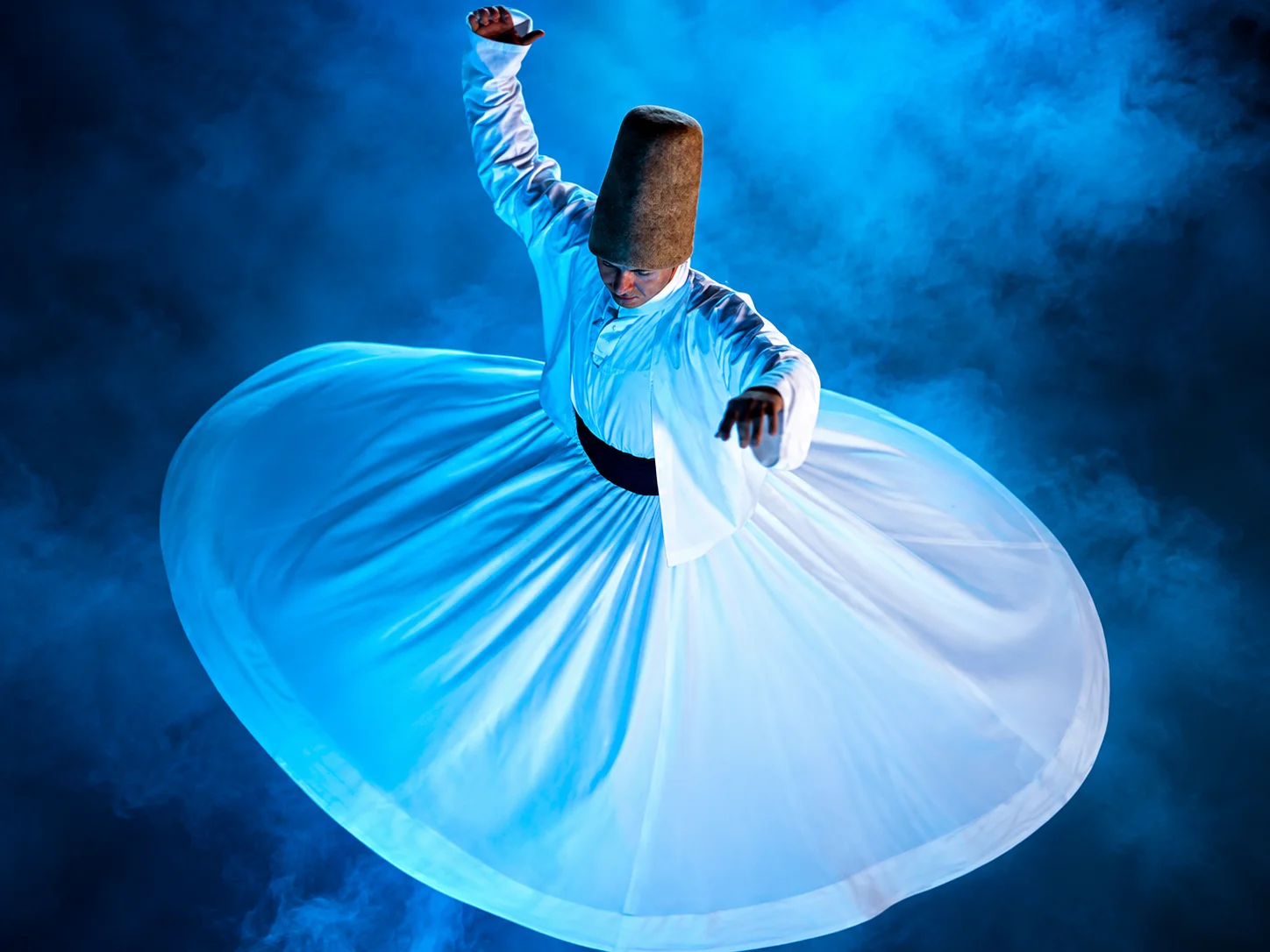
Sema (also written Sama; سماع in Arabic script) is a Mevlevi Sufi ritual that combines devotional music, poetic recitation and a meditative spinning movement. It is not a dance in the theatrical sense. Within the Mevlevi tradition, the turning of the semazen symbolises the soul's journey toward the divine — moving from one state of being to another through prayer, breath and concentrated attention.
The ceremony is conducted inside a semahane — a dedicated turning hall at the centre of a mevlevihane (Sufi lodge). The turning is always counterclockwise when viewed from above, with the dervish circling around his own heart (qalb). The right arm is raised with the palm open upward, symbolising the reception of divine grace. The left arm extends downward, palm facing the earth, representing the passing of that grace to the world below.
Who Is a Semazen?
A semazen is a trained practitioner who performs the Sema ceremony. The title applies specifically to the person who turns during the ritual — not to all members of the Mevlevi Order. Becoming a semazen requires years of preparation under a guide: learning breath control, posture, the geometry of the turn, and the spiritual discipline that gives the movement its meaning. The act of turning is the product of long practice, not improvisation.
Who Is a Dervish?
A dervish (Turkish: derviş) is a member of a Sufi tarikat (religious order) who has committed to a path of spiritual development. The word derives from the Persian darvish — meaning one who stands at the threshold between the material and spiritual worlds. Not all dervishes are semazens: the Sema ceremony is particular to the Mevlevi tradition and is not performed in other Sufi orders. When people speak of "whirling dervishes," they are referring specifically to Mevlevi semazens.
What Is a Mevlevihane?
A mevlevihane is the lodge of the Mevlevi Order — the place where its members lived, studied, practised and held ceremonies including Sema. At the height of the Ottoman Empire, Istanbul had more than a dozen mevlevihanes. Only the Galata Mevlevihanesi survives today as a functioning museum with a semahane still in active ceremonial use.
Rumi, the Mevlevi Order and the Origins of Sema
Jalal al-Din Rumi — known in Turkey as Mevlana Celaleddin-i Rumi — was a 13th-century mystic, scholar and poet born in 1207 in Wakhsh (in present-day Tajikistan). He spent the latter part of his life in Konya, in central Anatolia, where he died in 1273. His monumental work, the Masnavi, remains one of the most widely read Persian-language literary and spiritual texts in the world.
Rumi did not formally establish the Mevlevi Order himself. It was his son, Sultan Veled, who systematised the Order's practices and spread the tradition after Rumi's death. Konya remains the historical and spiritual centre of the Mevlevi world; the Mevlana Mausoleum there is one of the most visited sites in Turkey. Istanbul became the second great Mevlevi centre during the Ottoman period, at its peak housing multiple lodges whose patrons included sultans and scholars alike.
The Mevlevi Order, along with all Sufi brotherhoods, was formally closed by the Turkish Republic in 1925. Sema performances continued in parts of the Mevlevi diaspora and were eventually permitted again in Turkey — initially as cultural presentations. Today the tradition continues as both a living spiritual practice and a cultural heritage.
UNESCO Recognition: The Mevlevi Sema Ceremony
In 2005, UNESCO proclaimed the Mevlevi Sema Ceremony a Masterpiece of the Oral and Intangible Heritage of Humanity. In 2008, it was formally inscribed on the UNESCO Representative List of the Intangible Cultural Heritage of Humanity. This recognition covers the Sema as a living tradition — the ceremony, the music, the training process and the knowledge transmitted across generations. It does not designate any specific building or venue as a UNESCO site. Neither Hodjapasha Culture Center nor Galata Mevlevihanesi Museum is itself a UNESCO site; the heritage belongs to the ceremony and its tradition.
The Five Stages of the Sema Ceremony
The classical Mevlevi Sema ceremony follows a precise structure that has been observed for centuries. At cultural venues in Istanbul, the program is presented in an accessible format — typically around one hour — while preserving the core elements:
- Naat-ı Şerif — The ceremony opens with a devotional hymn in praise of the Prophet Muhammad, sung by a vocalist. The congregation stands.
- Ney Taksimi — A solo improvisation on the ney, the reed flute central to Mevlevi music. In Rumi's poetry, the ney's cry represents the soul's separation from its divine origin and its longing to return — the opening lines of the Masnavi speak directly of this image. The ney taksimi sets the emotional and spiritual tone for everything that follows.
- Devr-i Veledî (Sultan Veled Walk) — The dervishes make three slow circuits of the semahane, bowing as they pass each other. This represents the three great turning movements of the soul: from matter to spirit, from spirit to the divine, and from the divine back to the human community.
- Selamlar (The Four Salutations) — The heart of the ceremony. The dervishes remove their black hırka cloaks — symbolising the abandonment of the self — and begin the turning in their white tennure robes. There are four selams, each with its own rhythm, tempo and spiritual significance. The dervishes turn continuously during each selam, guided by the sheik presiding over the ceremony.
- Closing (Durak and Prayer) — The ceremony concludes with a recitation from the Quran and a prayer. The community returns to stillness.
At Hodjapasha and similar venues in Istanbul, this structure is typically preceded by a brief introduction and a short Sufi music concert, making the total visitor experience approximately one hour.
Hodjapasha Culture Center: Istanbul's Premier Sema Venue
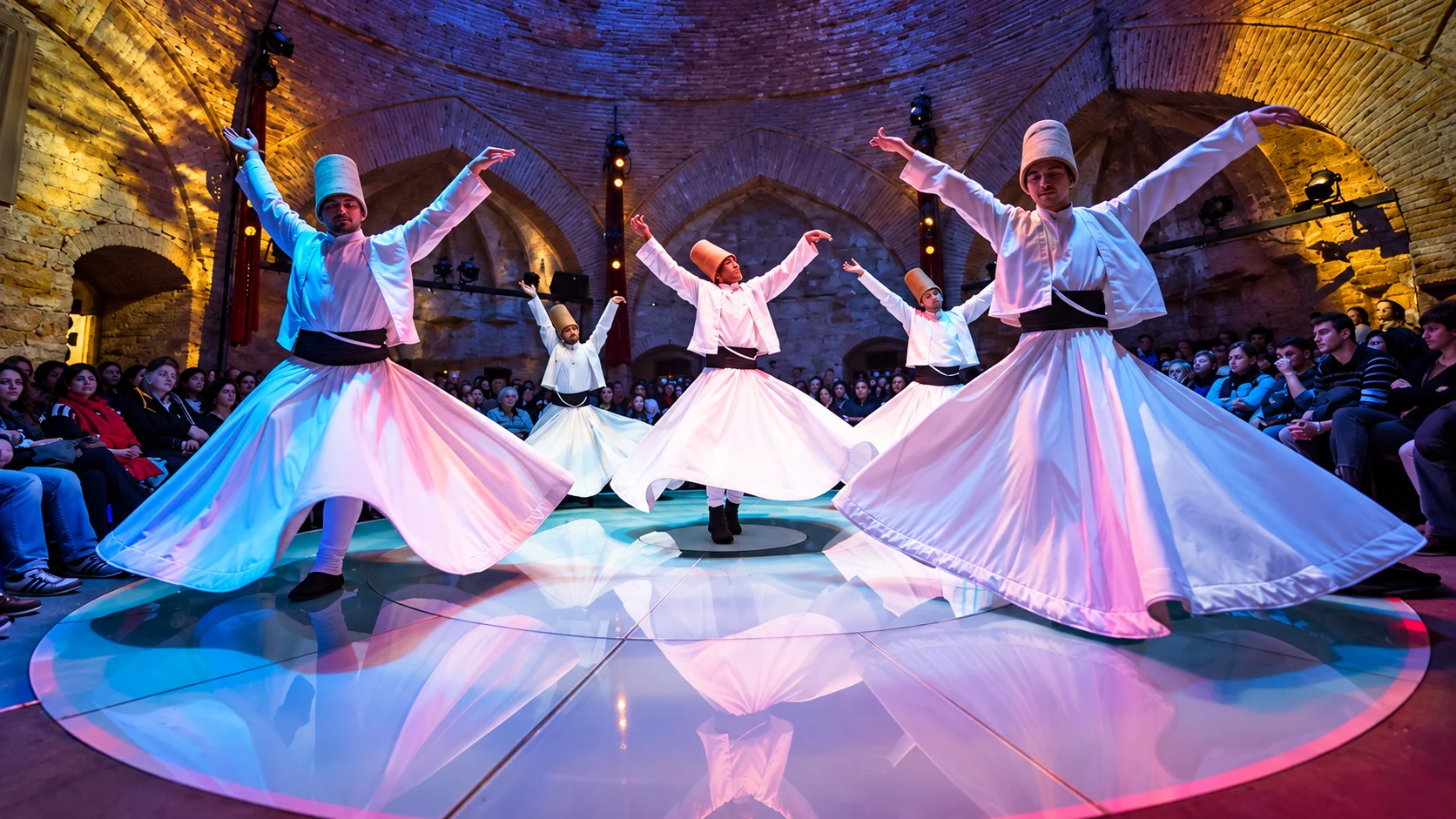
Hodjapasha Culture Center (Hocapaşa Kültür Merkezi, also written Hodjapasha Gösteri ve Etkinlik Merkezi) is housed inside Hocapaşa Hamamı — a 15th-century Ottoman bathhouse a few minutes' walk from Hagia Sophia and the Sultanahmet district. It has been hosting regular Sema performances for years and remains the most visited and accessible venue for whirling dervish shows in Istanbul.
The converted bathhouse provides an atmospheric setting: the original domed architecture creates excellent acoustics, and the circular layout of the performance space means all seated audience members have a clear view of the turning ceremony. The venue is professionally staffed and caters to an international audience.
Program Structure at Hodjapasha
The approximately one-hour program is structured as follows:
- Introductory presentation: approximately 5 minutes
- Sufi music concert (tasavvuf musikisi): approximately 10 minutes
- Sema ceremony: approximately 45 minutes
Practical Information
- Address: Hoca Paşa Mh., Hocapaşa Hamamı Sk. 3/B, Fatih, İstanbul (near Sirkeci, a short walk from Sultanahmet)
- Tickets: Available via Biletix and at the venue; approximately 1,100 TL per person in 2026 — prices change, verify before booking
- Schedule: Performances run on multiple evenings per week; check the official Biletix listing or Hodjapasha's website for current days and times
- Duration: Approximately 1 hour total
- Children: Not recommended for children under 7
- Photography: Generally permitted; flash photography is discouraged out of respect for the ceremony and other audience members
- Booking: Advance booking strongly recommended, particularly April through October
The venue is easily reached from the major Topkapı Palace and Grand Bazaar area hotels. Its location near Sirkeci train station also makes it convenient from the European-side tram stops.
Galata Mevlevi Lodge Museum: Istanbul's Oldest Mevlevi Site
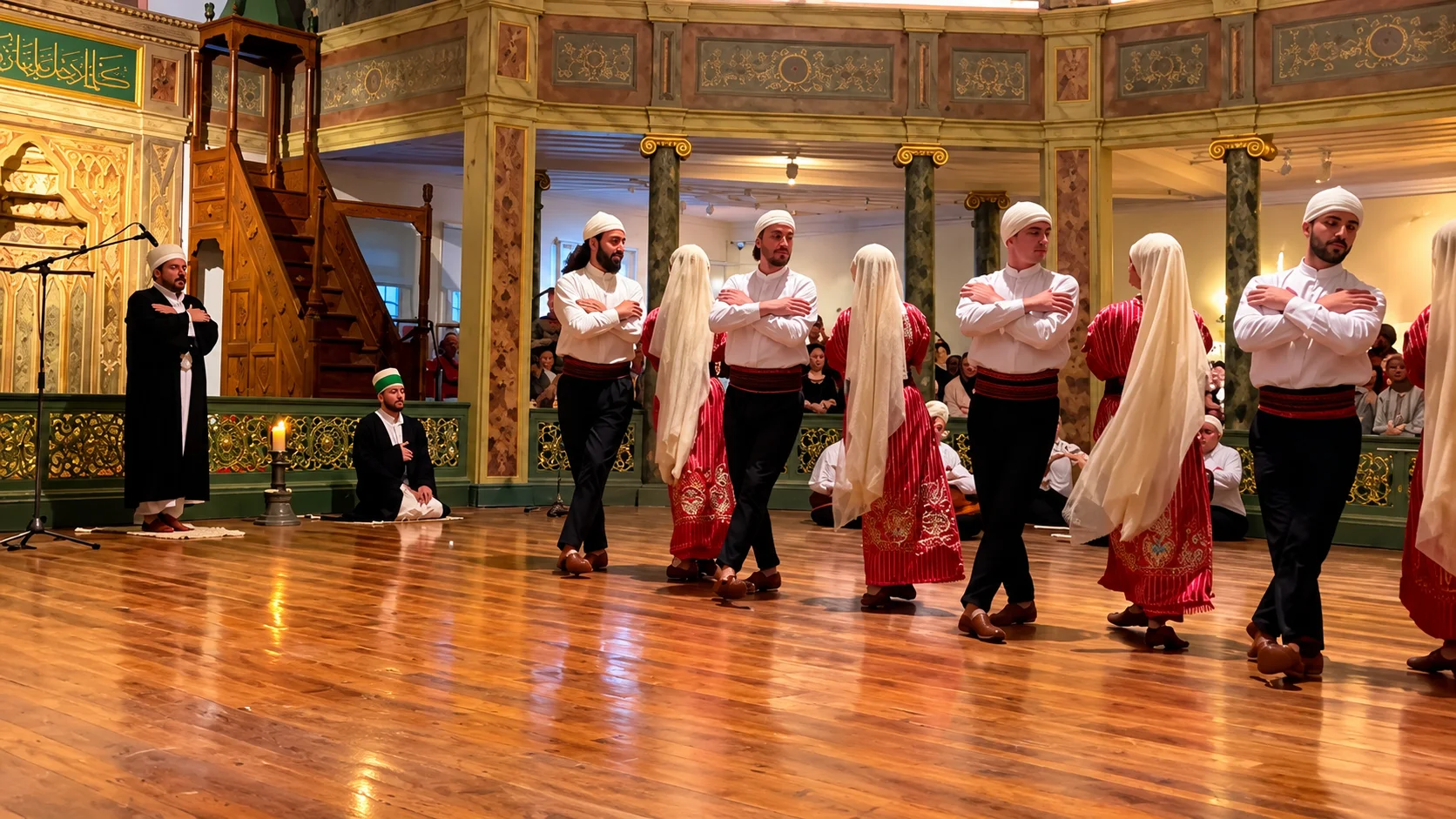
The Galata Mevlevi Lodge Museum (Galata Mevlevihanesi Müzesi) was founded in 1491 during the reign of Sultan Bayezid II, making it the oldest Mevlevi lodge still standing in Istanbul. Located on Galip Dede Caddesi in Beyoğlu — steps from the Tünel funicular at the lower end of İstiklal Avenue — it occupied a central place in the intellectual and spiritual life of Ottoman Istanbul for more than four centuries.
The complex was damaged and rebuilt several times over the centuries; the current structure reflects later Ottoman construction. The lodge was closed in 1925 along with all Sufi brotherhoods. It reopened in 1975 as the Divan Edebiyatı Müzesi (Museum of Divan Literature) and was renamed Galata Mevlevihanesi Müzesi in 2011. Today its semahane (turning hall), haziret (cemetery with Mevlevi tombs), dervish cells, şadırvan (ablution fountain) and exhibition spaces are all accessible to visitors.
The museum's collection includes Mevlevi musical instruments, hand-crafted sikke felt hats, ceremonial robes, ebru (paper marbling) artworks, calligraphy panels and manuscripts relating to the Order and Ottoman Sufi culture. The MüzeKart (Turkish museum pass) is accepted for entry.
Sema Ceremonies at Galata Mevlevihanesi
The museum hosts a Sema ceremony on the last Sunday of each month, beginning at approximately 17:00. These ceremonies are included in the museum entrance fee — no separate ticket is required. Unlike the regularly-scheduled tourist performances at Hodjapasha, the monthly ceremony at Galata Mevlevihanesi takes place in the original 15th-century semahane and follows a more traditional, ceremonial format. The audience is expected to observe quietly throughout. Places fill quickly — arriving 30 minutes early is recommended.
Visiting Information
- Address: Galip Dede Cad. 15, Beyoğlu, İstanbul
- Hours: Daily 09:00–18:30, closed Monday
- Entrance: MüzeKart accepted; check current single-entry fee at the museum
- Monthly Sema: Last Sunday of each month, approximately 17:00 — included with museum entry
- Getting there: Walk from Tünel station or down from the upper end of Galata Tower; also on foot from Karaköy
Other Mevlevi Sites in Istanbul
At its peak, Istanbul had more than a dozen mevlevihanes. Most were destroyed, demolished or severely altered during the 19th and 20th centuries. Several historical sites survive in various forms:
- Yenikapı Mevlevihanesi (Fatih): Once one of the most important Mevlevi lodges in the empire. Heavily damaged over time; a mosque complex now occupies the site. Physical remains of the original mevlevihane are minimal. Not open as a museum or cultural venue.
- Bahariye Mevlevihanesi (Eyüp): The original complex was demolished during the 20th century. Some sections survive but it does not function as a museum or hold performances.
- Kasımpaşa Mevlevihanesi: Largely demolished. Only partial structural traces remain in the Kasımpaşa neighbourhood.
- Üsküdar Mevlevihanesi: A portion of the original complex survives on the Asian side, but in heavily altered form and not open for cultural visits.
Of Istanbul's historic mevlevihanes, only Galata Mevlevihanesi is currently open as a functioning museum with Sema ceremonies held in its original semahane.
What About Sirkeci Station?
Sema performances were previously held at Sirkeci railway station — the historic Orient Express terminus — using the station's grand hall as a performance space. As of 2026, no confirmed performance schedule is available for Sirkeci; the station building has been undergoing significant works in recent years. If you are specifically looking for a Sirkeci venue experience, check locally before planning around it. Hodjapasha Culture Center, a few minutes' walk from the station, remains the confirmed active venue in that district.
Semazen Attire and Its Meaning
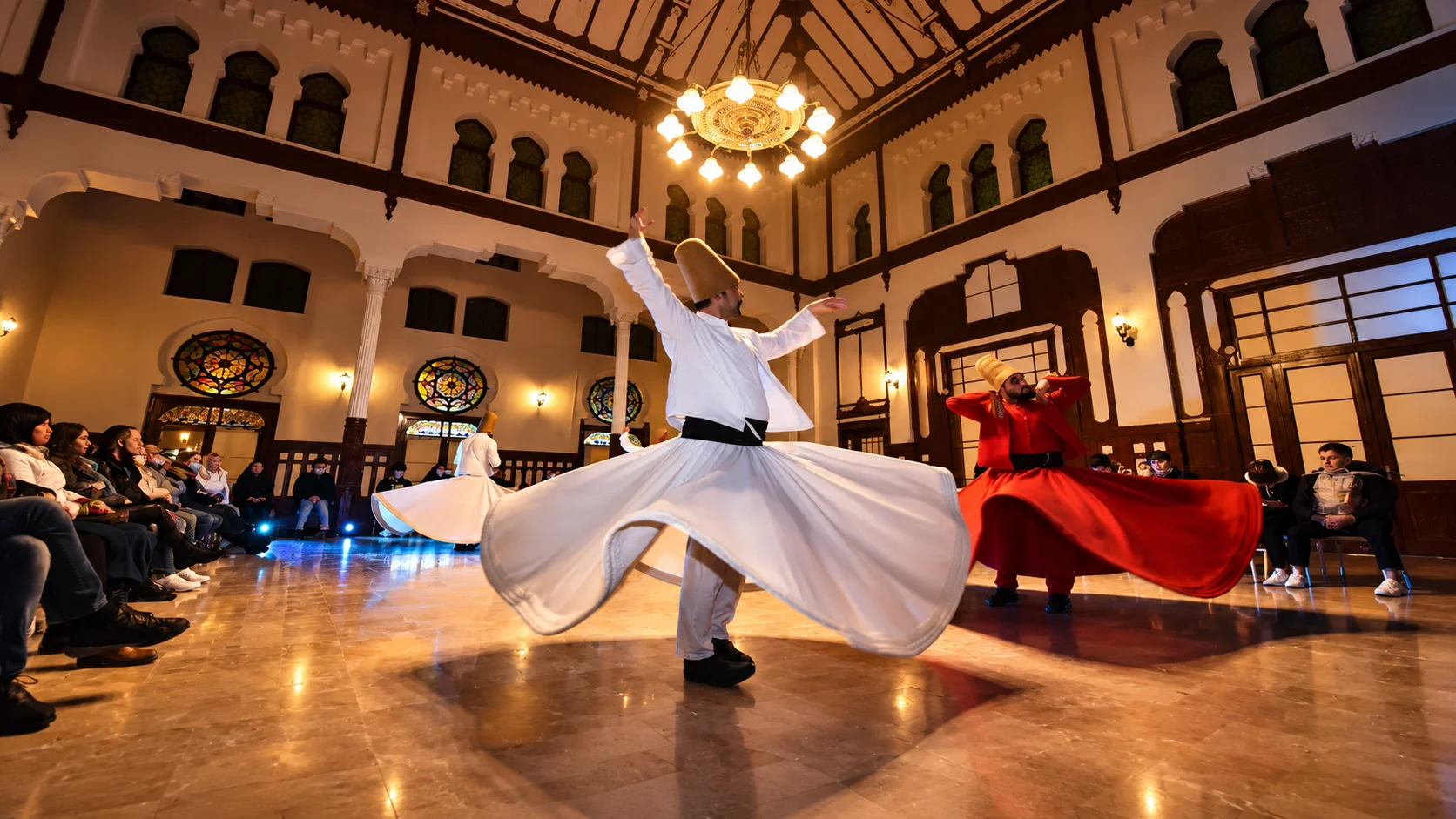
The semazen's distinctive costume is one of the most visually compelling aspects of the ceremony. Each element carries meaning within the Mevlevi tradition, though interpretations are transmitted orally through the Order rather than fixed in a single canonical text:
- Sikke — The tall, cylindrical felt hat (typically a warm camel or undyed tone) worn throughout the ceremony. It represents the tombstone of the ego.
- Tennure — The wide, flaring white robe that opens outward during the turning. It represents the funeral shroud of the ego — or the shroud from which the soul is freed.
- Hırka — The black outer cloak worn at the ceremony's opening. It represents the tomb. When the semazen removes the hırka before the Selamlar begin, the act symbolises dying to the self — and resurrection.
The position of the arms during the turn is equally deliberate. The right hand is open and raised toward the sky (receiving from God); the left hand is extended down toward the earth (distributing to creation). The semazen turns counterclockwise, always circling inward. The turning itself is not free-form — each circuit follows a path that returns to the same point, suggesting the soul's orbit around a fixed divine centre.
Observers sometimes ask why the tennure flares outward as it does. The physical reality is that centrifugal force widens the robe during turning. Within the Mevlevi understanding, this spread also carries meaning: the white robe opens like a flower, the soul expanding in its turning toward the divine.
Where to See Whirling Dervishes in Istanbul: Venue Comparison
There are two primary confirmed options in Istanbul for 2026:
Hodjapasha Culture Center
- Location: Fatih (Sirkeci/Sultanahmet area)
- Format: Tourist-oriented performance with introduction and Sufi music concert
- Schedule: Multiple evenings per week (check current listings)
- Duration: ~1 hour
- Ticket: ~1,100 TL, advance booking recommended
- Best for: Visitors wanting a convenient, well-organised evening event close to Sultanahmet
Galata Mevlevi Lodge Museum
- Location: Beyoğlu (near Tünel and Galata Tower)
- Format: Monthly ceremony in the original 15th-century semahane; also a museum with permanent collection
- Schedule: Last Sunday of each month, ~17:00
- Duration: ~45 minutes to 1 hour
- Ticket: Included with museum entry; MüzeKart accepted
- Best for: Visitors who want both cultural context and a traditional ceremony in its original space
Both venues present the actual Sema ceremony with trained semazens. The difference is primarily in frequency, format and atmosphere: Hodjapasha offers a structured tourist experience on demand; Galata offers a less frequent, more ceremonial occasion within a historically significant space.
Practical Visitor Guide: Tickets, Etiquette and Tips
Tickets and Booking
For Hodjapasha Culture Center: tickets are sold on Biletix (biletix.com.tr) and at the venue box office. The 2026 price is approximately 1,100 TL per person; verify before purchasing as prices change. The venue fills quickly during the April–October tourist season — book at least a few days ahead.
For Galata Mevlevihanesi: museum entry is required; the monthly Sema is included in the entry fee. The MüzeKart Turkish museum pass is accepted. Confirm the exact date of the next Sunday ceremony before visiting specifically for it.
Children
Hodjapasha specifies that its performance is not recommended for children under 7. For children above that age, the one-hour format is generally manageable. The monthly Sema at Galata Mevlevihanesi is held in a quieter, more solemn setting — it is best suited to children mature enough to observe quietly for around an hour.
Photography and Video
At Hodjapasha, photography without flash is generally permitted during the performance. Avoid standing devices or raised phones that block the sightlines of other audience members. At Galata Mevlevihanesi, museum photography is permitted in general; during the monthly ceremony, follow any specific guidance given at the venue that day, as the ceremony there is conducted with greater solemnity.
What to Wear
No strict dress code applies to Sema performances at either venue. Both are cultural centres rather than active mosques. Comfortable and respectful clothing is appropriate — avoid overly casual attire out of regard for the ceremony and other attendees.
When to Arrive
At Hodjapasha, plan to arrive at least 15–20 minutes before the scheduled start time. Seating may be assigned; late arrivals can lose preferred positions. For Galata Mevlevihanesi's monthly ceremony, which draws both local Mevlevi attendees and visitors, arriving 30 minutes early is advisable to secure a clear view of the semahane.
Before and After: Nearby Attractions
Near Hodjapasha (Sirkeci / Sultanahmet)
Hodjapasha is positioned in one of Istanbul's most historically dense neighbourhoods. A daytime visit to Hagia Sophia or Topkapı Palace pairs naturally with an evening Sema performance. The Blue Mosque, the Egyptian Spice Bazaar and Gülhane Park are all within comfortable walking distance. The Basilica Cistern entrance is also just minutes away.
Near Galata Mevlevihanesi (Beyoğlu)
The Galata lodge sits between the Tünel neighbourhood and the foot of İstiklal Avenue. Galata Tower is a short uphill walk — worth visiting before or after the museum for panoramic views of the city. Karaköy waterfront, directly below, is one of Istanbul's best areas for coffee, breakfast pastries and bakeries. The neighbourhood is walkable and well-served by public transport.
If you are combining venues across districts for an evening programme — for example, dinner in Beyoğlu followed by a Sema at Hodjapasha — a private vehicle is the most comfortable option. Cab Istanbul's car with driver service handles point-to-point journeys within the city, including hotel-to-venue transfers across the Bosphorus or between European districts.
Interesting Facts About Whirling Dervishes and the Sema
- The turn is always counterclockwise. Viewed from above, the semazen circles inward — toward the heart — not outward. The direction is invariable across all semazens in the semahane simultaneously.
- The ney is the soul's voice. The reed flute that opens every Sema ceremony is drawn directly from Rumi's Masnavi: "Listen to the reed flute, how it tells a tale, complaining of separation." The ney is cut from its reed bed — separated from its origin — and its cry is said to express the soul's longing to return to the divine.
- Training takes years. A semazen does not simply learn to spin. The training involves extended periods of meditation, breath practice, physical conditioning and study. The ability to turn for 45 minutes without disorientation is the result of this long preparation, not a special anatomical gift.
- The head can tilt. During the Sema, the semazen's head is typically tilted to one side — the right ear toward the right shoulder. This is part of the technique that helps maintain orientation during extended turning.
- Galata Mevlevihanesi was founded in 1491. That is four years before Christopher Columbus returned from the Americas, and 26 years before the Ottoman conquest of Egypt. The lodge predates most of what visitors associate with "Ottoman Istanbul."
- UNESCO's recognition is for the ceremony, not any building. The 2008 Representative List inscription covers the Mevlevi Sema Ceremony as intangible cultural heritage — the living transmission of knowledge, practice and music across generations.
- The Mevlevi Order was officially closed in Turkey in 1925. The Law on the Abolition of Tekkes and Zaviyas banned all dervish lodges. For decades, Sema was permitted only as a "cultural performance" before the tradition was gradually re-established in its fuller form.
- Rumi is buried in Konya, not Istanbul. His mausoleum — the Mevlana Dergahı in Konya — attracts millions of visitors each year. Istanbul's Mevlevi heritage is important but separate from the founding city of the Order.