
Byzantine Sultanahmet
Hagia Irene, also written Hagia Eirene and known in Turkish as Aya İrini, is the oldest surviving Byzantine church in Istanbul. It sits inside the First (outer) Courtyard of Topkapı Palace, just a short walk from Hagia Sophia, and has one distinction no other major Byzantine church in the city can claim: after 1453 it was never turned into a mosque.
The building served as Constantinople's principal church, the "Old Church" of the imperial capital, before Hagia Sophia was inaugurated in 360. The version you can visit today is largely Justinianic — a mid-6th-century rebuild after the Nika Revolt of 532 — and it preserves one of the rarest works of Byzantine religious art anywhere: a large iconoclastic cross set into the gold-ground mosaic of the apse. The name itself — Greek Ἁγία Εἰρήνη, "Holy Peace" — is a dedication to the concept of divine peace rather than to a martyr saint.
Where it is: inside Topkapı Palace, but a separate visit
Hagia Irene stands inside the outermost courtyard of Topkapı Palace, the wide green forecourt you enter through the Imperial Gate (Bab-ı Hümayun) at the top of Sultanahmet. This first courtyard was historically the palace's public zone, home to service buildings, the imperial mint and, from the Ottoman conquest onward, the state arsenal. Hagia Irene has occupied this space since long before the palace itself was built around it.
Practically, that geography matters for planning. Entering the first courtyard is free and open to the public. Hagia Irene itself, however, is usually a separate ticketed visit and is not always included in the standard Topkapı Palace museum ticket. During some periods, access is organised around scheduled guided sessions rather than open general admission.
The First Courtyard is also the gateway to Gülhane Park and the Istanbul Archaeological Museums, which sit against Hagia Irene's north wall — a handy detail if you plan to combine visits in one afternoon.
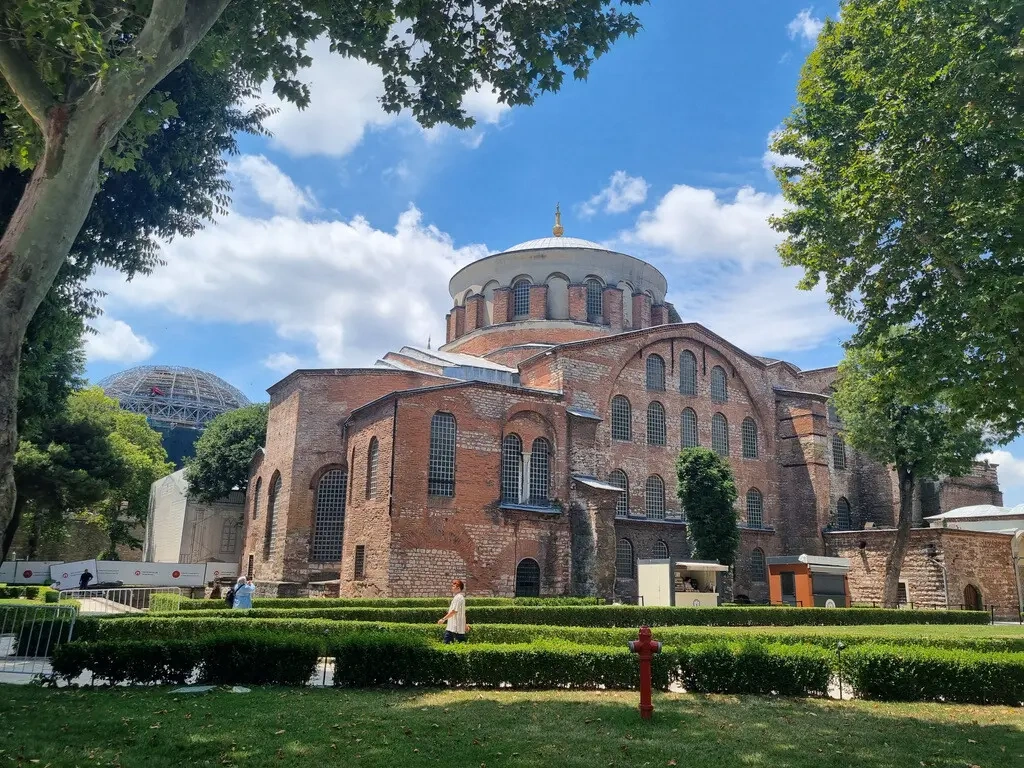
A layered history: Constantine, Justinian, iconoclasm, arsenal, museum
The traditional history places the first church on this site in the 4th century, associated with Emperor Constantine I. Hagia Irene functioned as the cathedral of Constantinople in that early period; the role passed to Hagia Sophia only when the latter was inaugurated in 360. The idea that a pre-Christian temple, sometimes named as one to Aphrodite in tourism sources, stood on the exact spot appears in older accounts but is not archaeologically confirmed — treat it as tradition rather than fact.
The Nika Revolt of 532 gutted much of the city, and the current fabric of Hagia Irene is essentially the Justinianic rebuild that followed, completed as a domed basilica in the mid-6th century. A severe earthquake in 740 damaged the dome; the Isaurian-era repairs and the iconoclastic decorative programme date to this 8th-century phase.
After the Ottoman conquest in 1453, Hagia Irene was folded into the palace complex not as a mosque but as an arsenal — Cebehane — storing weapons and armour for the Janissary corps. This alone explains why so much of the Byzantine fabric survived: it sat inside the imperial precinct, quietly guarded, for four centuries.
In 1846, Fethi Ahmed Pasha reorganised the collection here into the Ottoman Empire's first true museum, the Müze-i Hümayun. From 1908 the building housed the Ottoman Military Museum; in the Republican era it was restored again and reopened as a museum and, thanks to its acoustics, a distinguished concert venue.
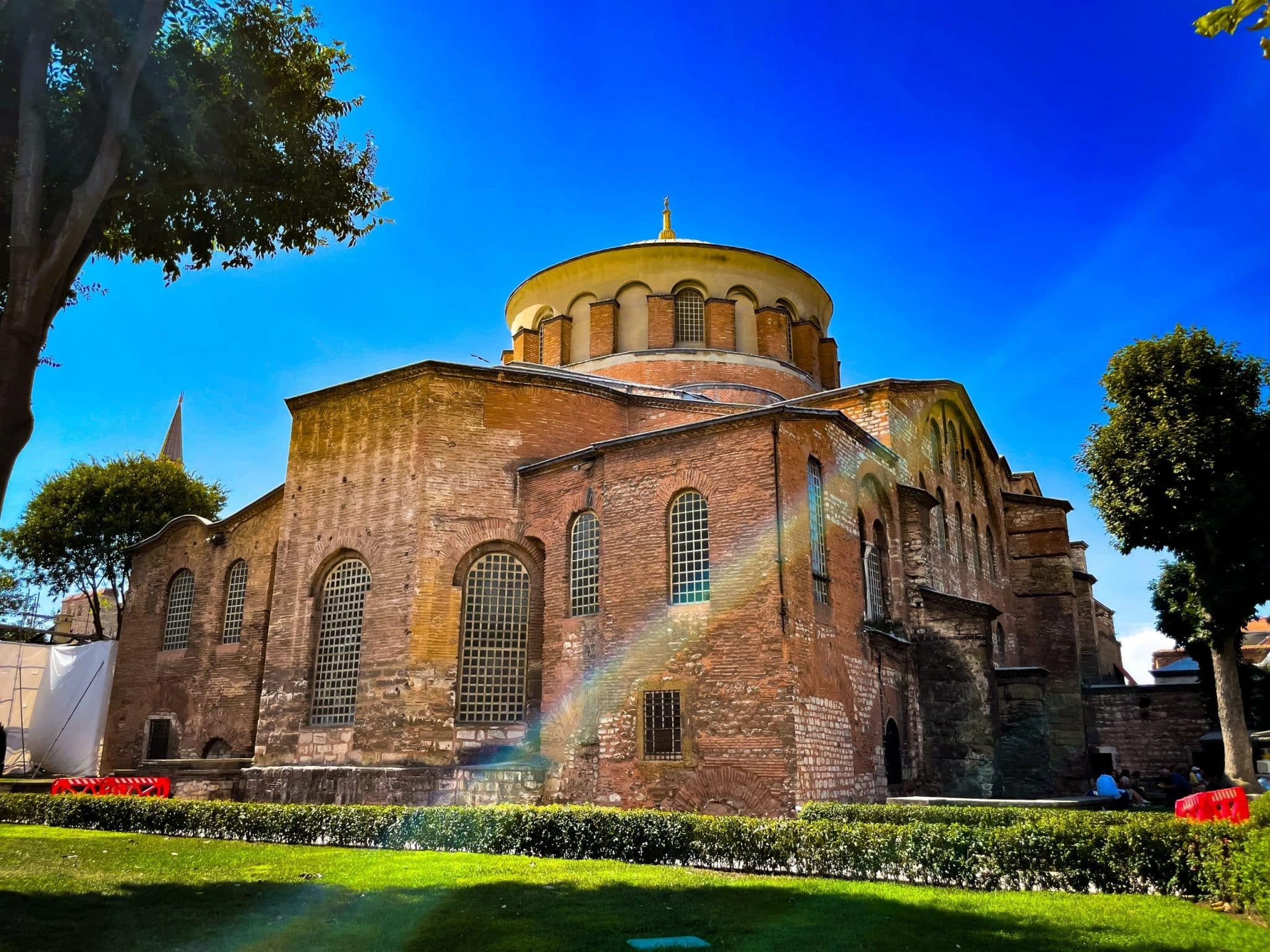
Inside: dome, apse cross, atrium, capitals
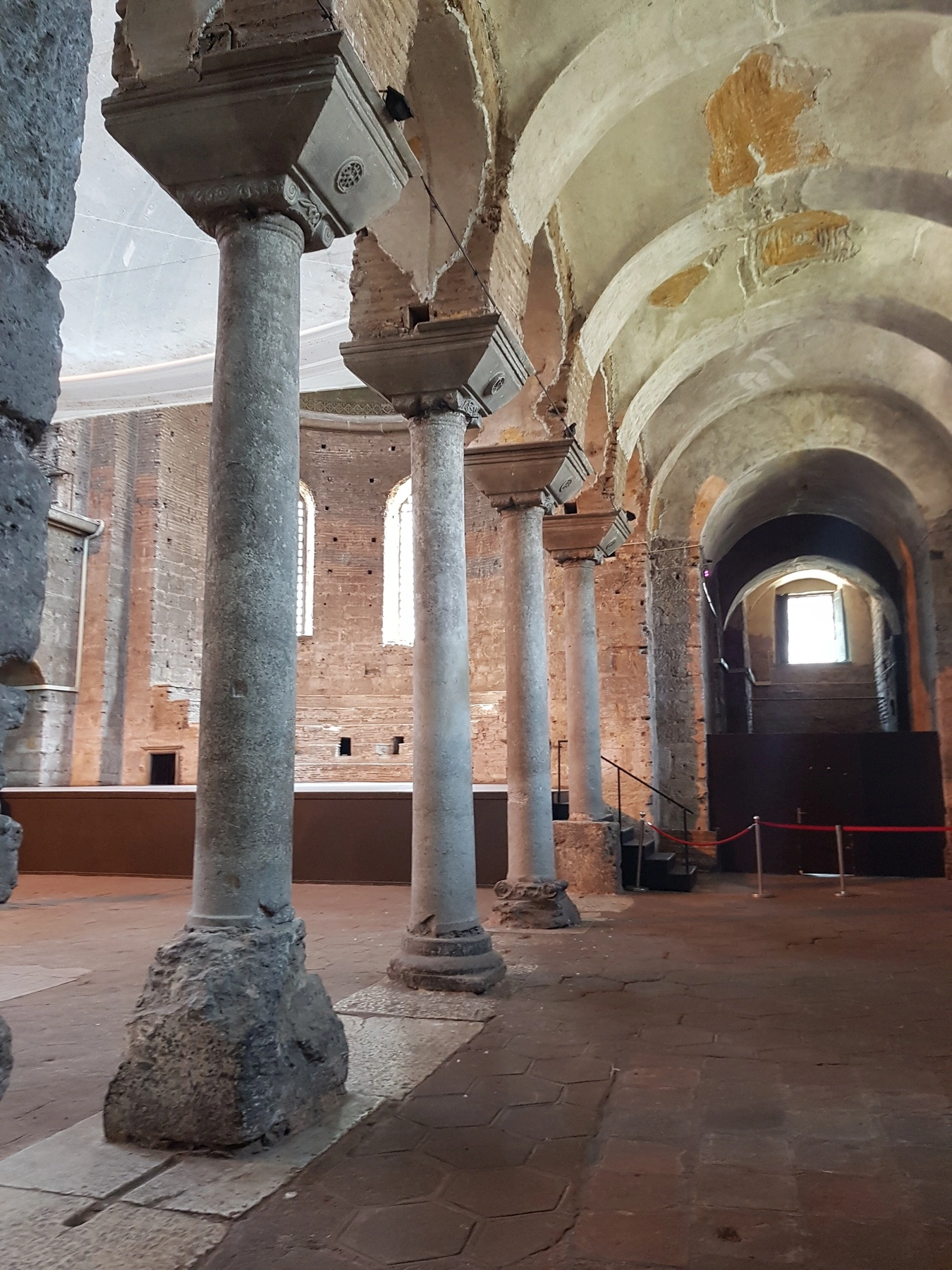
Where Hagia Sophia overwhelms with mosaic figures, Hagia Irene works the opposite way: it is austere by design. Its central visual is the large mosaic cross on a gold ground in the semicircular apse — an aniconic image installed during the 8th-century Byzantine Iconoclasm, when images of Christ, the Virgin and the saints were forbidden. It is one of the very few large-scale Iconoclastic monumental mosaics still visible anywhere.
The plan is a cross-domed basilica: a central dome carried on piers with pendentives, side aisles, and a semicircular apse. Look for marble capitals bearing Justinianic imperial monograms — spolia and freshly cut pieces reused according to the standard 6th-century practice.
Hagia Irene also keeps a rare surviving atrium, the open-air forecourt that early Christian basilicas used as a threshold between the street and the nave. Very few Byzantine atriums remain in Istanbul; this one is one of the reasons scholars still return to the building as a reference for early ecclesiastical typology.
The interior's other quiet marvel is acoustic. Thick masonry walls, a high dome and long stone aisles produce a slow, luminous reverberation — the reason Hagia Irene is programmed regularly for classical concerts, notably during the annual Istanbul Music Festival.
Hagia Irene vs. Hagia Sophia — how to tell them apart
The two buildings share a Byzantine domed-basilica lineage and stand five minutes apart, so the confusion is understandable. But the visitor experience is genuinely different, and knowing which one is which helps you plan.
- Vast — the empire's principal church after 360, now a mosque
- Rich figural mosaics from multiple Byzantine eras
- Free entry as a working mosque; separate galleries ticketed
- Very high visitor volume; queues common
- Smaller — the "Old Church", Constantinople's cathedral before Hagia Sophia
- Aniconic: golden cross, no figural mosaics
- Ticketed museum + concert venue inside Topkapı's First Courtyard
- Usually calm; sometimes closed for restoration or events
If your day already includes Hagia Sophia and Topkapı Palace, adding Hagia Irene is only a short detour and gives you a quieter, more contemplative counterpart to both.
Video: the church at a glance
Before you go, a short video is the easiest way to feel the scale of the nave, the height of the dome and the geometry of the apse. The clip below sits Hagia Irene inside the wider story of Byzantine Constantinople and is a useful primer if you have not been inside a Byzantine church before.
The building is not enormous by museum standards, but the surviving Byzantine fabric, the dome and the reverberant silence read very differently in motion than in a still photograph.
A short walk-through video of Hagia Irene, placing the church within the wider story of Byzantine Constantinople.
Practical visitor information
.webp)
Opening days, hours and ticket categories at Hagia Irene do move with the season, ongoing conservation work, and museum-management changes. Rather than commit to a single figure that could be out of date by the time you read this, confirm the current situation shortly before your visit at the official portal millisaraylar.gov.tr or the state museum listing muze.gen.tr. As a general rule:
- Typically open daily except Tuesday, with an early-evening close and a late-afternoon last-entry cutoff.
- Access requires a separate ticket in most current periods; combined Topkapı Palace tickets that also cover Hagia Irene are only sometimes offered, and only at select ticket booths.
- During some periods, entry is organised around scheduled guided sessions. Check whether your visit day falls under that regime.
- The First Courtyard (where the church stands) is publicly accessible during palace opening hours; you only need a ticket for the interior.
- Standard amateur photography is normally allowed inside; rules can change during concerts and special exhibitions.
- Restoration cycles occasionally close parts of the building; the exterior can always be walked around.
Arriving by public transport, the T1 tram stops at Sultanahmet (a five-minute walk up to the Imperial Gate) or at Gülhane (right next to the First Courtyard). If you are landing at IST or SAW and heading straight to Sultanahmet, an Istanbul airport transfer avoids the metro-plus-tram change and drops you at the hotel; a car with driver keeps the whole heritage day flexible if you plan to combine Hagia Irene with Topkapı Palace, Hagia Sophia and the Basilica Cistern. For a curated stop list around the historic peninsula, our private Istanbul tour covers the same route with a driver-guide combination.
Frequently asked questions
Is Hagia Irene the same as Hagia Sophia?
No. They are two separate Byzantine churches in Sultanahmet, five minutes apart. Hagia Sophia was inaugurated in 360 and became the empire's principal church; it is now a mosque and famous for its figural mosaics. Hagia Irene is older on this site and served as Constantinople's cathedral before Hagia Sophia; it is smaller, austere by design, was never converted into a mosque after 1453, and today operates as a museum and concert venue inside Topkapı's First Courtyard.
Is Hagia Irene included in the Topkapı Palace ticket?
In most current sources, no — Hagia Irene requires a separate ticket, sold at the First Courtyard. Combined tickets with Topkapı Palace exist in some seasons but are not universal. Because arrangements change, verify at millisaraylar.gov.tr or on-site before queuing.
Can you actually go inside Hagia Irene today?
Usually yes, but access varies. In some periods it is a standard museum visit; in others, entry is scheduled around guided sessions. Restoration work occasionally closes parts of the interior. The First Courtyard around the church is always publicly accessible during palace hours.
Why was Hagia Irene never converted into a mosque?
After the Ottoman conquest in 1453 the church was enclosed inside the Topkapı Palace precinct and repurposed as the state arsenal (Cebehane), storing weapons and armour for the Janissary corps for four centuries. Because it was operating as a military facility inside the imperial complex, the usual conversion to a mosque did not happen — which is precisely why so much of its Byzantine fabric has survived intact.
What is the iconoclastic cross in the apse?
During the 8th-century Byzantine Iconoclasm, figural religious images were banned. Hagia Irene's apse was decorated with a large mosaic cross on a gold ground — an aniconic design that survived later doctrinal reversals. It is one of the very few monumental iconoclastic mosaics visible anywhere and the church's single most distinctive interior feature.
Are concerts still held at Hagia Irene?
Yes. The high stone dome and long nave create a distinctive reverberation, and the church has become one of Istanbul's most sought-after classical venues, particularly during the Istanbul Music Festival programmed by İKSV. Concert nights change the visiting regime — check the venue calendar if your dates coincide.
What else is nearby?
Almost everything Sultanahmet is famous for is within a ten-minute walk: Hagia Sophia, Topkapı Palace proper, the Basilica Cistern, the Blue Mosque, the Istanbul Archaeological Museums, Gülhane Park, and — a little further — the Cistern of Philoxenos, the Grand Bazaar and the Egyptian Bazaar down toward Eminönü.
For your Sultanahmet day
Comfortable transfers for the historic peninsula
If you are combining Hagia Irene with Hagia Sophia, Topkapı Palace and the Basilica Cistern, a private car with an English-speaking driver keeps the day flexible and skips the metro-and-tram routine.