
Turkey is one of the world's most visited destinations, and sorting your mobile data before you land makes everything easier — maps, translation apps, booking confirmations, all of it. This guide covers every option for 2026: local SIM cards from Turkcell, Vodafone, and Türk Telekom; the best eSIM providers; price comparisons; and the one critical rule that changed in 2025 that every Turkey visitor needs to know.
Quick verdict, 2026: For most tourists, buy a Turkcell or Vodafone Turkey SIM from a city store — not the airport kiosk, where prices run 50–70% higher. If you want to step off the plane already connected, buy an international eSIM before you board. eSIM provider websites are blocked inside Turkey and cannot be purchased after arrival.
Physical SIM Cards in Turkey: Three Networks Compared
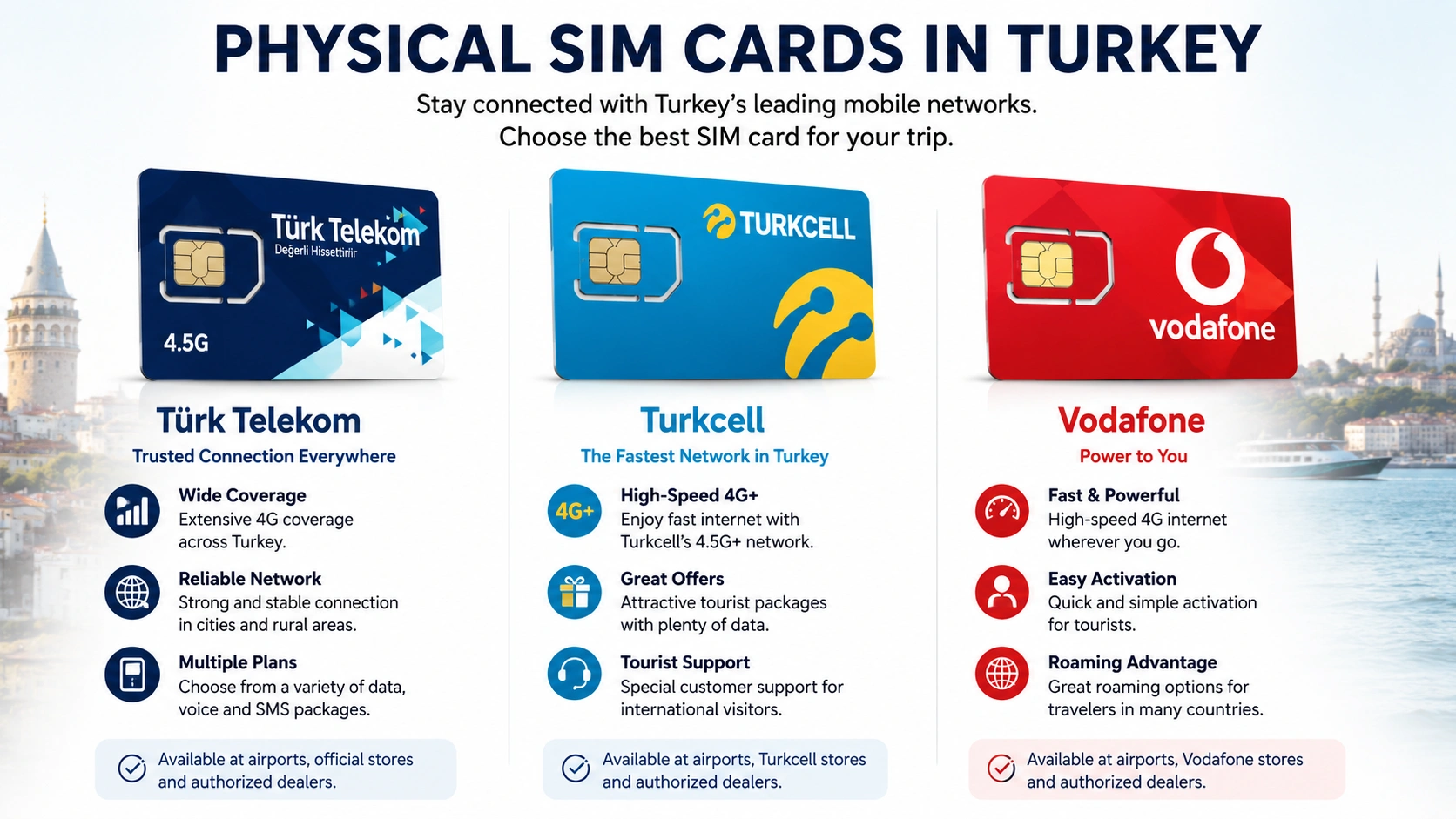
Turkey has three major mobile operators, all of which sell dedicated tourist SIM packages. Each includes a temporary Turkish mobile number, a data allocation, and domestic call minutes. You register with your passport — the process takes about 10–15 minutes at any official store.
Prices below are approximate city-store rates in mid-2026. The USD–TRY exchange rate fluctuates frequently — treat these as benchmarks and check current rates before you travel. Airport kiosks charge 50–70% above these city prices for the same packages.
| Operator | Data | Minutes | Validity | City Price (approx. USD) | Coverage Strength |
|---|---|---|---|---|---|
| Turkcell | 20 GB | 200 min | 30 days | ~$29 | Best — widest rural + urban |
| Vodafone Turkey | 20 GB | 750 min | 28 days | ~$32–39 | Excellent in cities and resorts |
| Türk Telekom | 25 GB | 750 min | 28 days | ~$55–59 | Good in cities and major towns |
Turkcell — Best Overall Coverage
Turkcell is Turkey's dominant carrier and operates the country's most extensive 4G LTE network. This matters if you're travelling beyond Istanbul — to Cappadocia, the Aegean and Mediterranean coasts, the Black Sea, or rural areas where Vodafone and Türk Telekom coverage becomes patchy. In urban areas, all three networks are broadly equivalent, but Turkcell's advantage compounds the further you travel from city centres.
The tourist SIM activates immediately on passport registration. Data throttles to 128 Kbps after the 20 GB allowance — usable for basic WhatsApp and navigation, but not comfortable for much else. Top-ups are available through the Turkcell app and at any Turkcell store. The main tradeoff: fewer included call minutes than Vodafone's equivalent plan.
Vodafone Turkey — Best Value for Callers
Vodafone Turkey's tourist packages deliver substantially more included call minutes — 750 minutes versus Turkcell's 200 on comparable plans. If you're making regular calls to local hotels, restaurants, tour operators, or Turkish contacts, Vodafone gives you far more included voice time for a similar price.
Coverage in Istanbul, the Turkish Riviera, the main Cappadocia zones, and all major tourist corridors is excellent. If your trip stays within these areas, Vodafone is a strong choice. The gap shows in eastern Turkey, the Black Sea highlands, and genuinely rural terrain where Turkcell's infrastructure advantage becomes meaningful.
Türk Telekom — Highest Data Allowance
Türk Telekom is Turkey's state-owned incumbent and offers the largest data ceiling of the three at 25 GB per tourist package. Pricing is higher, but for longer stays or if you need to run a mobile hotspot for multiple devices throughout the day, the extra headroom is genuinely useful. Türk Telekom is also the wholesale network provider for several international eSIM platforms — including Airalo — so many eSIM users are already running on Türk Telekom infrastructure without knowing it.
What to bring when buying a SIM: Your original passport is required — Turkish telecom law mandates SIM registration against a valid identity document. A phone photo or photocopy is not accepted at any official store or airport kiosk. Staff will record your details, register the SIM to your name, and activate it on the spot. Allow 10–15 minutes.
eSIM for Turkey in 2026: The Rule That Changed Everything
eSIMs work perfectly in Turkey. Coverage is good, speeds are solid, and every major eSIM provider offers Turkey plans. The issue — and this is the critical change from 2025 — is that you can no longer buy one once you're inside Turkey.
In July 2025, Turkey's telecommunications regulator (BTK — Bilgi Teknolojileri ve İletişim Kurumu) blocked access to more than 30 international eSIM provider platforms from within Turkey. This includes the websites and apps of Airalo, Nomad, Holafly, Saily, Ubigi, and most other major providers. When accessed from a Turkish IP address — including hotel WiFi, airport WiFi, or a Turkish mobile connection — these platforms are unreachable.
The rule: Buy and install your Turkey eSIM plan before you board your flight. Once you land and connect to any Turkish network — even airport WiFi — you will not be able to access eSIM provider platforms to purchase a new plan. A VPN may bypass the block in some cases, but this is unreliable. The simple solution is to buy in advance: it takes five minutes from home.
eSIMs purchased before arrival work without restriction. The BTK block only affects the purchase and account-access process — not eSIM data connectivity itself. Once installed, your eSIM connects to Turkish network infrastructure and functions exactly as expected.
Best eSIM Providers for Turkey 2026
All major eSIM platforms offer Turkey data plans. Coverage quality depends on which Turkish operator they've partnered with — Turkcell and Türk Telekom are both solid choices for the tourist routes most visitors take.
| Provider | Data | Price (USD) | Validity | Network | Hotspot |
|---|---|---|---|---|---|
| Nomad | 20 GB | ~$21 | 30 days | Turkcell | Yes |
| Nomad | 50 GB | ~$31 | 30 days | Turkcell | Yes |
| Airalo | 10 GB | ~$17 | 30 days | Türk Telekom | Yes |
| Airalo | 20 GB | ~$26 | 30 days | Türk Telekom | Yes |
| Saily | 20 GB | ~$24 | 30 days | Turkcell | Yes |
| Holafly | Unlimited* | ~$47 | 30 days | Varies | No |
| Ubigi | 5–30 GB | $12–45 | 30 days | Varies | Yes |
* Holafly's "unlimited" plan throttles speeds significantly after 3–5 GB of daily use. Light browsing and occasional maps: manageable. Streaming or heavy navigation use: frustrating. Holafly Turkey plans also do not support hotspot tethering.
No Turkish phone number with any eSIM. Every plan in the table above is data-only. You will not receive a Turkish mobile number, cannot receive Turkish SMS, and cannot be reached on a local number. WhatsApp, FaceTime, Google Meet, and all internet-based calling apps work fully. If you need a Turkish number for restaurant reservations, local contacts, or Turkish SMS authentication, choose a physical SIM instead.
Physical SIM vs eSIM: Full Head-to-Head
| Feature | Physical Turkish SIM | International eSIM |
|---|---|---|
| Arrive connected immediately | No — buy after landing | Yes — activate pre-flight |
| Turkish phone number | Yes | No |
| Included call minutes | Yes (200–750 min) | No (data only) |
| Passport required to buy | Yes | No |
| Purchase location | In Turkey only | Before departure only |
| City store price (20 GB) | ~$29–39 | ~$17–26 |
| Airport kiosk price (20 GB) | ~$45–65 (50–70% premium) | N/A |
| Hotspot / tethering | Yes (all operators) | Yes (most providers) |
| Best coverage option | Turkcell | Nomad or Saily (Turkcell) |
| Phone requirement | Any unlocked phone | eSIM-capable phone only |
Where to Buy a Physical SIM Card in Turkey
Physical SIM cards are available from four types of locations. Each has a different price point and tradeoff:
- Official operator stores (Turkcell, Vodafone, Türk Telekom) — cheapest city prices, authorised staff, full tourist package selection. Look for the operator's branded storefront rather than generic mobile phone shops, which may charge higher rates for the same product.
- Airport kiosks — available in the arrivals hall at both Istanbul Airport (IST) and Sabiha Gökçen (SAW), with immediate activation. Prices run 50–70% above city rates. Worth the premium only if convenience is the priority.
- PTT post offices — Turkey's national postal service sells Türk Telekom SIMs at standard prices. Less common in high-tourist areas but useful if you're near a branch.
- Authorised resellers — small mobile shops displaying an official network logo. Prices should match city store rates; verify before buying.
In Istanbul, official stores are easy to find in every tourist district. Sultanahmet, Taksim Square, İstiklal Avenue, Kadıköy, Beşiktaş, and all major shopping centres — Zorlu, İstinye Park, Cevahir, Kanyon — have multiple Turkcell and Vodafone branches within walking distance of each other.
Istanbul Airport SIM Cards: Convenient, But Not Cheap
Both Istanbul Airport (IST) and Sabiha Gökçen Airport (SAW) have official operator kiosks in their international arrivals halls. They're easy to spot, English-speaking staff are the norm, and SIMs activate within minutes of registration.
The airport premium is significant: a Turkcell 20 GB tourist package that costs ~$29 at a city store runs approximately $45–50 at the airport kiosk. Vodafone and Türk Telekom packages carry similar markups. This is a standard airport commercial structure — not a tourist trap — but the difference is large enough to weigh your options.
How to decide:
- Your hotel has WiFi and you can navigate without local data on arrival: skip the airport kiosk, reach your hotel, find a city store the next morning. Save 30–50%.
- You need connectivity immediately for contacts, maps, or time-sensitive bookings: buy at the airport. The premium is a one-time cost for peace of mind from your first minute in the country.
- You planned ahead: your eSIM is already activated, and this section is academic.
Sabiha Gökçen (SAW) note: SAW is considerably smaller than IST, and operator selection at its kiosks is more limited. At peak arrival times, the queue-to-kiosk ratio can be unfavourable. If you fly into SAW and prefer a physical SIM, factor in potential wait times — or buy your eSIM before departure to avoid the situation entirely.
If you need a transfer from either airport to central Istanbul, Cab Istanbul's private airport transfer from IST and SAW airport transfer operate with fixed pricing, flight tracking, and meet-and-greet service in arrivals — no meter, no negotiation.
How to Set Up Your Turkey eSIM Before You Fly
Setting up a Turkey eSIM before travel takes five minutes. Here's the full process:
- Confirm eSIM compatibility. On iPhone: Settings → General → About — scroll down to see if "Available eSIMs" is listed. On Android/Samsung: Settings → Connections → SIM Manager. If the eSIM option is present, your phone supports it.
- Confirm your phone is carrier-unlocked. An eSIM-capable phone still needs to be carrier-unlocked to accept a foreign operator's eSIM. Most iPhones purchased directly from Apple are unlocked by default. If unsure, contact your home carrier before travelling.
- Choose a provider and plan. For Turkcell coverage: Nomad or Saily. For Türk Telekom coverage: Airalo. Pick your data amount and purchase through the provider's website or app — both must be accessed from outside Turkey.
- Install the eSIM using the QR code. On iPhone: Settings → Cellular → Add Cellular Plan → Use QR Code. On Samsung: Settings → Connections → SIM Manager → Add eSIM. Scan the QR code sent by your provider via email.
- Set activation timing. Most providers let you activate immediately or delay activation until you arrive in Turkey. Delaying preserves your plan's validity days — relevant if you have a fixed-day plan starting from activation.
- Download the provider's app while at home. If you need to check usage, top up, or contact support, you'll need the app. Provider websites may be inaccessible from Turkey — download and log in before you fly.
- Save the QR code offline. Screenshot it or save it as a PDF. If the eSIM needs to be re-installed for any reason, you can re-scan the saved QR code without accessing the provider's website.
Label your plans correctly. After installation, rename the new eSIM in your phone settings (e.g. "Turkey Data"). Set your home SIM as the default for calls and SMS, and the Turkey eSIM as default for mobile data. This prevents accidentally routing data through your home plan and triggering international roaming charges.
Phone Compatibility & IMEI Registration in Turkey
Two checks to make before buying any SIM or eSIM for Turkey:
1. SIM-lock status. Your phone must be carrier-unlocked to accept a Turkish SIM or foreign eSIM. A phone locked to AT&T, EE, or any other home operator will not activate with a Turkish SIM. Contact your home carrier before travel to request an unlock — most do this free of charge after contract terms are met. Allow a few business days for processing.
2. IMEI registration. Turkey requires all mobile devices to be registered in a national IMEI database. Foreign visitors' devices receive an automatic 120-day grace period from the date of first use on any Turkish network. For a holiday of 1–4 weeks, this has zero practical impact — you'll leave Turkey long before the countdown becomes relevant. Long-stay visitors planning to remain more than four months need to formally register their device at a Türk Telekom branch or PTT office before the grace period expires.
Dual-SIM phones (physical slot + eSIM) can run your home SIM alongside a Turkish eSIM simultaneously. This lets you receive calls and SMS on your home number while using Turkish data — a practical setup for business travellers. Most modern flagship phones support this: iPhone 14 and later, Samsung Galaxy S22 and later, Google Pixel 6 and later.
Getting the Most from Your Data in Turkey
Apps you'll use frequently, with approximate data consumption:
- Google Maps with navigation: ~50–80 MB/day live. Download offline maps for Istanbul and any regions you plan to visit — eliminates live data needs for navigation entirely.
- WhatsApp (messages + voice calls): ~60–100 MB/day for text and voice. Video calls consume ~300–500 MB/hour.
- Instagram / TikTok browsing: ~200–500 MB/day depending on how much video you scroll through.
- Streaming video (Netflix, YouTube): 1.5–3 GB/hour at standard quality. Download content over hotel WiFi before venturing out.
- Google Translate camera: minimal data. Works well for menus and signs in Turkish.
Practical estimate: For a 7-day Istanbul trip with regular maps, WhatsApp calls, social media, and occasional streaming, expect 8–15 GB of usage. A 20 GB plan covers a standard two-week holiday comfortably. Step up to 30–50 GB only if you stream heavily throughout the day or need to run a hotspot for multiple devices.
Exploring Istanbul beyond public transport? A private car with driver handles navigation, parking, and local knowledge — useful for Bosphorus village drives, day trips to the Princes' Islands ferry connections, or the full historic peninsula circuit.
Private airport transfers — fixed price, no surprises
Meet and greet in arrivals, flight tracking, English-speaking drivers. Available for Istanbul Airport (IST) and Sabiha Gökçen (SAW). No meter, no negotiation.
Frequently Asked Questions
Can I buy a SIM card at Istanbul Airport?
Yes. Both Istanbul Airport (IST) and Sabiha Gökçen Airport (SAW) have official Turkcell, Vodafone Turkey, and Türk Telekom kiosks in the international arrivals hall. SIMs activate immediately after passport registration. Airport prices, however, run 50–70% above city-centre store rates for the same tourist packages — factor this in before you queue.
Do I need my passport to buy a SIM card in Turkey?
Yes. Turkish law requires all SIM cards to be registered against a valid identity document. Bring your original passport — a phone photo or photocopy is not accepted at official stores or airport kiosks. Staff will record your details, register the SIM, and activate it on the spot. Allow 10–15 minutes for the process.
Are eSIM websites blocked in Turkey?
Yes, since July 2025. Turkey's telecom regulator (BTK) blocked access to more than 30 international eSIM provider platforms from Turkish IP addresses. This includes Airalo, Nomad, Holafly, Saily, Ubigi, and most other major providers. The block affects the purchase process only — eSIMs purchased and installed before arrival work perfectly. Buy your eSIM plan before you board your flight.
Can I buy an eSIM after arriving in Turkey?
Not through the standard purchase flow. eSIM provider websites and apps are blocked from Turkish IP addresses, including airport and hotel WiFi. A VPN might bypass the block in some cases, but this is unreliable. The practical solution is to buy before you fly — it takes five minutes and the eSIM will be ready to activate the moment you land.
Which eSIM is best for Turkey?
For most travellers, Nomad offers the best combination of price and data (20 GB for ~$21 on Turkcell's network). Airalo is reliable and widely used, with competitive pricing on Türk Telekom infrastructure. Saily also uses Turkcell and is comparably priced to Nomad. Avoid Holafly if you need hotspot tethering or heavy daily data — their Turkey plans exclude hotspot and throttle speeds sharply after the daily threshold.
Is Airalo good for Turkey?
Yes. Airalo is one of the most established eSIM platforms globally, and their Turkey plans run on Türk Telekom's network — solid coverage across Istanbul, coastal resorts, and most tourist areas. Plans start from around $4–5 for 1 GB and scale to ~$26 for 20 GB. Install the eSIM and download the Airalo app before arriving in Turkey — both the website and app are blocked from Turkish IP addresses after landing.
Can I use WhatsApp and social media in Turkey?
Yes. WhatsApp, Instagram, TikTok, Facebook, YouTube, X (Twitter), and all Google services work in Turkey in 2026 without restriction. Turkey does not maintain permanent blocks on major social media platforms. Historically, very short-term restrictions have occurred during specific domestic events, but these are rare exceptions rather than policy.
Can I make phone calls with a Turkey eSIM?
Not traditional phone calls. Turkey eSIM plans are data-only and do not include a Turkish mobile number. Internet-based calling works fully: WhatsApp calls, FaceTime, Google Meet, Zoom — all function without issues. If you need a Turkish number for local calls, restaurant reservations, or SMS authentication via a Turkish number, a physical SIM from Turkcell or Vodafone is the right choice.
Is there 5G in Turkey?
Turkey launched commercial 5G in April 2026, but as of mid-2026 coverage is extremely limited — restricted to select areas in Istanbul and Ankara city centres. For tourists in 2026, 4G LTE is the practical standard and delivers excellent speeds for all typical travel use. Do not factor 5G into your SIM or eSIM decision — it will not affect your experience in any meaningful way.
How much does a SIM card cost at Istanbul Airport?
Airport kiosks typically charge 50–70% above city-store prices. A Turkcell 20 GB tourist SIM that costs ~$29 in an Istanbul city store runs approximately $45–50 at the airport. Vodafone and Türk Telekom packages carry similar premiums. The airport pricing structure is legitimate — not a scam — but the gap is large enough that a city store the next morning saves real money.
What is IMEI registration in Turkey — does it affect me?
Turkey requires all mobile devices to be registered in a national IMEI database. Foreign visitors receive an automatic 120-day grace period from the date of first use on any Turkish network. For a holiday of 1–4 weeks, this has zero practical impact. The requirement only becomes relevant after the grace period expires. Long-stay visitors planning to remain more than four months need to formally register at a Türk Telekom branch or PTT office before the grace period ends.
Can I use hotspot / mobile tethering in Turkey?
Yes, for most options. Physical SIMs from Turkcell, Vodafone Turkey, and Türk Telekom all support mobile hotspot — you can share your connection with a laptop, tablet, or travel companion's phone. Data shared via hotspot counts against your total plan allowance. For eSIMs: Nomad, Airalo, Saily, and Ubigi all support hotspot. Holafly's Turkey plans typically exclude hotspot functionality.
How much data do I need for a week in Turkey?
For a typical week — Google Maps, WhatsApp calls, social media, and occasional video — expect 5–10 GB of usage. A 10 GB plan is sufficient for a light user visiting Istanbul for a week; 20 GB covers a comfortable 1–2 weeks without rationing. If you stream video regularly or need to run a hotspot for multiple devices throughout the day, step up to 30–50 GB. Downloading offline maps and entertainment over hotel WiFi before heading out significantly reduces in-country data consumption.
Will my phone work in Turkey?
Almost certainly yes. Turkey's mobile networks use widely-compatible frequency bands (LTE Band 3, 7, 20 for 4G). Phones from Europe, North America, the Middle East, and Asia are broadly compatible. The critical requirement is that your phone is carrier-unlocked — a phone locked to your home operator will not accept a Turkish SIM. Contact your carrier before travelling to request an unlock if needed; allow a few business days for processing.
Is Turkcell or Vodafone better for Istanbul specifically?
Both deliver excellent coverage within Istanbul. The meaningful difference emerges outside the city: Turkcell's national network is more extensive, with better reach in rural areas, small towns, and eastern Turkey. Within Istanbul itself — including the Asian side, Bosphorus villages, and outer districts — coverage quality is broadly equivalent. If your trip stays in Istanbul or the main coastal resorts, choose based on price and included call minutes. For a wider Turkey itinerary, Turkcell's coverage advantage is worth the lower minute count.
Which is cheaper — an airport SIM or an eSIM?
An eSIM from Nomad or Airalo (20 GB for ~$21–26) is consistently cheaper than a physical SIM bought at Istanbul Airport (the same 20 GB running ~$45–50 at airport rates). An eSIM is also cheaper than a city-store physical SIM for equivalent data, though city-store SIMs include voice minutes that eSIMs don't. For data-only users, an eSIM wins on price. For travellers who need to make local calls, a city-store Vodafone SIM offers the best overall value.
The goal is simple: arrive in Turkey with your phone working, without paying airport-kiosk prices or losing an hour to a registration queue. Buy your eSIM before departure, or find an official city-centre operator store on your first full day. Either way, you'll have reliable data throughout Turkey at a fair price.